B.C. Rescue Tugs Deployed until 2028

Coast Guard keeps two emergency tugs on B.C. coast until 2028 as tanker traffic hits record. (Washington State keeps one deployed at Neah Bay). The Canadian Coast Guard will keep two leased emergency towing vessels working off the British Columbia coast for two more years. The arrangement is meant to tide Ottawa over until it has a long-term plan for rescuing large ships in distress, at a time when more oil tankers are leaving Burrard Inlet than ever before. One tug patrols northern waters between the Alaska border and the northern tip of Vancouver Island. The other covers the south, including the west coast of Vancouver Island and the Strait of Juan de Fuca. The Coast Guard says the pair has responded to more than 100 incidents since 2018.

A stopgap since 2018
The tugs were first leased in 2018 under the federal Oceans Protection Plan, on a three-year contract that has since been extended in short increments. In 2022, the Coast Guard renewed the lease for one year. (TrackSea Cargo)

The latest extension was promised in January. At a meeting in Prince Rupert with the Coastal First Nations–Great Bear Initiative, Prime Minister Mark Carney committed to extending the leases until 2028 and to “ensure ETV capacity is consistent with shipping activity,” according to the Prime Minister’s Office readout. He also promised to fund a marine traffic risk assessment study. Thursday’s release describes the extension as “an interim measure that supports the development of a long-term national towing strategy.” No such strategy has been published.

In September, Carney announced $1.2 billion for ocean protection, including a renewal of parts of the Oceans Protection Plan. He tied the spending directly to new West Coast infrastructure, including the Port of Vancouver’s Roberts Bank Terminal 2. “To effectively and sustainably build out our marine infrastructure, we will first protect our oceans,” the announcement said.

More tankers in Burrard Inlet
The extension comes as oil tanker traffic out of Vancouver runs at record levels. Before the Trans Mountain expansion opened in May 2024, the pipeline set aside 79,000 barrels a day for its Westridge Marine Terminal in Burnaby, according to the Canada Energy Regulator. The terminal can now export up to 630,000 barrels a day. The regulator counted an average of 23 vessels a month departing Westridge between June 2024 and July 2025. Analysts at RBC counted 29 tankers carrying Canadian crude out of Vancouver in July, close to what the bank estimates the pipeline can fill at full capacity. (TrackSea Cargo)

Laden tankers leaving Westridge are escorted by tugs through Burrard Inlet and the Salish Sea. The Coast Guard’s two emergency towing vessels serve a different purpose. They stand by offshore for any large ship, laden or not, that loses power or steering in open water, where a drifting vessel can reach the coast in hours. (TrackSea Cargo)

Defence Minister David McGuinty, whose department now includes the Coast Guard, said the extension delivers on a commitment “made to coastal communities and First Nations partners.”

Sources: Canadian Coast Guard news release, Nov. 19, 2026; Prime Minister’s Office, readout of meeting with Coastal First Nations leadership, Jan. 13, 2026, and news release, Sept. 29, 2026; Canada Energy Regulator, Market Snapshot on the Trans Mountain Expansion, 2025.

(ThinkPol)

Developer’s pitch for Port Angeles waterfront hinges on data center

In my career I once was part of the management team of one of the largest data centers in the world at the time. I helped with the disaster planning to get an alternative site in Eastern Washington so that we wouldn’t be suceptable to an earthquake in Puget Sound. The idea of putting a data center on Edith Hook Spit is about the most idiotic idea possible. Between sea level rise and earthquake vulnerablity only someone with no understanding of a data center requirements would do such a thing.

To put a business’ data into a building that could instanteously be underwater in an earthquake, would be a very bad decision. If a big one comes, both the businesses like the hospital in PA and this proposed datacenter will be gone in a moment. The need to get critical services back up in an emergency would require so much more. Backup satellite communications links like SpaceX, power generators like GE Vernova make or at worst large generators (I assume the hospital already has these). There will probably be no electricity, there is no fiber loop around the Peninsula so the single line running from the Hood Canal Bridge will likely be down and irreparable for weeks if not months, and even getting gasoline or diesel in will be a trick. So what is the guy thinking of? Is he that out of touch?

It can be argued that the mill has been there for 100 years, but if the mill were instantly destroyed, only some jobs would be lost. If a datacenter was lost, it could be catastrophic to many local businesses and government entities.


Candelaria Industries has proposed a data center within a 21,000-square-foot building at the mill. Rob Janicki, Candelaria’s founder, says this data center wouldn’t be like the massive “hyperscale” projects cropping up across the country, which he opposes, but would start with three modular “computing pods.”Isabell Breda reports.

Read the whole story in the Seattle Times.

Great News for the Environment!

Incredible blow out for the Democratic party tonight. Control of the House and Senate. Now to do what’s needed to protect our planet. Time is running out. No excuses.

Update on Protection Island & Dungeness Spit: Enviros vs. Enviros

I have received a lot of replies both here and through email on the article I published the other day about the charges of racism against me by Mr. Steve Hampton. Some have asked what they can do about this outrageous and counterproductive behavior by Mr. Hampton. Contacting Audubon Society in its various chapters is probably the best way to share your point of view. He is well respected by them.

Mr. Hampton is a member of The Rainshadow Bird Alliance, the local Audubon chapter. They have been unresponsive to anyone that wants to discuss any point of view but the Tribes’ on this issue as a number of people have tried to get on a monthly meeting or in their newsletter. It appears Mr. Hampton holds sway over this chapter.

EMAIL

General Inquiries
rainshadowbirdalliance@gmail.com

BOARD

President: Rick Jahnke, rjahnke@att.net, (360) 531-3417

Vice President: Bill Vogt, billvogt46@gmail.com,

Secretary: Ron Sikes, b1rdbrush@gmail.com,

Treasurer: Rick Jahnke (interim), rjahnke@att.net,

Program Chair: Rosemary Sikes, ptrose53@gmail.com,

Additionally, I would recommend calling or emailing the State and National Audubon Societies and register your displeasure with Mr. Hampton’s behavior. It appears the only way to get the point across is by talking to the people who value his expertise and are likely unaware of his current behavior.

Washington State Audubon: 206.652.2444

Action is usually the way to get results. Thanks for asking what can be done.

Al Bergstein

Editor/Publisher

The Olympic Peninsula Environmental News

Since 2007

EVENTS: Jefferson County Natural History Society

Outing: Explore the Duckabush

Join us on Saturday, Nov. 7, from 10:00am-2:00pm for a field trip to the Jefferson Land Trust’s Duckabush Oxbow Preserve and the nearby USFS Ranger Hole site. We’ll explore lush, lowland forests; look for mushrooms and wildlife; and maybe see coho salmon moving upstream to spawn. We’ll start at the Preserve on a gentle trail down to the Duckabush River, then return to our cars and head to the Ranger Hole parking area for lunch and an afternoon walk through a more mature verdant forest on a fairly level 2-mile loop trail (elevation gain 292’). Carpooling and final trip details will be provided to registrants. RSVP to Cheryl Lowe at cheryl.lowe@outlook.com

Book Club Selection

The Natural History Book Club will meet at Rosewind’s Common House on Monday, November 23, from 3:00 to 4:30 to discuss Wild Souls by Emma Marris. Please bring $1 for the facility. Find more information about the Book Club at: olympicnature.org/book-club/.

Protection Island & Dungeness Spit – enviros vs enviros

When I was a boy, my grandfather and I would walk the hills of the Appalachian Mountains behind their home. These hills were where anthracite coal was first mined, and the environmental destruction was enormous. By the time I was a kid, the mines were played out and the town was desperately trying to survive. As we walked, grandfather would point out various birds. There was one in particular, the Blue jay that we would hear squawking, “Hear that bird?” he asked one day, “Sure” I answered.

“What is that Jay screaming?”

“I don’t know.”

“It’s screaming ‘Jew, Jew, Jew Jew”. And yes, it did sound like that to my young ears.

This was my grandfather attempting to show me that sometimes, the world was going to be screaming bad things and I would have to just assume it was as crazy as that Blue jay.

Recently, a friend told me that noted birder Steve Hampton was publicly claiming I am a racist because I don’t support his position on the proposed transfer of Protection Island and Dungeness Spit Wildlife Refuges to the Jamestown S’Klallam Tribe. He has posted this charge on the bird watching listserv called Tweeters. I had no idea Tweeters even was a thing, so I joined up and sure enough, Steve was on there making his case that I am a racist. Why? Because other birders of note were agreeing with my position. It must have shook Steve.

The idea that I’m a racist is bizarre and ridiculous. I moved to the Pacific Northwest in 1978. As a photo journalist in 1975 I was the only white person allowed inside the Menominee Warrior Society takeover of an Abby. I was covering the story for an international news outlet. I remained inside for 30 days until they surrendered to the National Guard.

Since 2007 I have been running this blog to help people understand the environmental issues on the Peninsula. Since Mr. Hampton is a recent transplant from California, with a limited knowledge of our area, he must be unfamiliar with my credentials. You can make your own decision.


I worked for the Jamestown S’Klallam Tribe for about five or six years in the 2010s, producing two films for them under the guidance of a tribal elder, the late Marlin Holden, a good friend.

I went before the Tribal Council on numerous times to get funding and renew funding for the project and update the Tribal Council on the projects. My film, “ Treaty Resources “ documented many of the Tribes activities around fishing, hunting geoduck sales, etc.

During that filming I became acquainted with Tribal Chair Allen, the entire Tribal Council, many tribal elders and leaders and the late Kurt Grinnell. I sat in on a variety of tribal meetings and activities. I interviewed Ron Allen for the introduction to the film. I was honored to have been told I was the only white filmmaker ever to be allowed to film the annual tribal meeting.

Also, I was a member of the Jefferson County Marine Resources Committee for eight years including chairing it for two. In that role, I worked closely with the Jamestown Tribe to promote Olympia Oysters being restored to Dungeness Bay.

I worked as a volunteer photographer with Hazel Wolff, Helen Engle, Seattle, Audubon, Lorna Campion, who is now known as Lorna Smith and a noted environmental activist, and the late Eleanor Stopps documenting Protection Island and helping get it passed back in the 1980s. I did one of the last interviews with Eleanor before her death. It was because of Eleanor and the work of thousands of others that Protection Island became a National Wildlife Refuge.

I have documented what the tribe has done and said on this blog for over twenty years. You can search Protection Island and Dungeness Bay and see the vast variety of factual reporting that I have done on the various things that have happened there over those years. I have been an ardent supporter of much of what the Tribe has done over that time. I think that Ron Allen is an exceptional leader and the Tribe is successful because of his leadership.

It is sad that I and others find ourselves opposed to this land transfer that Ron Allen has asked for. No one else other than the Tribe has asked for this. Everyone is satisfied with the Tribe’s co-management of our national wildlife refuges. But make no mistake, the tribe is an economic juggernaut, with many successful businesses including aquaculture.

It is a fact that the Tribe, once they helped cleaned up Dungeness Bay, have filed to put an oyster farm inside the Bay, essentially abutting the Wildlife Refuge in the shallows that many birds, some rare, feed in. The original farm they took over was a small affair. But the tribe publicly stated they were going to expand it and put over 110,000 bags of oysters on the benthic layer. Eventually they reduced that number to 80,000. They attempted to do this in conjunction with the USFW. The Tribe did not receive a permit to operate from the US Fish and Wildlife Service (USFWS) responsible for the Refuge, nor did this agency agree to follow its law to write a compatibility determination (CD) determining whether the oyster operation would harm the Refuge. Protect the Peninsula’s Future; Coalition to Protect Puget Sound Habitat and Beyond Pesticides (Plaintiffs) sued the wildlife agency. That lawsuit is still pending. The Tribe is not happy that they are being blocked legally from proceeding with this oyster farm. They have downplayed the danger to the birds from both the Bay and Protection Island that feed there. .


There is no provision made for any public input into future Tribal decisions on the use of the island or its shores. It will be up to the Tribe, in concert with the State Department of Natural Resources, to decide if they want to use the island’s shoreline for commercial aquaculture. DNR has been promiscuous in its granting of aquaculture permits. Can we trust that this commercially driven Tribe will make the right decisions on behalf of our refuge when we will have no voice in decisions moving forward?

As to the Land Transfer in question of Dungeness Spit and Protection Island.

I have never accused the Tribe of the issues that Mr. Hampton is saying that I said on my blog. I have no idea why he seems to think this is related to the Makah and their battle to hunt whales, which has nothing to do with Protection Island. The Whales were under Federal Protection, once the land transfer happens, that is no longer true of the island and the spit.

But, to be clear, I am very concerned about this land transfer. Why?

  1. It was done in secret for months before becoming public. It has been documented that the discussions started in 2025 and were not made public until April of 2026. That is a fact. U.S. Representative Emily Randall worked in secret with the Tribe without any public input until it was leaked.
  2. No one but Tribal Chair Ron Allen wanted this. It was his request, understandably because it would be a great legacy as he nears retirement. I don’t blame him for attempting this. If I were in his shoes, it makes sense while the world is terrified of the Trump Administration and their Project 2025 statements that they want to get the federal government out of management of all our National Wildlife Refuges as well as our Parks. But this was not a proposal of USFW nor any of the environmental groups involved in Protection Island birding.
  3. The Tribe will be responsible for many of the federal laws as he states. I never stated they would not. This is Mr. Hamptons interpretation of what I said. He never reached out to me to ask for clarification. However, once transferred to the Reservation status, the two refuges will no longer be refuges. I have researched this and all my research says this is accurate. I would like Mr. Hampton to provide proof that this is not true.
  4. The Tribe runs a multimillion dollar business in aquaculture. I discussed this at length with the late Tribal Resources head Kurt Grinnell during my interviews with him. That is a fact, not a guess. They sell their geoduck to China. It is a daily business shipping the geoducks through SeaTac. They sell oysters to numerous outlets throughout the Northwest. I have no issue with either of these facts. Never have. My issue is that they appear to be willing to trade off bird protection for tribal profit. I get it. I oppose this one proposal. As far as I am concerned, as only one person, I’m fine with their Sequim Bay oyster farms and other efforts.
  5. If the Tribe gets Dungeness Spit and Protection Island they will be in control of it’s fate, as it relates to the fact that the reservation is a sovereign nation. The Tribe will have no legal reason to take any input other than their own into their decision making processes for the two refuges. To validate this, all Mr. Hampton needed to do was look it up. It’s all online about sovereign nation status.
  6. This status means that it is nation to nation treaty negotiations, and as such no longer is accountable to county or state laws governing the two refuges. This should be concerning to all birders.
  7. Tribal Chairwoman Loni Greninger-Grinnell was quoted in the Port Townsend Leader on May 6, 2026: “We can take our own resources more freely, invest it, keep the public access open and maintained. It’s just about widening what we are able to do now versus being tied to another government that has its own rules and its own opinions on how we do things.”
    1. Public access is not the issue. The issue is protection of the birds. How can we not worry about the meaning of that statement? She is saying that the Tribe does not want to be “tied” to the U.S. rules and can do what it feels is best? What does that really mean given their proposed oyster farm?
  8. There are many more questions I raise on my blog about this proposal. Nothing I have heard from the Tribe in public statements makes me change my concern for their desire to take control of these two refuges and possibly turn them or the waters next to them, into monoculture aquaculture farms. Mr. Hampton simply takes their word for their good intentions. I don’t trust anyone’s good intentions. I like to see things in writing. Even then, once in the reservation, the lands would be extremely hard to have any influence over the Tribe. Anyone working with the tribes and tribal law understands this.

As I asked in a public opinion piece in the Port Townsend Leader earlier this year:

Ron Allen is a great tribal leader. But Ron has been very clear to the public on his position. Here’s what he said at a meeting of the Jefferson County Commissioners earlier this year. Do you agree with this?

“So to go to your first question, that you raised Greg: [Greg Brotherton, County Commissioner] What initiated this to start with? So, we have an oyster farm inside of the Refuge……We ran into a buzzsaw with [U.S.] Fish and Wildlife on recertifying [non-native Pacific oyster commercial operations inside the tidelands of Dungeness Refuge] and getting all the permits because we were out of compliance. They raised issues with us which were really not legitimate issues, [ such as seabird impacts](his words not mine! – editor)….Basically we were clashing with Fish and Wildlife over that particular project, and so we got frustrated with them.” And later, “Over the years the Tribe has become really strong conservationists, you know for many different reasons…we’re developers too, so don’t confuse yourself that we’re just conservation-minded.” Could you imagine if this was anyone other than Ron Allen saying this?

So, in fact, it WAS the issue of disagreement between USFW and JST over the Tribe’s plan to expand Pacific oyster aquaculture in Dungeness Bay, inside Refuge boundaries,and the Tribes frustration over failure to get approval for that expansion which set this whole idea in motion.

And later in the transcript Allen says this about Protection Island: “But we decided that why not just take two of them? [Dungeness and Protection Island] … makes it simpler and easier for us? We do have a nexus with Protection Island. Our people would go over there to harvest shellfish. Shellfish was always a big deal for us historically—they would go different places to harvest different vegetation and different purposes that was important to us…So we just felt put the 2 together. It makes more sense for us because we basically wanted to remove [U.S.] Fish and Wildlife and that we can control and manage it –what we think is much more respectful”

And finally, “No, [our frustration is] just U.S. Fish and Wildlife. Yeah, they were coming up with reasons why we can’t establish an oyster farm, which has nothing to do with the Refuge itself. They didn’t want to see it happen, We did farm oysters and clams [traditionally] that is something we did do, just today in the 21st Century, just bigger. And its not just for subsistence anymore, its just for commercial purposes.”

So how much more clarity do you need? The protection of the birds is secondary to commercial aquaculture. Just change the name, what if Taylor Shellfish wanted to do this? Would you still support this?

There are so many unanswered questions. We have not heard publicly that other Tribes support this transfer as they would be affected by this since they also have “usual and accustomed” rights to these waters. Ron Allen also stated that other tribes like the Makah and Lummi are waiting on the outcome of this to see if they can take over all the other federal refuges in the Salish Sea. Do we really want to give away all these federally protected ecosystems?

Facts are facts. But this is what I believe:

These public lands belong to all Americans including the Jamestown S’Klallam. They were created after hard fought legislative battles by thousands of people including Audubon members. We can leave the situation as it is with the Tribe being paid to manage it and not risk the tribe making a profit over protection.

Let me go on record (again) stating that I am in support of Land Back projects around the country. None of these raised the type of issues that are being raised with this proposal. If Jefferson or Clallam counties wanted to give other non refuge properties to the tribe, maybe the more valuable land in downtown Sequim or Port Townsend, I would be in full support. But I am not in favor of giving away our National Wildlife Refuges after what the Tribe themselves have said that they expect to do with them. How much clearer do you want this put to you dear reader?

I believe that Steve Hampton loves Protection Island, Dungeness Spit and the birds that live there. I think that he is blinding himself to the actual words and deeds that the Tribe is saying and doing that I described above. He has his own reasons for that blindness.

If Mr. Hampton wants to ingratiate himself with the Tribe, why should we care? I have no problem with him having a position on this. But when he starts throwing around “racism” to try and denigrate the legitimate opposition to this highly sensitive environmental proposal, I can’t help but remembering that Blue jay screaming his call in the trees to my grandfather and me.

Al Bergstein
Editor/ Publisher

Analyzing the B.C. Election

There is little good news north of the border as the Conservatives won a decisive victory in a snap election called by the NDP, who thought they would easily beat the out of office party. This has to be one of the worse political decisions ever. They lost, 48% to 37%. It was an election not needing to be called, since they still had two years to govern.

The damning thing of the election is that it was the lowest voter turnout on record. Fewer than half of eligible voters cast a ballot. So in essence, the Conservatives won with less than 25% of the eligible voters voting.

The new government leader, Lorne Doerkson has immediately called for massive growth in resource extraction along the lines of Alberta. Timber cutting at new record levels and LNG extraction and shipping along with new expansions of tanker traffic on both the north and south coasts.

We have taken a lot of self righteous heat from our Canadian neighbors over our reelection of Trump (let alone his first election). But the B.C. voters who actually showed up were following in Bill Clinton’s words, “It’s the economy, stupid”. Now a minority of the minority has elected a right wing environmental foe. Do Canadians really deserve their democracy? (for that matter does the U.S.? We’ll find out next week). If you don’t value voting maybe you deserve the politicians you get. They are about to get environmental destruction on a level they thought they had reigned in decades ago. The indigenous tribes have also lost, as the government also plans to repeal the Declaration on the Rights of Indigenous Peoples Act (DRIPA) according to the Narwhal news. That may be harder to do than they think, as the Conservatives need the approval of tribes to enact their environmental destruction. Otherwise they could be caught up in court for years.

Court denies Jamestown appeal of oyster farm lawsuit

The ongoing battle for the ability of the Jamestown S’Klallam tribe to put thousands of bags of oysters on the bottom of the shallow Dungeness Bay continues. Protect the Peninsula’s Future sued the U.S. Fish and Wildlife Service for not following it’s own rules in not writing a compatibility determination (CD) regarding the impact the Jamestown S’Klallam Tribe’s industrial oyster farm could have on the Dungeness National Wildlife Refuge in Sequim.  While the U.S. District Court in Tacoma was finalizing its ruling, the Tribe asked to intervene.  Twice the judge denied intervention.  The case is whether the USFWS must write the CD, which it resists doing.  The Tacoma judge advised the Tribe it could appeal his decision after he made his final ruling. The Tribe did not take that advice and instead appealed its inability to intervene, prior to a final ruling, to the U.S. 9th District Appellate Court in San Francisco.  However the Appellate court found:

APPEAL DISMISSED; PETITION DENIED. 

The Court stated:

“Appellate review requires finality—a decision that “ends the litigation on the merits and leaves nothing for the court to do but execute the judgment.”

“In addition to our jurisprudence concerning non-final orders, we have held that … determination is not immediately appealable, because it can be reviewed after a final judgment.”

“…we lack jurisdiction to hear S’Klallam’s appeal of the non-final district court orders.”Hopefully the Tacoma Judge will not take long to finish his ruling that the USFWS must write a compatibility determination.

This does not end the case, nor the Tribe’s determination to both seek the ability to farm the inside of Dungeness Spit, but is probably part of the reasoning that the Tribe has moved to take over both the Spit and Protection Island. Once that land transfer happens, if it does, it will allow the Tribe to avoid any Federal and State laws as it relates to environmental regulations over the two Federal Wildlife Refuges. A Tribal Council member has actually stated to the Port Townsend Leader that was a goal of the land transfers.

So the ruling on whether the U.S.F&W will have to follow their own laws and write a compatibility determination will need to await the judge’s final ruling. No understanding on when that ruling will come down.

If you want to help fund the legal battle, you can send checks to Protect the Peninsula’s Future at the following address:


Protect the Peninsula’s Future

PO Box 421
Sequim WA  98382

Event: Salmon Advocates to Rally in Sequim

On Thursday, October 22, the Let Our Salmon Come Home campaign will hold a rally and press conference, followed by a procession of voices for change ahead of the public comment period during the Pacific Salmon Commission’s 2026 Fall Meeting.

The Pacific Salmon Treaty, a harvest agreement between the United States and Canada, is currently being renegotiated, and decisions made now will determine the fate of our salmon, Southern Resident killer whales, and coastal communities for the next decade or more. The public has its most consequential opportunity in a generation to call on decision-makers to reform unsustainable ocean fisheries and Let Our Salmon Come Home to the rivers, ecosystems, and coastal communities that depend on them.

SCHEDULE
11:30 AM | Rally | Gardiner Community Center (view map)
The day of action kicks off with a morning rally where salmon advocates from across the region will gather for music, food, and solidarity.

1:00 PM | Press Conference | Gardiner Community Center (view map)
The press and members of the public are invited to hear speakers from across the coast share what’s at stake for our salmon, Southern Resident killer whales, and coastal communities. Speakers include Adrian Tuohy, Let Our Salmon Come Home campaign; Riley Starks, commercial fisher; Dylan Tomine, Washington recreational fisher; Paul Engelmeyer, Oregon conservationist; and others to be announced.

2:00 PM | Procession and Demonstration | 7 Cedars Casino (view map)
Participants will walk from the parking lot to a site adjacent to the casino, where the Pacific Salmon Commission meeting is being held, to raise their voices and amplify the coastwide call to Let Our Salmon Come Home. Backbone Campaign is producing a large-scale visual display, providing strong photo and video opportunities.

3:30–5:00 PM | Public Comment Period | 7 Cedars Casino (view map)
Per the Pacific Salmon Commission’s guidelines, media may attend open sessions under the same registration and conduct rules as the public, but recording, photography, and livestreaming of proceedings are not permitted. Learn more on the Pacific Salmon Commission’s website.

Let Our Salmon Come Home is an international grassroots movement and advocacy campaign led by individuals, organizations, and businesses from California to Alaska, united by a shared commitment to reform unsustainable ocean fisheries and bring our salmon home. Learn more at www.letoursalmoncomehome.org.

Voting guide for Environmental Supporters

It’s time to get out the vote. As the midterm it’s a smaller slate, but the main action is in the Washington State Supreme Court, seeing a lot of judges needing to be re-elected or to fill a seat that has been vacated. Let’s start with the Initiatives.

IP26-645 Trying to overturn the Millionaires tax – VOTE NO

As it states in the voters pamphlet: This measure would decrease funding for public K-12 education, higher education and healthcare. Need we say more?

IL26-001 Would repeal laws establishing children’s rights. VOTE NO

If passed it would remove commonsense protections for child abuse victims. It requires schools to hand over sensitive information to parents who may be under criminal investigation for rape or other abuse of a child. Additionally, it would remove the legal requirement for a school to immediately notify parents when a crime is reported by a child. It would also put LGBTQ+ children at increased danger of violence and homelessness by outing them to potentially abusive families. The WA State Nurses association opposes this bill.

IL26-638 Would prohibit “biologically male” students from competing in certain school athletic activities, even if they are identifying as female. VOTE NO.

It would require verification of biological sex by the students’ healthcare providers. The requirement is only for boys, not girls. Washington state Nurses association, Planned Parenthood and many doctors oppose this. Many girls without a primary care physician would be subject to genital examinations by total strangers.


Representative District 6 – Emily Randall – Vote for her or leave it blank. As disappointing as Emily Randall has been as a U.S. Representative in her first term, we do not want a Republican with no experience and a supporter of Donald Trump to become another House seat. Fox actually went to the Immigrant detention center and argued with protestors. She supports the ongoing kidnapping and deporting of innocent people who have given this country their tax dollars and worked hard to try and establish a home away from violence.

Randall was one of only 4 Representatives to not show up to stop the bill to end PBS and billions of dollars of foreign aid with no excuse for where she was that night. Randall is supporting giving away our wildlife refuges to Tribal interests, locking the public out of a voice in protecting our most crucial environmental lands. She does not deserve to be returned to office. Vote for her if you will, but leave it blank if you wish. She’s likely to win in a landslide so I doubt any vote is going to count much.

These two incompetents should have a real opponent. Unfortunately this is what the Democratic and Republican parties have chosen to shove at us. Pathetic.


Legislative District 24 – Take your pick: Kaylee Kuehn or Marcia Kelbon. I am endorsing both for different types of voters.

Kaylee Kuehn: Democrats will be voting for Kaylee. She is a very nice person, my interview with her is on this site, my concern is that she is very inexperienced in general, with very little background that would recommend her for the position. She is supported by the unions, so you should expect essentially the same votes as all the other Democrats. She did say she does not support giving Protection Island and Dungeness Spit to the Jamestown S’Klallam, favoring the status quo. She says she is in favor of tax overhaul and universal health coverage. So those are some of the positives. If you are a Democrat that expects the status quo in Olympia, continuing the work that Steve Tharinger was successful at, then Kaylee will probably provide you with that. Given the nightmare budget scenario the State is facing, whoever wins will be looking at significant budget cuts to bring back to the district.

Marcia Kelbon – Independent – Marcia has broken from the Republican party, as her views overlap with Democrats when it comes to a woman’s right to choose, and LGBTQ+ rights. (Her interview is also on this site). By her own admission she was a Democrat for part of her life and a Republican in the past more from a pro business perspective. She did not vote for Trump in primaries and she hoped he would be something better than he was. Her pro business stance is aligned with talking point from both parties in our district. She is what used to be called a Moderate Republican, one who went to the legislature to promote business issues and sometimes supported environmental ones as well. We all know what happened to that party and those voters, who are now called “independents”. But Marcia is a very smart, experienced woman, with a great resume of significant achievement. She is critical of the laws such as the Growth Management Act, and Climate Commitment Act, Democratic achievements that are worthy of being questioned or modified at this point (i.e. is the GMA, done in the early 1990s, really still valid for our counties in 2026? Is the CCA actually reducing CO2 or is it raising taxes on gas and spending it on minor issues, like being used to fund electric ferries? Should they be modified?). She opposes giving the wildlife refuges to the tribes.

My recommendation on Marcia is that if you are a moderate Republican or true Independent who doesn’t support either party, then Marcia is a solid vote for you. If she gets elected, she will likely find herself on the outs by both parties, might have a hard time finding committee assignments, but could be an effective independent vote at times. I doubt she will vote for tax increases. She is more likely to support the timber industry. But she is very likely to vote to support women’s issues, healthcare, alternative energy and other areas that are more traditionally thought of as ‘liberal’.

State Representative District 24 Position 1 – Adam Bernbaum (D) Adam has done a solid job as first term Representative. It’s worth giving him another term to expand on his insight into the way laws are crafted. He is supported by Planned Parenthood, Washington State Labor Council and others.


Judges for the Supreme Court:

Colleen Melody – Yes.

Jamie Michelle Hawk – Yes.

Birk or O’Donnell take your pick – Both highly endorsed by powerhouse supporters. Both rated “Exceptionally well qualified” which is a big deal, according to my wife, who was a lawyer who at one time headed that committee!

Theo Angelis – Yes

Deborah Stevens – Yes.


Clallam County PUD: Randy Brackett

Endorsed by the Olympic Climate Action. Sophisticated understanding of the intertwining of science, technology, economy, politics, and culture. Supports reasoned, incremental development of clean tech, local generation & storage. Wants to be an agent for positive change at the Bonneville Power Administration


Jefferson County PUD Dist 2

Keith Kisler

Keith is a fourth generation farmer and co-owner of Finnriver Farm. He’s been living here for 30 years. He’s endorsed by virtually everybody that counts.


Jefferson County Commissioner

Anji Scalf

Raised in Jefferson County, Anji is the right choice. Her opponent is a hard right conservative.

Ecology cites PT mill for its 2025 discharges 

By Christy Carley -Peninsula Daily News

PORT TOWNSEND — The state Department of Ecology has issued a notice of violation to the Port Townsend Paper Company for two unauthorized wastewater discharges in November 2025.

The paper mill has 30 days to respond to the notice, which was issued on Oct. 14.

One of these appears to be a second leak caused by diesel pumps, not becoming activated during a maintenance outage. -Olyopen

The rest of the story at the Peninsula Daily News. Support local journalism subscribe to the PDN.

https://peninsuladailynews-wa.newsmemory.com/?publink=4d6032c5b_13522c0

Eleanor Stopps tribute night

For those in Port Townsend and nearby there is going to be a tribute evening to the late Eleanor Stopps who was one of the key people who saved Protection Island and got the government to turn it into a Federal wildlife refuge.

It will also be an opportunity for you to learn more about the debate over the Jamestown S’Klallam Tribe requesting that the Federal government transfer the island to be included in their reservation.

Audubon Holds State Meeting in Bellingham

Time to read

4–6 minutes

I just returned from Bellingham where I participated in the state Audubon society that held their annual meeting with chapter leaders and other interested members.

The agenda was to review the successes that Audubon had achieved in 2026 and the policy goals for 2027. Aububon is a powerhouse environmental organization, both nationally and in the state. Given that one of Washington Audubon’s major achievements in the late 1970s and early 1980s was the work to create the Protection Island National Wildlfe Refuge, I was wondering whether there would be any mention of the brewing controversy over the request by the Jamestown S’Klallam Tribe to transfer the refuge to the Tribe. But there was no mention made of it at all.

The primary goal of Audubon nationally is working to reverse the destructive downward trend of wild bird populations . Audubon themselves, though working as best they could, has seen a decline of an estimated 3 Billion birds lost since 1970. Their goal is to reverse this as quickly as possible.

Programs for 2027

Audubon has two main focuses for the state in 2027.

Lights Out Washington Program

A success in 2026 was the adoption of the Lights Out Washington resolution. This program is a state wide effort to educate the public on the issue of mitigating the effects of lights in the night on migratory birds. Huge amounts of light pollution lighten the night sky, whether from cities, harbors, street lights and other general light sources. Anyone walking outside in the middle of the night can likely see stray light sources lighting up the sky. The long term goal is to convince both homeowners, businesses and municipalities to take actions to reduce or eliminate light sources that are not needed. One example discussed was terminal port activities that keep a huge amount of light on all night regardless of whether it is needed or not.

The organization trained the audience to help them prepare for Audubon Lobby Day 2027 to promote additional bills of support for Lights Out Washington and other environmental bills.

Migratory Bird Day

The celebration of World Migratory Bird Day educates the public on challenges of bird migration. Audubon has been promoting an online tool called, “The Migratory Bird Explorer” an amazing compilation of data from scientists and amateur birders across the continent and hemisphere.

Migratory Bird Explorer

Helen Engle Volunteer of the Year presentation

Helen Engle was the president of Seattle Audubon and also Washington State Audubon in the seminal growth period of 1970- 1980s. From Wikipedia: She co-founded various environmental organisations, including the Tahoma Audubon Society, the Washington Environmental council, Washington Wilderness Coalition, The Arboretum Foundation, Nisqually Land Trust, and Citizens for a Healthy Bay in Tacoma. She was a board member of National Audubon Society. The award honors her legacy of environmental activism, a trait sorely missing in so many environmental groups today. I had the honor to meet and travel with Helen to a state convention around 1980. She was a formidable environmental leader.

The Helen Engle Award was given to Alan McCoy from Spokane Audubon. As chapter president he has headed an incredible team of volunteers to expand the chapter and it’s protections for birds in the Spokane area.

Protection Island & Dungeness Spit Land Transfer

I spent a few minutes talking to Csenka Favorini-Csorba, who is the policy director for Washington State Audubon. I asked her about the issue of Protection Island and at first she stated that there is no bill for them to take issue with or support yet so she was not going to comment on it. However as we talked further about the issue, she said that other land transfers, in her opinion, had been very successful. She saw no reason to worry about whether or not the land transfer would be beneficial or not for the birds and the tribes were good stewards of the lands that have been transferred . I reminded her that Jamestown has a significant aquaculture business and that they have already been proposing putting 80,000 bags of oysters on the bottom of Dungeness Bay, right next to the refuge, where diving birds fed .She did not seem to be aware of that or the lawsuit by another environmental organization against the tribe that had stopped this proposal for the time being. Her point of view seemed to be very supportive of tribal land transfers in general saying that the land had been “stolen” (her words) from them long ago and it would be appropriate in some cases to be giving it back to them. (historically it would be more accurate to state that the 1855 treaty that the Jamestown signed along with other tribes ceded land in exchange for the right to hunt and fish in perpetuity. That Treaty and that specific language was the reason for the successful outcome of the Boldt decision in the 1970s for the northwest tribes). I asked her if Audubon Washington might support simply keep things as they were with the tribe co-managing the property so all Americans including the tribe could be able to weigh in on issues of management through the United States Fish and Wildlife. She said that it would be better to wait until the bill came out. It would appear from our conversation that Audubon Washington has little interest in either getting involved in the land transfer when it happens or opposing it in any way shape or form. In her defense, Audubon has to work with many other tribes in the state in order to achieve their goals, and I can understand why they would not be willing to make any statements pro or con until the bill is actually out. I left wondering whether or not Audubon members throughout the state would feel the same way about giving away a refuge that former Audubon leaders including Helen Engle, Hazel Wolf, Lorna Smith (nee Campion in the 1970s), the Nature Conservancy along with thousands of members and the public had spent a huge amount of time putting in the federal reserve system in the first place. That obviously will be a question to be answered next year.

PT Mill: Leak was far worse than originally reported

The Seattle Times reported yesterday that the supposed minor leak at the Port Townsend Paper mill was far worse than originally reported. A mill worker became a whistle blower with photos to prove it. He was fired for his efforts. The Times story should shock the complacent in this town.

This blog has reported for over a dozen years of the lack of real oversight by the Washington Department of Ecology, which seems to take an approach that it is in coordination with the mill. Some years ago, an effort promoted by local concerned citizens to do random air sampling to determine whether we were being exposed to toxic chemicals from the smell we all smell at times, found the WDOE sharing that they were going to monitor the mill air during a certain week, and surprise! the mill shut down for maintenance that week. Since the Longview mill tank rupture there has been virtual silence on whether the same tank(s) here may be at risk. A recent sighting of a large crane near one of the tanks led some to wonder if work was being done on it. All this is enough to convince many of us there is little use in expecting the DOE to take our side in an issue. And then there is the Port Townsend Leader, which seems unlikely to report anything seriously criticizing one of the largest employers in the area and the advertising revenue it may represent. The story mentions that U.S. Representative Emily Randall is “looking into it”, and of course that makes us wonder how much money the company may have contributed to her reelection campaign. It’s all of a piece. We who live here are left feeling like victims of a corrupt system, and you can read those thoughts on social media week by week. We wonder whether eating crab from the Bay was safe over the last months. Could Ecology even properly test crab for those chemicals? Doubtful.

The following story is behind a paywall. You can either subscribe to the Times (I hope you do, we need this local reporting) or go the the library to read the whole story for free.

WA paper mill reported minor spill; fired worker warns it was far worse
A company report, accepted by state regulators, said that in late November a hole opened within the bowels of a pulp and paper mill and, briefly, poured a small stream of untreated wastewater into the city’s bay….Washington’s Department of Ecology didn’t investigate. That is, until months later, when John Tippins, a veteran millwright, gave inspectors at Ecology dozens of his own photos and videos from the November spill. He described the episode as “catastrophic,” the worst he had seen. Conrad Swanson reports. (Seattle Times)

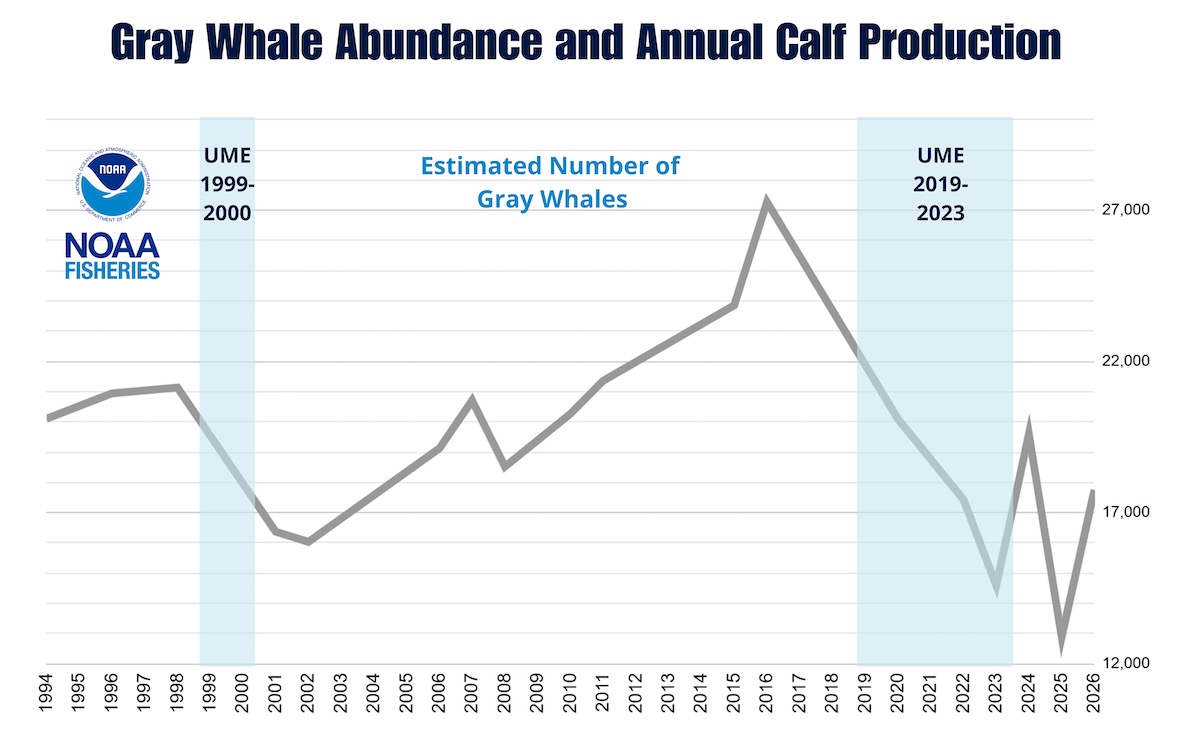
Gray whale safe haven in Puget Sound takes on new significance amid population decline

Puget Sound and the greater Salish Sea have become something of a safe haven for gray whales. Why they are dying is still somewhat of a mystery, with starvation being one of a number of causes due to changes in the ocean, some brought on by our use of fossil fuels, aka Climate Change.

Almost 200 gray whales have washed up dead along the West Coast in 2026. A small group of gray whales who feed in Puget Sound is surprisingly central to understanding the crisis. Sarah DeWeerdt reports. (Salish Sea Currents Magazine)

Graphic by NOAA (UMEs are Unusual Mortality Events)

Pump the Brakes on the West Coast Oil Pipeline, Washington Says

The Tyee is reporting that there is a letter that was written by the director of the state’s Department of Ecology to the government of Canada, urging them not to fast track the West Coast pipeline. This is just another example of the outcome of Trump‘s insanity, he has given the Canadian government the ammunition to be able to push even more oil through to the West Coast and threaten everyone’s waters here. I want to remind you that an election is coming up and we need to do everything we can to make sure that Democrats take control of at least one of the houses of power in Washington.


The state of Washington is urging the Mark Carney government not to fast-track the new West Coast oil pipeline, saying shared waters are “too valuable” to expedite a project that could lead to a catastrophic oil spill and harm ecosystems and the maritime economy.

In a Sept. 18 letter to the government, Casey Sixkiller, director of the state’s Department of Ecology, wrote that the proposed pipeline would double the volume of crude oil exported through the Salish Sea.

“Not only would this increase the risk of an oil spill exponentially, but the spill response resources available on both sides of the border are not sized for the risks” posed by larger oil tankers travelling more frequently, Sixkiller wrote in the letter to Dominic LeBlanc, minister for Canada-U.S. trade, intergovernmental affairs, internal trade and One Canadian Economy.

Read the whole story at the Tyee. Support local journalism, subscribe..

https://thetyee.ca/News/2026/09/29/Pump-Brakes-West-Coast-Oil-Pipeline/


WA public lands commissioner scales back order protecting older forests

The Seattle Times reported on the 24th about the change in rules for older forests, due to the extreme budget problems Olympia is facing. The head of DNR is caught between the legal requirements of his job as currently legislated and the demands of environmental activists wanting to protect remaining older growth forests. The money from this logging helps cities like Port Angeles meet their budgets for critical local services. It will be up to the legislature to fix this problem starting in January. If you care about this, you should write your state Senator and Representatives now.

“Without the (legislative) tools Upthegrove is pursuing, the roughly 55,000 acres could be included in timber sales after 2030. Staff estimates based on similar forests suggest that with no change to state policies, managing these 55,000 acres in ways other than traditional harvest would result in tens of millions of dollars lost.“

Read the whole story in the Seattle Times. Support local journalism. Subscribe to the Times.

WA-Public-Lands-Commissioner-Story

Protection Island: 1st Public Meeting with Randall’s staff.

Read the whole article on my new Substack site: https://olyopen.substack.com

Citizens showed up to be treated to a Zoom rather than a real person in attendance. Photo courtesy of Darrell Smith.

On Wednesday, Sept 23rd, the opponents of the land transfer proposal that U.S. Representative Emily Randall is getting ready to introduce into Congress, finally got an opportunity to talk directly to her staff about their points of view. It did not go well.

Staff members had originally said they would have one person there, so people came expecting to hear them and instead were only allowed a “Zoom” call, and Representative Randall decided not to attend at all. (Congress is currently out so she was in the area). If the staff would have simply started by saying they would not be in attendance, perhaps a larger audience would have attended online.

Her staff gave a short overview of the “process” that the draft bill is going through at the moment, stating that:

  1. It was a process started in 2025. (it was not made public until spring 2026).
  2. It was already going through the backchannels of Congress to prepare for Randall to present it to Congress.
  3. “There is a long way to go”. One staffer said.
  4. Finally, “It’s only the start of the process and you still have an opportunity to put your feedback into it.”

The last sentence received a roomful of boos from the 30 or so people in attendance.

I think that the staff member did not fully understand that a bill that was being discussed behind closed doors for over a year by Ron Allen of the Jamestown S’Klallam Tribe and the Representative of hundreds of thousands of constituents who have not had a chance to comment on it , was not at a point anyone would call, “the start of the process”. The bill is very far along the “process” and Representative Randall still has not held a public meeting with her present to discuss it at all. Once proposed into Congress, the public will have little opportunity to realistically kill this proposal as the meetings are likely to be held in Washington D.C. and Randall is making no promises yet to hold meetings throughout her district.

There is also the small fact that Chairman Allen has donated over $1000 for the last two years, along with the Jamestown S’Klallam donating over $9000 to her campaign. This makes the whole sordid issue seem like a back room deal done for money and votes. No one other than the Tribe has asked for this transfer to happen. Other S’Klallam Tribes apparently were not consulted nor have weighed in as to why they are getting nothing out of this, odd because it is part of the “usual and accustomed” land from the 1855 Treaty that all of them share.

Ron Allen himself has said that other tribes like the Makah and Lummi have been looking at this to decide whether to ask for other National Wildlife Refuges. When asked whether Representative Randall was in talks with them as well, since the Makah, Quinault, Hoh and Quileute are in her district, her staff did not reply.

The meeting was hosted by Lorna and Darrell Smith. Lorna was one of the original people who worked with Eleanor Stopps to create the wildlife refuge in the 1980s. Without their work, the Tribe would have no opportunity to ask for it back, as it would have become a white man’s subdivision.

Many people got up to ask questions of Randall’s staff. Very few questions were answered. No one asking them was in support of the transfer. One surprise guest was Marcia Kelbon, who is the independent running for the State House position given up by Steve Tharinger. Mrs. Kelbon stated she was opposed to the land transfer. It was gratifying to see a person running for state Congress come out and state a position on the issue.

What is Randall thinking? Neither Clallam nor Jefferson County commissioners have come out in support of this, mainly due to the extremely negative public feedback on this proposal. And Senator Murray and Cantwell have yet to weigh in.

This entire exercise is a P.R. disaster for the young, naive Representative Randall. While she has been anointed the Representative of the 24th district, she is a shadow of the former representative, Derek Kilmer. Kilmer had better political instinct than to take on an issue like this without getting significant public input first. Unfortunately, no one was willing to run against Randall, so the Democrats gave us no choice but to not vote or support her.

A word from Eleanor Stopps’ Granddaughter about Protection Island

Eleanor Stopps. Named Citizen of the 20th Century in Jefferson County and creator of the Protection Island Wildlife Refuge

Donna Armstrong, Eleanor Stopps granddaughter sent this to me for publication.


Protection Island is more than a place on a map. It is an island in the Strait of Juan de Fuca that provides nesting habitat for tufted puffins, rhinoceros auklets, pigeon guillemots, and many other species. After failed farming and development attempts, parcels were purchased for the purpose of creating a public wildlife refuge. In 1974, Eleanor Stopps (my grandmother) and Fayette Krause of The Nature Conservancy helped create the 48-acre Zella Schultz Washington Seabird Sanctuary.

Over the next decade, Eleanor, Lorna Smith, and many individuals and organizations volunteered to acquire private lots. One example was the “Adopt a Seabird” campaign, which raised $50,000 to purchase 23 lots. I was eight years old when I adopted a seabird.

Now, U.S House of Representative Emily Randall will be sponsoring the Jamestown S’Klallam Land Transfer Act of 2026, which proposes transferring ownership of Protection Island and Dungeness Spit National Wildlife Refuges into trust through the Bureau of Indian Affairs for the Jamestown S’Klallam Tribe.

Eleanor, Lorna, and many others worked tirelessly for years with elected officials and public agencies. In 1982, Congress established Protection Island National Wildlife Refuge, with conservation purposes that included protecting wildlife, scientific research, education, and interpretation.

Since then, Protection Island has been stewarded through collaboration among the U.S. Fish and Wildlife Service, Washington Department of Fish and Wildlife, conservation organizations, scientists, and the public. In August 2024, the Jamestown S’Klallam Tribe joined this framework through a co-stewardship agreement, creating opportunities to include Tribal knowledge and perspectives. When environmental challenges arise, this model brings Tribal partners, public agencies, scientists, and managers together for solutions.

Representative Randall’s proposal would repeal the 1982 law and remove Protection Island from national refuge status and the protection that provides. I am firmly against taking this action and I am sure my granddmother would have been also. Protection Island exists today because Eleanor, Fayette, Lorna, and many others gave their time, resources, and determination to establish it from private land. That history is part of public trust, future generations can believe in a democracy that can still work for them.

To learn more, visit the protect refuges website https://protectrefuges.org and People for Protection Island & Dungeness NWR on Facebook People For Protection Island & Dungeness NWR | Facebook

Editor’s Note: Eleanor Stopps was named Citizen of the Century by Jefferson County for her efforts.

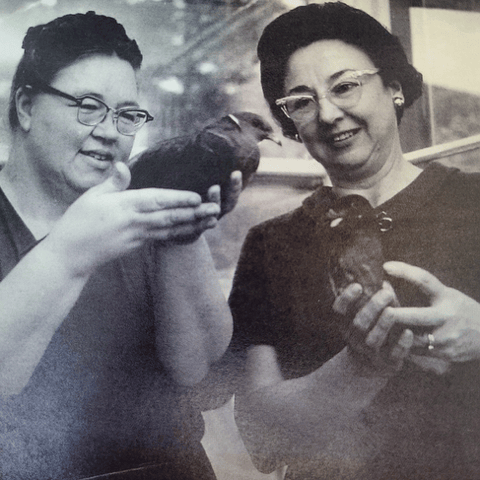
Zella Schultz & Eleanor Stopps

State of Washington DOE fines Port Townsend Mill record fine

PTPC Aerator Ponds (courtesy of Google Earth)

The Seattle Times is covering the story of the Washington State Dept. of Ecology (DOE) issuing the largest fine ever to the Port Townsend Paper Company (PTPC) for it’s Glen Cove paper mill. The violations that occurred related to the aeration ponds malfunctioning and the actual removal of some of the aeration equipment comes in the wake of the disasterous rupture of a badly maintained tank at a Longview mill that killed 11 and injured more.

This could be the reason for the increasing reports of excessive mill odor reported on Next Door for many months by local residents around the Port Townsend neighborhoods.

After decades of local complaints to DOE it appears that the cozy relationship with the mill owners may be over. As usual that took a disaster with deaths and serious injuries. The Mill<>DOE relationship led to one event in which the mill was given advanced notice of State air quality monitoring, which not surprisingly allowed it to shut down for “maintainence” the week of the monitoring . While Mill shutdowns are scheduled long in advance, the timing of this by both parties was suspect.

The inspections that led to the fines happened almost a year ago, which makes one wonder how long a pollution violation may go before DOE actually does something about it.

The Times quotes DOE as saying, “Other portions of the aeration system were malfunctioning or had been removed.”

These aeration systems are critical to reducing the smell that permeates the area. During periods of calm winds the smell can move into large areas of Port Townsend, causing many people to report headaches and other unusual ailments that were not present prior to the air pollution cloud moving uptown. The pollution is also highly variable to the prevailing winds, which usually blow the smell out to the Bay. When the winds shift from the South or simply stop altogether the reports of the smell increase.

The mill is important to the town and county due to the hundreds of jobs at stake. Paper mills have been shutting down for decades, leaving a legacy of highly toxic soils. Many are Superfund sites. In Port Angeles, the Federal government has simply been up fences and cleanup is just in the discussion phase as it has been for over a decade.

The full article can be found on the Seattle Times web site. Please support the Times with your subscriptions as it remains one of the only local independent newspapers in the Pacific Northwest.

WA fines Port Townsend paper mill for chemical spill, poor maintenance

https://www.seattletimes.com/seattle-news/climate-lab/wa-fines-port-townsend-paper-mill-for-chemical-spill-poor-maintenance/