By donating to the News you help us bring more news to you! We will use the donations to pay additional reporters, and spend more time on stories! Want to donate more than $10? Under the $10 is a dropdown box, choose multiples of 10. (i.e. Qty 3 at $10)
*DataGovArchive
archive of data.gov on Source Cooperative. The 16TB collection includes over 311,000 datasets harvested during 2024 and 2025, a complete archive of federal public datasets linked by data.gov. It will be updated daily as new datasets are added to data.gov.
-Alexandra Morton's Web Site (NEW)
The new web site for the work of Canada’s leading researcher in to farmed Atlantic Salmon and it’s effects.
-The Cove
One of the most important environmental documentaries ever created. If you value dolphins, then you must see this film.
North Olympic Peninsula Skills Center Natural Resources
To provide a program that provides hands-on, relevant natural resources research experience while meeting the needs of and building capacity within individual students and the North Olympic Peninsula region.
openchannels.org
OpenChannels is designed to become a comprehensive source for news, guidance, and community discussion on sustainable practices in ocean planning and management.
River of Kings – Video
Part 1 of 2 part series by Carl Safina on the Nisqually River Restoration.
Salish Magazine
Salish Magazine is a free online magazine that takes inquisitive readers outdoors with visually rich storytelling about features people can see firsthand in our public forests and beaches.
Victoria Sewage Project
The official city site on the project. The latest scoop on the Canadian poop!
WA State Family Forest Fish Passage Program
The Family Forest Fish Passage Program provides funding to small forest landowners to repair or remove fish passage barriers. Download the film.
Green Acre Radio on KBCS
Green Acre Radio on KBCS — Sustainability, local food production, restoration & environmental talk radio.
NW Indian Fisheries Commission
The Northwest Indian Fisheries Commission (NWIFC) is a support service organization for 20 treaty Indian tribes in western Washington.
Brinnon Group
Local group opposing Black Point resort
Clam Gardens
Network of researchers exploring First Nation gardening of clams in history, and it’s relationship to today.
Coastal Watershed Institute
“To promote long term, ecological, community based stewardship of marine and terrestrial ecosystems thru scientific research and local partnerships.”
League of Women Voters – Clallam County
a nonpartisan political organization, encourages the informed and active participation of citizens in government, and influences public policy through education and advocacy.
League of Women Voters – Jefferson County
The League of Women Voters, a nonpartisan political organization, encourages the informed and active participation of citizens in government, and influences public policy through education and advocacy.
Local Food Access Network
North Peninsula local food org with an emphasis on developing and supporting increased and sustainable capacity for production, distribution, and consumption locally.
North Olympic Salmon Coalition
The mission of the North Olympic Salmon Coalition is to restore, enhance, and protect habitat of North Olympic Peninsula wild salmon stocks and to promote community volunteerism, understanding, cooperation and stewardship of these resources.
Northwest Watershed Institute
NWI’s mission is to provide scientific and technical support to protect and restore fish and wildlife habitats and watershed ecosystems of the Pacific Northwest.
Olympic Environmental Council
The Olympic Environmental Council works on issues related to the environment and health that affect our North Olympic Peninsula communities.
Olympic Park Associates
If you share with us a passion for Olympic National Park, a concern for the Park’s future, and a vision that Olympic National Park should always be a wild and natural place, we invite you to join Olympic Park Associates.
Washington Environmental Council
WEC has been working for a couple of decades on environmental activism. A great group of people actually getting things done.
Whale Trail
Signs along the way to take you to great whale viewing locations
Wild Fish Conservancy
Wild Fish Conservancy seeks to improve conditions for all of the Northwest’s wild fish
As we see across the nation, the Trump administration is dumping National Wildlife Refuges to private entities like SpaceX. This Trump nominated judge is going along with it. The plaintiffs will be appealing up the court system. It raises the question of why is U.S. Representative Emily Randall running the playbook of Project 2025 and attempting to dump our local national wildlife refuges to the privately held Jamestown Tribe? Especially since we are so close to an election that we are hoping will turn the tide in Congress?
SpaceX’s operations have caused significant damage to the fragile bird habitat surrounding the launch site, according to a New York Times investigation. A rocket launch in 2024 sent debris flying into the refuge, crushing birds’ nests and igniting a small fire, the investigation found.
Exclusive to the Olympic Peninsula Environmental News
Protection Island National Wildlife Refuge
In a surprising statement Monday in a meeting of the Jefferson County Board of County Commissioners, Jamestown S’Klallam Chairman and CEO Ron Allen stated that a number of tribes in the Salish Sea and coastal waters seek to transfer ownership of National Wildlife Refuges (NWR) and incorporate them into their tribal reservations.
This proposed transfer of numerous public lands to private entities like the tribes, is unusual and raises questions about the process of transfer of public lands out of public hands.
Chairman Allen came to the meeting to discuss the proposed “Land Transfer of Dungeness Spit and Protection Island”, and was commenting on this transfer to the three County Commissioners (and public in attendance) when he mentioned that this land transfer is only part of a larger effort by all the tribes to take back public lands that are National Wildlife Refuges. He said that the Makah tribe was seeking land transfers of three properties off the coast, the Nisqually were looking to transfer one adjacent to theirs, and the Lummi Nation or Swinomish (he wasn’t sure which) were looking to transfer the San Juan Islands Wildlife Refuge.
“…Because we know (the) Makah’s going to go after the three (refuges) on the coast. And we’re pretty certain that (the) Lummi or “Swin” (Swinomish) will go after the San Juan (reserve)… We know that that once we get this done they’re gonna go after the other three or four.” Allen said.
He went on about the Nisqually Tribe: “…There’s other tribes doing exactly the same thing just like this…. They’re (The Nisqually Tribe) are always pursuing the refuge in their area in Nisqually Valley area.” It is likely that what Chairman Allen was referring to was the current Nisqually Clear Creek Land Transfer Act of 2026 which is sponsored by Representative Marilyn Strickland and Senators Cantwell and Murray. The tribe is in the process of having U.S. Fish and Wildlife transfer buildings at the hatchery which sits on tribal land to the tribe. It is not seeking to transfer the Billie Frank National Wildlife Refuge to them at this point, but Allen’s comments raise questions about the future of the refuge.
There are six maritime National Wildlife Refuges in Washington State managed by the US Fish and Wildlife Service. They are considered the Washington Maritime National Wildlife Refuge Complex:
The Jamestown S’Klallam currently have been in a co-management agreement with Fish and Wildlife, being paid approximately $800,000 for their work on Protection Island and Dungeness Spit. It is unclear if the Trump administration would be in favor of granting these annual funds if the properties were no longer owned by the Federal Government. It is agreed by all parties that they have been doing exemplary work for the government, and their ability is not being questioned. There have been no calls from the Trump Administration, the Federal government nor the State government to transfer these two particular lands. The request has come only from the Tribe and not from the public. Many public comments ask that nothing change in the relationship.
Washington U.S. Representative Emily Randall (D) has been in talks with the tribe for months if not years, and has openly acknowledged her support of the goal of a land transfer of Dungeness Spit and Protection Island to the Tribe. At a recent public meeting Representative Randall seemed taken aback at the level of public concern over the transfer. The public has only been aware of this land transfer since April. The Jefferson County Board of County Commissioners, City of Sequim and Clallam County Commissioners meetings have been the only local way for the public to comment in person despite this being a federal issue. The Clallam County County Commissioners meetings have been very contentious. The lack of federal sponsored meetings from Randall on the subject is unusual, given the outpouring of negative comments at both counties meetings.
The Trump Administration has been giving up public lands like these refuges as part of their announced Project 2025, which calls for government to get out of the vaguely worded business of “conservation”. In Texas, the administration is in the process of giving away part of the Lower Rio Grande Valley National Wildlife Refuge in south Texas to SpaceX in exchange for other properties by SpaceX. A lawsuit has been filed on June 10th to stop this transfer.
Chairman Allen said that they took a big ad in the Peninsula Daily News and Port Townsend Leader because they wanted to be as transparent as they possibly could be …but he added, “Congresswoman Randall asked us to kind of back off on it and we said, okay, that’s fine.” (emphasis mine) This raises the question of whether Congresswoman Randall asked the Tribe to not advertise their intentions to the public.
Washington Senator Maria Cantwell has also been in discussion with the Tribe but has not yet fully committed to the transfer and would like to see more public input, according to a person who discussed it with her staff. However she has not held any public meetings on this. There has been no mention of the Governor being involved in the discussions at this time, but it could be deduced that this kind of large scale planning would have been mentioned at some point to him.
This reporter has seen the draft bill that has been written by tribal lawyers that is assumed to be entered into the U.S. Congress at some near future date. The draft bill does not contain any legally binding language that would protect the island, spit, nor the nearshore waters that are owned by DNR from the tribe using it for commercial aquaculture. The concern by the environmental community is that the rare protected species on the island feed off the marine flora and fauna of the waters and beaches around the island. Creating a monoculture “farm” could impact the amount of food available for the birds. The current tribal council and Chairman Allen claim they have no plans. But it is easy to petition the Washington State Department of Natural Resources to open privately held shoreline to commercial use. DNR have a long history of supporting aquaculture and the State of Washington legally views aquaculture as a desired commercial priority. Once it becomes part of tribal lands, it would also be exempt from state or federal oversight as negotiations would be nation to nation based on treaty law.
The Protection Island National Wildlife Reserve was created in 1982 after almost 20 years of work by bird lovers Zella Schultz, Eleanor Stopps and the coordination with Seattle Audubon. It is the breeding ground of most of Puget Sound’s glaucous wing gulls as well as rare Tufted Puffins and Rhinoceros auklets. It’s creation was supported by virtually all the Washington State federal and state senators and representatives, including Senators Warren Magnuson, Henry Jackson and Slade Gorton along with Republican governor John Spellman.
The tribe has admitted that they look forward to writing their own rules for use of the island. In an interview in the local Port Townsend Leader Tribal Vice Chair Loni Greninger stated, “If we’re able to have that fuller ownership instead of co-management, then I don’t have to rely on any other government and their rules and regulations. I can take my deeper regulations from an ancestral standpoint and be able to infuse that and implement it.”
Our stories may be republished online or in print under Creative Commons license CC BY-NC-ND 4.0. We ask that you edit only for style or to shorten, provide proper attribution and link to our website.
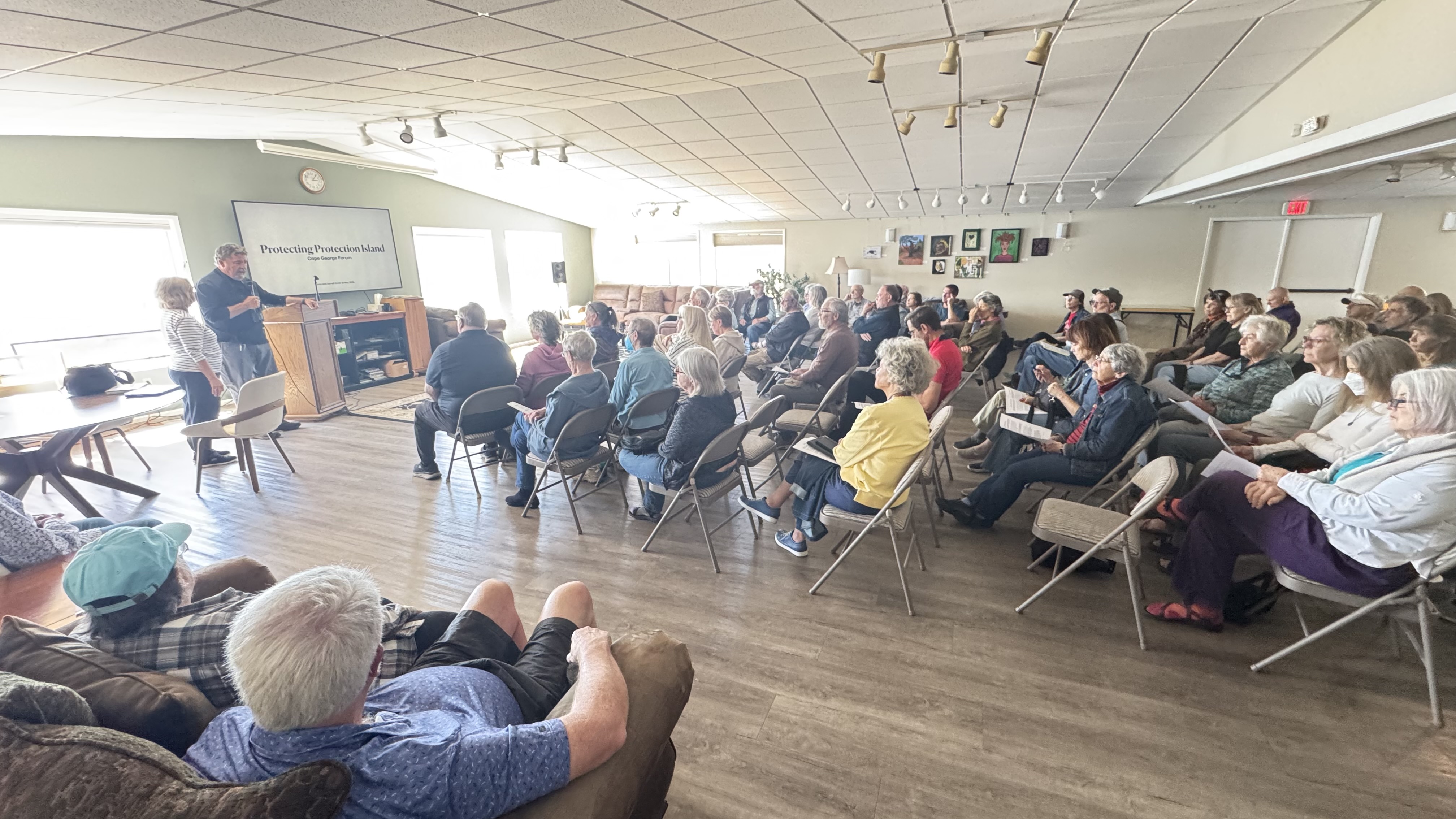
A large crowd of people gathered at Cape George on Sunday to hear Lorna and Darrell Smith discuss both the history of Protection Island and why they are concerned about the proposed Jamestown S’Klallam Land Transfer that the tribe recently has made public.
In the 1970s and early 1980s Lorna Smith was a key person in the work done to make Protection Island a national wildlife refuge. She acted as the liaison between the Seattle Audubon Society and the two women from Jefferson County that led the battle to get the island designated as a refuge, Zella Schultz and Eleanor Stopps, The thousands of letters of support from both native and non native Americans convinced even normally reticent politicians such as Senator Slade Gorton to help push the legislation through Congress and convince President Ronald Reagan to sign it. It was supported by all members of the Washington delegation and the Republican governor, John Spellman.
Also in attendance on Sunday were two granddaughters of Eleanor Stopps who share Lorna’s concerns. This reporter, who also worked with Audubon photographing the spit in the late 70s, also was in attendance.
The Smiths spent the first hour discussing the rich bird heritage of the island and the Spit, before pivoting to the proposed land transfer and the many questions that need to be answered about this proposal.
The Tribe currently is paid approximately $800,000 a year by the federal government to co-manage the Spit and the island. A month ago the Federal Government authorized over $76 million to support the refuges of the country. Money is there. There is no imminent threat of the government cutting off funds. That would have to be authorized by Congress.
The tribe has already begun requesting the ability to lay 80,000 bags of oysters on the bottom of Dungeness Spit’s inner bay, much to the dismay of bird supporters, who worry that this may cause continued loss of fish and other animals the birds feed upon. Currently, there is a lawsuit moving through the courts to stop this from happening.
In March, tribal Vice Chair Loni Greninger testified in Congress that the co-management has been very successful from both the point of view of the Tribe and the government. So if the working arrangement for co-management is successful, why should the Tribe give up $800k and why should Americans give up one of their 570 national wildlife refuges to the Tribe to become owned by them? How much is the Spit and the island worth to the Tribe and why? The answer might be found in the tribe’s lucrative aquaculture industry, wholly owned by them. While the tribe in their proposal denies having any plans for anything other than the vague term, “conservation” the actual answer to this question might have come from Vice Chair Greninger’s comment to the Port Townsend Leader on April 22nd edition. In it she stated:
“If we’re able to have that fuller ownership instead of co-management, then I don’t have to rely on any other government and their rules and regulations,” she said.
This is exactly what is feared by those who fought so hard to protect this island and Spit. With the tribe in full ownership, we will have no say as to what happens to it, nor if future tribal leaders decide to utilize these environmental treasures for economic gain. While it is understandable that the Tribe once used to forage for seafood there, the differences between subsistence shellfish harvest and modern mechanized aquaculture, with the ability to liquify the bottom with air compressors to get to geoduck, or spread thousands of bags of oysters across hundreds of acres at a time is a far cry from how it once was done.
There is every reason to continue to have the tribe manage the refuges. There is little incentive for Americans to simply hand them over to satisfy a demand. Why is Representative Emily Randall and Senator Maria Cantwell so hellbent on getting this done?
The birds are currently protected, as is the unique ecosystem they rely upon. Why should Americans relinquish this to a tribe that is engaged in the business of oyster, geoduck, crabbing, fish farming and fishing when they themselves are admitting that they want to set their own rules for the use of Protection Island? If the Tribe does get it, will we be on the outside looking in and have no input into protecting birds that live there? Many of us are waiting for more answers.
An argument that has been used recently to support the notion of the Jamestown S’Klallam Tribe taking ownership of our two wildlife refuges is that the current administration is not funding support for refuges. This press release seems to show that’s not quite true.
Here is the interview I did with Phil Andrus last week. While I didn’t get every point across I wanted I got the jist of it for you. We discuss the proposed land transfer of Dungeness Spit and Protection Island to the Jamestown S’Klallam Tribe. Is this good or not for the bird sanctuary? Do we give away a National Wildlife Refuge with no guarantees of what might happen to it in the future? You decide. The devil as usual is in the details of the proposal.
As the controversy over the possible transfer of management and ownership of the Dungeness Wildlife Refuge and Protection Island to the Jamestown S’Klallam Tribe continues, I was sent this quote which sums up the issue of approving this transfer. At the moment, the Refuge decision making process is theoretically one for the protection of its wildlife for all of American citizens. Yes, that’s not always what happens. But in this case, for 100+ years, I think it has been done well. It is worth remembering that the Tribe is attempting to engage in commercial aquaculture (for their financial benefit) at the very edge of the Refuge, with criticism coming from some key biologists as to the effects of this on the very species that the refuge is supposed to protect. To be clear, in 2024 the US Fish & Wildlife Service signed over management of the Dungeness Spit and Protection Island to the Jamestown Tribe in a deal with virtually no public input that will pay the Tribe at least $500,000 annually and allow them to commercially harvest non-native oysters in a 50-acre parcel within the Refuge. Now a bill has been drafted and will be presented in Congress that would give the Tribe total ownership as part of their reservation allowing them to determine all rule making and audiences for those rule making processes. This makes this quote all the more important in the decision making process of granting this request.
Jean Pratschner wrote Sequim City Council:
My husband Greg Pratschner (deceased) was a regional administrator of USF&W, all over the country. He often worked with tribal groups, very familiar with their agendas, programs, and abilities, often brought them into the Federal programs and helped with scholarships, training, grants, projects. He was awarded many honors for his inclusionary concepts in co-management. We had many Native friends. But, he often felt the goals and perspectives were not on the same page when it came to fisheries and refuges. He could never go against or find a legal way or option to alter a bad aspect of their programs, and always felt there was no argument or decision that he could use to make them comply with a negatively contrived agenda about an issue. His hands were always tied, by ultimately BIA power, that had no concern for non -Native viewpoint, only one opinion or goal would be followed. Native opinion. He always had to bend. Always. Sometimes it turned out less than good for all parties.
The Peninsula Daily News reported that Protection Island is seeing what may be the last breeding pair of Tufted Puffins. Smith and Protection Islands were what state officials believe to be the last islands with nesting pairs.
According to the Washington Department of Fish and Wildlife, in 1909, there were an estimated 25,000 Tufted Puffins across 44 nesting sites on the coast of Washington and in the interior Salish Sea. By 2009, the population had plummeted to less than 3,000, with only 19 nesting sites remaining and only two in the Salish Sea.
Tufted Puffins are still thriving in Alaskan waters, however …”a troubling mass die-off event on St. Paul Island in 2016 raises significant concern for the species’ future. Over 350 severely emaciated carcasses washed ashore, underscoring the urgency for further research and conservation efforts to safeguard these remarkable birds.” (as reported in https://www.adventuresnw.com/rare-birds-the-endangered-puffins-of-the-salish-sea/)
The loss of Puffins may be from a wide variety of causes, including habitat loss and the loss of species of fish they eat.
When I first started coming to the Strait, in the late 70s, Tufted Puffins were quite common to see. Now, they rarely are seen.Many nested on Protection Island and the efforts to establish the island as a Federally protected place were an attempt to protect those populations. Seems like my random observations are accurate. The state is working to see if there’s anyway to bring them back. Listing is one good starting point, but restoring the fish that these birds eat, such as herring which has seen a huge loss of resident populations, and is the target of restoration and protection, is going to be another key issue.
The state Department of Fish and Wildlife is accepting public comment on a status report for the tufted puffin, and a proposal to add the Pacific Northwest bird to the state’s list of endangered species. Tufted puffins are native seabirds once common in the San Juan Islands, Strait of Juan de Fuca and along the state’s coast, Fish and Wildlife said in a news release. But over the last several decades, 38 of 43 known breeding sites have been abandoned or seen significant declines in use. (Skagit Valley Herald)
Eleanor Stopps passed away today, after a short illness. She was attended to by hospice. I think it time we brought out the unpublished interview Mountainstone Productions shot of her as part of “Voices of the Strait”. Video will follow, but takes quite a bit longer to get right.
Eleanor talks about her life, and how she came to protect Protection Island. Interview by Betsy Wharton and Jo Anne Bailey.
Downloads allowed. However, no commercial use of this audio track is allowed without written permission. Please contact mountainstoneproductions AT gmail.com for use questions (replace the AT with @ as usual)
The focal point for environmental news & perspective on the news. Our goal is to help educate and connect the public on the Peninsula. We are not a non-profit so donations are not tax deductible. Maybe someday with your help!
This site is based on news and my opinion on that news. I come with over 50 years of experience in various environmental and tribal involvement. You may not agree with my POV. At my age, I am willing to listen to your POV and put it in comments. But I might not agree with you and that's the way it works.
HOTLINES FOR REPORTING SPILLS
WA State Emergency Management Division: 1-800-258-5990
National Response Center: 1-800-424-8802
Pacific States & British Columbia: 1-800-OILS-911 (1-800-645-7911)
Local Events
Add your local event here. Contact us to include your next event.
—————————————————
TSUNAMI DEBRIS HOTLINE:
1-855-WACOAST (1-855-922-6278)
—————————————————
Event Date:
NATURE NOW
A Program About the Natural World.
KPTZ.ORG 91.9
WEDNESDAYS AT 12:05
REPEATS: SATURDAYS 12:30 AND WEDNESDAYS
PODCASTS AT KPTZ.ORG