Dungeness Spit Aquaculture: Court rules in favor of environmentalists

The U.S. District Court for the Western District of Washington State concludes that the Federal Refuge Act requires the U.S. Fish and Wildlife Service (USFWS/Service) to complete a compatibility determination, that the Court has jurisdiction and that plaintiffs’ case has merit and should be heard. 

In a major ruling for environmentalists fighting to stop the conversion of the Dungeness Spit wildlife refuge into an industrial aquaculture farm, a federal judge has ruled that the USFWS must complete a “compatibility determination” on potential impacts to these federal lands.  A 50-acre industrial shellfish operation has been allowed to operate abutting the Dungeness National Wildlife Refuge in Sequim WA without the agency having written a compatibility determination or permitted the shellfish operation. This Refuge hosts 240 species of birds, 29 species of mammals, 8 species of reptiles and amphibians, and 26 species of fish.  

Protect the Peninsula’s Future (PPF), a WA State non-profit was joined by another WA State non-profit, Coalition To Protect Puget Sound Habitat and the national non-profit, Beyond Pesticides challenging the USFWS in US Western District Court, pleading that the USFWS must write a compatibility determination stating the shellfish operation’s harm to this refuge.  The USFWS/Department of Interior asked the court to dismiss our case, denying their own authority. On July 17, 2024, the federal district court denied dismissal of the case.

The NGOs also pled that should the operation be allowed, it needed a permit. The federal judge left open the opportunity to strengthen this argument.

In his review of the USFWS attempt to dismiss the plaintiffs’ case, Judge Benjamin H. Settle underscored that the Refuge Act mandates that the Service “shall not initiate or permit a new use of a refuge or expand, renew, or extend an existing use of a refuge, unless the [Service] has determined that the use is a compatible use and that the use is not inconsistent with public safety.”  The federal judge continued, “To conclude otherwise would lead to absurd results. It would require the Court to ignore the clear instructions in the Refuge Act and its regulations that deputize the Service to regulate activity within the Refuge. Indulging the Service’s position would also require ignoring the points in the Refuge Act that carefully instruct the Service on how to navigate conflicting or concurrent authority within a refuge.”

“It bears repeating that the Service already acknowledged that it ‘cannot allow the proposed activity unless the entirety of the commercial oyster farming operation within the Refuge boundary is found Compatible with the Refuge purposes.’”

This blog has repeatedly reported on the move to create an industrial aquaculture operation inside Dungeness Spit. In previous articles, we saw key members of the wildlife reserve send reports saying that the proposal was bad for birds and other creatures in the waters inside the Spit. Regardless of the concerns DNR head Hilary Franz signed an approval of leasing the tidelands to the company. Yesterday, Franz lost her bid to move to the U.S. Congress, and she might be replaced by one of two Republicans, but the votes are still being tallied, and Democrat and environmental champion Dave UptheGrove is still in second place as of this writing.

You can help this legal case by sending donations to: PPF   PO Box 421   Sequim WA  98382

or make online through PayPal:  https://www.protectpeninsulasfuture.org/donate/

Election24: primary results

Links below for each candidate are for their endorsement pages.

WON THE PRIMARY! Congressional District 6 US Representative: Emily Randall

  • High integrity; doesn’t take corporate PAC money or timber industry
  • Wants to fight climate change, protect our forests and rivers
  • Washington Conservation Action gives 100% rating for her work in the Legislature
  • Fights for women, children, LGBTQ rights and health care.
  • Helped pass the strongest abortion protections in the country. Planned Parenthood named her the “legislature’s biggest champion of abortion rights.”
  • Secured the largest investment in affordable housing, providing much-needed help to first-time homebuyers, low-income and homeless residents, and rural communities.
  • Lowered prescription drug costs, supporting the creation of the Prescription Drug Affordability Board, which limits the price of high-cost drugs across the board for every WA resident.
  • Banned the purchase and sale of assault weapons.
  • Refuses to accept corporate PAC money.
  • Emily’s opponent has not been truthful in many occasions where she’s taking sides against environmental protection and then not admitted that she had done so. I trust Emily to do the right thing.

Governor: Bob Ferguson – WON THE PRIMARY

  • Serving as attorney general since 2012, has won some of the biggest and most consequential legal cases in Washington history, including protecting water quality from Trump’s pro-pollution environmental policies
  • Committed to establishing Washington as a clean energy hub
  • Endorsed by Senator Patty Murray and Washington Conservation Action
  • This is a no-brainer. Bob Ferguson has proven over and over again through the years of Trump’s presidency to be willing to fight for our rights against the attacks on our constitutional rights.

Attorney General:  Nick Brown – ADVANCING TO ELECTION!

  • Experience as general counsel – appointed by Gov Inslee. 
  • President Biden nominated Nick to become the U.S. Attorney for Western Washington where he was praised for his work fighting drug cartels and sex trafficking, addressing the fentanyl crisis, and reducing violent crime, and fighting Trump against the Muslim ban.
  • Chaired the Attorney General’s Advisory Subcommittee on Civil Rights, and brought a focus to keeping every Washingtonian safe by preventing and prosecuting hate crimes, and protecting the most vulnerable and members of marginalized communities.
  • JAG officer / Bronze Star medal during Iraq war

Commissioner of Public Lands: Dave Upthegrove – PRIMARY TOO CLOSE TO CALL. WAITING ON FINAL RESULTS

  • Long track record of environmental advocacy in both the State Legislature and the King County Council
  • The only candidate pledging to put a moratorium on cutting the state’s older forests
  • The only major candidate who does not take corporate PAC or timber money
  • Endorsed by Washington Conservation Action and the Sierra Club… and our own Connie Gallant who has worked with Dave on projects over the years.
  • Environment and Climate Caucus 

Superintendent of Public Instruction: Chris Reykdal – ADVANCING TO ELECTION.

  • As a member of the State Board of Natural Resources, has been by far the most supportive of protecting the State’s older forests
  • Advocates decoupling timber harvest revenue from funding government functions
  • Sole endorsement of Washington Conservation Action

Legislative District 24 State Senator: Mike Chapman – ADVANCING TO ELECTION.

  • Generally strong record on environmental issues, including some tough votes on climate action
  • Has taken some controversial positions that many of my environment colleagues disagree with on forests, but his positions are evolving, as evidenced by his recent support for protecting the Power Plant legacy forest
  • Strong leadership record in the State House which he will carry to the Senate
  • I have talked to Mike many times over the years and respect his positions regardless if I agree with them or not. Highly recommended, no reservations..

Legislative District 24 State Representative position 1: Adam Birnbaum – ADVANCING TO ELECTION!

  • Served as Senator Kevin Van De Wege’s Legislative Assistant
  • In the community, Adam serves on the boards of the Olympic View Community Foundation, the Nor’wester Rotary, and the Clallam County Conservation Futures Program Advisory Board.
  • Adam grew up in rural Washington. His father was in the union and Adam saw the union help his family through some extremely tough times. He is very pro union.

Legislative District 24 State Representative position 2: Steve Tharinger – ADVANCING TO ELECTION

  • Long tenure in the legislature with a generally strong record on climate, including some tough votes.
  • He has taken some positions that many of my environment colleagues disagree with on forests, but in his role chairing the House Capital Appropriations Committee, he helped secure funding to protect some of the older state forests. Has done a good job with the Capital budget
  • Washington Conservation Voter rating 92% (lifetime as of 2019-20; 2021-22 is 83%). he has supported many important causes on the peninsula in the many years that I’ve been here. It may be Steve’s last campaign, so let’s send him back to Olympia to complete the bills he’s hoping to get done.

Jefferson County Commissioner District 1 – Heather Dudley-Nolette – ADVANCING TO ELECTION

  • Long time Jefferson County resident and active in numerous city government issues over the decades.
  • Co-Founder of the CoLab in Port Townsend.
  • Deeply involved in housing issues for low-income families. Currently Deputy Executive Director of Bayside Housing & Services.
  • Has worked in county government in King County under Ron Sims Office of Management and Budget.
  • Volunteered in numerous organizations in the county.
    • Former President of the Port Townsend Main Street Program
    • One of the founders of the Young Professionals Network
    • Awarded Citizen of the Year by the Main Street Program in 2015
    • Awarded Business Leader of the Year in 2016 by the Chamber.
  • Husband is a contractor and runs a small business.
  • Family has deep roots in the community for decades.

Washington State Insurance Commissioner – Patty Kuderer – ADVANCES TO ELECTION

  • Endorsed by Bob Ferguson
  • Supports Univeral Health Care
  • Has been a State Senator

Washington State Supreme Court Position 2 – Sal Mungia – ADVANCES TO ELECTION

  • Extremely well qualified.
  • Former president of the Washington State Bar Association
  • Highly respected lawyer
  • Extensive Pro-bono work
  • Exceptionally well qualified by six bar associations.

United States Senator – Maria Cantwell – ADVANCES TO ELECTION.

Washington State Lieutenant Governor – Denny Heck – ADVANCES TO ELECTION.

Washington State Secretary of State – Steve Hobbs – ADVANCES TO ELECTION

President of the United States

Kamala Harris. We need a younger energetic president, who is tuned into the issues of the minority communities of America and women’s rights. She is an incredibly qualified person for the job of President.

The alternative is a sexual predator , a felon who in most states would be unable to run for office. A man who does not believe in science nor a woman’s right to make choices on the healthcare of her own body. He is running a cult of gullible people who think he can turn back the clock to an America that only exists in their memory. An America that was “great” only if you were white, and not even then if you were Jewish or a woman.

Representative Kilmer Delivers for Peninsula

In his waning days as a U.S. Representative, Derek Kilmer has delivered more money as promised to help our counties. It is time for the Republicans to stop whining about Democrats inability to bring home the bacon for our desperate needs. Our unemployment rate is much higher than the Puget Sound region, the Port Angeles mill has just shut down, throwing hundreds out of work. Our hospitals are struggling to stay afloat. But through it all, Kilmer and President Biden have delivered. He has reached out across the aisle to the Republicans who actually want to get things done, in a bipartisan manner. He delivers the goods. Read it. And vote for more Democrats who can deliver money to help us with our needs. The Democrats are actually getting things done.


A Major Win for the North Olympic Peninsula by U.S. Representative Derek Kilmer

As many readers of this newsletter know, I grew up on the Olympic Peninsula and was in high school right around the time the timber industry took it on the chin. I saw a lot of folks in our community lose their jobs and their livelihoods. It had a big impact on me.

It’s why I studied economic development policy in college and grad school. It’s why I worked in economic development, it’s why I ran for office and it’s why I introduced the RECOMPETE Act – bipartisan legislation to establish a new federal grant program to invest in communities that have faced long-term economic challenges.

Excitingly, that bill was turned into the Recompete Pilot Program, which President Joe Biden signed into law in 2022 as part of a comprehensive economic competitiveness bill called the CHIPS and Science Act.

The mission of Recompete is simple: to empower communities with flexible multi-year grants to meet local economic development needs, create good jobs, and rebuild stronger with lasting opportunity.

It’s a recognition that America cannot compete if it leaves people – and entire communities – on the economic sidelines.

I am absolutely thrilled to announce that, just this week, the U.S. Economic Development Administration (EDA) awarded $35 million to reinvigorate the economy on the North Olympic Peninsula.

At the end of last year, the North Olympic Peninsula Recompete Coalition (NOPRC) – a diverse coalition of regional economic development leaders, local governments, Tribal nations, and education leaders, was awarded a Strategic Development Grant to enhance local planning and coordination efforts.

Out of 565 applications across 49 states, NOPRC was named one of twenty-two national finalists for the implementation funding we are celebrating this week. Now, the NOPRC has been a national awardee – and will be able to utilize $35 million to chart a course for an economic resurgence that honors our past while innovating for our future.

Specifically, the funding will help NOPRC drive renewed economic competitiveness and good job opportunities in the region. Specifically, the funding will support the expansion of the Composite Recycling Technology Center, a facility that manufactures Advanced Cross-Laminated Timber (ACLT) in cooperation with the Makah Tribe; critical marine transportation infrastructure; and a workforce strategy with social support services. This investment means we will be able to ensure that we can create good-paying, long-lasting jobs that will reinvigorate the region’s economy for decades to come.

The Recompete Pilot Program is more than just another policy initiative. It’s a beacon of hope for communities that have been overlooked. Designed specifically for regions that are considered “economically distressed” by the EDA – those where employment among 25- to 54-year-olds lags behind the national average – the Recompete Pilot Program aims to revitalize economic activity in distressed communities, including right here in Western Washington.

Seeing the RECOMPETE Act – an idea I’ve championed for years – come to fruition with this funding for the North Olympic Peninsula gives some real cause for hope. Indeed, the NOPRC is a terrific example of what we can achieve through the power of partnership. It’s a culmination of years of dedicated effort by community leaders and passionate individuals who believe in the Olympic Peninsula’s potential.

Together, we are showing a commitment to not only revive but reinvent our legacy industries. We are crafting a strategy for growth and resilience that can serve as a model for other communities. And while we’re still writing the story of the Olympic Peninsula, our journey toward a stronger economy continues – powered by the will and innovation of folks who care about the community. As a PA native, I’m proud to be a partner. Let’s keep at it!

Investing in Regional Climate Resilience

With 3,000 miles of coastline and more than 70,000 miles of rivers and waterways, our state is particularly prone to the threats posed by the climate crisis. From sea level rise to coastal erosion to loss of vital habitats and ecosystems, climate change is threatening the way of life, economic security, and health and safety of communities across our region.

At the end of July, I was thrilled to announce, alongside Senators Maria Cantwell and Patty Murray, that National Oceanic and Atmospheric Administration (NOAA) has awarded more than $75 millionin federal funding for projects here in Washington to help make our state’s coast more resilient to climate change and other coastal hazards. This funding, through the Climate Resilience Regional Challenge, was made possible by the Inflation Reduction Act, which I voted for and which was signed into law by President Biden.

This funding will help complete major projects across our region – like realigning SR112 on the Peninsula, restoring critical shoreline on Puget Sound and on the coast, improving stormwater drainage, and protecting and restoring important fish habitat. These transformational projects will create jobs, protect the environment, and make coastal communities more resilient. That’s a big deal for our region.

For years, I have advocated for increased federal funding for Tribal relocation and resilience efforts, and this recent investment by NOAA is yet another step towards that goal. 

I’m proud to have been able to help secure this crucial funding for major projects in our region, and I’ll keep working back in D.C. to ensure the federal government continues to invest in local efforts to make our coastal and Tribal communities more resilient.

Get your ballots in!

Less than 11% of the state’s nearly 4.9 million registered voters had returned their ballot as of Tuesday, according to data on the secretary of state’s website. We do NOT want to see some oddball candidate win or come in second and knock out a serious candidate. Get those ballots in!

Rosario Strait Tidal Energy Project

The Hyrdo News has reported that “Orcas Power & Light Cooperative (OPALCO) has submitted a preliminary permit application to the Federal Energy Regulatory Commission for the Rosario Strait Tidal Energy Project (P-15368)”. The application is proposing the project just east of Blakely Island.

Rosario Strait courtesy of Bing Maps

The preliminary permit is looking to study and possibly implement a tidal turbine that could generate as much as 5.7 GWh of electricity, approx. 5% of the current capacity needs. “The proposed project would serve as a pilot project to test the capacity of Rosario Strait for tidal turbine technology that supports OPALCO’s microgrid. The Orbital O2 device proposed for use in this location is a floating tidal turbine with a 245-ft-long hull and twin rotors suspended underneath. The device is 165 ft wide including the span of the blades underwater. When operating, the Orbital O2 sits about 90 ft deep in the water column and floats about 5 ft above the waterline and 7.5 ft below the waterline.” – Hydro News

OPALCO was selected by the Department of Energy for Phase 1 grant funding to explore the development of a tidal generation project in San Juan County. The funding is to explore the feasibility of this pilot project. An upcoming workshop will go over the various aspects of this project including the technical and logistical considerations involved.  This will be on August 27th via Zoom if you are interested to learn more and ask questions. 

Here is the link to the upcoming public Zoom meeting: https://opalco.zoom.us/meeting/register/tZ0pdO-urD8pGtCqSdkfRoIz-P_Grbv7x6sp#/registration

Orca researchers have expressed concerns about putting a turbine in the location where endangered Orca’s routinely travel. At this point apparently none have been consulted.

These are the issues we face as we have to make very difficult choices away from the clear and present danger of the use of fossil fuels to the unclear choices of renewable resources from wind to tidal energy. We have no time left to make hard decisions that are going to become even more harder or draconian as the next few years bring larger wildfires and melting ice caps that soon will accelerate the loss of shorelines across the globe. According to virtually all global climate scientists we are passing the point of no return now taking us into a future that may bring the end to democracies like ours if not human civilization as we know it. As the election of Trump a few years ago and his near tie in the current election, as people grow concerned, they often throw complex solutions out of the window and turn to fascism or a ruler who promises that he is the “answer” to their concerns. We should not forget that this country, like Saudi Arabia is captured by our ever-growing need for more oil and gas, and our politicians find themselves having millions of dollars of campaign contributions by the oil and gas industry as they continue to do everything they can to stop a move to renewables (though they claim natural gas is also renewables and even the Democrats parrot this). This is not a time to move slowly! But across the U.S. we are seeing locals work to stop or slow renewable projects. We also see corporations and their allies in various oil and gas industry NGO’s use words like “so called Climate Crisis”. Are they not watching thousands of homes destroyed every year in California, Canada and Colorado, to name just a few of the more forest fire active locations as the planet warms and hits new record high temperatures every year?

I would ask the opponents of this project who are from the green side of this debate to bring forward a list of suitable sites to locate a project like this if they don’t like the existing site. In 2013 the Orca Conservancy brought out a petition to oppose the Admiralty inlet site, saying the site was “unsuitable” but they never proposed an alternative site. Since it seems every site proposed by either wind or tidal projects is “unsuitable” it’s up to the green alliance to tell the corporations where they would like to see these sited so we can move more quickly. As an environmental activist I am frankly very frustrated with opposition without clarity of alternatives. As stated above, there is no time to waste!

I hope that the project planning for this will bring aboard at least one Orca research scientist to represent what may be a show stopping concern for this project. A similar project off Whidbey Island some years ago also ended up in failure for some of the same reasons.

The full article in Hydro News is here.

Washington tribes seek to pause offshore wind development – Axios Seattle

Axios Seattle is reporting that Washington Tribes under The Northwest Indian Fisheries Commission have asked for a pause in the planning for the offshore wind farms along the Washington coast while the tribes concerns are addressed. The Tribes are not asking for a total ban on the farms but have environmental concerns they say have not been addressed.

Worth noting is that the farms are in the very early stages of permitting by the Federal Government.

As Axios notes:

The Bureau of Ocean Energy Management has received two unsolicited lease proposals for offshore wind farms along Washington’s coast.

  • One, from Trident Winds, would cover an area of about 315 square miles about 45 miles off the coast of Grays Harbor and Pacific counties.
  • The other, from Hecate Energy, seeks to lease 403 square miles in a nearby area about 17 miles off the coast.

Both these farms are planning on wind turbines with virtually no impact on the visual look of the coast, but the concerns are more about their impacts on fishing and whales.

As stated in an earlier blog post, this blog along with the stated goals of the tribes in the article is to support wind energy projects, but “not on the backs of the tribes”. The assumption is that the wind energy companies can provide reasonable scientific backing for their proposals. The east coast has implemented wind energy farms much closer in than the proposed Washington coast project, with no signficant impacts. Some of the background on those efforts are found here:

BOEM Completes Environmental Analysis for Proposed Wind Project Offshore Massachusetts, Rhode Island, and New York | Bureau of Ocean Energy Management

Comparison of Environmental Effects from Different Offshore Wind Turbine Foundations (boem.gov)

The Institute for Energy Research does have this conclusion to the New England wind farms. It appears that high interest rates, which are impacting the sales of electric cars, are also impacting the implementation of wind energy. Note the concerns in bold:

While a few offshore wind projects have gotten off the ground and have started producing electricity, others have been canceled, often with developers occurring fines. Developers have canceled several projects along the East Coast, saying they were no longer financially feasible. Offshore wind projects have struggled to surmount rising construction and material costs, as well as serious manufacturing problems. In recent months, rising materials costs, high interest rates, and supply chain delays have prompted project developers to cancel or try to renegotiate power contracts for commercial-scale offshore wind facilities in the United States with operating start dates between 2025 and 2028. Offshore wind facilities are among the most expensive utility scale power projects under construction in the United States and would not have gotten off the ground without massive support from state and federal governments and pre-approved power purchase agreements. With the cancellations that have occurred, President Biden’s goal of 30 gigawatts of offshore wind capacity by 2030 is expected to be half that amount.

New England Is Moving Ahead with Offshore Wind Facilities, Despite Their Cost – IER (instituteforenergyresearch.org)

The wind farm built by Avingrid has started producing 68 Megawatts of power to Massachusetts since then.

A good scientific reearch paper on the subject was produced by Nature:

Reviewing the ecological impacts of offshore wind farms | npj Ocean Sustainability (nature.com)

Microsoft’s CoPilot produces this summary of it’s search on the topic:

Wind farms in New England, particularly offshore wind projects, have both positive and negative environmental impacts.

On the positive side, the development of the New England Wind lease area is projected to reduce carbon dioxide emissions by nearly 4 million US tons annually, which is equivalent to taking approximately 700,000 cars off the road each year during the lifespan of the project1. The New England Wind project is expected to generate up to 2,600 megawatts of electricity, sufficient to power more than 900,000 homes with clean renewable energy23.

On the other hand, there are potential negative impacts associated with the construction and operation of wind farms. These can include disruption to marine life during the construction phase, potential collision risks for birds and bats, and changes to the seascape that can impact tourism and fishing2. Research is being conducted to prevent environmental damage4.

It’s important to note that the specific impacts can vary depending on the location and design of the wind farm, and measures are often put in place to mitigate potential negative effects. For example, the Bureau of Ocean Energy Management (BOEM) completed an environmental review of the proposed New England Wind project offshore Massachusetts3. This review process is designed to carefully analyze the environmental impact of the proposed project3.

In conclusion, while wind farms can have some environmental impacts, they also play a crucial role in reducing greenhouse gas emissions and providing a source of renewable energy. It’s a balance between managing these impacts and transitioning to cleaner energy sources to combat climate change.”

Sign up for Axios to support independent journalism in the Pacific Northwest.

Washington tribes seek to halt offshore wind farms – Axios Seattle

Hilary Franz’s DNR work prioritized political gain, some staffer say: Seattle Times.

Department of Natural Resources (DNR) head Hilary Franz, is again in the hotseat, as allegations surface from numerous staff of hers that her image and race for higher office has been the focus of her tenure at DNR. As someone who has covered the Commissioner of Public Lands since her first run for office, I can say that these charges do not surprise me at all. Her lack of honesty in dealing with issues has been a hallmark of her tenure to those of us who have needed her support. A simple example is that she denied she ever approved the controversial DNR leasing to an industrial aquaculture company of the waters inside the Dungeness Spit Wildlife Refuge, even when shown her own signature on the DNR documents. Her comment to me at the time was, “I have no idea about that.” That staffers openly say her only goal was higher office also goes hand in hand with what I’ve witnessed in her dealing with Jefferson County Democrats during fundraisers. As readers know, this blog has come out in favor of her opponent, Emily Randall.

The Times has endorsed Franz, and even beloved cartoonist David Horsey decided that the charges were not worth worrying about in his editorial. Needless to say, he has never worked with her, nor needed to deal with her department to try and protect the shores of our waters. And this is the problem, to a casual observer, she appears to be a great choice, but when one actually has to work with her and her department, it’s a totally different story. Horsey claims Hilary doesn’t kowtow to industry, when all of us who have been involved in following her choices know that is just not true. To Horsey, I would only say, Hilary is not just an ambitious politician, she is all about whatever it takes to promote Hilary’s march to Washington. And the environment is just a prop to gain power and distract those that are not paying attention.

Franz came and talked to the Jefferson County Democrats in her first race for Lands Commissioner. We welcomed what seemed like a bright, energetic woman who claimed she was all about protecting the environment. We also could tell how ambitious she was, in her slapping her buttons on the chests of those of us in line to get in before even introducing herself to us. It was an odd introduction. But after she took office, we began to see that she was far more interested in promoting industry over the environment and that all the issues were about Hilary and her supposed accomplishments. It was not listening but telling. Always a warning when dealing with a politician.

Long time Jefferson County Democratic party activist and environmental leader Connie Gallant, tried to work with Hilary on numerous occasions and came to same conclusion. Ms. Gallant sent a strong letter describing her feelings about the Times article to her environmental email list, redoubling her support for Emily Randall.

If this candidate was a Republican, or Donald Trump, the Times would likely have more real outrage about the allegations. But given that Hilary plays well with the environmental movement leaders in places like Bellevue and Seattle who never seem to get out of their tower offices to see what is happening on the ground in places like the Olympic Peninsula, papers like the Times will cheer her on.

It’s totally likely that she will be our next Congressional Representative, given the support Franz has received from the usual suspects. I guess we could at least say she will be out of our hair on a local level and worrying about a much wider range of issues than the environment. Her support of business over the environment will likely have less negative impacts. She will have a replacement who hopefully will care more about protecting the environment than she has, though our state’s reliance on turning forests into tree farms and turning virgin shorelines into industrial aquaculture farms means the fight will have to go on indefinitely.

Here’s the crux of the Times story. Please either subscribe to the Times, as it is one of our only regional newspapers left or go to your local library and read it for free. And take a look at our choices for elected officials we have found listen to us, do the hard work to stand up for environmental protection, or have pledged to do so. Our recommendations are at

Election24: primary recommendations | Olympic Peninsula Environmental News (olyopen.com)


Fifteen current and former DNR employees described in interviews with The Seattle Times how Franz aggressively used the agency to burnish her image to run for higher office — first for governor and now for Congress — in ways that some say blurred lines governing the use of public resources for political purposes.

The current and former employees, including women and men who have worked as senior aides and managers, said they were pressured to organize official events driven by Franz’s campaign needs and to help her secure political endorsements.

The current and former employees, including women and men who have worked as senior aides and managers, said they were pressured to organize official events driven by Franz’s campaign needs and to help her secure political endorsements.

Hilary Franz’s DNR work prioritized political gain, some staffers say | The Seattle Times

Job opening – Marine Mammal Stranding Network Program Specialist

The Port Townsend Marine Science Center holds a letter of authorization from NOAA Fisheries West Coast Region, to serve as the Marine Mammal Stranding Network (MMSN) coordinators for East Jefferson County on the Olympic Peninsula of Washington. In the summer of 2023, we experienced a significant increase in response calls for stranded harbor seals along the shores adjacent to Rat Island and Fort Flagler State Park on Marrowstone Island. With concerns related to the highly pathogenic avian influenza (HPAI) H5N1 infected Caspian Terns, we plan to increase monitoring of these areas this year and do more outreach to the public about HPAI and what to do if you find a stranded marine mammal (call the MMSN).

The Marine Mammal Stranding Network Program Specialist will focus on marine mammal stranding network response and educational outreach to the public. The position is based out of the Port Townsend Marine Science Center. This is a seasonal, temporary, part-time, non-exempt (hourly) position.

Primary duties for the role involve monitoring the PTMSC marine mammal stranding network hotline; dispatching volunteers when necessary; responding to strandings and collecting Level A data and photos; collecting animals for transport to Center Valley Animal Rescue (CVAR) when candidate for rehabilitation; collecting carcasses and transporting to CVAR for HPAI testing; surveying shorelines as needed; and providing educational outreach to the public about MMSN and HPAI.

Qualified applicants should have previous education in Marine Biology, Aquarium Science or a related field; experience with animal care in a public, research, or wildlife facility; experience following protocols and procedures; experience communicating clearly in a variety of settings; experience working and interacting with all levels and different styles of personalities while maintaining a professional attitude.  Previous education in aquarium or life sciences is strongly preferred, and experience in a customer-driven environment is a plus. Reliable transportation is required for this position. Mileage reimbursement is available for travel to and from animal response sites and for the transport of animals to and from CVAR from sites. Weekend and holiday work will be required for this position.

This is an hourly position, paid at a rate of $18.00 to $20.00 per hour based on qualifications and professional experiences. This position will average approximately 25-30 hours/week. Benefits include Paid Sick Leave at the rate of 1 hour sick leave for every 10 hours worked.

At PTMSC we value collaboration generated by a positive, friendly environment. A good sense of humor is a must! In addition to departmental responsibilities, team members have opportunities to participate in special projects, represent the science center at events, and advance their professional development.

How to Apply:

Find the full position description on our website, ptmsc.org/work-for-us.

This position is open until filled. Only electronic submissions will be accepted. Please email a copy of your resume and cover letter to jobs@ptmsc.org, with the subject “MMSN Specialist Position.” Please address your cover letter to Betsy Carlson, Citizen Science Coordinator.

PTMSC will provide equal opportunity to all applicants regardless of race, color, religion, age, sex, national origin, ancestry, disability, pregnancy, military status, marital status, order of protection status, genetic information, sexual orientation, transgender status, or any other category protected by law, in accordance with all applicable law.

Wind energy surpasses coal use

More good news. In April, wind power generated more electricity than coal for the second month in a row, according to the latest available data from the Energy Information Administration. Wind briefly surpassed coal once before in April last year, but this time it’s by a much larger margin and for two consecutive months.

It was inconceivable to me 20 years ago that we would be at this point today . I didn’t believe that we would get here this quickly. This is one of the reasons why I support efforts for wind energy off the coast of Washington. We have no time to lose in fighting climate change, and the rising levels of CO2 in our atmosphere. It is threatening our very existence and virtually every scientist in the planet is in agreement with this. There are certainly downsides to every single project possible but the need for generating more electricity everywhere we can in an environmentally neutral way has never been more important.

The next time you hear of wind energy project and hear objections to it. Please be willing to be open minded to the bigger picture as to why this is needed.

Plastics recycling still has a long ways to go

Chartr recently posted this great chart view of the Organisation for Economic Co-operation and Development (OECD) data on plastics disposal globally. It’s pretty clear that overall use of plastics continues to grow globally and the major way that plastics is getting disposed of is through landfills.

Additionally, as we have heard, some recycling efforts are nothing more than collecting separate trash that ends up being in a landfill anyway because there’s no market for it.

Also as the article points out so much is being dumped into the ocean that there will be more plastic than fish by approximately 2050. One political party here in the United States seems to want to do nothing about plastics while the other is not doing much it seems. We need to continue to put pressure on our elected officials to actually reuse our waste.

We are lucky here in the Pacific Northwest that we definitely recycle cardboard and have a paper processing plant that can deal with it. But as we saw recently, the market has been softening for corrugated paper and the Port Angeles paper mill just closed throwing over 400 jobs out in a rural area that cannot afford to lose that many at one time. The ripple effects from the closure of that mill are going to be substantial for the Olympic Peninsula, Port Angeles, and Clallam county tax revenue streams.

Check out Chartr and their sister publication called Sherwood.

Aquaculture Continues Its Global Rise

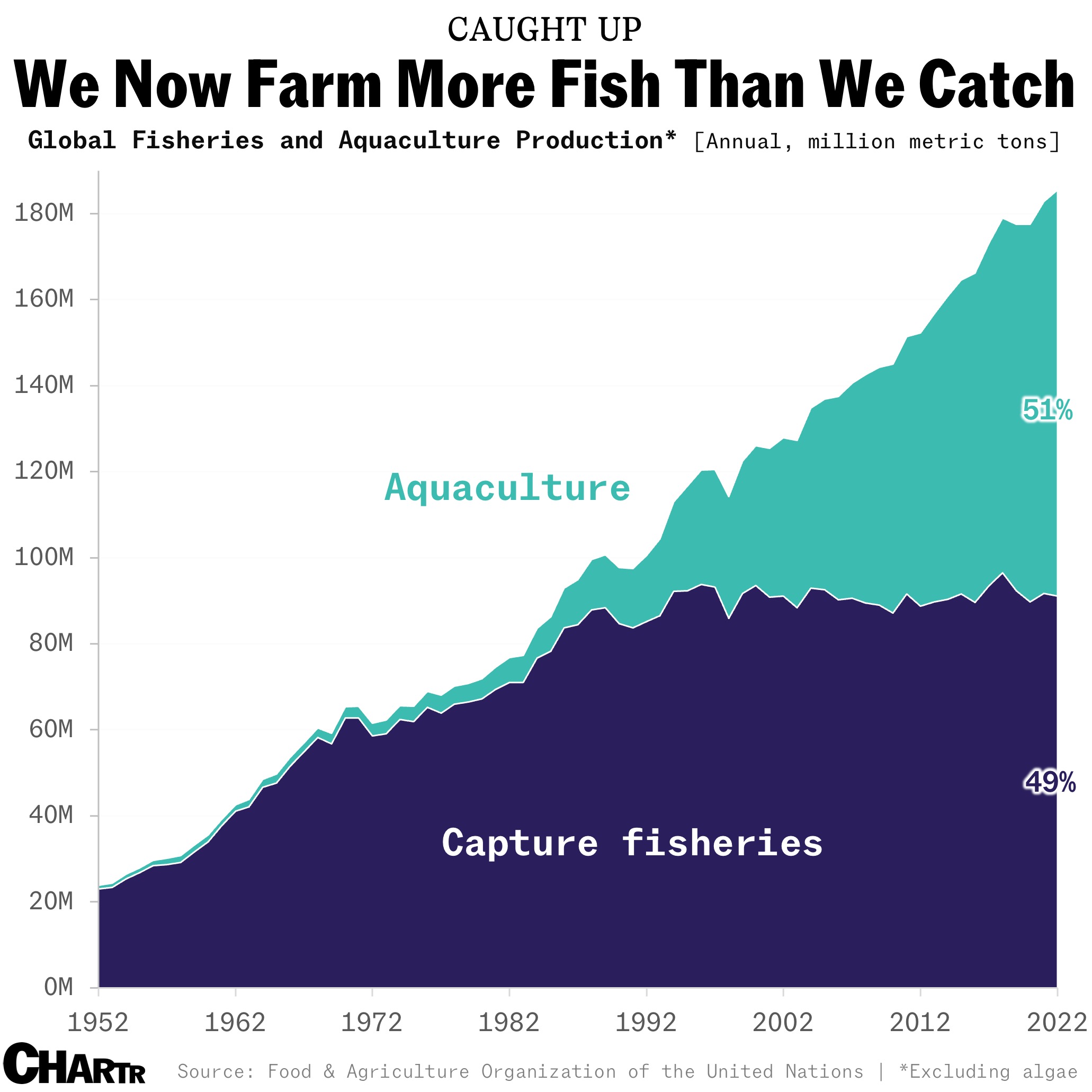
A recent article in Sherwood titled, “Aquaculture is Making History” (subtitled “We now farm more fish than we catch”) spoke to the amazing growth of aquaculture worldwide. While the good news is that Americans, the most morbidly obese country on earth, are eating 5 lbs. more seafood per year than they had in the 1990s, the downside to all this is that farmed fish are perhaps the most destructive farming imaginable. Along with land-based farming’s effect on the planet, including the destruction of rain forests, the oceans have witnessed an across-the-board destruction in wild places needed to support wild fish and other wild seafood we eat.

Note: Total aquaculture production, which includes algae and aquatic plants like seaweed, overtook wild fishing efforts more than a decade ago (the more recent milestone excludes sea plants).

From the destruction of mangrove forests along the coasts of tropical waters, where the shrimp farms destroy miles of fish nurseries for the bland shrimp we eat, to the conversion of hundreds of miles of virgin shoreline for the monoculture of various bivalves like geoduck, from the fish farms off the coast of South America to the net pens in Sweden, Norway and Canada creating vectors for disease, we are in the process of radically altering our seas. Eating wild fish is the best thing you can do to stem this trend. Avoiding farmed shrimp and salmon makes an economic statement to those engaged in it.

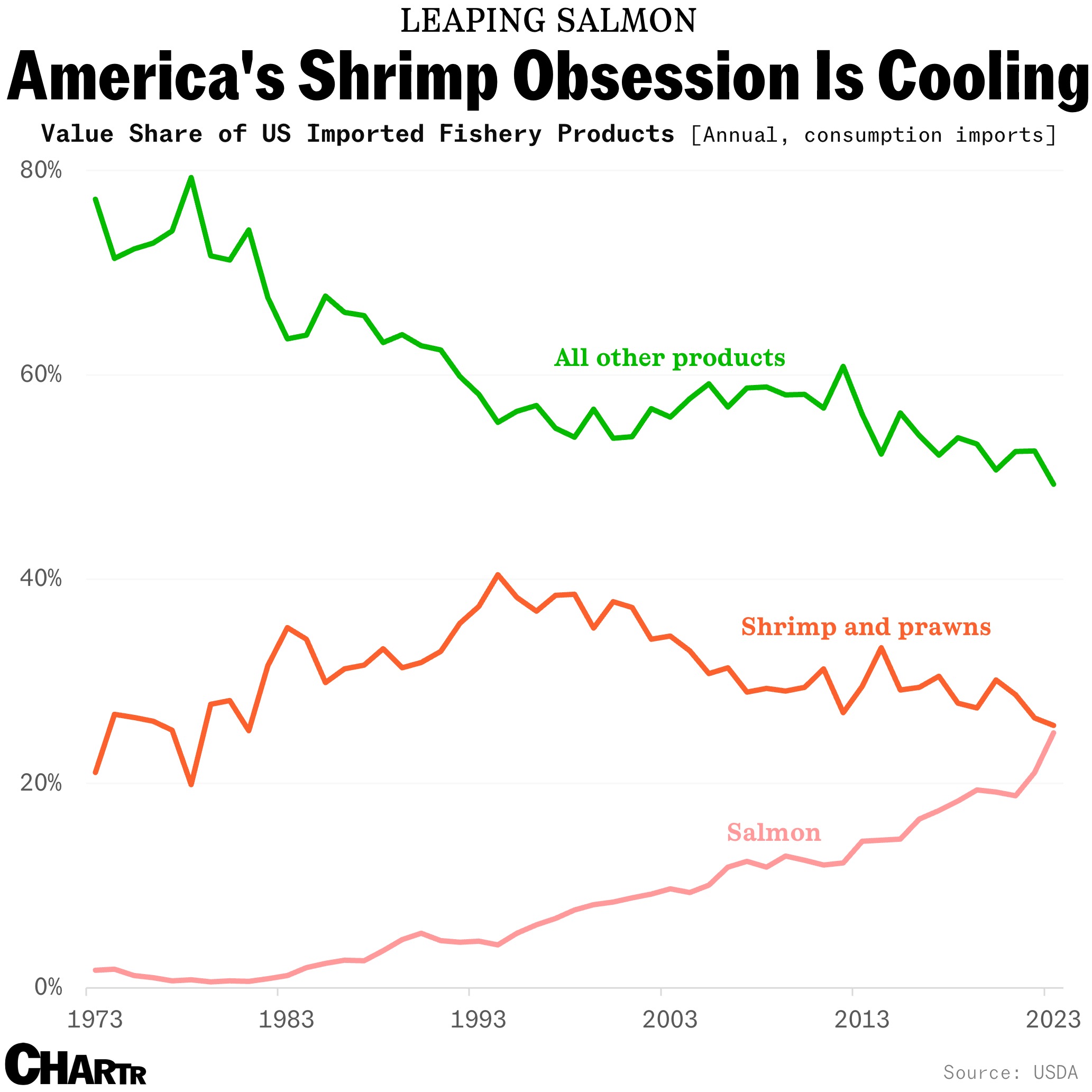
Salmon in particular is a huge problem. While the global community outside of Alaska have decimated salmon runs, salmon net pens continue to provide a growing number of fish to the American market. Salmon has now met the demand of shrimp in our diets.

This rise in farmed salmon, while good for our diets, poses the huge threats to wild salmon, who of course swim past the nets to get a free lunch and then contract whatever disease is happening to the confined fish inside the nets. Think this is just supposition? When net pens were recently banned and removed in specific Canadian waters, the next years that fish that had migrated past since the removal of the pens the runs were huge and healthy, showing virtually no signs of sea lice or disease. Sea lice were huge problems for the net pen industry and attached themselves to wild fish swimming nearby.

What is to be done? Even the Nature Conservancy recently hired an ex-aquaculture industry person who unequivocally supports fish farming globally. Are you really going to fund such an organization?

It is worth noting that the rise in aquaculture also supports seaweed and other plant-based farming. With a push by NOAA (who officially sees the Puget Sound as worthy of turning into an aquaculture farm) to open seaweed farms here, the possibility of even more waters being turned off limits to all of us so floating farms and shorelines can continue to be converted to industrial use is very real.

In 1999 & 2000 the Governor of Washington State and the shellfish industry opened the floodgates to industrial geoduck farming, given that the Chinese market was exploding with a crazy belief in the aphrodisiac properties of eating geoduck. What was never discussed in that law was “how much is enough? When do we say we have converted enough shoreline to aquaculture?” The industry influences our rural politicians by contributing to their campaigns and seeds their people into environmental organizations both by sitting on their councils, and donating to their “recovery” efforts, as long as it does not impact their ability to make money. In discussions with environmental organizations about this very issue, all but one of them would consider talking up against aquaculture, because they all rely on grants from the industry to support their non-profit work.

Tribes have shifted into commercial aquaculture, some doing good work in raising relatively benign fish such as sablefish (aka black cod) but have also taken on extremely controversial acts such as pressing to put a large-scale aquaculture farm inside the federally protected Dungeness Spit. While scientists from the Spit were threatened with their jobs by national managers (during the Trump presidency), local leaders and environmentalists were unwilling to criticize the tribes for any reason whatsoever.

All this means that while some environmental organizations may be crowing about the growth of aquaculture to feed a hungry planet, the increasing threats to our seas and wild fish continue unabated.

Read the whole article on Sherwood and sign up for their newsletter.

Sherwood News

Note: Some of you regular readers may note that The News has not been publishing as much lately. While I have made an effort to keep up, bad news has been in much greater volume than good news, and I strive to find positive environmental stories to share with you, along with efforts by concerned citizens to protect our fragile and decreasing natural resources. So, my feelings are “less is more”. I’ll continue to bring you the News as it matters. Today’s article I felt was more educational in nature, helping put in perspective the larger forces that are affecting our region. Have a great 4th of July. Our democracy means we have voices that can dissent against this wholesale destruction and not find ourselves in a “re-education” camp, or worse. This November, vote for candidates who actually deliver and not just talk. There are too many of the talk, not deliver on both sides. We will be posting our picks for true environmental candidates in an upcoming post. Thanks again for reading.

Net Pens, Dead? Don’t count on it. Thank Hilary Franz

From coastalwatershedinstitute.org: There’s been a bit of buzz about the status of steelhead net pens in the US/Washington state Salish Sea over the last three months or so. Most recently, Cooke Aquaculture withdrew their appeal of the recent decision upholding Washington state DNR’s ban of net pens on state aquatic lands. This has been touted as, quote, ‘the end of the fight’ against net pens in Washington waters (DNR March 2024).

Except? It absolutely *isn’t* the end of the fight. While Hillary Franz, the current Washington state Department of Natural Resources (DNR) Public Lands Commissioner, made the decision to ban net pens over a year ago, the DNR hasn’t taken any action to codify this rule into agency law (DNRa). Codifying the decision is a three-step process (DNR b). And while other DNR rules have sailed thru this codifying process over the same time period, the net pen decision? Hasn’t budged.

Hillary Franz is not running for re-election. She will no longer be DNR Lands Commissioner after the November elections.

In it’s current state, the net pen ban can be rescinded with a literal stroke of a pen by the next Lands Commissioner. Industry is laying plans for just this. At least one Commissioner candidate has made very clear statements supporting net pens. And Cooke Aquaculture and the Jamestown Tribe, collaborators on a steelhead net pen plan for the central Strait of Juan de Fuca/ Port Angeles Harbor, are now giving ‘informal’ presentations to local groups to try and garner support of future in water net pen projects-including Port Angeles harbor. This isn’t a ‘proposal’. It’s a *plan*. And they’re not asking-they are *telling* folks what is going to happen. They’re doing so quietly now-but will be full throttle after the Washington State DNR Commissioner election is over, and the new Commissioner is in place.

What can you do?

1. PUSH Washington DNR to codify the current net pen ban rule immediately;

2. Confirm early and repeatedly the position of prospective future incoming Washington State Lands Commissioner on in-water net pens, and make sure they also have your input and a clear position on net pens, and;

3. Make sure to let local aquaculture leaders and resource agency managers and officials know that upland contained is the only farmed salmon alternative for our country and state (one very successful operation is already in full swing in BC-link to their information is below).

For those that are new to the topic, here is an excellent link summarizing truth about open net pens https://www.youtube.com/watch?v=p4fVPt1V3sw .

More information, links, and key citations are here:

DNR a. netpen rulemaking https://www.dnr.wa.gov/publications/em_rule_netpen_cr101.pdf

DNR b.https://www.dnr.wa.gov/rule-making….

DNR 2024. https://www.dnr.wa.gov/…/commissioner-franz-fight…

Mapes 2022. https://www.seattletimes.com/…/state-supreme-court-oks…/

Blue Star Foods model farm module designed to grow 100 Tonnes of Steelhead Salmon per year: https://bluestarfoods.com/little-cedar-falls/

Upland Net Pens get fish into tanks out of the sea.

https://olyopen.com/2018/02/01/norwegian-company-to-build-large-land-based-salmon-farm-in-belfast-maine-republican-journal/?amp=1

What’s better: Electric Cars or Combustion Cars?

Interesting podcast by Living Planet out of Germany. An in-depth look at the environmental costs of both kinds of autos, and the answers might surprise you.

On the road to a carbon-free future, a lot of drivers are facing a tough dilemma: Is it worth switching to an electric car if the gas-powered car I have can still run a few more years? Is the environmental footprint of an EV really that much better? We spoke to several experts about the upside and downside of e-mobility from range anxiety to charging infrastructure and more. Click here to listen.

The URL is

https://www.dw.com/en/whats-better-electric-cars-vs-combustion-cars/audio-69160469

NOAA agrees hearing on Endangered Alaskan Chinook

In January, The Wild Fish Conservancy petitioned NOAA for a listing urging protection for Alaskan Chinook under the Endangered Species Act. 

Last week, NOAA announced a positive 90-day finding on that petition, agreeing the information included was substantial and warrants further review. This decision triggers an in depth scientific review that will determine if a threatened or endangered listing is warranted.

The decision will likely come as a surprise to many, as Alaska is perceived as having widely abundant salmon runs and all Alaskan salmon fisheries were just recertified by Marine Stewardship Council (though that decision is being challenged). This week, the Copper River run has come in to Seattle markets, trading at around $100 a pound. However, the data shows Alaskan Chinook populations are facing a similar crisis as rivers coastwide, and in some cases are in even worse condition.

Endangered Species Process

We’ll look forward to tracking this process as it progresses.

Department of Justice Asked to Investigate Big Oil Misconduct

Yesterday — taking a necessary and historic step — Rep. Jamie Raskin (Maryland) and Sen. Sheldon Whitehouse (Rhode Island) formally recommended that the United States Department of Justice open an investigation into Big Oil’s deceptive actions.

Here’s what David Arkush, director of Public Citizen’s Climate Program, told the national media:

“It is essential that the Department of Justice investigate the fossil fuel industry’s misconduct. Strong evidence already in the public domain suggests that Big Oil has likely violated a number of federal laws. And … there is ample reason to think the industry is hiding even worse wrongdoing.”

Holding Big Oil accountable for decades of misconduct that have brought the world to the brink of climate catastrophe is a goal of a number of environmental organizations and politicians.

Whitehouse: “What we found is that the well-known campaign of the Big Oil companies to deny climate change, to treat it as a hoax, to question the science, all of that nonsense has morphed into a new campaign in which they pretend they care about climate”

https://www.budget.senate.gov/chairman/newsroom/press/new-joint-bicameral-staff-report-reveals-big-oils-campaign-of-climate-denial-disinformation-and-doublespeak

Cooke Aquaculture gets $2B lawsuit alleging violated U.S. Fishing Laws

The company that ran the net pen aquaculture in this state for years has now been sued for allegedly violating U.S. fishing laws. The $2B lawsuit “False Claims Acts” alleges that Cooke violated U.S. rules for U.S. ownership of fishing fleets by creating taking over an American fishing company and creating a shell company to hide its ownership. These actions occurred on the Atlantic coast, not here.

The article is behind a paywall for National Fisherman magazine unfortunately but likely other sources will soon emerge. I’ll update this article as I get new information.

State Continues Quest to Eradicate Invasive Spartina – MorningAg

The controversial efforts to eliminate Spartina continue.

Survey and eradication efforts for Spartina, led by the Washington State Department of Agriculture (WSDA), will take place in multiple areas, including Grays Harbor, Hood Canal, Willapa Bay, Puget Sound, the north and west sides of the Olympic Peninsula, and near the mouth of the Columbia River.

https://www.morningagclips.com/state-continues-quest-to-eradicate-invasive-spartina-2

Local border waters are on the cusp of a major rise in oil tanker traffic – Tom Banse

From five tankers a month to 30 or more. Whatever could go wrong? Everything. The only positive aspect to this nightmare story is that the Canadians will be utilizing escort tugs, as we do. I don’t want to hear anyone talk about how environmentally aware Canadians are anymore. That notion is a joke. This pipeline was supported by Trudeau, a liberal. His enviromental policy is so much greenwash.


Are we ready? Completion of a Canadian pipeline expansion means more crude-carrying vessels passing through the Salish Sea en route to the Pacific, amplifying spill concerns.

A significant increase in oil tanker traffic is in store for the Salish Sea with the completion of the Trans Mountain Pipeline expansion in British Columbia. 

The project triples the volume of Alberta crude the pipeline can carry to an export terminal in Burnaby near Vancouver, British Columbia. The facility now sends out an average of five loaded tankers per month. The expansion aims to raise the pace to one vessel per day. The oil-filled ships pass by the San Juan Islands and Olympic Peninsula as they head out to sea. 

Read the rest of the story in the Salish Current.

Event: Forest Conservation Spring Celebration: Honoring the Preservation of the “Shore Thing” Legacy Forest

Port Angeles, April 26, 2024 – The North Olympic Peninsula community is invited to join in a joyous celebration of a recent conservation victory – the protection of the beloved “Shore Thing” Legacy Forest. This spring event, open to all, will highlight the collaborative efforts that led to the preservation of this cherished older forest, marking a significant milestone in protecting the Elwha watershed.

“We are thrilled to announce the successful protection of the former ‘Shore Thing’ Timber Sale,” said Scott McGee, a member of the Elwha Legacy Forests Coalition. “This achievement is a testament to the power of collective action and the enduring commitment to preserving our natural heritage. By safeguarding this pristine wilderness, we are not only protecting vital habitat for countless species but also ensuring that future generations can continue to experience the wonder and beauty of this special place.”

The ‘Shore Thing’ Timber Sale, with its towering Douglas firs and hemlocks anchoring a structurally complex forest, serves as a sanctuary for biodiversity, providing habitat for a diverse array of plant and animal species. Additionally, its proximity to Lake Sutherland makes it an essential part of the local ecosystem, contributing to water quality, flood control, and recreational opportunities for residents and visitors alike.

Event Details:

Date: Saturday, May 11th, 2024

Time: 1:00 pm – 4:00 pm

Location: Wandering Joy Campground (Private)

233035 US-101, Port Angeles

(North of 101, Next to Lake Sutherland)

Parking: Parking for this event is limited, please consider carpooling. Some folks will be offering ride/share from the Laird Road Park & Ride. No parking below at the General Store.

Event Highlights:

  • Family-Friendly & Dogs Welcome: Bring your loved ones, including furry friends, to enjoy a day in nature.
  • Forest Hike: Explore the protected forest with a short hike (0.8 miles) and marvel at its natural beauty.
  • Live Music: Groove to the tunes of the Whump Acoustic Duo (Formerly Tuff Puffin), setting the perfect ambiance for celebration.

Event Co-Sponsors:

Center for Responsible Forestry, Earth Law Center, Elwha Legacy Forests, Legacy Forest Defense Coalition, Olympic Climate Action, Olympic Forest Coalition, Wandering Joy Campground

Contact:

Nina Sarmiento

Olympic Region Coordinator Center for Responsible Forestry. — olympic@c4rf.org

Wind Energy Growing

More good news on the wind energy front. The naysayers from PR firms working for global big oil always said that we’d never get enough energy out of the wind to make it valuable. Latest stats show that we’re getting over 10% of energy from the wind in the U.S. and new installed capacity nearly doubled in one year. The capacity shown on the far right is enough to supply over 22 million homes with electricity in this country. An oil free future is coming whether they like it or not. The chart provided by my favorite stat blog, Chartr.