By donating to the News you help us bring more news to you! We will use the donations to pay additional reporters, and spend more time on stories! Want to donate more than $10? Under the $10 is a dropdown box, choose multiples of 10. (i.e. Qty 3 at $10)
*DataGovArchive
archive of data.gov on Source Cooperative. The 16TB collection includes over 311,000 datasets harvested during 2024 and 2025, a complete archive of federal public datasets linked by data.gov. It will be updated daily as new datasets are added to data.gov.
-Alexandra Morton's Web Site (NEW)
The new web site for the work of Canada’s leading researcher in to farmed Atlantic Salmon and it’s effects.
-The Cove
One of the most important environmental documentaries ever created. If you value dolphins, then you must see this film.
North Olympic Peninsula Skills Center Natural Resources
To provide a program that provides hands-on, relevant natural resources research experience while meeting the needs of and building capacity within individual students and the North Olympic Peninsula region.
openchannels.org
OpenChannels is designed to become a comprehensive source for news, guidance, and community discussion on sustainable practices in ocean planning and management.
River of Kings – Video
Part 1 of 2 part series by Carl Safina on the Nisqually River Restoration.
Salish Magazine
Salish Magazine is a free online magazine that takes inquisitive readers outdoors with visually rich storytelling about features people can see firsthand in our public forests and beaches.
Victoria Sewage Project
The official city site on the project. The latest scoop on the Canadian poop!
WA State Family Forest Fish Passage Program
The Family Forest Fish Passage Program provides funding to small forest landowners to repair or remove fish passage barriers. Download the film.
Green Acre Radio on KBCS
Green Acre Radio on KBCS — Sustainability, local food production, restoration & environmental talk radio.
NW Indian Fisheries Commission
The Northwest Indian Fisheries Commission (NWIFC) is a support service organization for 20 treaty Indian tribes in western Washington.
Brinnon Group
Local group opposing Black Point resort
Clam Gardens
Network of researchers exploring First Nation gardening of clams in history, and it’s relationship to today.
Coastal Watershed Institute
“To promote long term, ecological, community based stewardship of marine and terrestrial ecosystems thru scientific research and local partnerships.”
League of Women Voters – Clallam County
a nonpartisan political organization, encourages the informed and active participation of citizens in government, and influences public policy through education and advocacy.
League of Women Voters – Jefferson County
The League of Women Voters, a nonpartisan political organization, encourages the informed and active participation of citizens in government, and influences public policy through education and advocacy.
Local Food Access Network
North Peninsula local food org with an emphasis on developing and supporting increased and sustainable capacity for production, distribution, and consumption locally.
North Olympic Salmon Coalition
The mission of the North Olympic Salmon Coalition is to restore, enhance, and protect habitat of North Olympic Peninsula wild salmon stocks and to promote community volunteerism, understanding, cooperation and stewardship of these resources.
Northwest Watershed Institute
NWI’s mission is to provide scientific and technical support to protect and restore fish and wildlife habitats and watershed ecosystems of the Pacific Northwest.
Olympic Environmental Council
The Olympic Environmental Council works on issues related to the environment and health that affect our North Olympic Peninsula communities.
Olympic Park Associates
If you share with us a passion for Olympic National Park, a concern for the Park’s future, and a vision that Olympic National Park should always be a wild and natural place, we invite you to join Olympic Park Associates.
Washington Environmental Council
WEC has been working for a couple of decades on environmental activism. A great group of people actually getting things done.
Whale Trail
Signs along the way to take you to great whale viewing locations
Wild Fish Conservancy
Wild Fish Conservancy seeks to improve conditions for all of the Northwest’s wild fish
We knew that this would be coming. And here it is. In what would be a seismic shift, the Trump administration is quietly moving to strip a core protection of the Endangered Species Act. At the center of the change is what it means to “take” an endangered animal, something that has long been prohibited under the act. Under a new interpretation of the law’s language outlined in the memo, the accidental killing or injury of an animal would no longer be considered illegal; only actions specifically intending to target an animal would. The change would be transformative because, in the United States, the killing of endangered animals almost always happens incidentally, in the course of economic activity. Catrin Einhorn reports. (NY Times)
Center for Whale Research confirms new southern resident orca calf in L Pod The Center for Whale Research has confirmed the sighting of a new calf, designated L130, among the endangered southern resident killer whales of L Pod.
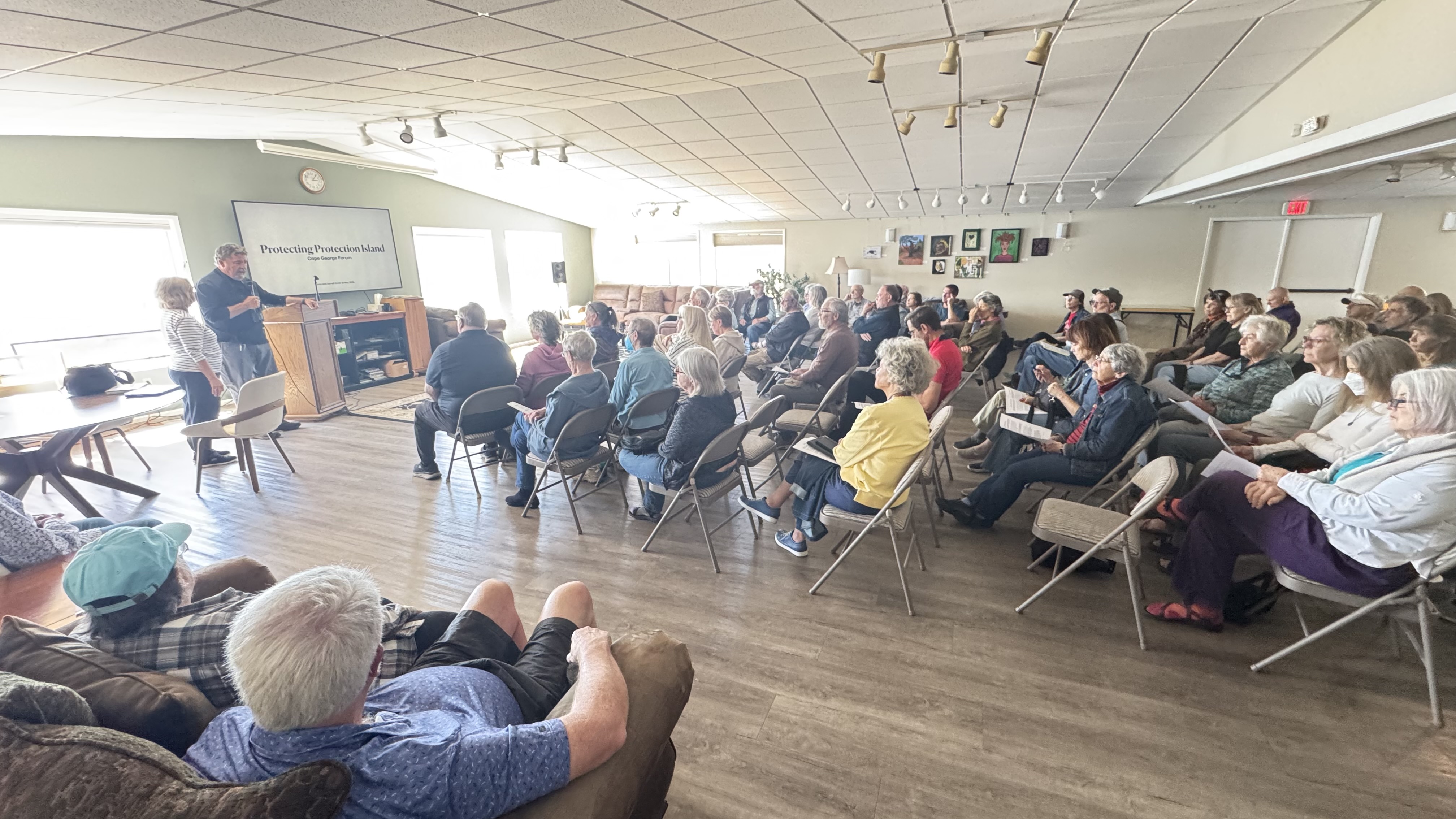
A large crowd of people gathered at Cape George on Sunday to hear Lorna and Darrell Smith discuss both the history of Protection Island and why they are concerned about the proposed Jamestown S’Klallam Land Transfer that the tribe recently has made public.
In the 1970s and early 1980s Lorna Smith was a key person in the work done to make Protection Island a national wildlife refuge. She acted as the liaison between the Seattle Audubon Society and the two women from Jefferson County that led the battle to get the island designated as a refuge, Zella Schultz and Eleanor Stopps, The thousands of letters of support from both native and non native Americans convinced even normally reticent politicians such as Senator Slade Gorton to help push the legislation through Congress and convince President Ronald Reagan to sign it. It was supported by all members of the Washington delegation and the Republican governor, John Spellman.
Also in attendance on Sunday were two granddaughters of Eleanor Stopps who share Lorna’s concerns. This reporter, who also worked with Audubon photographing the spit in the late 70s, also was in attendance.
The Smiths spent the first hour discussing the rich bird heritage of the island and the Spit, before pivoting to the proposed land transfer and the many questions that need to be answered about this proposal.
The Tribe currently is paid approximately $800,000 a year by the federal government to co-manage the Spit and the island. A month ago the Federal Government authorized over $76 million to support the refuges of the country. Money is there. There is no imminent threat of the government cutting off funds. That would have to be authorized by Congress.
The tribe has already begun requesting the ability to lay 80,000 bags of oysters on the bottom of Dungeness Spit’s inner bay, much to the dismay of bird supporters, who worry that this may cause continued loss of fish and other animals the birds feed upon. Currently, there is a lawsuit moving through the courts to stop this from happening.
In March, tribal Vice Chair Loni Greninger testified in Congress that the co-management has been very successful from both the point of view of the Tribe and the government. So if the working arrangement for co-management is successful, why should the Tribe give up $800k and why should Americans give up one of their 570 national wildlife refuges to the Tribe to become owned by them? How much is the Spit and the island worth to the Tribe and why? The answer might be found in the tribe’s lucrative aquaculture industry, wholly owned by them. While the tribe in their proposal denies having any plans for anything other than the vague term, “conservation” the actual answer to this question might have come from Vice Chair Greninger’s comment to the Port Townsend Leader on April 22nd edition. In it she stated:
“If we’re able to have that fuller ownership instead of co-management, then I don’t have to rely on any other government and their rules and regulations,” she said.
This is exactly what is feared by those who fought so hard to protect this island and Spit. With the tribe in full ownership, we will have no say as to what happens to it, nor if future tribal leaders decide to utilize these environmental treasures for economic gain. While it is understandable that the Tribe once used to forage for seafood there, the differences between subsistence shellfish harvest and modern mechanized aquaculture, with the ability to liquify the bottom with air compressors to get to geoduck, or spread thousands of bags of oysters across hundreds of acres at a time is a far cry from how it once was done.
There is every reason to continue to have the tribe manage the refuges. There is little incentive for Americans to simply hand them over to satisfy a demand. Why is Representative Emily Randall and Senator Maria Cantwell so hellbent on getting this done?
The birds are currently protected, as is the unique ecosystem they rely upon. Why should Americans relinquish this to a tribe that is engaged in the business of oyster, geoduck, crabbing, fish farming and fishing when they themselves are admitting that they want to set their own rules for the use of Protection Island? If the Tribe does get it, will we be on the outside looking in and have no input into protecting birds that live there? Many of us are waiting for more answers.
This week I wrote an Op-Ed piece that was published in the Port Townsend Leader. In case you don’t have access to the Leader I have included what I wrote below with minor updates. Unfortunately, the Leader only allowed a 700 word limit on the editorial. Obviously, there are many more words to be said about this proposed transfer. A few of them would be: if you agree that more needs to be clarified, and that the process ought to be slowed down, please contact our city, county, state and federal representatives and make your point of view known.
Your comments might be to oppose or simply slow the process to make sure that the island is never to be used for any commercial activity. That is currently not a part of this discussion between the Tribe and the State and Federal Government.
I want to clarify that I do not support efforts I’m hearing about in Clallam County from a group who oppose this and appear to be anti-Tribal in nature. I am not anti-Tribe.
You might ask: Why should I have any credibility to discuss this issue at all?
I have worked for the Tribe, creating two films over 5 years. I worked closely with the late Tribal Elder, Marlin Holden, a close friend, for “Treaty Resources: Legacy of Our Ancestors” that is viewable at the Tribe’s library. I have interviewed the late Kurt Grinnell and Ron Allen. I have presented in front of the Tribal Council a number of times. I was trusted by the Tribe to video tape tribal meetings, something I was told had never been allowed by anyone outside the Tribe. As a member and chair of the Jefferson County Marine Resources Committee I supported efforts led by the Tribe and other aquaculture companies to reestablish Olympia Oysters in Discovery Bay. The Tribe has done an outstanding job under Ron Allen and Kurt Grinnell’s leadership to forge new economic engines for the Tribe and Clallam County’s benefit, including an active aquaculture industry that sells geoduck to China along with oysters and clams regionally.
Promotional poster for Legacy of Our Ancestors
I produced a second film, paid for by the Tribe about the Dungeness River Management team on the restoration of the Dungeness River, called “Working for the River”.
Promotional poster for “Working for the River”
But I also was there at the efforts to create a wildlife refuge at Protection Island. In late 1970s, I was a professional photographer who volunteered for Seattle Audubon, the organization leading national efforts organized by Jefferson County locals Zella Schultz and Eleanor Stopps over a 20 year period. I traveled to John Wayne Marina where Fish and Wildlife staff took me to the island to photograph. The island had been under threat of having 800 lots developed, with no protection for the rare bird habitat that did and does exist there. Through all the efforts by Zella, Eleanor, Lorna Smith, Hazel Wolf and thousands of others, Congress finally established the Refuge, especially with the help of Republican Slade Gordon and Governor John Spellman, Democratic Senators Scoop Jackson and Warren Magnuson & Governor Dixie Lee Ray, along with the entire Washington State delegation who convinced the Reagan administration to sign the bill, the only such refuge established during his eight year presidency.
I have read a lot of what the Tribe wants to do with Protection Island. On the surface, with little detail, it seems benign. I have read a draft of a possible Congressional Bill that would establish the handover. But I am very troubled by the possible use of this island refuge for commercial aquaculture. Destroying the nearshore for commercial purposes would impact the habitat that these birds need to feed and survive. My concern is that we are rushing into an irreversible action with very little forethought and this legal business decision is not clearly defined at the moment. Now is the time to do the right thing and ensure that Protection Island is protected for *all time and all people* of the United States. That is what currently exists.
To hear more on this issue, I will be on KPTZ (91.9 locally on the Olympic Peninsula and kptz.org online) at 9PM Sunday May 17th on Phil Andrus’ “Cats in our Laps” show for one hour to discuss this in even more detail and answer questions from Phil. The show will be podcast later.
With that background, here is the 700 words that were published today in the Port Townsend Leader. I have expanded on this original letter today slightly to include a few issues that I was forced to edit out due to space constraints.
If I told you that a prized National Wildlife Refuge was going to be handed over to an aquaculture company, what would be your reaction? If I told you it was going to be handed over to The Jamestown S’Kallam Tribe, would your reaction be different? Would it be different if you knew that the Tribe runs an expanding aquaculture company?
What if I told you that in a few years, you will not have any say in what the aquaculture company does with the Refuge? That is exactly what is happening.
Protection Island National Wildlife Refuge is being considered for transfer to the Jamestown S’Klallam Tribe to add to their reservation. Protection Island is currently owned by all of the citizens of the United States. Why does the Tribe want it for their exclusive use? And what is the importance of Protection Island?
The U.S. Department of the Fish and Wildlife has this to say about Protection Island:
Protection Island National Wildlife Refuge provides some of the last remaining undeveloped habitat for many burrow-nesting seabirds in the Salish Sea, but is of particular importance to the rhinoceros auklet. Scarred by over a hundred years of farming and grazing, and carved up for a summer home subdivision in the late 1960’s, it was finally recognized in 1982 with a National Wildlife Refuge designation before irreversible damage occurred.
It supports thriving wildlife populations, including what is thought to be the third largest rhinoceros auklet colony in North America, one of the last two breeding sites for tufted puffins in the Salish Sea, and the largest glaucous-winged gull colony in Washington state.
Over the last year, the Jamestown S’Klallam Tribe have been working in conjunction with the U.S. Department of Fish and Wildlife and U.S. Representative Emily Randall to transfer the title of the island, with its nesting habitat, to the Tribe. At this time, the proposal does not specify the aquatic lands, which remain with the State, but mentions a path to the state relinquishing them to the Tribe in the future.
There is a draft bill that will soon be introduced to make the transfer happen. This work has been done by the Tribal attorneys without any public input. It oddly goes along with the Trump administrations goals of getting the United States of out management of Federal Lands. Project 2025, specifically the “Mandate for Leadership” document, proposes restructuring federal land management by prioritizing energy production, expanding logging, and increasing state or private control over public lands. (highlight is mine). Key proposals include Chapter 13 (Interior Department) for dismantling conservation agendas…
We have already transferred the Dungeness Spit Wildlife Refuge to the Tribe with an understanding that the Tribes aquaculture business was going to drop 80,000 bags of oyster spat on the bottom of the bay. This transfer was opposed by the wildlife biologist that worked at the Spit at the time that the transfer was proposed. There is currently a lawsuit in progress to challenge the process that was used to do this transfer.
Question: “Is the proposed transfer of Protection Island really the best thing for us to do?”
Protection Island refuge was established after a national campaign led by two local women, Eleanor Stopps & Zella Schultz, and the work of the Seattle Audubon Society led byHelen Engle and Hazel Wolf one of the legendary environmental leaders in our state. It was a work that took tens of thousands of volunteer hours with help from National Audubon Society and The Nature Conservancy. (You can listen to an interview I conducted with Eleanor Stopps in 2010 for my film “Voices of the Strait” at the following link.)
Transferring the Island to the Tribe means that it becomes part of it’s reservation and sovereign territory of the Tribe, no longer forced to follow the rules and regulations of the US Wildlife Refuge Acts of 1966 and 1997 There is no provision made for any public input into future tribal decisions on the use of the island, or it’s shores. There are vague references to the tribe continuing “conservation efforts” without specifying what they are. It will be up to the Tribe in concert with the State Department of Natural Resources to decide if they want to use the island’s shoreline for commercial aquaculture. DNR has been promiscuous in its granting of aquaculture permits. Can we trust that this commercially driven Tribe will make the right decisions on behalf of our Refuge when we will have no voice in decisions moving forward?
Also, the great work that the Tribe has done in restoring environmental places like Jimmy Come Lately Creek, the Dungeness River and other locations was done with Federal and State grants or funds. If the Federal Government is attempting to rid itself of Federal lands like this, who is going to pay for the ongoing management the Tribe claims they will do?
There are many who trust Ron Allen. What about future Tribal leaders after him?
What protection do we have if the Tribe’s plans dramatically shift towards commerce than protection? Can we effectively veto or alter the Tribes’ activities on the island? How? The act of moving this crown jewell of wildlife will place it beyond the jurisdiction of local or state officials forever. In fact, it makes enforcement by the Federal government a nation to nation affair that leaves our voices out of the regulation process.
I suggest we start by stopping. There is no need for speed in this process. If Republicans want to get rid of Wildlfe Sanctuaries and Democrats want to support whatever the Tribes want, none of that will change with another year or two of public input. Pause this transfer while we figure out how all of us and not just one Tribe, will have a voice in the future of Protection Island if we relinquish control over it to the Tribe.
Listen to me Sunday night on KTPZ.ORG at 9PM Pacific
As the controversy over the possible transfer of management and ownership of the Dungeness Wildlife Refuge and Protection Island to the Jamestown S’Klallam Tribe continues, I was sent this quote which sums up the issue of approving this transfer. At the moment, the Refuge decision making process is theoretically one for the protection of its wildlife for all of American citizens. Yes, that’s not always what happens. But in this case, for 100+ years, I think it has been done well. It is worth remembering that the Tribe is attempting to engage in commercial aquaculture (for their financial benefit) at the very edge of the Refuge, with criticism coming from some key biologists as to the effects of this on the very species that the refuge is supposed to protect. To be clear, in 2024 the US Fish & Wildlife Service signed over management of the Dungeness Spit and Protection Island to the Jamestown Tribe in a deal with virtually no public input that will pay the Tribe at least $500,000 annually and allow them to commercially harvest non-native oysters in a 50-acre parcel within the Refuge. Now a bill has been drafted and will be presented in Congress that would give the Tribe total ownership as part of their reservation allowing them to determine all rule making and audiences for those rule making processes. This makes this quote all the more important in the decision making process of granting this request.
Jean Pratschner wrote Sequim City Council:
My husband Greg Pratschner (deceased) was a regional administrator of USF&W, all over the country. He often worked with tribal groups, very familiar with their agendas, programs, and abilities, often brought them into the Federal programs and helped with scholarships, training, grants, projects. He was awarded many honors for his inclusionary concepts in co-management. We had many Native friends. But, he often felt the goals and perspectives were not on the same page when it came to fisheries and refuges. He could never go against or find a legal way or option to alter a bad aspect of their programs, and always felt there was no argument or decision that he could use to make them comply with a negatively contrived agenda about an issue. His hands were always tied, by ultimately BIA power, that had no concern for non -Native viewpoint, only one opinion or goal would be followed. Native opinion. He always had to bend. Always. Sometimes it turned out less than good for all parties.
The never ending drama of the State Wildlife Commission continued with an open session allowing comments from both sides in the controversy. We urge the Governor to take steps to remove Director Kelly Susewind. The Governor never had any need to follow the lead of the hunters associations as they hated him from the beginning and never would have voted for him in the past or the future. These attacks on Commissioners nominated for their environmental protection stance and the ability to follow science rather than the hunting communities perceived needs to kill bears. This continues attacks across the country on environmental protection under this radical regime in Washington D.C. that fuels this behavior.
Commissioner Smith is a local environmental activist from Jefferson County. I’ve known her and worked with her and her husband Darrell for decades. She was part of the team that lobbied congress to get Protection Island turned into a National Wildlife Refuge in 1982. She has fought for wolf and cougar protection along with protecting bears from slaughter. This hunting often leaves orphaned cubs in its wake. There is no one more qualified to fight to protect the issues of the environment than her. If the Governor abandons her, it will be a stain on his supposed environmental credentials for the rest of his term.
From the Washington Standard:
Surly public comments are a staple of Washington Fish and Wildlife Commission meetings, revealing the deeply personal stakes of those fighting over how far the state should go in protecting various species or allowing for hunting or fishing.
But last week’s session carried a slightly harsher tone, fueled by an investigation into whether commissioners violated open meetings and public records statutes ahead of a decision in 2022 to ban spring bear hunts, and a federal civil rights lawsuit filed against the agency’s director by a commissioner targeted by the probe.
The meeting took place Thursday to Saturday in Olympia. Speakers vented grievances with decisions of the citizen panel, actions of individual members and leaders of the Department of Fish and Wildlife, which the commission oversees. Some called for commissioners to resign, others for agency Director Kelly Susewind to be fired.
here we go again…thank you for the Peninsula Daily News for covering this story. The whole story link is found at the bottom of this article.
While I normally in the past would’ve suggested you send in your comments, it’s been my experience that the Navy takes them says thank you very much and then totally ignores them. The only thing that stops them are court orders, but send your comments in nevertheless. It might be useful in court.
SILVERDALE — The U.S. Navy and U.S. Coast Guard are accepting public comment regarding the environmental impact of at-sea military training activities through Jan. 19.
The services are jointly preparing a supplement to the 2015 Northwest Training and Testing (NWTT) final environmental impact statement (EIS) and the 2020 NWTT final supplemental EIS to assess the potential environmental effects associated with continuing at-sea military readiness activities, according to a press release from Navy Region Northwest.
At-sea military readiness activities include training, research, development, testing and evaluation activities, and range modernization and sustainment.
Those activities would occur on and beneath the water surface and in the airspace within the study area.
The study area, which does not include any land or overland airspace, consists of areas offshore of the Washington, Oregon and Northern California coasts, inland waters of Washington and the western Behm Canal in Southeast Alaska.
Comments may be submitted via the project website at www.nepa.navy.mil/nwtteis or by mail to: Naval Facilities Engineering Systems Command Northwest; Attention: NWTT SEIS/OEIS Project Manager; 1101 Tautog Circle, Room 102, Silverdale, WA 98315-1101.
Read the rest of the story in the Peninsula Daily News today at the following link. please subscribe to the Peninsula Daily News to support local journalism like this .
The Peninsula Daily News reported that Protection Island is seeing what may be the last breeding pair of Tufted Puffins. Smith and Protection Islands were what state officials believe to be the last islands with nesting pairs.
According to the Washington Department of Fish and Wildlife, in 1909, there were an estimated 25,000 Tufted Puffins across 44 nesting sites on the coast of Washington and in the interior Salish Sea. By 2009, the population had plummeted to less than 3,000, with only 19 nesting sites remaining and only two in the Salish Sea.
Tufted Puffins are still thriving in Alaskan waters, however …”a troubling mass die-off event on St. Paul Island in 2016 raises significant concern for the species’ future. Over 350 severely emaciated carcasses washed ashore, underscoring the urgency for further research and conservation efforts to safeguard these remarkable birds.” (as reported in https://www.adventuresnw.com/rare-birds-the-endangered-puffins-of-the-salish-sea/)
The loss of Puffins may be from a wide variety of causes, including habitat loss and the loss of species of fish they eat.
EDMONDS, Wash.— The Conservation Angler and Wild Fish Conservancy reached a settlement agreement with NOAA Fisheries establishing a deadline requiring the agency to issue its long-overdue finding on whether Olympic Peninsula steelhead warrant protection under the Endangered Species Act (ESA).
Under the court-ordered deadline, NOAA Fisheries must complete its 12-month finding on the organizations’ petition to list Olympic Peninsula steelhead under the ESA by December 1, 2025. The decision was originally required by August 1, 2023, following the agency’s initial positive finding that Olympic Peninsula steelhead may require federal protection.
The settlement was reached in a lawsuit filed by the conservation groups challenging NOAA Fisheries for delaying ESA protections to Olympic Peninsula steelhead. At the time of filing, the agency’s determination was 535 days overdue.
“This settlement finally puts an end to the federal government’s inexcusable delay in deciding whether these magnificent fish deserve protection,” said John McMillan, Executive Director of The Conservation Angler. “Olympic Peninsula steelhead have been waiting for this decision for nearly two years beyond the statutory deadline. Every day of delay puts these fish at greater risk.”
Olympic Peninsula steelhead are a distinct population segment that occurs in the remote northwest corner of Washington State. Once numbering in the tens of thousands, these iconic fish have steadily declined throughout their range for decades due to commercial harvest, mismanaged recreational fisheries, hatchery operations, climate change, and legacy and contemporary effects from habitat degradation.
“We’re pleased to reach this agreement, but the real work is just beginning,” said Emma Helverson, Executive Director of Wild Fish Conservancy. “NOAA has already acknowledged Olympic Peninsula steelhead face a moderate risk of extinction. This agreement ensures the agency can no longer delay action. We expect the agency to follow the science and provide these fish with the protections they desperately need.”
The Conservation Angler and Wild Fish Conservancy submitted a petition to list Olympic Peninsula steelhead under the ESA on August 1, 2022. Following the agency’s positive 90-day finding in February 2023, NOAA had one year from the petition submission date to complete a final determination.
In October 2024, NOAA released a status review report confirming that Olympic Peninsula steelhead are at moderate risk of extinction. However, the agency still failed to issue the required decision on the need for ESA-listing, prompting the lawsuit on January 17, 2025.
“The science is clear – Olympic Peninsula steelhead populations are in trouble and need immediate protection,” said John McMillan, Executive Director of The Conservation Angler. “This settlement ensures NOAA can no longer ignore its legal obligations to protect these imperiled fish.”
Olympic Peninsula steelhead face mounting pressures across their range. Commercial and recreational fisheries continue to target these fish during their most vulnerable life stages. Hatchery operations threaten the genetic integrity of wild populations. Climate change has altered freshwater and ocean conditions, and decades of logging have degraded spawning and rearing habitat.
“These fish are indicators of ecosystem health throughout the Olympic Peninsula,” added Helverson. “Protecting Olympic Peninsula steelhead means protecting the entire web of life that depends on healthy rivers and forests in this unique region.”
###
The lawsuit was filed in U.S. District Court for the Western District of Washington. The Conservation Angler and Wild Fish Conservancy are represented by Kampmeier & Knutsen PLLC. kampmeierknutsen.com
The Conservation Angler fights for the protection of wild Pacific anadromous fish populations and their watersheds throughout the Pacific Northwest and Russia’s Kamchatka Peninsula. theconservationangler.org
Wild Fish Conservancy is a nonprofit conservation organization headquartered in Washington and working from California to Alaska to preserve, protect and restore the northwest’s wild fish and the ecosystems they depend on, through science, education, and advocacy. wildfishconservancy.org
Filed under: Endangered Species, Environmental Law, fisheries | Comments Off on Legal Settlement Reached for Endangered Species Act Decision Deadline for Olympic Peninsula Steelhead
With $19 million in NOAA funds, nonprofit and tribal partners plan to remove 17 barriers blocking fish passage on critical spawning rivers originating in Olympic National Park, Washington.
The cold water rivers of Western Washington descend from the glaciers and snow-capped mountains of Olympic National Park. They hold some of the last, best freshwater habitat for salmon and steelhead in the lower 48 states. Despite a warming climate, their high-elevation headwaters are predicted to remain cool enough for salmon and steelhead for at least the next 50 years.
However, the region’s roads—some a legacy of the logging industry—crisscross the watersheds. They often force streams to flow underneath them through small, poorly designed tunnels called culverts that block fish passage. There are more than 4,000 culvert barriers on the Olympic Peninsula. Salmon and steelhead are often unable to reach the historical habitat they need to spawn and produce the next generation.
Remove 12 high-priority barriers in the Hoh, Quillayute, and Quinault watersheds
Finalize designs for 5 additional culvert replacements
Expand the ability of tribes to perform restoration work
Inject money into the regional economy by hiring local and tribally owned contracting companies
Mitigate flood damage risks by installing culverts built to handle high flows from the region’s increasingly heavy rain storms
“We are running out of time to recover and protect these salmon and steelhead populations,” says Luke Kelly, Western Washington Program Director for Trout Unlimited. “We need to pull out all the stops now, so it’s been great to see all of our government, tribal, nonprofit partners, and private landowners coming together to get this done.”
The campaign has support from local, state, and federal agencies including NOAA. In past years(PDF, 8 pages) project partners have also repaired instream and riparian habitat damaged by road building and destructive logging practices.
Also;a new short video looking at the Cold Water Connection Campaign on the Olympic Peninsula . It really celebrates the extensive work the partners have done to make sure they are prioritizing the most impactful barriers for removal, and the benefits this work provides to local communities above and beyond the important benefits to fish and coastal watersheds.
Just in from Alexandra Morton, the leading net pen researcher in the world. Now the science gets even clearer as follows:
Just published! In-depth review of the risk specific farm salmon pathogens causes BC salmon populations. It’s no coincidence the 1st generation of chum that went to sea after salmon farms were removed from the Discovery Islands are returning in larger numbers than we have seen in a long time. We explain why some DFO fish farm science cannot be relied on if you want wild salmon. Huge thanks to my incredible co-authors! This entire edition of Science Advances examines the real cost of salmon farming… https://www.science.org/toc/sciadv/10/42..
Our local representative from Taylor Shellfish has long trashed her in public and is always given a free podium at local Marine Resources Committee meetings to promote his opinions which have never been based in science, but what appears to many as simple character assassination (he has stated numerous times she is not a “real” scientist). The next time you buy shellfish, remember that Taylor Shellfish has been at the forefront of working to discredit her work. Because of the work of businesses attacking her like that, it took years longer to deal with the problems our salmon are facing.
Peter Bahls and his organization the NW Watershed Institute, have pulled off another successful land transfer that they’ve been working on for years in the waning days of public lands commissioner Hilary Franz’ administration. But the agreement may also find itself strapped for funds if the Climate Commitment Act (CCA) is reversed in the next election or a Republican takes office to replace Franz. Your vote is important to passing this . Our website is supporting King County Commissioner and former State Representative Dave Upthegrove as the next land commissioner because of issues such as this.
QUILCENE — The Dabob Bay Natural Resources Conservation Area has been expanded by 3,943 acres to include more than 11,000 acres around the bay.
Hillary Franz, the state Commissioner of Public Lands, signed an order on Sept. 23.
“Dabob Bay is a unique and special landscape, and I am incredibly happy to protect and preserve public lands there so that future generations get to enjoy its beauty and ecological importance,” Franz said. “This further expansion is a testament to years of hard work from stakeholders and staff to find a solution that protects these rare ecosystems while still supporting local services in east Jefferson County.”
In January, The Wild Fish Conservancy petitioned NOAA for a listing urging protection for Alaskan Chinook under the Endangered Species Act.
Last week, NOAA announced a positive 90-day finding on that petition, agreeing the information included was substantial and warrants further review. This decision triggers an in depth scientific review that will determine if a threatened or endangered listing is warranted.
The decision will likely come as a surprise to many, as Alaska is perceived as having widely abundant salmon runs and all Alaskan salmon fisheries were just recertified by Marine Stewardship Council (though that decision is being challenged). This week, the Copper River run has come in to Seattle markets, trading at around $100 a pound. However, the data shows Alaskan Chinook populations are facing a similar crisis as rivers coastwide, and in some cases are in even worse condition.
Endangered Species Process
We’ll look forward to tracking this process as it progresses.
The baby orca known as J60 is missing and presumed dead, according to the Center for Whale Research.
The month-old male was the youngest member of the Northwest’s endangered population of salmon-eating killer whales, which often die before their first birthday due to toxic pollution and a lack of food.
Well worth an hour to hear from a key State Commissioner. Click anywhere on the photo below to be taken to the signup page. The RSVP link does not work in the image.
Time after time, citizens have had to sue the U.S. Fish and Wildlife Service (USFWS) for failing to protect the animals and their habitat as required by law, in areas that the nation has recognized as critical to preserve as habitat and for public recreation. Now USFWS is willing to allow, for private profit, the industrialization of refuge lands for shellfish operations.
>>Tell the U.S. Fish and Wildlife Service and U.S. Secretary of Interior Deb Haaland that the Dungeness National Wildlife Refuge lease for industrial aquaculture must be rescinded.
In spite of demonstrated harm to birds, salmon, forage fish, and shellfish, and a recommendation by the National Marine Fisheries Service that “an alternative site be identified in a location that results in less potential impacts to wildlife that is more appropriate for aquaculture and meets the goals of the tribe,” USFWS approved a lease for an industrial oyster farm inside the Dungeness National Wildlife Refuge. This decision, which is in violation of the Clean Water Act and the Migratory Bird Treaty Act, must be reversed.
In the words written of an October 2022 USFWS internal memorandum, “Forgoing a compatibility determination in order to facilitate incompatible commercial activities by any entity would be a subversion of the fundamental requirements in the [USFWS] Improvement Act.”
We are targeting the most recent case of the USFWS’s permissiveness in one of the country’s most pristine nature lands, the Dungeness National Wildlife Refuge in the small rural town of Sequim Washington, just below the Olympic National Park. In this case, the shellfish corporation raises shellfish on other sites. They do not need to operate in a national refuge and deny wildlife their feeding and breeding grounds.
The Dungeness National Wildlife Refuge was created by Executive Order in 1915 by Woodrow Wilson, directing the area to be set aside as a “refuge, preserve and breeding ground for native birds and prohibits any disturbance of the birds within the reserve.” The front page of the Refuge website states: “Pets, bicycles, kite flying, Frisbees, ball-playing, camping, and fires are not permitted on the Refuge as they are a disturbance for the many migrating birds and other wildlife taking solitude on the Refuge.” With this level of concern, it is counterintuitive to allow destructive industrial aquaculture.
Industrial shellfish aquaculture is known to reduce or eliminate eelgrass with the use of pesticides. Shellfish aquaculture also involves large-scale use of plastics—PVC tubes and plastic netting—that are hazardous to marine organisms and can trap and entangle wildlife. Commercial shellfish aquaculture is a major industry in Washington state that has significant impacts on the nearshore marine environments, which provide essential habitat for many species, including invertebrates, fish (including herring and salmon), and birds (migratory and shorebirds).
Among the negative impacts of this project are: 50% reduction in bird primary feeding grounds; plastic oyster bags that exclude the probing shorebird flocks from feeding deeply into the substrate, entrap fish and birds, add macro- and micro-plastic bits to the sediment throughout the refuge, and shift the benthic community composition; diminishing of the ecological benefits provided by eelgrass to threatened fish and birds, such as nourishment and cover from predators; and increased algal blooms that will leave a graveyard of dead oysters. These detrimental effects to the Dungeness National Wildlife Refuge are NOT minimal. Decisionmakers should not place financial benefits to the corporation above the long-term and cumulative impacts to the refuge. Half of the world’s 10,000-odd bird species are in decline. One in eight faces the threat of extinction. 2.9 billion breeding adult birds have been lost from the United States and Canada in only 50 years.
Let’s raise our national voice and try and stop this refuge destruction with public persuasion. This is a public space we pay to protect. For more information, check out the Daily News post from last August, “Groups Sue U.S. Interior Department to Protect the Dungeness National Wildlife Refuge from Industrial Aquaculture.”
This action follows a lawsuit filed by three environmental organizations against the U.S. Department of Interior for failing to protect the Dungeness National Wildlife Refuge from industrial aquaculture. The groups, including Protect the Peninsula’s Future, Coalition to Protect Puget Sound Habitat, and Beyond Pesticides, filed their complaint in the U.S. Western District Court of Washington State. The complaint states that the U.S. Fish and Wildlife Service (USFWS), U.S. Department of Interior, must “take action that is required by the Refuge Improvement Act and conduct a compatibility determination and require a special use permit for a proposed industrial aquaculture use” that will abut and impact the Refuge. The plaintiffs are represented by the Seattle, WA law firm of Bricklin and Newman LLP.
>>Tell the U.S. Fish and Wildlife Service and U.S. Secretary of Interior Deb Haaland that the Dungeness National Wildlife Refuge lease for industrial aquaculture must be rescinded.
We are focusing this Action against the U.S. Environmental Protection Agency and the U.S. Secretary of State.
Thank you for your active participation and engagement!
Please take this ACTION and circulate it to your family, friends and colleagues.
DUNGENESS NATIONAL WILDLIFE REFUGE UPDATE (DNWR): Groups Sue USFWS For Failure to Protect the Dungeness National Wildlife Refuge
On August 17, Protect the Peninsula’s Future (PPF) was joined by The Coalition to Protect Puget Sound Habitat and the WA D.C. national organization Beyond Pesticides in a legal action to hold the U.S. Fish and Wildlife Service (USFWS) accountable to follow its regulations and protect the Dungeness National Wildlife Refuge. They were represented by the Seattle WA law firm Bricklin and Newman
The August 17 federal complaint, submitted to the United States District Court For The Western District of Washington, states that the USFWS must “take action that is required by the Refuge Improvement Act and conduct a compatibility determination and require a special use permit for a proposed industrial aquaculture use” that will abut and impact the Refuge.
Plainly, the compatibility determination would decide whether this industrial- shellfish operation is compatible with the mission of the Refuge.The Dungeness National Wildlife Refuge was created in 1915 by President Woodrow Wilson. The Refuge provides habitat, a preserve, and breeding grounds for more than 250 species of birds and 41 species of land animals. The shellfish operation lease is for 50 acres of Washington State bottomlands. 34 acres would be covered with up to 80.000 plastic grow-out bags of non-native shellfish spat, staked into the bottomlands and potentially killing all marine life underneath and snaring wildlife in the netting. These plastic bags will cover the primary feeding grounds for the birds, essentially starving them as they peck through the plastic trying to reach nutrients. This operation would shift the natural year-round-sediment drift, moving the sediment into and covering the eelgrass beds – beds protected for rearing salmon for whales and nourishment for particular migratory ducks. To protect the birds, the area is closed to the public during the migratory bird season. However the USFWS will allow the shellfish operation in to the area all year long to the detriment of the birds.
June 23, 2023— In a shocking ruling against Endangered Species protection, a Ninth Circuit Court approved a request by NOAA Fisheries, the State of Alaska, and the Alaska Trollers Association that will allow commercial troll fishers in Southeast Alaska to continue over-harvesting depleted Chinook salmon, jeopardizing the recovery of both wild chinook and critically endangered Southern Resident killer whales.
The lower Court decision was set to close the fishery beginning on July 1st, in just ten days. Now, despite numerous environmental violations and ongoing harm found by a federal District Court, the stay will allow the fishery to continue operating while the Ninth Circuit considers the case on appeal.
“The economic, ecological, and cultural cost of losing Southern Resident orcas and wild Chinook is unfathomable. It is unfortunate that the Ninth Circuit determined the short-term economic interests of Southeast Alaska commercial harvesters should be prioritized over the long-term interests of all current and future generations of First Nations, Tribal Nations, and communities throughout the Pacific Northwest who depend on these iconic species,” said Emma Helverson, Executive Director of Wild Fish Conservancy. “We are incredibly disheartened by this decision to continue the fishery while California, Oregon, Washington and British Columbia are enacting closures or severe constraints on many of the same populations due to continuing Chinook declines. We strongly advocate for consumers to avoid purchasing Chinook caught in Southeast Alaska.”
In March, a federal District Court issued a final order in a lawsuit brought by Wild Fish Conservancy against NOAA Fisheries requiring the Southeast Alaska commercial troll fishery to remain closed in the summer and winter seasons until the federal government provided a new analysis and conducted environmental review demonstrating that the fishery’s harvest plan would not continue to jeopardize endangered Southern Resident killer whales or threatened Chinook salmon.
In their ruling on remedy, the District Court considered the economic disruption that closure of the fishery would pose to Alaskan commercial fishers, yet determined protecting species threatened or endangered with extinction is the greatest priority under the Endangered Species Act. Referencing existing case law, the Court’s report and recommendation stated: “The ESA . . . did not seek to strike a balance between competing interests but rather singled out the prevention of species [extinction] . . . as an overriding federal policy objective.”
Southern Resident killer whales were listed as Endangered in 2005. Currently, there are only 73 individuals in the population, an alarming decrease from nearly 100 only 25-years ago. Reduced prey availability, specifically large and abundant wild Chinook, has been identified by killer whale experts and NOAA as the primary cause of their decline. Research has shown an alarming 69% of Southern Resident killer whale pregnancies are aborted due to insufficient prey.
“It’s possible to find creative solutions to compensate and protect the economic interests of fishers in the interim while NOAA corrects their violations,” says Helverson. “On the other hand, it’s impossible to replace Southern Resident killer whales or wild Chinook once they are gone, extinction is forever.”
In NOAA’s 2019 biological opinion evaluating the fishery’s impact on threatened and endangered species, NOAA admitted that over the last decade and persisting today, Chinook harvest in Southeast Alaska’s troll fishery is occurring at levels that are unsustainable for the long-term survival and reproductive success of both threatened wild Chinook populations and endangered Southern Resident killer whales. Still, NOAA authorized the harvest to continue at these levels relying on proposed mitigation they claimed would offset this serious harm. In summary judgement in August, the District Court overwhelmingly found the mitigation was insufficient and seriously violated the ESA and that NOAA also evaded legally required environmental review.
While the fishery occurs in Southeast Alaska marine waters, the majority of Chinook harvested in the Alaskan troll fishery are not Alaskan Chinook. Up to 97% of all Chinook harvested in the fishery are born in rivers throughout British Columbia, Washington, and Oregon. Roughly half of the fish harvested originate from the Columbia River, and many come from populations listed as Threatened under the ESA. These Chinook are harvested in their ocean nursery habitats, preventing them from reaching maturity and returning back to their homewaters where the Southern Resident killer whales encounter them. The majority of stocks harvested in the fishery are identified as priority stocks for the malnourished and endangered whale population.
“While communities throughout the coast have closed fisheries and made significant economic sacrifices to protect threatened and endangered Chinook populations in their home rivers, these same depleted populations are being harvested far from home in Southeast Alaska where they are marketed and sold as sustainable Alaskan Chinook,” says Helverson. “While this case is about conservation, it’s also about equity and we will continue to advocate for the conservation burden of protecting and restoring these species to be more equally shared by all communities who depend on them.”
“We know yesterday’s decision is concerning to so many who have been following this case and working tirelessly to recover our beloved Southern Resident killer whales and wild Chinook populations. Despite this temporary setback, the appeal process is just beginning and we remain dedicated to advocating for the recovery of these iconic species through every avenue possible,” says Helverson.
From Wild Salmon Conservancy. A major ruling with far reaching impacts.
May 3, 2023— Yesterday, in an international, coastwide environmental victory, Seattle federal Court issued a landmark order halting the overharvest of Chinook salmon in Southeast Alaska that has persisted for decades, jeopardizing the survival of federally-protected Southern Resident killer whales (SRKW) and wild Chinook populations coastwide. This significant decision will immediately allow the starving Southern Resident population far greater access to these Chinook which are the whale’s primary prey, marking a turning point for their recovery.
“This Court decision is the largest victory for Southern Resident killer whale recovery in decades and will be celebrated internationally. After years of inaction by our federal government to address the prey crisis facing the Southern Residents, Judge Jones’ decision will finally provide starving orcas immediate access to their primary prey,” says Emma Helverson, Executive Director of Wild Fish Conservancy. “What’s more, by allowing far more wild Chinook to return home to their spawning grounds, this action is also helping to recover and restore wild Chinook from rivers throughout Oregon, Washington, and British Columbia, essential to rebuilding both populations in the long-term.”
On Tuesday, U.S. District Judge Richard A. Jones issued a final ruling in Wild Fish Conservancy’s lawsuit agreeing that halting the summer and winter seasons of the Southeast Alaska Chinook troll fishery is the most appropriate remedy. The Court subsequently remanded NOAA Fisheries’ inadequate biological opinion in order for the agency to address the serious underlying violations of environmental law previously found by the Court.
In that biological opinion evaluating the fishery’s impact on threatened and endangered species, NOAA admitted that over the last decade and persisting today, Chinook harvest is occurring at levels that are unsustainable for the long-term survival and reproductive success of both threatened wild Chinook populations and endangered Southern Resident killer whales. Still, NOAA authorized the harvest to continue at these levels relying on proposed mitigation they claimed would offset this serious harm. In summary judgement in August, the Court overwhelmingly found the mitigation was insufficient and violated the Endangered Species Act (ESA) and that NOAA failed to conduct legally required environmental review of the mitigation, which would include opportunities for public input and an evaluation of alternatives, such as reductions in harvest.
Southern Resident killer whales were listed as Endangered in 2005. Currently, there are only 73 individuals in the population, an alarming decrease from nearly 100 only 25-years ago. Reduced prey availability, specifically large and abundant wild Chinook, has been identified by killer whale experts and NOAA as the primary cause of their decline. Research has shown an alarming 69% of Southern Resident killer whale pregnancies are aborted due to insufficient Chinook salmon and inbreeding depression has been identified as a growing threat to the population’s survival and recovery.
“This is unbelievable news, yet so long in coming,” said Wild Orca’s Science and Research Director, Dr. Deborah Giles. “The high pregnancy failure rate within the Southern Resident killer whale population is linked to poor nutrition, so having more fish returning to their home waters in British Columbia, Washington, and Oregon, will increase the whales’ prey base and improve their chances of giving birth to healthy calves.”
In an expert declaration evaluating the effect of the troll fishery’s harvest on the Southern Resident population, modeling by Dr. Robert E. Lacy projected closing the fishery would increase prey availability by approximately 6%, which would be enough to stabilize the population and stop their decline toward extinction, though additional actions would be required to begin to grow the population. The Court stated: “Though there is uncertainty as to how much prey would ultimately reach the SRKW, the record before the Court suggests that closure of the fisheries meaningfully improves prey available to the SRKW, as well as SRKW population stability and growth, under any scenario.” As a result of yesterday’s decision, approximately 172,000 Chinook that would have been harvested or indirectly killed in the 2023 summer and winter seasons of the Southeast Alaska troll fishery will now be able to continue their historical migration south to home spawning grounds and into the whale’s key foraging areas.
“Dr. Lacy’s findings suggest that the single action of closing this fishery would increase prey availability enough to stabilize the Southern Resident population. Stopping the precipitous decline of the whales toward extinction is the highest priority toward recovery efforts. These findings clearly demonstrate that Chinook harvest in Southeast Alaska’s troll fishery is contributing to the decline of the whales, validating why the Court’s decision is so critically important to the survival of this population,” says Helverson.
While the fishery occurs in Southeast Alaska marine waters, most people are unaware that up to 97% of all Chinook harvested in the Southeast Alaska troll fishery migrate from rivers throughout British Columbia, Washington, and Oregon. Roughly half of the fish harvested originate from the Columbia River, and many come from populations listed as Threatened under the ESA. Currently, these Chinook are harvested in their ocean rearing habitats preventing them from migrating back into southern waters where the Southern Resident killer whales encounter them. Majority of stocks harvested in the fishery are identified as priority stocks for the Southern Residents.
“Alaskan fishers should not be blamed for NOAA’s chronic mismanagement of this fishery, and we are sincerely sympathetic to the burden this decision will pose to Southeast Alaskan communities,” says Helverson. “However, this decision will finally address decades of harm and lost opportunity this overharvest has caused to fishing communities throughout British Columbia, Oregon, and Washington who depend on these fish, particularly Tribal and First Nations. In addition to the unparalleled benefits to killer whale and Chinook recovery, the Court’s decision is addressing this historic inequity and restoring control to coastal communities of the destiny of salmon recovery in their home watersheds.”
“The underlying harvest issues in this case are not an anomaly, but rather just one example that demonstrates the problems caused when harvest occurs in the ocean where it is impossible to avoid unintentionally harming threatened and endangered populations or intercepting high proportions of salmon from rivers coastwide,” says Kurt Beardslee, Director of Special Projects. “Scientists are increasingly calling for harvest reform measures that shift harvest out of the ocean and into fisheries in or near each river of origin where salmon return, providing fisheries managers and coastal communities the ability to manage recovery with far greater accuracy and success.”
The pressure is building on Canada to end the use of net pens that effect wild salmon runs. A huge win for Alexandra Morton and her supporters, but more importantly, for the wild salmon runs which, as the article points out, are in serious decline.
After years of concerns over the impact of aquaculture on wild sockeye salmon, Canada’s fisheries department has decided not to renew the operating permits of 15 Atlantic salmon farms in an environmentally sensitive area of British Columbia.
The focal point for environmental news & perspective on the news. Our goal is to help educate and connect the public on the Peninsula. We are not a non-profit so donations are not tax deductible. Maybe someday with your help!
This site is based on news and my opinion on that news. I come with over 50 years of experience in various environmental and tribal involvement. You may not agree with my POV. At my age, I am willing to listen to your POV and put it in comments. But I might not agree with you and that's the way it works.
HOTLINES FOR REPORTING SPILLS
WA State Emergency Management Division: 1-800-258-5990
National Response Center: 1-800-424-8802
Pacific States & British Columbia: 1-800-OILS-911 (1-800-645-7911)
Local Events
Add your local event here. Contact us to include your next event.
—————————————————
TSUNAMI DEBRIS HOTLINE:
1-855-WACOAST (1-855-922-6278)
—————————————————
Event Date:
NATURE NOW
A Program About the Natural World.
KPTZ.ORG 91.9
WEDNESDAYS AT 12:05
REPEATS: SATURDAYS 12:30 AND WEDNESDAYS
PODCASTS AT KPTZ.ORG