By donating to the News you help us bring more news to you! We will use the donations to pay additional reporters, and spend more time on stories! Want to donate more than $10? Under the $10 is a dropdown box, choose multiples of 10. (i.e. Qty 3 at $10)
*DataGovArchive
archive of data.gov on Source Cooperative. The 16TB collection includes over 311,000 datasets harvested during 2024 and 2025, a complete archive of federal public datasets linked by data.gov. It will be updated daily as new datasets are added to data.gov.
-Alexandra Morton's Web Site (NEW)
The new web site for the work of Canada’s leading researcher in to farmed Atlantic Salmon and it’s effects.
North Olympic Peninsula Skills Center Natural Resources
To provide a program that provides hands-on, relevant natural resources research experience while meeting the needs of and building capacity within individual students and the North Olympic Peninsula region.
openchannels.org
OpenChannels is designed to become a comprehensive source for news, guidance, and community discussion on sustainable practices in ocean planning and management.
River of Kings – Video
Part 1 of 2 part series by Carl Safina on the Nisqually River Restoration.
Salish Magazine
Salish Magazine is a free online magazine that takes inquisitive readers outdoors with visually rich storytelling about features people can see firsthand in our public forests and beaches.
Victoria Sewage Project
The official city site on the project. The latest scoop on the Canadian poop!
WA State Family Forest Fish Passage Program
The Family Forest Fish Passage Program provides funding to small forest landowners to repair or remove fish passage barriers. Download the film.
News Sites
Green Acre Radio on KBCS
Green Acre Radio on KBCS — Sustainability, local food production, restoration & environmental talk radio.
NW Indian Fisheries Commission
The Northwest Indian Fisheries Commission (NWIFC) is a support service organization for 20 treaty Indian tribes in western Washington.
Brinnon Group
Local group opposing Black Point resort
Clam Gardens
Network of researchers exploring First Nation gardening of clams in history, and it’s relationship to today.
Coastal Watershed Institute
“To promote long term, ecological, community based stewardship of marine and terrestrial ecosystems thru scientific research and local partnerships.”
League of Women Voters – Clallam County
a nonpartisan political organization, encourages the informed and active participation of citizens in government, and influences public policy through education and advocacy.
League of Women Voters – Jefferson County
The League of Women Voters, a nonpartisan political organization, encourages the informed and active participation of citizens in government, and influences public policy through education and advocacy.
Local Food Access Network
North Peninsula local food org with an emphasis on developing and supporting increased and sustainable capacity for production, distribution, and consumption locally.
North Olympic Salmon Coalition
The mission of the North Olympic Salmon Coalition is to restore, enhance, and protect habitat of North Olympic Peninsula wild salmon stocks and to promote community volunteerism, understanding, cooperation and stewardship of these resources.
Northwest Watershed Institute
NWI’s mission is to provide scientific and technical support to protect and restore fish and wildlife habitats and watershed ecosystems of the Pacific Northwest.
Olympic Environmental Council
The Olympic Environmental Council works on issues related to the environment and health that affect our North Olympic Peninsula communities.
Olympic Park Associates
If you share with us a passion for Olympic National Park, a concern for the Park’s future, and a vision that Olympic National Park should always be a wild and natural place, we invite you to join Olympic Park Associates.
Washington Environmental Council
WEC has been working for a couple of decades on environmental activism. A great group of people actually getting things done.
Whale Trail
Signs along the way to take you to great whale viewing locations
Wild Fish Conservancy
Wild Fish Conservancy seeks to improve conditions for all of the Northwest’s wild fish
A new study has just come out that helps better understand how to rear hatchery steelhead salmon without impacting genetic diversity, which has been a key concern of wild salmon advocates for years. The findings show that if wild salmon are allowed to spawn naturally, and then the eggs are collected for rearing in a hatchery, that the genetic risks were lessened. This is good news for both sides of the debate, as it shows that hatchery rearing of wild collected eggs may not be a threat to genetic diversity, or at least that’s the way I read it. The authors do state that “…While the longer-term genetic effects were not assessed in this study, other programs have realized reduced genetic diversity during similar timeframes.”
ABSTRACT
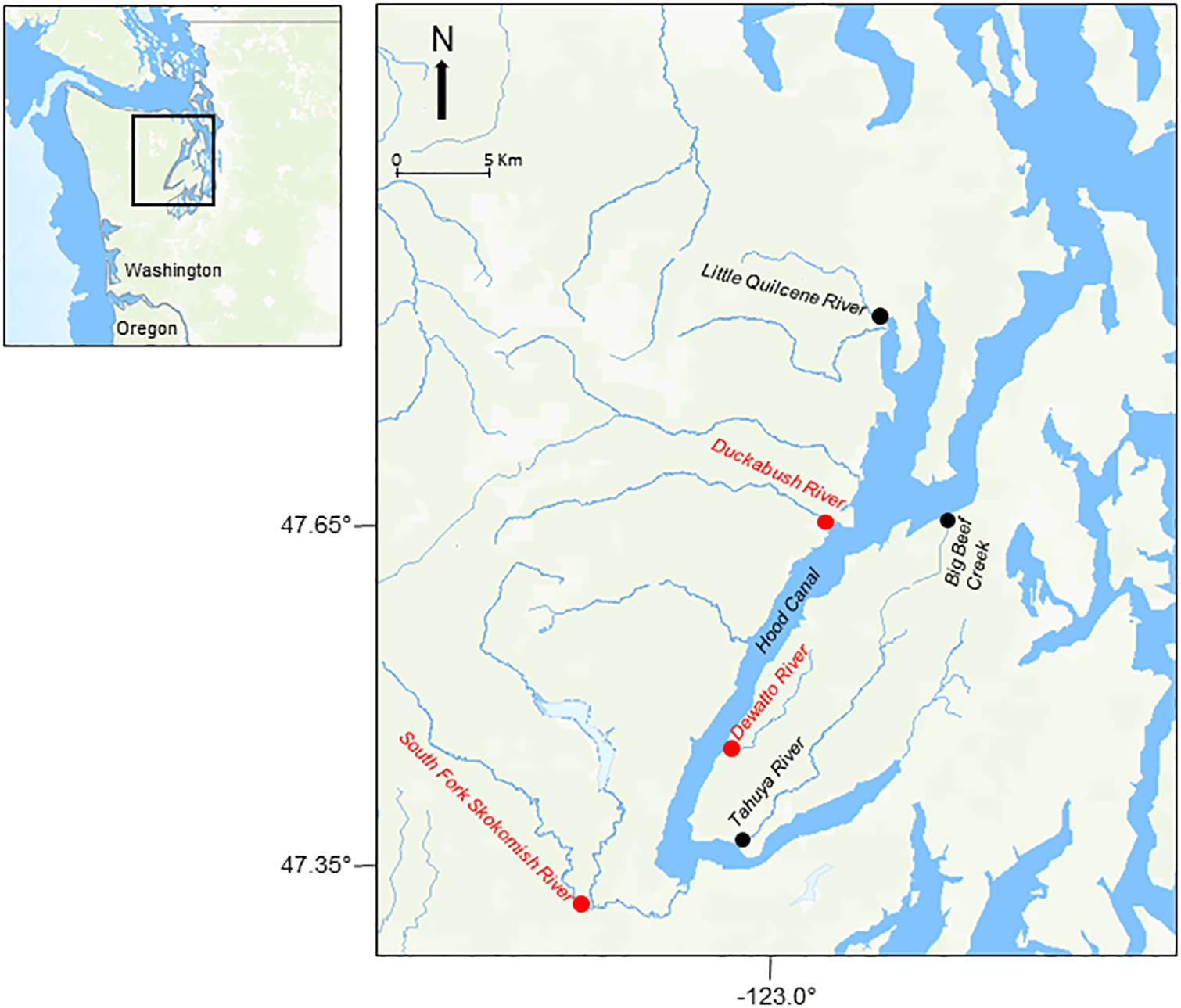
Declining salmonid populations often prompt the use of captive-reared fish to supplement wild stocks, but such programs risk negative genetic and ecological impacts. We evaluated six steelhead (Oncorhynchus mykiss) populations in the Hood Canal watershed, Puget Sound, Washington, including three supplemented and three unsupplemented control populations, over the span of 17 years to assess the effects of supplementation on several population genetics metrics. This program uniquely allowed natural spawning to occur before removing eyed eggs from redds for captive rearing, and later release as smolts or adults. Key genetic metrics—expected heterozygosity, allelic richness, and effective population size—remained stable from before to after supplementation in both the supplemented and non-supplemented populations. Parentage analyses confirmed successful reproduction by captively reared adults after they were released into the wild. These findings suggest that natural spawning prior to captive rearing, among other aspects of the program, lessened the genetic risks typically associated with artificial propagation such as loss of genetic diversity, or a reduction in effective population size. Our results highlight the potential for carefully designed supplementation programs to conserve genetic diversity and maintain effective population sizes in threatened steelhead populations.
Introduction
Supplementation programs, where captive-reared fish are introduced into wild populations to enhance natural production and increase abundance, have been widely implemented as a conservation strategy for declining salmonid populations. However, previous studies have highlighted several potential drawbacks of supplementation efforts, including genetic and ecological risks that may outweigh the intended benefits [1–7]. Understanding these risks is critical because the long-term success of supplementation programs depends not only on their ability to increase population sizes but also on their capacity to maintain the genetic health of these populations. Careful genetic monitoring is therefore essential to assess the effectiveness of these efforts and prevent unintended harm.
Press Release from Center for Food Safety and Wild Fish Conservancy
Pacific Seafoods’ so-called “sustainable” fish farming facilities in violation of Clean Water Act permits daily since at least 2020
Portland, OR – Today, Center for Food Safety (CFS) and Wild Fish Conservancy(WFC) filed a lawsuit against Pacific Seafood Aquaculture, LLC, for multiple violations of the Clean Water Act (CWA) at three commercial netpen aquaculture facilities on the Columbia River raising rainbow trout, often marketed as ‘steelhead.’ The filing, along with the prior 60-day notice of intent to sue, details how the company has repeatedly violated the terms of its National Pollutant Discharge Elimination System (NPDES) permit. The plaintiff nonprofits are represented by Kampmeier & Knutsen PLLC and CFS counsel.
In sharp contrast to the products’ marketing as sustainably raised, government records obtained through the Freedom of Information Act (FOIA) revealed that the Pacific Seafood facilities have actually been in continuous violation of their NPDES permit conditions since at least April 2020 when the permits were reissued. This includes both pollution discharge violations exceeding Environmental Protection Agency (EPA)-set limits, as well as monitoring and reporting violations. The unlawful pollution harms wild fish and the surrounding river ecosystem. The Columbia River is home to several endangered fish species protected under the Endangered Species Act.
“Despite ‘sustainable’ marketing claims and third-party certifications, government records tell a different story— one of chronic noncompliance and ecological harm,” said Emma Helverson, Executive Director of Wild Fish Conservancy. “In the face of the public’s sustained, long-term efforts to protect and restore the Columbia River and its ecosystems, Pacific Seafood has repeatedly violated the Clean Water Act, undermining public trust, degrading water quality, and threatening the survival of wild salmon and steelhead. Local communities and economies should not be left to shoulder the costs of cleanup and ecological damage while a billion-dollar corporation cuts corners on basic environmental protections.”
“These confined industrial fish farming operations have been unlawfully and egregiously polluting the Columbia River for years,” said George Kimbrell, CFS Legal Director. “Fish feed, fish waste, chemicals, pharmaceuticals, and other contaminants released by these facilities threaten water quality and native fish populations. We’re taking this action to ensure compliance with environmental laws designed to protect our waterways and the species that depend on them.”
Background
Industrial netpen aquaculture is known to cause adverse environmental and intertwined socioeconomic impacts, including pollution from drugs, chemicals, pesticides, fungicides, pharmaceuticals, and other inputs; nutrient pollution from uneaten fish food and fish waste; the spread and amplification of parasites, viruses, and disease from farmed fish to wild fish; overfishing of forage fisheries in order to make fish meal and oil to grow aquacultured fish; adverse ecological effects on surrounding marine wildlife from the facilities; harm to traditional and indigenous fishing cultures and communities; and harm to recreational and commercial fisheries. Chronic fish spills, caused by equipment failure, human error, or weather, are among the worst causes of harm. Escaped fish harm wild fish by competing for food and habitat, spreading viruses and disease, and inbreeding, thus reducing genetic diversity and resilience. In August 2017, a devastating netpen aquaculture collapse at a facility maintained by Cooke Aquaculture in Puget Sound released an estimated 250,000 non-native and viral-infected Atlantic salmon into Puget Sound. Washington has subsequently removed the industry and permanently banned netpen aquaculture in its state marine waters. Globally, more than 25 million aquacultured fish escaped between 1996 and 2012.
# # #
Center for Food Safety and Wild Fish Conservancy are represented by Kampmeier and Knutsen, PLLC of Seattle and Portland and counsel from Center for Food Safety
Just in from Alexandra Morton, the leading net pen researcher in the world. Now the science gets even clearer as follows:
Just published! In-depth review of the risk specific farm salmon pathogens causes BC salmon populations. It’s no coincidence the 1st generation of chum that went to sea after salmon farms were removed from the Discovery Islands are returning in larger numbers than we have seen in a long time. We explain why some DFO fish farm science cannot be relied on if you want wild salmon. Huge thanks to my incredible co-authors! This entire edition of Science Advances examines the real cost of salmon farming… https://www.science.org/toc/sciadv/10/42..
Our local representative from Taylor Shellfish has long trashed her in public and is always given a free podium at local Marine Resources Committee meetings to promote his opinions which have never been based in science, but what appears to many as simple character assassination (he has stated numerous times she is not a “real” scientist). The next time you buy shellfish, remember that Taylor Shellfish has been at the forefront of working to discredit her work. Because of the work of businesses attacking her like that, it took years longer to deal with the problems our salmon are facing.
Finally. Thanks to everyone all over the Sound that worked so hard to end this bad business.
The company behind a massive spill of Atlantic salmon in 2017 has thrown in the towel on its efforts to keep farming fish at two sites in Puget Sound.
Cooke Aquaculture withdrew its appeal Friday of a 2022 Washington Department of Natural Resources order to shut down its floating farms off Bainbridge Island, just west of Seattle, and Hope Island in Skagit County.
Drone images of cages shot by activist reveal open sores affecting ‘up to 1m fish’. Fish producers are now culling them for animal feed.
The ongoing nightmare of farmed salmon continues as Iceland now ends up in the same mess as Norway. And here on the Peninsula, the spokespeople for Taylor Shellfish continue to bad mouth anyone fighting against farmed salmon or other fish, as they have for over a decade. In the process they have cowed and bought off by donations many of the very organizations that are supposed to be protecting our shorelines. Just say no to farmed fish, and buy your seafood from someone than Taylor. Leave the hatcheries to the Tribes, who are working to restore the local gutted runs that were partially caused by sea lice as fish passed by net pens. The Tribes work is small scale compared to the globally owned corporate farms.
The Taylor spokespeople always argued in meetings that I attended that we “don’t see sea lice here” yet refused to support independent monitoring. That the salmon might head north along the routes that could bring them into contact with contaminated fish or encountering them in the open ocean, were never anything they agreed might happen.
“The lesions don’t get much worse than this,” said Bergsdóttir. The wounds were worsened by bacteria which make them deeper and bigger, she said. “What has surprised everyone here is how quickly it happened.”
The Peninsula Daily News mentions that the Kiwana’s of Port Angeles invited fishing guide, columnist and long time “salmon restoration industry” critic Pat Neal to speak at their recent meeting. We have long documented Neal’s rants against any and all efforts to restore the rivers he claims to love.
Neal blames virtually all parties, the Federal government, State government, and Local Governments for spending millions of dollars and having nothing (in his mind) to show for it. The article says that he ended by saying the Tribes should be running fish restoration, as if they haven’t been for decades. He clearly has been out of touch with what has been happening all around him.
Having done volunteer environmental work on the Peninsula for 20 years, along with producing films for the Jamestown S’Klallam and my film “Voices of the Strait” in 2010 for the Puget Sound Partnership, which was a documentary on the “old timers” that grew up fishing and hunting here, I can state that what Neal conveniently leaves out, is as important as what he says.
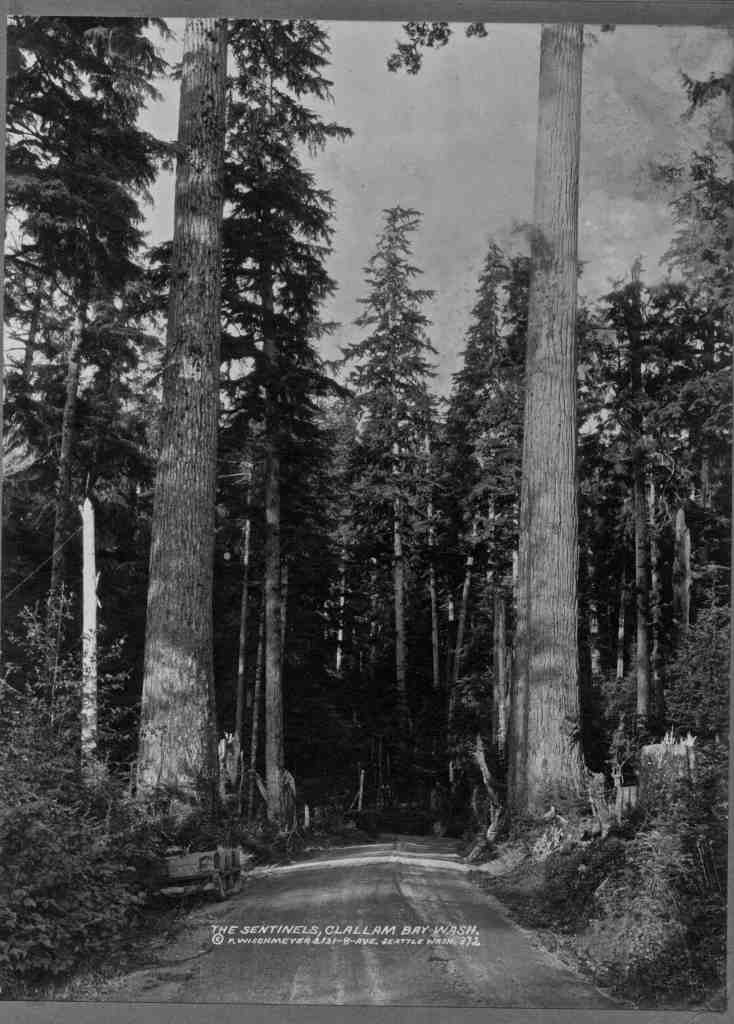
1930s roads in Clallam Bay
First off, Neal does not seem to understand that the efforts of restoration will take far longer and far more than the little we have already done. Why? Because we are dealing with 150 years of rampant exploitation of the Peninsula and it’s environment by a variety of people and companies operating with a worldview of “unlimited resources.” They were people of a very different time, legal framework and perspective.
Logging companies commercially cut over 95% of the old growth timber here. While doing that, they destroyed the 12,000 year old forest floors right down to the streambeds. A recovery from this destruction will take over another 100 years, if ever. This ecosystem was where the salmon (and numerous other unique species) thrived. They couldn’t and can’t live without it. There is no “blame” here, these people did not have a scientific understanding of how the ecosystem worked. They simply thought there was so much abundance, it could never end. The last “one log” truck went out on this peninsula as late as the early 1970s, while the Congress allowed raw logs to go out to Japan without using our sawmills. I watched as the ships were loaded with giant cedar and fir. Who profited from those decisions? Yet many still want to blame the Spotted Owl or the Boldt Decision for the end of the logging era and the almost simultaneous collapse of the salmon runs. The Spotted Owl fiasco was an outcome, not a cause. The Boldt Decision simply recognized that our neighbors indeed had “Treaty Rights” and they were going to be asked to help manage a fishery they had historically successfully managed for centuries.
One Log Truck c1960s. Photographer unknown.
Additionally, well meaning farmers gutted the rivers for irrigation, especially in the Sequim/Dungeness basin. One long time fisherman named Vince Cameron I interviewed for “Voices of the Strait”, told me that as a young boy, growing up on the Dungeness, he witnessed a tractor come into the river and cut a channel to create an irrigation ditch, during the middle of a salmon run, stranding thousands of fish as they moved upstream to spawn. He also discussed that channelizing the river, to end the flooding of the valley, created a high pressure hose effect, essentially scouring the banks where the salmon spawned.
Vince Cameron on the Dungeness River. Photo by Al Bergstein
The reversal of this entire mess has taken hundreds of millions of dollars, decades of the efforts of the Jamestown S’Klallam and the collaborative work of the Dungeness River Management Team, which included the Tribes, fishermen, hunters and farmers. It has been a successful effort. But it will likely take many more decades before we see significant numbers of salmon, especially the runs of Chinook. Neal would apparently rather sit on the sidelines and complain than take part in these efforts.
Another old timer told me that once the Hood Canal Floating Bridge came in, he noticed that the fishing in Hood Canal seemed to collapse. Since that comment to me, we have scientifically found out he was right, that the bridge is contributing to deaths of millions of fry on their way out to sea. Efforts to understand how we can keep the bridge and yet make it safe for salmon fry are ongoing.
Alexandra Morton in Canada scientifically proved that net pens were contributing to sea lice that were killing and weakening salmon as they passed by on their way to the sea. I witnessed the PR people employed by major aquaculture companies we all love here in Puget Sound, denounce her and her work over and over again. She was finally, after decades of work, successful in getting the Canadian Government to remove these farms. The runs this year, the first year that returns came back having not passed the farms, were spectacular. The people who denounced her have continued to be members of influential committees here on the Peninsula and continue to denounce efforts to reign in their ongoing takeover of our beaches.
We also have witnessed extensive construction of homes and businesses along the banks of salmon streams, destroying the natural habitat for a mixture of concrete and lawns. The reversal of that is taking decades as homes are bought out, removed and flood plains put back in place. Flood plains are the “lungs” of the river, and our destruction of them was incredibly bad news for salmon. Now we are on a path to restoration with best available science helping guide decisions being made by large groups of representatives from our cities, counties and environmental organizations.
I interviewed men who ran sports fishing boats out of Sekiu and other places. Herb Balch told me how he and other sports fishing fleet owners begged the Department of Fisheries to put limits on the salmon fishing during the 50s and 60s because they felt it was wasting the resource. He mentioned to me he would take out a boat of Boeing executives who would want to fish the “limit” and would come back with a boat of 30 to 50 fish. The customers might take one or two leaving him needing to gut and give away the rest. He could never find high school kids to be ready to do the work and in disgust, would dump the remaining fish over the side. This went on, day in and day out during fishing season.
Herb Balch, photo by Al Bergstein
Dick Goin, the late long time fisherman who was the spark for removing the Elwha dam, also documented the dramatic decline in salmon from the 1930s, when he arrived, to when he ended his fishing career. I have a copy of his legendary document, “Roll Call of the Lost” if anyone would like to see it.
Dick Goin photo by Al Bergstein
Ray Hunter, who grew up in Dungeness Bay, recalled the day that the boats came in and swept across the bay, dragging nets that destroyed the bottom and brought an end to many of the fisheries that he experienced growing up in the 40s and 50s.
Ray Hunter photo by Al Bergstein
Peter Becker told me of being on fishing boats in the late 70s with the latest fish finders and him and the crews wondering who would catch “the last salmon”.
Peter Becker photo by Al Bergstein
None of these men were environmental radical activists. They were simple fishermen, paper mill workers, truck drivers and businessmen that were appalled by the destruction they watched. They watched the ‘baseline’ as it’s called in science, move, and understood what was happening. From a baseline of virgin forests to a pillaged clear cut, from dozens of dead salmon floating away in the Strait, it was clear to them what was happening. Dick worked hard to reverse it, and the removal of the Elwha Dam and the return of the chinook and other fish to the upper reaches is now being seen. It’s not yet to a place where river guides can make a living, but we are headed that way. Unfortunately, it is not likely to be done in Pat Neal’s lifetime. It just isn’t that simple.
You can watch my film, “Voices of the Strait” on YouTube. Unfortunately, I was requested at the time to keep the running time short, and had to cut many interviews. I’m hoping to return to the film someday and make the running time long enough to include much of what was left “on the cutting room floor”.
You can watch my film, “Working for the River” about the Dungeness recovery efforts, on Vimeo.
The Seattle Times has an excellent story of the people employed in long line fishing (fishing with hooks not nets) here in Port Townsend, as they find themselves caught between the court battle between NOAA and the Wild Fish Conservancy (WFC). The WFC has sued to stop NOAA’s supposed “safe catch” limits for harvesting Chinook salmon. The numbers, as the story mentions, are depressing, with chinook down 60% over the last decades. NOAA continues to act as if almost nothing is wrong, and yet the WFC found significant flaws in their arguments, which one judge agreed with, and other judges did not. While the battle goes on in court, the folks who take chinook are usually small boat owners, as documented by the Times. I know some of these people and they are struggling to maintain the catch in an environmentally positive way, while supplying the restaurants you eat at with salmon. As the catch declines, it’s a lose-lose-lose for all of us.
While this story is behind the Times paywall, you might get a free article before being shut out. But I highly recommend you subscribe to the Times, even if the online version. Do I like their politics? Nope. But they are the last major news outlet actually sending dozens of reporters into the field for pay. That’s worth supporting.
PORT TOWNSEND — With her legs tucked to her chest in the wood-paneled wheelhouse of the F/V Nerka, steaming mug of coffee in hand, Tele Aadsen reminisced on the fishery that led her to meet her life and fishing partner, Joel, and helped her connect with the sea.
It has been an up-and-down year for Aadsen and other fishers who pilot their boats out of this port each June and head to the waters of Sitka, Alaska, to catch Chinook, or king salmon.
They’ve been embroiled in a court battle over the future of a fishery worth about $85 million a year, whose fleet trolls with hook and line instead of large nets, to catch salmon sold to restaurants and grocers all over the West and beyond.
June 23, 2023— In a shocking ruling against Endangered Species protection, a Ninth Circuit Court approved a request by NOAA Fisheries, the State of Alaska, and the Alaska Trollers Association that will allow commercial troll fishers in Southeast Alaska to continue over-harvesting depleted Chinook salmon, jeopardizing the recovery of both wild chinook and critically endangered Southern Resident killer whales.
The lower Court decision was set to close the fishery beginning on July 1st, in just ten days. Now, despite numerous environmental violations and ongoing harm found by a federal District Court, the stay will allow the fishery to continue operating while the Ninth Circuit considers the case on appeal.
“The economic, ecological, and cultural cost of losing Southern Resident orcas and wild Chinook is unfathomable. It is unfortunate that the Ninth Circuit determined the short-term economic interests of Southeast Alaska commercial harvesters should be prioritized over the long-term interests of all current and future generations of First Nations, Tribal Nations, and communities throughout the Pacific Northwest who depend on these iconic species,” said Emma Helverson, Executive Director of Wild Fish Conservancy. “We are incredibly disheartened by this decision to continue the fishery while California, Oregon, Washington and British Columbia are enacting closures or severe constraints on many of the same populations due to continuing Chinook declines. We strongly advocate for consumers to avoid purchasing Chinook caught in Southeast Alaska.”
In March, a federal District Court issued a final order in a lawsuit brought by Wild Fish Conservancy against NOAA Fisheries requiring the Southeast Alaska commercial troll fishery to remain closed in the summer and winter seasons until the federal government provided a new analysis and conducted environmental review demonstrating that the fishery’s harvest plan would not continue to jeopardize endangered Southern Resident killer whales or threatened Chinook salmon.
In their ruling on remedy, the District Court considered the economic disruption that closure of the fishery would pose to Alaskan commercial fishers, yet determined protecting species threatened or endangered with extinction is the greatest priority under the Endangered Species Act. Referencing existing case law, the Court’s report and recommendation stated: “The ESA . . . did not seek to strike a balance between competing interests but rather singled out the prevention of species [extinction] . . . as an overriding federal policy objective.”
Southern Resident killer whales were listed as Endangered in 2005. Currently, there are only 73 individuals in the population, an alarming decrease from nearly 100 only 25-years ago. Reduced prey availability, specifically large and abundant wild Chinook, has been identified by killer whale experts and NOAA as the primary cause of their decline. Research has shown an alarming 69% of Southern Resident killer whale pregnancies are aborted due to insufficient prey.
“It’s possible to find creative solutions to compensate and protect the economic interests of fishers in the interim while NOAA corrects their violations,” says Helverson. “On the other hand, it’s impossible to replace Southern Resident killer whales or wild Chinook once they are gone, extinction is forever.”
In NOAA’s 2019 biological opinion evaluating the fishery’s impact on threatened and endangered species, NOAA admitted that over the last decade and persisting today, Chinook harvest in Southeast Alaska’s troll fishery is occurring at levels that are unsustainable for the long-term survival and reproductive success of both threatened wild Chinook populations and endangered Southern Resident killer whales. Still, NOAA authorized the harvest to continue at these levels relying on proposed mitigation they claimed would offset this serious harm. In summary judgement in August, the District Court overwhelmingly found the mitigation was insufficient and seriously violated the ESA and that NOAA also evaded legally required environmental review.
While the fishery occurs in Southeast Alaska marine waters, the majority of Chinook harvested in the Alaskan troll fishery are not Alaskan Chinook. Up to 97% of all Chinook harvested in the fishery are born in rivers throughout British Columbia, Washington, and Oregon. Roughly half of the fish harvested originate from the Columbia River, and many come from populations listed as Threatened under the ESA. These Chinook are harvested in their ocean nursery habitats, preventing them from reaching maturity and returning back to their homewaters where the Southern Resident killer whales encounter them. The majority of stocks harvested in the fishery are identified as priority stocks for the malnourished and endangered whale population.
“While communities throughout the coast have closed fisheries and made significant economic sacrifices to protect threatened and endangered Chinook populations in their home rivers, these same depleted populations are being harvested far from home in Southeast Alaska where they are marketed and sold as sustainable Alaskan Chinook,” says Helverson. “While this case is about conservation, it’s also about equity and we will continue to advocate for the conservation burden of protecting and restoring these species to be more equally shared by all communities who depend on them.”
“We know yesterday’s decision is concerning to so many who have been following this case and working tirelessly to recover our beloved Southern Resident killer whales and wild Chinook populations. Despite this temporary setback, the appeal process is just beginning and we remain dedicated to advocating for the recovery of these iconic species through every avenue possible,” says Helverson.
From Wild Salmon Conservancy. A major ruling with far reaching impacts.
May 3, 2023— Yesterday, in an international, coastwide environmental victory, Seattle federal Court issued a landmark order halting the overharvest of Chinook salmon in Southeast Alaska that has persisted for decades, jeopardizing the survival of federally-protected Southern Resident killer whales (SRKW) and wild Chinook populations coastwide. This significant decision will immediately allow the starving Southern Resident population far greater access to these Chinook which are the whale’s primary prey, marking a turning point for their recovery.
“This Court decision is the largest victory for Southern Resident killer whale recovery in decades and will be celebrated internationally. After years of inaction by our federal government to address the prey crisis facing the Southern Residents, Judge Jones’ decision will finally provide starving orcas immediate access to their primary prey,” says Emma Helverson, Executive Director of Wild Fish Conservancy. “What’s more, by allowing far more wild Chinook to return home to their spawning grounds, this action is also helping to recover and restore wild Chinook from rivers throughout Oregon, Washington, and British Columbia, essential to rebuilding both populations in the long-term.”
On Tuesday, U.S. District Judge Richard A. Jones issued a final ruling in Wild Fish Conservancy’s lawsuit agreeing that halting the summer and winter seasons of the Southeast Alaska Chinook troll fishery is the most appropriate remedy. The Court subsequently remanded NOAA Fisheries’ inadequate biological opinion in order for the agency to address the serious underlying violations of environmental law previously found by the Court.
In that biological opinion evaluating the fishery’s impact on threatened and endangered species, NOAA admitted that over the last decade and persisting today, Chinook harvest is occurring at levels that are unsustainable for the long-term survival and reproductive success of both threatened wild Chinook populations and endangered Southern Resident killer whales. Still, NOAA authorized the harvest to continue at these levels relying on proposed mitigation they claimed would offset this serious harm. In summary judgement in August, the Court overwhelmingly found the mitigation was insufficient and violated the Endangered Species Act (ESA) and that NOAA failed to conduct legally required environmental review of the mitigation, which would include opportunities for public input and an evaluation of alternatives, such as reductions in harvest.
Southern Resident killer whales were listed as Endangered in 2005. Currently, there are only 73 individuals in the population, an alarming decrease from nearly 100 only 25-years ago. Reduced prey availability, specifically large and abundant wild Chinook, has been identified by killer whale experts and NOAA as the primary cause of their decline. Research has shown an alarming 69% of Southern Resident killer whale pregnancies are aborted due to insufficient Chinook salmon and inbreeding depression has been identified as a growing threat to the population’s survival and recovery.
“This is unbelievable news, yet so long in coming,” said Wild Orca’s Science and Research Director, Dr. Deborah Giles. “The high pregnancy failure rate within the Southern Resident killer whale population is linked to poor nutrition, so having more fish returning to their home waters in British Columbia, Washington, and Oregon, will increase the whales’ prey base and improve their chances of giving birth to healthy calves.”
In an expert declaration evaluating the effect of the troll fishery’s harvest on the Southern Resident population, modeling by Dr. Robert E. Lacy projected closing the fishery would increase prey availability by approximately 6%, which would be enough to stabilize the population and stop their decline toward extinction, though additional actions would be required to begin to grow the population. The Court stated: “Though there is uncertainty as to how much prey would ultimately reach the SRKW, the record before the Court suggests that closure of the fisheries meaningfully improves prey available to the SRKW, as well as SRKW population stability and growth, under any scenario.” As a result of yesterday’s decision, approximately 172,000 Chinook that would have been harvested or indirectly killed in the 2023 summer and winter seasons of the Southeast Alaska troll fishery will now be able to continue their historical migration south to home spawning grounds and into the whale’s key foraging areas.
“Dr. Lacy’s findings suggest that the single action of closing this fishery would increase prey availability enough to stabilize the Southern Resident population. Stopping the precipitous decline of the whales toward extinction is the highest priority toward recovery efforts. These findings clearly demonstrate that Chinook harvest in Southeast Alaska’s troll fishery is contributing to the decline of the whales, validating why the Court’s decision is so critically important to the survival of this population,” says Helverson.
While the fishery occurs in Southeast Alaska marine waters, most people are unaware that up to 97% of all Chinook harvested in the Southeast Alaska troll fishery migrate from rivers throughout British Columbia, Washington, and Oregon. Roughly half of the fish harvested originate from the Columbia River, and many come from populations listed as Threatened under the ESA. Currently, these Chinook are harvested in their ocean rearing habitats preventing them from migrating back into southern waters where the Southern Resident killer whales encounter them. Majority of stocks harvested in the fishery are identified as priority stocks for the Southern Residents.
“Alaskan fishers should not be blamed for NOAA’s chronic mismanagement of this fishery, and we are sincerely sympathetic to the burden this decision will pose to Southeast Alaskan communities,” says Helverson. “However, this decision will finally address decades of harm and lost opportunity this overharvest has caused to fishing communities throughout British Columbia, Oregon, and Washington who depend on these fish, particularly Tribal and First Nations. In addition to the unparalleled benefits to killer whale and Chinook recovery, the Court’s decision is addressing this historic inequity and restoring control to coastal communities of the destiny of salmon recovery in their home watersheds.”
“The underlying harvest issues in this case are not an anomaly, but rather just one example that demonstrates the problems caused when harvest occurs in the ocean where it is impossible to avoid unintentionally harming threatened and endangered populations or intercepting high proportions of salmon from rivers coastwide,” says Kurt Beardslee, Director of Special Projects. “Scientists are increasingly calling for harvest reform measures that shift harvest out of the ocean and into fisheries in or near each river of origin where salmon return, providing fisheries managers and coastal communities the ability to manage recovery with far greater accuracy and success.”
This is a progressive step by the Department of Natural Resources to explore the implementation of land based aquaculture. It’s been my impression following this over the years that Sustainable Blue and others like it have not yet become profitable in this industry, but I may be not informed on recent financials. They are a small company in Nova Scotia and their website does not appear to have been updated in over a year. They sell their sustainably raised salmon online and apparently in outlets in Nova Scotia and New Brunswick. It’s unclear of whether they have garnered support from the regional restaurant industry, as Chef Tom Douglas of Seattle has been deeply involved is supporting the Alaska salmon market. We can hope this partnership can lead to something that benefits tribes like the JamesTown S’Klallam, who are already in partnership with others on raising black cod in the area.
Note that this only is an exploration of land-based sites. There is no mention of costs to be incurred by the State or Sustainable Blue. No mention of the amount of staff to be assigned. Does Commissioner Franz expect that there will be a variety of sites selected and that then, what? Will the state build the facilities or signal it’s intent to support industry to build on these sites? If these fish are significantly more expensive, how will this succeed in the market? It is worth noting that the JamesTown have announced a lawsuit against DNR for the end of leasing fish farms in the state, this could be seen as simply a tactic in the lawsuit.
Commissioner of Public Lands Hilary Franz signed today a partnership agreement with Nova Scotia-based Sustainable Blue, a zero discharge, land-based salmon farming company, to identify opportunities for siting sustainable finfish aquaculture in Washington State.
“I’m excited to bring this partnership to Washington,” said Commissioner Franz. “This agreement represents an important step toward restoring finfish aquaculture in a sustainable, healthy way that does not pit farmed fish against the native salmon we all work so hard to sustain.”
The letter of intent launches an exploration of land-based sites managed by the Washington State Department of Natural Resources (DNR) that would be suitable for closed-containment aquaculture on state-owned lands. DNR manages 2.6 million acres of state-owned aquatic lands on behalf of the people of Washington, along with 2.1 million acres of upland public lands.
The 2017 collapse of finfish aquaculture net pens off Cypress Island made clear the dangers that open water commercial finfish aquaculture facilities pose to native salmon and their habitat. Citing this event and other operational and maintenance issues that have been documented from the four open water net pen aquaculture facilities in Washington’s waters, Commissioner Franz last year announced such commercial facilities would no longer be leased on state-owned aquatic lands.
Sustainable Blue is the longest-running commercial zero-discharge Recirculating Aquaculture System (zRASTM) in North America. The Sustainable Blue zRAS recirculates 100% of its salt water, creates zero discharge to local waterways and communities, eliminates any potential for escapes, and offers a value-added proven model for aquaculture.
“This is a different path forward, and we’re thrilled to have the State of Washington on board to chart this new path in the United States,” says Kirk Havercroft, CEO of Sustainable Blue. “What we know is that all RAS systems are not created equal; Sustainable Blue offers a proven, long-running, zero discharge system that provides food security and economic stimulation, as well as consistency in product and market supply.”
With this letter of intent, Commissioner Franz and DNR signal their continued commitment to sustainable, market-based solutions that benefit the citizens of Washington while protecting the state’s natural capital. The agreement also represents the first step in a long-term partnership to explore multiple facility locations that are not reliant on marine or watershed environments.
Commissioner Franz plans to begin site exploration later this spring. “We know finfish aquaculture can be a great source of food and employment. But we have to balance those benefits with protecting our significant investments in restoring salmon and their habitat,” said Commissioner Franz. “I’m excited by this opportunity to do both.”
###
About Sustainable Blue
Founded in 2007 in Nova Scotia, Canada, Sustainable Blue is the longest-running commercial zero-discharge Recirculating Aquaculture System (zRAS) in North America. Through nearly 30 years of extensive research and development, Sustainable Blue has eliminated the need that is typical in a traditional RAS to discharge wastewater back into the ocean, making it the only land-based saltwater aquaculture facility in the world to do so. Waste solids are instead separated and used to generate electricity (with additional use cases currently being researched and developed). The wastewater is cleaned and returned back to the facility, all resulting in zero discharge back into the environment. The company’s proprietary aquaculture model was created by Dr. Jeremy Lee and is designed to mirror nature’s complex ecosystem found in oceans and waterways, but on land, protecting wild salmon populations from both disease and overfishing. Because Sustainable Blue’s system is fully self-contained, the salmon are free of sea lice and other fish diseases, meaning they require no antibiotics. Led by CEO Kirk Havercroft and Chief Sustainability Officer David Roberts, Sustainable Blue has been raising and processing salmon at its Nova Scotia headquarters for the past 15 years, supplying to the region’s restaurants, fishmongers and retailers.
Yesterday, The federal court in Seattle issued a landmark decision. The outcome of this is still to be determined. But it likely means an end to Chinook harvest in Alaska. NOAA has been losing in court due to their lack of rigorous science behind their decisions. This lawsuit was brought by the Wild Fish Conservancy, one of the most effective environmental organizations in the Pacific Northwest. If you want to support their work, it’s a good time to donate.
More to come on this.
December 16, 2022— In a massive international and coast-wide decision for wild Chinook and Southern Resident killer whale recovery, Seattle’s federal Court issued a landmark opinion on Tuesday that recommends terminating unsustainable commercial salmon harvest that has persisted for decades until new environmental reviews of those fisheries occur. Overfishing was found in a previous ruling to illegally harm the recovery of both endangered Southern Resident killer whales and wild Chinook salmon across the Pacific Northwest.
On Tuesday, U.S. Magistrate Judge Michelle Peterson issued a report and recommendation on Wild Fish Conservancy’s lawsuit, agreeing that halting the summer and winter seasons of the Southeast Alaska Chinook troll fishery is the most appropriate remedy. Simultaneously, the judge found the federal government’s inadequate biological opinion should be remanded back to NOAA in order for the agency to address violations of environmental law.
In August, U.S. District Court Judge Richard A. Jones issued a stunning summary judgment based on a previous report and recommendation by Magistrate Peterson confirming that NOAA violated the law by improperly relying on undeveloped and uncertain future mitigation to offset ongoing overfishing authorized by NOAA.
In their most recent analysis of this fishery’s impact on threatened and endangered species, NOAA admits that over the last decade and continuing today, Chinook harvest is occurring at levels that are unsustainable for the long-term survival and reproductive success of both threatened wild Chinook populations and endangered Southern Resident killer whales. The overharvest of the whales’ prey has been ongoing for decades.
“The benefits to wild Chinook and Southern Resident killer whale recovery from the Court’s action cannot be overstated,” says Emma Helverson, Executive Director of Wild Fish Conservancy. “If adopted by the District Judge, this recommendation will result in the first scientifically-proven recovery action in the Pacific Northwest to immediately provide Chinook for starving killer whales. The decision will also recover and restore the larger and more diverse life histories of wild Chinook these whales evolved to eat, which are fundamental for rebuilding both populations.”
While these Chinook are harvested in Southeast Alaska marine waters and currently certified by major U.S. seafood certifiers as ‘sustainable wild caught Alaskan Chinook’, approximately 97% of all Chinook harvested in the Southeast Alaska troll fishery actually originate from rivers throughout British Columbia, Washington, and Oregon. Currently, these Chinook are harvested prematurely, before they can migrate back into southern waters where the Southern Resident killer whales encounter them. In 2021, the fishery of concern harvested approximately 150,000 Chinook, many of which were listed as threatened under the Endangered Species Act.
For the first time in decades, Magistrate Peterson’s recommendation to terminate this fishery would finally allow these Chinook to migrate back down the coast and pass through the Southern Resident killer whales’ key foraging areas. Similarly, this action would support the coastwide recovery of wild Chinook stocks by allowing far more wild Chinook to return and spawn in rivers in B.C., Washington, and Oregon.
“I want to emphasize that Alaskan fishers are not to blame for NOAA’s chronic mismanagement of this fishery, and we are sympathetic to the burden this decision may pose on Southeast Alaskan communities,” says Emma Helverson, Executive Director of Wild Fish Conservancy. “However, it’s critical to also acknowledge that for decades this fishery has harvested majority non-Alaskan Chinook at unsustainable levels with cascading and coastwide consequences for fishing communities throughout British Columbia, Oregon, and Washington. In addition to the unparalleled benefits to killer whale and Chinook recovery, the Court’s decision will restore more control to communities over the recovery of their local Chinook salmon populations, particularly tribal people and First Nations.”
Southern Resident killer whales were listed as Endangered in 2005. Currently, there are only 73 individuals in the population, an alarming decrease from nearly 100 only 25-years ago. Reduced prey availability, specifically large and abundant Chinook, has been identified by killer whale experts and NOAA as the primary cause of their decline.
“With less fishing in Alaskan waters, more Chinook can return to spawn in their home rivers in British Columbia, Washington, and Oregon,” said Dr. Deborah Giles, Science and Research Director at Wild Orca. “An increase in larger, mature fish is essential—not just for the whales— but for the survival of these imperiled Chinook populations, whose future also hangs in the balance. A recovery for Chinook benefits all fishers, whales, and humans alike.”
“Despite the clear evidence, for too long government agencies, certifiers, and the media have been unwilling to acknowledge and address the unsustainable salmon harvest management in this fishery and others that is harming the recovery of the Southern Resident killer whales and the wild Chinook they depend on,” says Helverson. “The Court’s finding is playing an important role in bringing science and policy closer together for the benefit of wild salmon, killer whales, and coastal communities.”
In the coming months, the Magistrate Judge’s report and recommendation and any objections from the defendants will be considered by the District Judge presiding over the case for a final ruling.
###
An executive order from a Washington state agency earlier this month aims to end commercial net pen fish farming in public waters. Cooke Aquaculture is being forced to shut down its operations, but it has a key partner in its fight to remain. The Jamestown S’Klallam Tribe is forging ahead with its net pen aquaculture plans, testing a carve-out clause in the order.
— Read on www.knkx.org/environment/2022-12-01/washington-tribe-tests-its-rights-to-commercial-net-pen-fish-farming
More dams are slated for removal to save what’s left of the historic salmon runs. Decommissioning could mean that the method that they use could allow the dams to be reinstated if the runs go extinct. It can mean clearing around the dams to allow the river to free flow but leave the dams standing. As the story tells, this was driven by the local Tribes (with help from environmental organizations), who’s treaties the Federal Government ignored for over a century. For those of us who have seen this remarkably beautiful river, it is a joy to think it will be freed again. Now to continue the move to solar power, wind power and wave power to replace the dam’s energy output. That part of the coast has lots of sunshine and of course, wave action galore.
U.S. regulators approved a plan on Thursday to demolish four dams on a California river and open up hundreds of miles of salmon habitat that would be the largest dam removal and river restoration project in the world when it goes forward. The Federal Energy Regulatory Commission’s unanimous vote on the lower Klamath River dams is the last major regulatory hurdle and the biggest milestone for a $500 million demolition proposal championed by Native American tribes and environmentalists for years. The project would free hundreds of miles of the river, which flows from Southern Oregon into Northern California. Gillian Flaccus reports. (AssociatedPress)
While many are glad to see this long-awaited decision, it is by no means the end of Cook Aquaculture and its efforts to farm fish here. But if they indeed do remove the Rich Passage net pen, it could be good news for the remaining salmon that run through Orchard Rocks off southern Bainbridge Island. Why? Because it has never been fully investigated as to whether this net pen was partially responsible for the collapse of the salmon run through the passage and Agate Pass. Given recent news that the Hood Canal Floating Bridge may be a significant cause of salmon collapse in Hood Canal, and the hunch by some old fishermen that stocks collapsed after the net pen in Rich Passage went in, anything is possible. Obviously, shoreline development in the area at that time also had a good deal to do with the salmon loss.
A reminder to all that Cooke still has a business agreement with the Jamestown S’Klallam Tribe and the two are rearing Black Cod (Sablefish) in Port Angeles harbor. My guess is that Cooke will look for additional opportunities like this and will approach other tribes if they haven’t already. Still to come, is understanding how the recent unanimous Supreme Court ruling may affect this decision. Will Cooke and allies sue in court, based on their previous win? I don’t think this is as over as it seems, but for now, it’s a good decision, long overdue.
Official Press Release:
The Washington State Department of Natural Resources (DNR) has ended the remaining two finfish net pen aquaculture leases on Washington’s state-owned aquatic lands.
DNR officials informed Cooke Aquaculture Monday that the agency will not renew expired leases for the two remaining finfish net pen aquaculture facilities in Washington; in Rich Passage off Bainbridge Island and off Hope Island in Skagit Bay.
“Since the catastrophic Cypress Island net pen collapse in 2017, I have stood tall to defend the waters of Puget Sound,” said Commissioner of Public Lands Hilary Franz. “This effort began by terminating finfish net pen operations due to lease violations. Despite years of litigation – and a company that has fought us every step of the way – we are now able to deny lease renewals for the remaining net pen sites. Today, we are returning our waters to wild fish and natural habitat. Today, we are freeing Puget Sound of enclosed cages.”
“This is a critical step to support our waters, fishermen, tribes, and the native salmon that we are so ferociously fighting to save,” said Commissioner Franz.
DNR’s denial of Cooke Aquaculture’s request to re-lease the sites to continue finfish net pen aquaculture gives the company until December 14 to finish operations and begin removing its facilities and repairing any environmental damage.
The Hope Island lease expired in March and has been in month-to-month holdover status since. The Rich Passage lease expired in November.
Decision Draws Support
Salish tribes and conservation groups hailed the decision as a step toward protecting the habitat of struggling stocks of native salmon.
“We are very pleased that Commissioner Franz rejected Cooke Aquaculture’s lease application. Removal of the existing net pen will restore full access to the Tribe’s culturally important fishing area in northern Skagit Bay. Swinomish are the People of the Salmon, and fishing has been our way of life since time immemorial. Cooke’s net pens have interfered with the exercise of our treaty rights for far too long. We look forward to the day when the Hope Island net pen facility will be a distant memory,” said Swinomish Indian Tribal Community Chairman Steve Edwards.
“This decision is a joyous and historic victory for the recovery of wild fish, orcas, and the health of Puget Sound,” says Emma Helverson, Executive Director of Wild Fish Conservancy. “For years, the public has overwhelmingly called for an end to this dangerous industry in our public waters. Commissioner Franz’s response proves she is both accountable to the public and dedicated to protecting Puget Sound’s irreplaceable public heritage for current and future generations.”
“We say, ‘the table is set when the tide goes out.’ Seafoods have always been a staple of Samish diet and traditions,” said Tom Wooten, Samish Indian Nation Chairman. “By removing the Sound’s remaining net pens, our delicate ecosystem now gets a chance to replenish, repair and heal. We are grateful and lift our hands to the DNR’s partnership in helping protect the Salish Sea that tie us to our history and culture.”
Denials End Saga Started by 2017 Collapse
Cooke Aquaculture had previously leased four sites for net pen aquaculture from the Department of Natural Resources, recently growing steelhead trout in the net pens after years of using them to grow Atlantic salmon.
DNR’s letters denying an extension of Cooke’s leases lists several areas where the firm violated terms of the leases. DNR determined that allowing Cooke to continue operations posed risks of environmental harm to state-owned aquatic lands resulting from lack of adherence to lease provisions and increased costs to DNR associated with contract compliance, monitoring, and enforcement.
In August of 2017, a net pen at Cooke’s Cypress Island fish farm collapsed, releasing hundreds of thousands of Atlantic salmon into Puget Sound. As a result, DNR terminated that lease. Cooke was fined $332,000 and found negligent by the state Department of Ecology. The net pens were removed in 2018.
In December of 2017, DNR terminated Cooke’s Port Angeles lease due to Cooke operating in an unauthorized area and failing to maintain the facility in a safe condition. Cooke challenged that termination in the superior court and that litigation is still pending.
The Washington state Legislature in 2018 phased out Atlantic salmon farming, and the company since shifted operations at its remaining leaseholds in Rich Passage and Hope Island to grow sterile steelhead trout.
Future Net Pen Policy will be Announced Friday
Following the denials of these lease renewals, Commissioner Franz is reviewing policies for net pen salmon aquaculture throughout Washington’s state-owned aquatic lands, and will announce this decision at a press conference alongside partners and tribes at 11 a.m. Friday, November 18, on Bainbridge Island.
King salmon that you might have eaten recently apparently might not be available much longer. I know when I saw them in the fish-market two weeks ago I wondered if whether it had been legal to catch it. I assume it had as our fish market is very good at making sure that the only buy a sustainably caught fish .But here’s the background on it.
Those sustainably harvested Chinook salmon seemingly legally caught by trollers off Southeast Alaska aren’t “sustainably harvested.” So ruled U.S. District Judge Richard A. Jones, adding that the plan that has allowed them to be harvested there violates the federal Endangered Species and National Environmental Policy acts. On August 10, the federal judge granted Duvall-based Wild Fish Conservancy (WFC) summary judgment against the National Marine Fisheries Service (NMFS), its parent Department of Commerce, various officials of both agencies, and the Alaska Trollers Association and the State of Alaska, which had intervened. Dan Chasen writes.
A new film, titled “The Lost Salmon,” opens with a video montage that takes us through some wondrous scenes: A wide aerial shot of California’s majestic Salmon River, moving to an underwater view of salmon swimming through the clear water and then to an action spectacle of wild salmon practically flying through the air to surmount a rushing cascades. Christopher Dunagan reports. (Puget Sound Institute)
Filed under: Endangered Species, Salmon | Comments Off on New film about spring Chinook delves into history, culture and science in unique habitats – PSI
Excellent series by long time Northwest journalist Christopher Dunagan
Following dam removal, migratory salmon have been free to swim into the upper Elwha River for the first time in 100 years. Their actual behaviors and reproductive success may well be driven by changes in their genetic makeup. Our seven-part series ‘Returning home’ examines how the fish are doing and whether the Elwha’s genetic legacy remains intact.
Good news from the work done by North Olympic Salmon Coalition (NOSC) and the State.
Only six juvenile salmon were found during seining in the five years before the bridge opened. During this year’s seining, over two days in May, volunteers netted close to 1,000 juvenile salmon
Hakai Magazine has published an excellent overview of the issue of hatchery salmon. Author Jude Isabella has dove deep into the history of hatcheries in the Pacific Northwest. This is part of a larger project called The Paradox of Salmon Hatcheries. The work is also available in audio format. I highly recommend this to anyone that thinks they know that hatcheries are a “good thing” The history just doesn’t support it.
From their beginnings in the late 19th century, salmon hatcheries have gone from cure to band-aid to crutch. Now, we can’t live without manufactured fish.
The following letter (edited to 250 words) was sent to the PDN this morning.
It was dismaying to see the PDN give column space today to the opinions of Pat Neal and his alternative universe of salmon restoration. If I read it right, he offers nothing but criticism of what he calls “The Salmon Restoration Industry” and no actual concrete proposals other than “build and fund more hatcheries” as if this will somehow fix the slow extinction of salmon in our region. It’s so easy to ignore the decades of science, funding and citizen involvement that has brought us to this point of restoration, as well as ignoring the habitat destruction that all of us contributed to over the last 100 years. I guess it’s easy to stand on the river and pretend hatcheries will fix everything.
Virtually all scientists agree on an “All H” method of salmon restoration. This means addressing Habitat, Hydro (dams, rivers, lakes),Hatcheries and Harvest. Increase and restore habitat. Monitor and manage river flows, well densities, fix hydropower issues, or perhaps tear down dams. Increase hatchery size and type. And manage harvest to save runs. The current “salmon restoration industry” as Neal so derisively puts it, has been established *because* of the need to address all four of these issues. If it’s failing, maybe it’s from something other than ongoing support. Like needing even more funding which is substantial but nowhere near enough. Perhaps more enforcement of the regulations on the books. Well, the list of what could be done goes on and on. Easy to pick your favorite solution and say “if only”.
Hatcheries have been given far more importance in budgets over the last 10 years, including large increases proposed by the Governor in his 2019 and 2021 budgets at the behest of sports fishermen and tribes (2020/21 had cuts to everything due to the Pandemic). This despite mounting scientific evidence that hatcheries produce fish that compete for food with wild stock and reduce genetic diversity. Salmon for fishermen and not for whales or the ecosystem at large. Neal uses hatchery numbers from 1961 to supposedly show that these hatchery fish were the reasons we had such a huge amount of salmon in our waters. Given the survival rate of hatchery fish it seems absurd to draw a conclusion like that. It ignores that we had dramatically fewer people, a climate under some semblance of stability, and had yet to finish destroying virtually all old growth forests between here and Juneau. But the signs of impending doom were clear to those that wanted to look.
Neal’s use of the Dungeness River as an example is perfect. It is a perfect example of not understanding history. For my 2010 movie “Voices of the Strait” I interviewed fishermen who were on the Dungeness in the 40s, 50s and 60s and their stories all were the same: they understood but had no way to stop the unrestrained destruction of habitat that they witnessed, including the cutting of irrigation channels into the Dungeness during peak salmon return seasons, leaving millions of fish to die without spawning. They had no environmental vocabulary to describe it,as we do now. They just all said, “what a waste”.The diking of the Dungeness only helped to kill the river by accelerating the river flow and wiping out locations where the fish spawned. It was done for the benefit of farmers and homeowners, not salmon. The late Port Angeles angler Dick Goin actually documented the losses in his unpublished “Roll Call of the Lost” counts of the loss of fish on all our rivers. I have a copy if anyone is interested. He saw it in real time. The hatcheries Neal describes were created to *fix* that problem, and yet the science shows it’s not nearly enough and they are failing to produce significant results. For instance, we now know by scat analysis what Orcas actually eat and it’s not hatchery salmon but fish from the Fraser and Columbia.
Additionally, charter fishermen who I interviewed described to me in vivid detail that there were no limits on sports fishing up until the 1960s, despite their pleas to Fish & Wildlife to not waste the fish. The sports fishermen from Seattle would come out, catch 30 to 40 fish in a day and leave with a few in their coolers. The charter fishermen couldn’t hire enough kids to clean the fish so they would just throw them back in the Strait when the guys from the east side of the Sound left. They knew this was wrong but had no power to stop it and no storage for the fish. Limits on salmon were finally put in, too little too late. Now we are at place where shutting down the season appears as the only way to protect the runs from complete destruction.
Habitat restoration has been funded due to the efforts of the Tribes, the Counties, the Cities, the State, the Feds, sports and commercial fishermen and hundreds of other people who have *volunteered* their time to work on this. They sit in interminably long, boring meetings trying to come to consensus. They debate long lists of priorities. There is not the money for all of the priorities. The results of their work may take decades to show up in any significant numbers. It is like a giant puzzle with the pieces fitting together and finally, near the end, painting a bigger picture.
Pat ignores the history of international fishing fleets with gear so good they could laugh about who would catch the last fish, as one old timer who fished with them told me. Pat ignores our own logging for raw logs right here on the Peninsula to ship to Japan in the 70s & 80s, wiping out entire ecosystems of salmon runs for the quick profit of the few. He ignores that we clearcut over 90% of old growth forests until the Feds put an end to it due to documented losses of species, like salmon and birds. He ignores the enormous build out of suburbs & exurbs around Puget Sound most with little or no efforts back then to protect fish. I watched that happen myself, seeing subdivisions on the East side of Lake Washington build right down to the banks of streams and small lakes. Or ignoring 100 years of culverts put into roads for our benefit that cut off salmon from returning to spawn. And the armoring of shorelines around Puget Sound that is still going on. And of course ignoring a warming climate that could make all these efforts go for naught. All of it nibbling away at the habitat and the fish until there wasn’t enough left. And of course, there was the Boldt Decision, used for propaganda purposes to demonize the very people who have done the most to attempt the restoration. Love them or hate them, they haven’t sat idly by while the fish vanish. They are at the table, working to save them using the best available science today.
Will the efforts to restore runs succeed? We don’t know yet, but some runs on the Elwha are returning, just not yet the chinook in any numbers. As are some runs on Jimmy Come Lately Creek and others. It costs a lot of time, people and money to fix 100 years of destruction.
No one I’ve talked to or read in the last 20 years who is seriously working on this issue, other than Pat Neal, thinks simply making more hatchery fish is some kind of solution. Pat, you have a lot of passion, how about working to help solve the problems rather than ignore the scientists and anglers who have been in the trenches fighting to reverse this ? Your passion might be useful if you are willing to listen and learn.
The focal point for environmental news & perspective on the news. Our goal is to help educate and connect the public on the Peninsula. We are not a non-profit so donations are not tax deductible. Maybe someday with your help!
HOTLINES FOR REPORTING SPILLS
WA State Emergency Management Division: 1-800-258-5990
National Response Center: 1-800-424-8802
Pacific States & British Columbia: 1-800-OILS-911 (1-800-645-7911)
Local Events
Add your local event here. Contact us to include your next event.
—————————————————
TSUNAMI DEBRIS HOTLINE:
1-855-WACOAST (1-855-922-6278)
—————————————————
Event Date:
NATURE NOW
A Program About the Natural World.
KPTZ.ORG 91.9
WEDNESDAYS AT 12:05
REPEATS: SATURDAYS 12:30 AND WEDNESDAYS
PODCASTS AT KPTZ.ORG