New research on wild vs hatchery steelhead

A new study has just come out that helps better understand how to rear hatchery steelhead salmon without impacting genetic diversity, which has been a key concern of wild salmon advocates for years. The findings show that if wild salmon are allowed to spawn naturally, and then the eggs are collected for rearing in a hatchery, that the genetic risks were lessened. This is good news for both sides of the debate, as it shows that hatchery rearing of wild collected eggs may not be a threat to genetic diversity, or at least that’s the way I read it. The authors do state that “…While the longer-term genetic effects were not assessed in this study, other programs have realized reduced genetic diversity during similar timeframes.”


ABSTRACT

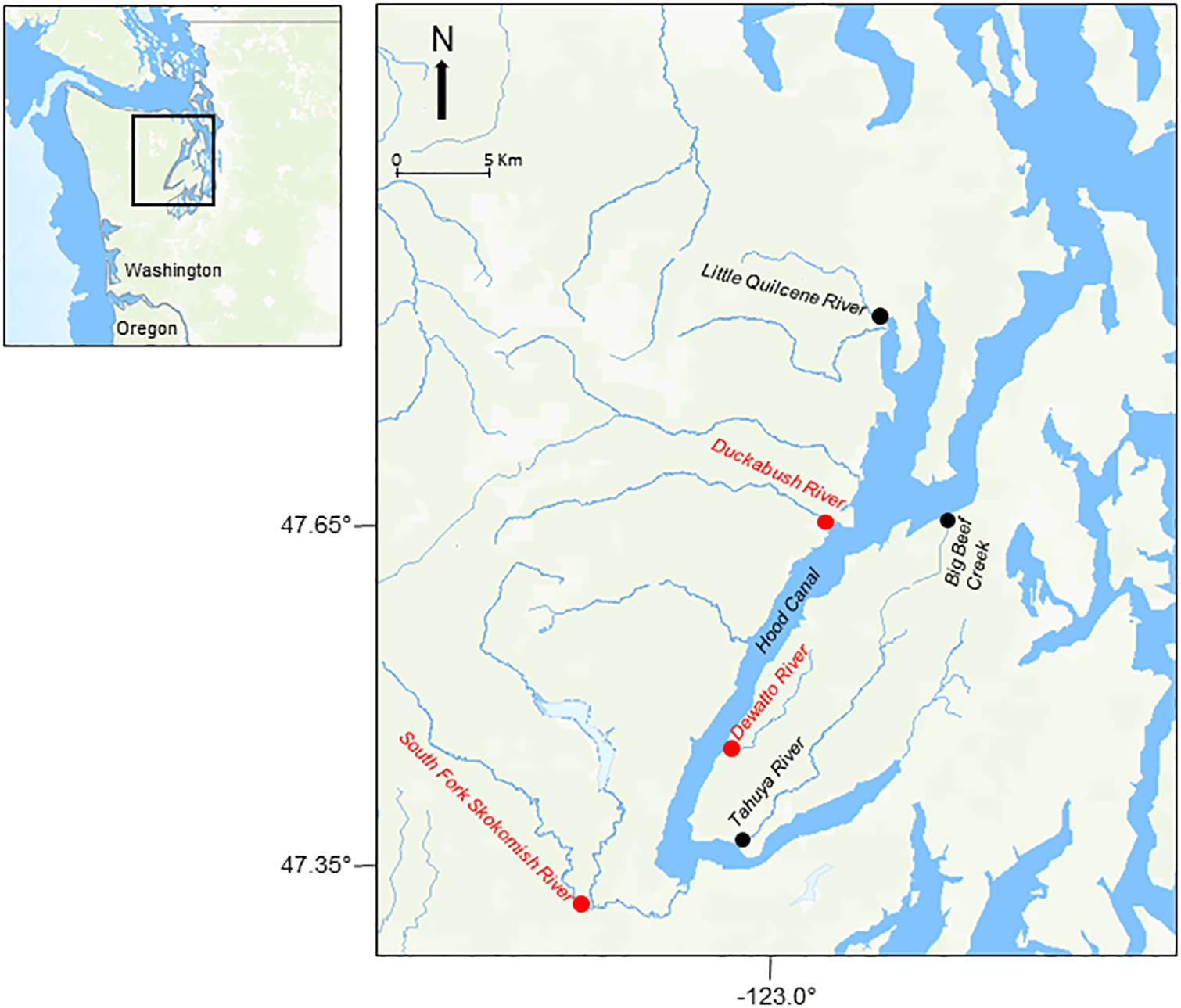
Declining salmonid populations often prompt the use of captive-reared fish to supplement wild stocks, but such programs risk negative genetic and ecological impacts. We evaluated six steelhead (Oncorhynchus mykiss) populations in the Hood Canal watershed, Puget Sound, Washington, including three supplemented and three unsupplemented control populations, over the span of 17 years to assess the effects of supplementation on several population genetics metrics. This program uniquely allowed natural spawning to occur before removing eyed eggs from redds for captive rearing, and later release as smolts or adults. Key genetic metrics—expected heterozygosity, allelic richness, and effective population size—remained stable from before to after supplementation in both the supplemented and non-supplemented populations. Parentage analyses confirmed successful reproduction by captively reared adults after they were released into the wild. These findings suggest that natural spawning prior to captive rearing, among other aspects of the program, lessened the genetic risks typically associated with artificial propagation such as loss of genetic diversity, or a reduction in effective population size. Our results highlight the potential for carefully designed supplementation programs to conserve genetic diversity and maintain effective population sizes in threatened steelhead populations.
Introduction

Supplementation programs, where captive-reared fish are introduced into wild populations to enhance natural production and increase abundance, have been widely implemented as a conservation strategy for declining salmonid populations. However, previous studies have highlighted several potential drawbacks of supplementation efforts, including genetic and ecological risks that may outweigh the intended benefits [17]. Understanding these risks is critical because the long-term success of supplementation programs depends not only on their ability to increase population sizes but also on their capacity to maintain the genetic health of these populations. Careful genetic monitoring is therefore essential to assess the effectiveness of these efforts and prevent unintended harm.

You can read the whole article here:

https://journals.plos.org/plosone/article?id=10.1371/journal.pone.0339458

Steelhead snorkel study biologist wants hatchery compromise – KING NEWS

The good news here is that science is now allowing us to better understand the various issues people like John McMillan can move from solutions that are massive and widespread in scale, to more micromanaged ones, that rely more on the specific knowledge of a watershed and it’s species. Wild Fish Conservancy should seriously look at this proposal.

Rivers in Washington may soon be divided into territory for either wild steelhead or hatchery steelhead. The hatchery steelhead are stuck in legal gridlock right now, after a lawsuit filed by the Wild Fish Conservancy argued they’re bad for wild steelhead. One biologist wants a compromise, and he’s advocating for it underwater. John McMillan works for Trout Unlimited. He’s studied steelhead by snorkeling for more than 20 years across 1,500 miles of river, taking video of their behavior changes over time…. McMillan agrees with the state’s plan to map rivers, potentially separating hatchery and wild steelhead. He thinks hatchery fish serve a purpose for fishermen – but need their own territory. Alison Morrow reports. (KING)

http://www.king5.com/story/tech/science/environment/2015/09/24/steelhead-hatchery-wild-fish-lawsuit-trout-unlimited/72775250/

Agencies review Puget Sound hatchery plans – Tacoma News Tribune

This has been a highly contentious issue, with lawsuits by environmental groups trying to stop all hatchery releases and the sports fishermen and the Tribes opposed to that. The environmental groups have very solid science showing that when you compare rivers like the Skagit and the declines over 70 years to almost no steelhead, with similar rivers in Oregon, like the Umpqua, which have seen virtually no change in steelhead production over the same period in time with no hatchery fish released, it begs the question of ‘why not ban all hatchery fish for a 10 year period?” The courts seem inclined to go along with that arguement. For some of the Tribes and the sports fishermen, it  seems as if science doesn’t matter, and that they want to fish to the last wild fish. They may get their wish. As one scientist said at hearings in Olympia on this last spring, “Without wild steelhead, you will not have hatchery fish.” So if you lose the wild run, it’s game over. 

How Puget Sound fish hatcheries will operate in the future could be determined by an environmental impact statement now being developed. As part of that process, NOAA Fisheries is holding public workshops this week to discuss the draft environmental impact statement that assesses alternative operations of salmon and steelhead hatcheries around the Sound. The proposed action alternative in the draft would operate hatcheries under two state and tribal resource management plans developed jointly by the state Department of Fish and Wildlife and Puget Sound treaty tribes, according to a NOAA news release. The proposed action would maintain hatchery production at current levels. Jeffrey P. Mayor reports. (Tacoma News Tribune)

http://www.thenewstribune.com/2014/09/03/3359645_agencies-review-puget-sound-hatchery.html

Study: Hatcheries Can Disrupt Steelhead Navigation – Earthfix/AP

Hmmm. more bad news on hatchery fish. Obviously more work needs to be done to validate these findings.

A new study suggests steelhead trout can have trouble using the Earth’s magnetic field to navigate if they were raised in a hatchery, where the field may be distorted by iron pipes. Scientists at the Oregon Hatchery Research Center raised two sets of fish: one outside the hatchery with a natural magnetic field, and one inside the hatchery where the field was distorted. Fish raised outside the hatchery oriented themselves to changes in the magnetic field, but fish raised in the hatchery’s distorted magnetic field did not. (Associated Press)

http://kplu.org/post/study-hatcheries-can-disrupt-steelhead-navigation

Is the Hood Canal Floating Bridge Causing The Problems in Hood Canal?

In 2010 I worked on a video for the Puget Sound Partnership called, “Voices of the Strait”. In that video I interviewed old timers from all over the Peninsula, and asked them about their experiences and changes in the environment. Off camera, I happened to meet one old fisherman, a man who had fished here for his whole life, and was in his 80s. We got to talking over coffee about the Hood Canal problems, and he had an interesting thing to tell me.

“It’s my opinion,” he said, “that ever since the Hood Canal Floating Bridge went in, we have seen a collapse of fish stocks and water quality down there. None of this ever seemed to be a problem before that. I bet the bridge is the cause of it all.”

I remember that conversation clearly, but didn’t ask him to be on camera, because it was, as we say, more of a hypothesis than a proof. You could insert many other hypothesis’ and be just as likely to be right, given a lack of data.

Now, it appears the old timer may have been correct in his observations. At a meeting of restoration recovery organizations held in Port Townsend, Scott Brewer, the head of the Hood Canal Coordinating Council, stood up and validated what the old timer had said. Brewer said that preliminary research  has shown, especially with steelhead, that the bridge might be stopping the fish from moving out to sea. Radio tagged fry have been seen swimming up to the bridge and are unable to figure out how to get around it. They appear to pool against the bridge, which is 30 feet deep, and get picked off by seals or sea lions.  The fry tend to stay on the surface layer of the water, so are stymied by the blockage. Additionally, the bridge may be affecting tidal water exchange.

This poses an interesting problem. Obviously, if accurate, short term fixes might look something like fish ladders or perhaps some kind of underwater fence that could direct the fish towards one end or the other. But longer term, if the bridge is the problem, the question of replacing the bridge will have to be raised. The health of an entire ecosystem might be at stake.

While all this is preliminary and speculative, we’ll keep an eye on this issue and report back as we get more data. But it’s worth remembering that most of the major and minor fundamental scientific advancements, up to the 20th century, were usually amateur local scientists, relying on observation, and hypothesis based on that knowledge of local systems from living there. It’s well worth keeping an open mind to even the oddest possible root causes. The notion that we can throw down a bridge and  have it not affect the body of water it lies on is  something that most bridge planners probably never anticipated. And the findings also point out that the revolution in miniaturization of computer and GPS tracking, will have profound effects on our ability to better understand natural processes.