Dan McConnell on Lou Whitaker

Dan McConnell on the legacy of Lou Whitaker. As Dan says,”

“Lou is a remarkable man and his achievements are many.  I celebrate Lou’s career as a true mountain man.”

http://extremedanmc.blogspot.com/2013/08/credit-where-credit-is-due.html

Join us in Port Townsend on September 20th for a special event.


New films highlight salmon recovery efforts across the State

From the State Department of Recreation and Conservation Office. Very well done videos by the good folks at North40 over in Wenatchee.

We at the Recreation and Conservation Office and the Governor’s Salmon Recovery Office are proud of our work to finalize and distribute our new video and clips about salmon recovery in Washington State. Our wide distribution is in progress. Please help us spread the word about the salmon recovery story and our state’s great work to recover these iconic species.

The 10-minute video and 2-minute clips reveal why salmon are so important to Washington State. The videos present perspectives from tribes, agencies, scientists, public citizens and other salmon recovery partners working to bring salmon back from the brink of extinction. Visit our YouTube site and watch the videos.

We’ve had important successes in salmon recovery over the past several years. The videos emphasize some of the returns on our investments as well as the need for continued support. While we need to show the progress we are making, there is work ahead and some salmon populations are still in serious trouble. These issues are also detailed by the Treaty Indian Tribes in western Washington in their paper on tribal Treaty Rights at Risk and in the Northwest Indian Fisheries Commission’s State of the Watersheds Report.

Please post the You Tube link to these videos on your website and Facebook page, as well as mention them in a tweet. It is our intent to share these videos broadly to shine light on the importance of salmon to our economy and our ecosystems.

Feel free to localize the message for your audiences. The short clips satisfy various interests by capturing perspectives from tribal and state co-managers to commercial fishers, landowners, scientists, and others. If you need information about how to embed the videos contact Jennifer.Johnson@gsro.wa.gov

http://www.youtube.com/watch?v=uTGndUjkDko&feature=share&list=PLjYJiZuq3RP98CtprIwqXEAWSahCk_0T7

Will term limits lead to MRC overhaul? – San Juan Journal

Why is this story important to the Peninsula? Because as we in Jefferson County debate the possible conversion to a Charter County, the San Juans, which converted to a Charter County in the middle of the last decade, are now in the process of politicizing their advisory committees because the Tea Party activists that now control the county have chosen to do so. Folks, as we look at the choice of whether to turn Charter, the hard reality is that it is very likely to have severe unintended consequences. While the current process here seems to be pushed by liberals, the outcome is not guaranteed to be environmental leaning.

NOTE: There is an active comments section on this story. Feel free to read it and join in.

A newly established policy that ushered in term limits to San Juan County’s numerous advisory committees could lead to a major overhaul of the MRC. Eight positions on the Marine Resources Committee will be appointed by the County Council in the coming weeks and a new MRC coordinator will soon be announced.
On July 30, Philip Green, Robin Hirsch and Chuck Schietinger were appointed to MRC positions 2, 1 and 4, respectively.

The appointments were made without notice or prior naming of the candidates during the final agenda time, titled “County Manager and Clerk Updates.”

Steve Wehrly reports.
http://www.sanjuanjournal.com/news/220528501.html

Can-Am Leaders Launch Salmon Recovery Effort – Earthfix

UPDATE SINCE FIRST PUBLISH: (I’ve substantially rewritten this after chatting with Jacques White)

I think that Ashley Ahearn for Earthfix may have not quite got right the gist of what this project is going to be all about. After reading this article, and posting my thoughts, I called and chatted with Jaques White of the “Long Live the Kings”, one of the core groups helping get this project done. Jacques told me that this is all about creating monitoring of nearshore habitat for primarily steelhead, as they are the most robust younger fish and can actually more easily be tracked. Jacques stated that there if very little knowledge about what these fish do after reaching the salt water, and if we can figure them out, perhaps we can bring science to bear on fixing the problem of their high mortality rates, which have gotten much worse since the 1980s, never recovering to previous numbers.

The money will be spent on hiring scientists to monitor these fish and their habitats, both from the NW Indian Fisheries and State Dept of Fish and Wildlife.  So all good work to get the money to research this problem more.

It’s a good thing to get the leaders from both countries together and try and come up with the latest in scientific data on why, despite all the best of work and intentions, our salmon are still going down over all. However, not all is dire. Runs are increasing on many rivers, due to an incredible amount of work by many thousands of people and agencies. Those watersheds are being repopulated with fish because people already know what’s wrong and are working to implement solutions. However, as mentioned in the story, “The marine survival for many stocks of chinook, coho and steelhead that migrate through the Salish Sea is now less than one-tenth of what it was 30 years ago.” At least the participants in this new entity are good choices, and include a wide range of active participants in current solutions.

A stumbling block on all this  is the ugly truth that the Canadian government is purposely blocking independent researchers like Alexandra Morton from finding out what is really going on with fish viruses, which she has shown to be present. Unless Canada is willing  to accept that they may have a massive problem on their hands that might go against their business interests, and stop protecting the foreign investments that seem to be buying Ottawa’s support, it’s likely this will not help much for increasing ocean stocks. The Canadian government is treating Morton like a pariah, their actions speak much louder than their words. They have actively been shutting down any and all government funded labs that choose to work with her in the last six months alone. This is really outrageous, and puts their efforts to help fix the problem as suspect. So with that background, here’s the article by Earthfix.

Leaders on salmon research and recovery from the U. S. and Canada came together in Seattle Wednesday to announce a new project. It’s called the Salish Sea Marine Survival Project and it’s meant to address a major question: Why aren’t salmon and steelhead in Washington and Canadian waters recovering, despite the millions of dollars that have been spent on research and habitat restoration? “We have a fairly clear idea of what salmon need and what they’re doing in the freshwater environment. We know considerably less about the marine systems,” said Jacques White, executive director of Long Live The Kings. The Seattle-based non-profit is coordinating the effort along with the Pacific Salmon Foundation in B.C. Ashley Ahearn reports.

http://earthfix.kcts9.org/flora-and-fauna/article/new-transboundary-salmon-recovery-effort-launched/

PT – Quimper Grange to host documentaries on GMO products

Quimper Grange will be hosting four documentaries on how genetically engineered foods impact our health, the health of our agricultural system and the health of the environment. (A poster describing the films is attached).

If you are only now becoming aware of the campaign to get Genetically Modified foods (GMO) at least labeled properly or the threat to our food supplies and your ability to continue to get organic food, then you should think of seeing one of these if not all these films.

The schedule for Quimper Grange screenings are:

AG 28, 7:00 — THE WORLD ACCORDING TO MONSANTO

SEPT 4, 7:00 — SEEDS OF DEATH

SEPT 11, 7:00 — GENETIC ROULETTE – THE GAMBLE OF OUR LIVES

SEPT 16, 7:00 — SEEDS OF FREEDOM

GMO Films 11x17 size

$3.7M in NOAA fish-habitat grants awarded to 3 NW states – Seattle Times

he National Marine Fisheries Service announced $3.7 million in grants Tuesday for fish-habitat restoration in Washington, Oregon and Alaska. The largest grant, $1.4 million, goes for three projects to restore nearly 500 acres of flood-plain habitat on Puget Sound. An additional $1 million with Snohomish County will help restore nearly 330 acres of wetland in the Snohomish River estuary.

http://seattletimes.com/html/localnews/2021652443_noaagrantsxml.html

BirdNote: Woodpeckers as Keystone Species

Woodpeckers – including this Northern Flicker – are master carpenters of the bird world. They’re called “keystone species” for their crucial role in creating habitat suited to other woodland wildlife. Abandoned woodpecker nest-holes become nests or roosts for small owls, cavity-nesting ducks, swifts, bluebirds, swallows, wrens, and other birds, as well as many small mammals.
http://birdnote.org/show/woodpeckers-keystone-species

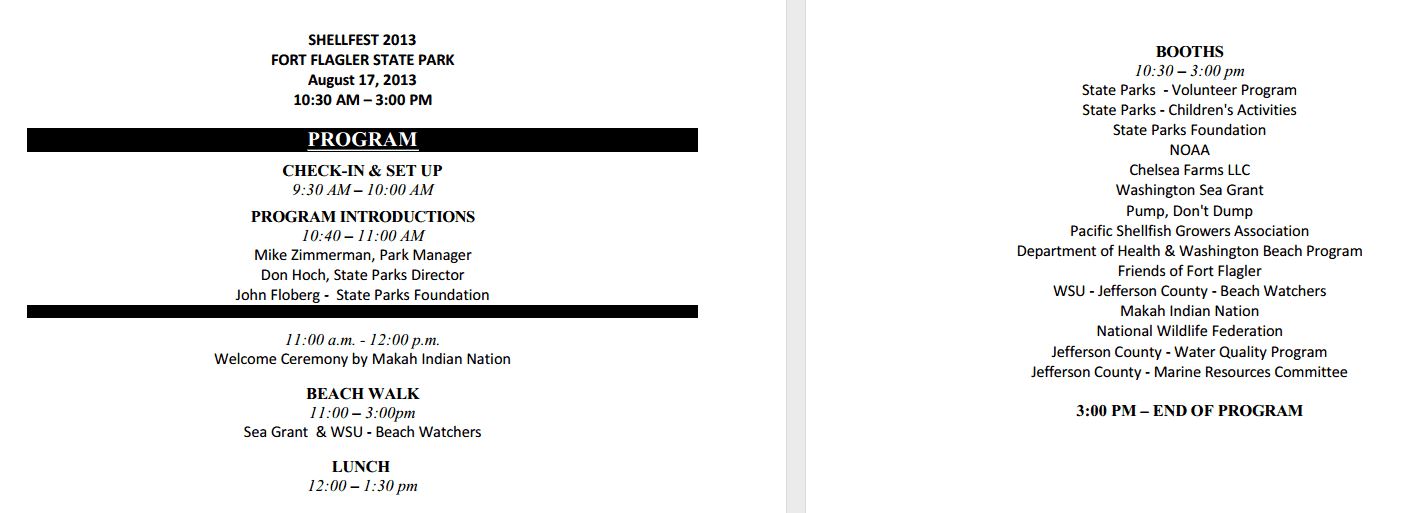
Come out to Shellfest today (8/17) on Marrowstone Island

Looking for outdoor activities today? You can drive, bike, swim, sail, or paddle your way across to Fort Flagler to have fun at Shellfest 2013. The Jefferson County Marine Resource Committee will be one of many exhibitors at the at Fort Flager on Marrowstone Island today. Here’s a bit of the schedule.  Come out for some great shellfish if for no other reason! It’s very shellfish of you, I know, but hey, just remember to “keep clam.”

Shellfest-2013-Fort-Flagler-Poster-final-LR


Shellfest 2013 Program


Salish Sea Health Report–EPA and Environment Canada

The scorecard from both the US EPA and the Canadian version of the EPA, Environment Canada. http://www2.epa.gov/salish-sea

The sad reality is we are essentially losing in some of the most key areas. Good news is we now know it and are working on it.

To help convey the status and trends of ecosystem components and how they relate to human activities, ten indicators address the following questions:

  1. What’s happening?
  2. Why is it important?
  3. Why is it happening?
  4. What are we doing about it?

salishsea-map-wwuMap courtesy of Western Washington University

Study confirms farmed fish can spread virus to Pacific herring–Herring Conservation Society

Experimental infection studies demonstrating Atlantic salmon as a host and reservoir of viral hemorrhagic septicemia virus type IVa with insights into pathology and host immunity.

Lovy J, Piesik P, Hershberger PK, Garver KA.
Source
Herring Conservation & Research Society, 1-5765 Turner Road, Suite 403, Nanaimo, BC V9T 6M4, Canada; Pacific Biological Station, 3190 Hammond Bay Road, Nanaimo, BC V9T 6N7, Canada. Electronic address: Jan.Lovy@dep.state.nj.us.

In British Columbia, Canada (BC), aquaculture of finfish in ocean netpens has the potential for pathogen transmission between wild and farmed species due to the sharing of an aquatic environment. Viral hemorrhagic septicemia virus (VHSV) is enzootic in BC and causes serious disease in wild Pacific herring, Clupea pallasii, which often enter and remain in Atlantic salmon, Salmo salar, netpens. Isolation of VHSV from farmed Atlantic salmon has been previously documented, but the effects on the health of farmed salmon and the wild fish sharing the environment are unknown. To determine their susceptibility, Atlantic salmon were exposed to a pool of 9 isolates of VHSV obtained from farmed Atlantic salmon in BC by IP-injection or by waterborne exposure and cohabitation with diseased Pacific herring. Disease intensity was quantified by recording mortality, clinical signs, histopathological changes, cellular sites of viral replication, expression of interferon-related genes, and viral tissue titers. Disease ensued in Atlantic salmon after both VHSV exposure methods.

Fish demonstrated gross disease signs including darkening of the dorsal skin, bilateral exophthalmia, light cutaneous hemorrhage, and lethargy. The virus replicated within endothelial cells causing endothelial cell necrosis and extensive hemorrhage in anterior kidney. Infected fish demonstrated a type I interferon response as seen by up-regulation of genes for IFN_, Mx, and ISG15. In a separate trial infected salmon transmitted the virus to sympatric Pacific herring. The results demonstrate that farmed Atlantic salmon can develop clinical VHS and virus can persist in the tissues for at least 10 weeks. Avoiding VHS epizootics in Atlantic salmon farms would limit the potential of VHS in farmed Atlantic salmon, the possibility for further host adaptation in this species, and virus spillback to sympatric wild fishes.

Published by Elsevier B.V.

Disease killing Pacific herring threatens salmon, scientist warns – Globe and Mail

Independent fisheries scientist Alexandra Morton is raising concerns about a disease she says is spreading through Pacific herring causing fish to hemorrhage. Ms. Morton has called on the federal Department of Fisheries and Oceans to investigate, saying it could cause large-scale herring kills and infect wild salmon, which feed heavily on herring…. Ms. Morton, a researcher and environmental advocate who campaigns against fish farms, said she caught some herring with similar symptoms in beach seine nets in 2011, but was unable to get DFO to investigate.
Mark Hume reports.
http://www.theglobeandmail.com/news/british-columbia/disease-killing-pacific-herring-threatens-salmon-scientist-warns/article13722113/

A Challenging Tribal Canoe Journey Strengthens Culture – Earthfix

The incoming tide breaks at Angie Mason’s shins and soaks her rolled jeans. She stands unfazed by the surf, waiting to welcome her son and daughter ashore on their tribe’s canoe. To Mason — of the Bella Bella First Nation — the splashing salt water is the least of her worries. Traveling from the remote central coast of British Columbia, the Bella Bella tribe paddled south for more than a month, logging 15 to 20 miles a day. The tribal canoe journey is an annual celebration that recognizes the cultural importance of canoe travel to indigenous people. This year’s journey was the Paddle to Quinault, with a final destination at the shores of the Quinault Indian Reservation on the Olympic Peninsula. Mason was one of thousands gathered to welcome 89 canoes there last week. Katie Campbell, Sarah Vaira and Ryan Hasert report.

http://earthfix.opb.org/communities/article/a-challenging-tribal-canoe-journey-strengthens-cul/

Washington Developing New Rules For Derelict Vessels – Earthfix

The Washington Department of Ecology is developing a new permit that lays out clear rules for the deconstruction of derelict vessels over water. Currently, any approved dismantling of an abandoned or defunct ship must happen at a dry-dock facility. But Ecology officials hope establishing the permit will open a new door for the safe removal of some of the 153 derelict vessels now languishing on Washington waterways.

Eric Florip reports. http://earthfix.kcts9.org/water/article/washington-developing-new-rules-for-derelict-vesse/

National Marine Fisheries Service (NMFS), propose to designate critical habitat for three species of rockfish in Puget Sound & Strait

Big news. The Federal Government is proposing designating critical habitat for certain rockfish. Public comment now open. Comments on this proposed rule must be received by 5 p.m. P.S.T. on November 4, 2013. Requests for public hearings must be made in writing by September 20, 2013. Comments close on 11/04/2013. The Feds say “Puget Sound” but actually are also including some areas of the Strait of Juan de Fuca. To them, it’s apparently all the same. They delineate it deeper in the document.  From the people I’ve talked to close to this decision, this has been studied a great deal and a lot of meetings have been held getting to this decision.  It likely will raise some objections, likely intense. But the stocks are in such critical shape in many places,  this appears to be needed. It’s not a new issue, the fact that the Feds have finally moved on it is. Hopefully (and apparently) we still have time to save some of them.  As you may or may not know, rockfish do not migrate. They hang out in their habitat, and can live  a long long time. They are often bycatch of other fisheries, and if you bring them up from a great depth, they end up often getting ‘the bends’ (barimetric poisoning) and die.

The National Marine Fisheries Service (NMFS), propose to designate critical habitat for three species of rockfish listed under the Endangered Species Act (ESA), including the threatened Distinct Population Segment (DPS) of yelloweye rockfish (Sebastes ruberrimus), the threatened DPS of canary rockfish (S. pinniger), and the endangered DPS of bocaccio (S. paucispinus) (listed rockfish). The specific areas proposed for designation for canary rockfish and bocaccio include approximately 1,184.75 sq mi (3,068.5 sq km) of marine habitat in Puget Sound, Washington. The specific areas proposed for designation for yelloweye rockfish include approximately 574.75 sq mi (1,488.6 sq km) of marine habitat in Puget Sound, Washington. We propose to exclude some particular areas from designation because the benefits of exclusion outweigh the benefits of inclusion and exclusion of those areas will not result in the extinction of the species.

https://www.federalregister.gov/articles/2013/08/06/2013-18832/endangered-and-threatened-species-designation-of-critical-habitat-for-yelloweye-rockfish-canary


And more from Mike Satos’ blog:

The National Marine Fisheries Service proposes to designate almost 1,200 square miles of Puget Sound as critical habitat for three species of endangered rockfish. The habitat protection follows the 2010 decision to list yelloweye, canary and bocaccio rockfish under the Endangered Species Act. The Fisheries Service says the rockfish are vulnerable to overfishing because they have long lives and mature slowly with sporadic reproduction. Tuesday’s designation will require federal agencies to make sure their actions don’t harm rockfish habitat. The protected area in Puget Sound overlaps existing critical habitat for Puget Sound Chinook and Hood Canal summer-run chum, bull trout and Southern Resident killer whales. Critical habitat listed for Puget Sound rockfish http://kplu.org/post/critical-habitat-listed-puget-sound-rockfish Also, if they haven’t erected a paywall, Chris Dunagan reports: Habitat protection proposed for endangered rockfish in Puget Sound http://www.kitsapsun.com/news/2013/aug/06/habitat-protection-proposed-for-endangered-in/#axzz2bGUhM000


NOAA: Puget Sound Killer Whales To Stay Protected – AP

NOAA throws out the claims by the Pacific Legal Foundation (a conservative legal action organization that fights against environmental laws, among other issues), that that the Puget Sound Southern Resident pod was not unique. The people that funded this ought to replace their lawyers, who might have warned them that the argument was absurd and a waste of time and money.

SEATTLE (AP) — Killer whales that spend their summers in Puget Sound are a distinct population group and will remain protected under the Endangered Species Act, the National Oceanic and Atmospheric Administration announced Friday.

Read the whole story at:
http://bigstory.ap.org/article/noaa-puget-sound-killer-whales-stay-protected

Legislature funds final push to rid Puget Sound of derelict fishing nets – WDFW

This is the outcome of over a decade of work, from a huge range of people and organizations, to get this done.  While the NW Straits has been the lead, many of us have lobbied to have the funding for it approved. It’s been a huge state wide effort, and thanks to the NW Straits Foundation, the Tribes, State Agencies like WDFW, the Marine Resource Committees, the old People For Puget Sound organization, a large number of other organizations that I now forget, and many legislators over the years, including bi-partisan support from legislators like Rep. Norma Smith described below.  We can turn around the destruction of the environment, but it’s never easy, nor free. We have to be able to set aside politics as usual and work to solve the problem. Thanks to all of you, and you know who you are, that helped get this done.

OLYMPIA – The final push in a decade-long effort to clear Puget Sound of derelict fishing nets within 105 feet of the surface will get under way later this year with funding approved by the Washington State Legislature.

The state budget adopted last month provides $3.5 million for the Washington Department of Fish and Wildlife (WDFW) to complete the task in partnership with the Northwest Straits Foundation, which has led the net-removal effort since 2002.

Since then, divers working for the non-profit organization have removed 4,437 lost or abandoned fishing nets, 2,765 crab pots and 42 shrimp pots from the waters of Puget Sound. Animals found dead or entangled in that gear include porpoises, sea lions, seabirds, canary rockfish, chinook salmon and Dungeness crab.

According to one predictive catch model, those derelict nets were entangling 3.2 million animals annually every year they remained in the water.

Robyn du Pré, executive director of the foundation, said the new funding will support the removal of approximately 1,000 derelict nets in high-priority areas of Puget Sound after current funding runs out in December.

“These legacy nets have been fishing the waters of the Salish Sea for decades,” du Pré said. “We are thrilled to have the opportunity to finish the job and to celebrate a true conservation success story in 2015.” Du Pré added that current fishing net loss is minimal and commercial fishers are now required to report any lost nets.

State Rep. Norma Smith of Whidbey Island led the legislative effort to fund the net-removal initiative.

“I am deeply grateful to my colleagues who helped achieve the goal of a $3.5 million appropriation for the Northwest Straits Foundation to remove the last of the legacy nets from the Puget Sound,” Smith said. “Lost in previous decades, they have had a devastating impact on harvestable natural resources and marine life. Once removed, because of the reporting requirements now in place, this challenge comes to an end. What an achievement!”

WDFW Director Phil Anderson said the new funding is specifically designed to support the removal of derelict fishing nets in areas of the Sound where historic fisheries coincide with bottom conditions likely to snag nets. The foundation locates those nets using sidescan sonar surveys, then dispatches recovery vessels with dive teams to retrieve them.

Few efforts have been made to remove nets from depths of more than 105 feet, because of safety concerns. However, the foundation recently completed an assessment of deepwater net-removal strategies that include the use of remotely operated vehicles, grapples, and deepwater divers.

“Working in conjunction with our partners at Northwest Straits and in the State Legislature, we have made enormous strides toward eliminating the risks posed to fish and wildlife by derelict fishing gear,” Anderson said. “This is difficult work, and it requires a real commitment from everyone to get it done. We look forward to celebrating the next milestone in 2015.”


Feasibility study addresses Dungeness/3 Crabs-area pollution – PDN

This actually seems to be a reasonable alternative. The recommendation is to enforce current laws, raise the local money to pay for regular inspection, which as I have heard, is not happening currently, and monitor to see whether the problems improve. Rushing to judgement on putting in a huge infrastructure project, even if it’s eventually found to be the right solution, seems premature. Let’s make sure the existing laws work, before abandoning them.

Clallam County should strengthen an existing program to operate and maintain individual on-site septic systems in the Dungeness/3 Crabs area, a new study concludes. Staying the course was one of four alternatives being considered in a feasibility study for wastewater management in an unincorporated area where failing septic systems were said to be polluting Dungeness Bay with fecal coliform and nitrogen. Damon McAlister, a senior engineer with Parametrix, and county Environmental Health Director Andy Brastad presented the final study to the Clallam County commissioners Tuesday. Rob Ollikainen reports.

Feasibility study addresses Dungeness/3 Crabs-area pollution http://peninsuladailynews.com/article/20130731/NEWS/307319994/feasibility-study-addresses-dungeness-3-crabs-area-pollution

Support local journalism: Subscribe to the PDN.

Canoe Journey 2013

Canoe Journey 2013

Photos by Al Bergstein

Arriving in the fog in Port Townsend. Sunday

The challenge of the Canoe Journey | Paddle to Quinault – PDN

Safe journeys to our friends, who are headed to The Quinault Nation, down the coast. 

When pulling in a Northwest tribal canoe, the key is balance: each puller’s stroke must be made in unison, the pullers must support and trust each other. So what happens when the ocean literally turns you sideways, taking control of your movements? You paddle on anyway. This year’s Canoe Journey ends in Taholah on the Quinault Nation reservation, on the Pacific Coast of the Olympic Peninsula. For many, this will be the first time pulling in the challenging open ocean, unlike the relative calm of the protected inland waters of Puget Sound. Megan Stephanson reports.


http://www.northkitsapherald.com/news/216074521.html


Also see: Paddle journey canoes greeted at Fort Worden — next stop Jamestown Beach near Sequim today.

http://peninsuladailynews.com/article/20130722/NEWS/307229992/paddle-journey-canoes-greeted-at-fort-worden-8212-next-stop

Catch and Release for Puget Sound’s Rockfish: the Catch is in the Release – San Juan Islander

Now here’s a great idea, and an issue that I was discussing on the radio with Phil Andrus just last Friday. Congratulations to Puget Sound Anglers for trying something really different. 

Recreational fishermen have been practicing catch-and-release fishing for years. Anglers who fish Washington’s Puget Sound waters are no exception. The assumption has always been that the release part of the equation will result in a free-swimming fish that will survive. Barbless hooks, minimum handling, and quick return to the water have all been developed to insure high survival rates. But fish caught at substantial depths – 30 feet or more – present their own challenge and it’s a tough one. Fish don’t typically get the bends – that sometimes fatal nitrogen-gas syndrome that befalls human scuba divers who rise too rapidly from depth – but some fish can get something equally dangerous: barotrauma…. To increase the survival of released fish, marine anglers are using devices, like release weights and baskets, to manually lower fish to the appropriate depth before releasing them. Known as recompression, lowering fish to their natural depths in a controlled manner allows the gas to be reabsorbed into their bodies. This increases their chances of survival. This spring, Puget Sound Anglers, the largest fishing club in the state of Washington, dedicated time and resources to combat barotrauma. In April, the organization purchased 330 recompression devices, essentially a mechanism that allows anglers to lower and release fish to natural depths. The manufacturer donated an additional 100 apparatuses. 

Read the whole story here. 

http://www.sanjuanislander.com/island-newshome/environment/6629-catch-and-release-for-puget-sounds-rockfish-the-catch-is-in-the-release