Sportsmen Fight Trump Plan To Log Roadless Headwaters on Olympic Peninsula Public Lands

Another day, another threat from the Trump administration to open public lands, revoke roadless areas to open them to cutting on Federal forests. This press release is from the Sportsmen for Wild Olympics.


FOR IMMEDIATE RELEASE September 8th, 2025

QUILCENE, WA—September 8th, 2025: Today, Sportsmen for Wild Olympics released a new map with photos illustrating the devastating impacts that developing key roadless backcountry public lands on Olympic National Forest could have on critical headwaters of prime trophy fishing rivers and public access on the Olympic Peninsula. The group is calling on Congress to pass the Wild Olympics Act as a proactive solution to permanently protect these lands.

“This map tells Congress and the Administration: protect the Olympic Peninsula’s public lands—don’t privatize or develop them,” said Ashley Nichole Lewis, a Quinault Indian Nation fishing guide and spokesperson for Sportsmen for Wild Olympics. “It gives our fellow sportsmen and women something to fight for, not just against—a lasting solution to threats we are confronting right now.”

The urgency comes as the Trump Administration announced a shortened comment period ending September 19th on their plans to rescind the Roadless Rule in order to log & develop sensitive spawning habitat on public lands, a key federal safeguard for undeveloped backcountry areas across national forests, including Olympic National Forest. The new map with photos highlights & names the critical ancient forest roadless headwaters & salmon streams on Olympic National Forest that are now threatened by the Trump Administration’s plan to lift protections for these backcountry public lands prized by Olympic Peninsula sportsmen for the clean water, critical habitat & access they provide.

What is the Roadless Rule?

The Roadless Rule, established in 2001, protects undeveloped areas of national forests from new road construction and logging. These “roadless” areas are often rugged backcountry landscapes that provide crucial habitat for fish and wildlife, protect water quality, and offer remote hunting and angling opportunities. Removing these protections opens the door to industrial development in some of the last remaining intact, healthy forest lands in the country.

“Rescinding the Roadless Rule is yet another attempt to hand over our essential public resources to special interests—at the expense of salmon, clean water, and future generations,” Lewis said.

The coalition—comprising thousands of local and regional hunters and anglers, and over 30 leading sportsmen organizations—has already punched well above their weight earlier this year playing an outsized role in the national backlash opposing the unprecedented threats to public lands coming from both Congress and the Administration. Lewis says these threats highlight exactly why the group supports the Wild Olympics Wilderness & Wild and Scenic Rivers Act, recently reintroduced by Senator Patty Murray and Representative Emily Randall.

“The different public land sale efforts in Congress and the new plan to strip protections from 59 million acres of core forest headwaters nationwide—including lands on the Peninsula—show that they will use any tactic to privatize or exploit our public lands,” Lewis said. “This map shows what that would actually look like. Congress & the White House must reverse course and pass Wild Olympics to permanently protect these critical salmon streams instead.”

The Wild Olympics Act, developed with years of local input, would enhance hunting and fishing access while permanently protecting some of the last, best intact salmon-spawning habitat left in the Lower 48. Importantly, it would not close existing roads or cost timber jobs. It has broad local support with over 800 local endorsements.

The new map & photos show how the Wild Olympics proposal would protect key areas such as South Quinault Ridge, Moonlight Dome, and other core ancient forest headwaters & rivers vital for hunting & fishing on the Peninsula —areas the Administration now plans to open for logging by rescinding the Roadless Rule.

(The steep forested slopes of the Moonlight Dome Roadless Area forms the critical headwaters for both the East and West Forks of the Humptulips River (seen ok the left), one of the top ten Trophy Fishing Rivers in Washington State).

The map also reveals that 300,000 acres of Olympic National Forest have been identified as eligible for sale under different plans by the Administration and some members of Congress during earlier drafts of the budget bill passed earlier this year. While the land sale provision was struck from the budget, proponents continue to push this idea forward.

The unprecedented threats to public lands recently sparked Senator Murray to throw down the gauntlet in the Senate, announcing she will block any public lands legislative package that comes out of Utah Senator Mike Lee’s Senate Energy & Natural Resources Committee unless it includes her Wild Olympics bill, a move that galvanized local supporters to pull out all the stops to get it done this Congress.

Lewis hopes the map inspires more hunters and anglers to join the thousands who have already signed their petition.

“The outdoor community is powerful. Our fishing and hunting guides are pillars of this community. The same places we work the hardest are the ones we return to after the day is done—because we love them. Let’s use that collective power to ensure a single pen stroke can never take our public lands away. Let’s pass the Wild Olympics Act.”

###

HOW TO FIGHT BACK. 

1) Sign the WildOlympics.org/wild-olympics-petition/ telling Congress ancient temperate rainforests of the #WildOlympics aren’t for sale & to permanently protect Olympic Peninsula #publiclands & rivers against travesties like this in the future. 

2) Those who can afford it PLEASE WildOlympics.org/DONATE to fuel our fight. We helped defeat this four years ago. Help us defeat it again & pass the Wild Olympics Wilderness & Wild & Scenic Rivers Act to permanently protect ancient forests & salmon streams once & for all. 

3) SUBMIT A COMMENT AT PORTAL LINK Comment Period Ends Sept 19th. Tell USDA to uphold the Roadless Rue to protect Olympic Peninsula Ancient Forests & critical salmon nurseries that were already centuries-old when our nation was born. 

For more information, including a rolling list of articles from sportsmen outlets covering the threats to public lands, visit: SportsmenForWildOlympics.org/threats


Sportsmen For Wild Olympics Members Include:

Waters West Guide Service (Montesano)

Bad Ash Outdoors (Tahola)

Northwest Sportfishing Industry Association

Northwest Guides & Anglers Association

The Washington Wildlife Federation,

Izaak Walton League (Gr. Seattle Chapter) Backcountry Hunters and Anglers, (Washington Chapter)

Association of Northwest Steelheaders,

The Gray Wolf Fly Fishing Club (Sequim)

SAGE Fly Rods

Doug Rose Fly Fishing (at request of family)

Bad Ash Fishing (Tahola)

Washington Council of Trout Unlimited

Little Stone Fly Fisher (Port Townsend)

Johnson Guide Service (Sequim)

Olympic Peninsula Skagit Tactics (Forks)

Able Guide Service (Seiku)

Mike Z’s Guide Service (Forks)

Brazda’s Fly Fishing

Angler’s Obsession (Forks)

Sea Run Pursuits

Peninsula Sportsman Guide & Outfitting Service (Port Townsend)

Waters West Fly Fishing Outfitters (Port Angeles)

The Wild Steelhead Coalition

Piscatorial Pursuits (Forks)

Able Guide Service (Sekiu)

LimbSaver

Oly Women On The Fly

WA Council of Fly Fishers International

Puget Sound Fly Fishers

Coastal Cutthroat Coalition

A win for saving Dungeness Spit


The battle over keeping industrial aquaculture out of our National Wildlife Refuges, is still being played out in the courts. Recently three environmental organizations have successfully sued to get the US Fish & Wildlife Service to complete a “compatibility determination (CD)” for the industrial operation. The court has ruled that a CD must be performed. It is not clear whether the company must now stop any work in the refuge.

Here is the press release from the plaintiffs. Please consider donating to any of them to help offset the costs of the lawsuit. It’s *our* wildlife refuge at stake.


In 2023, Protect the Peninsula’s Future, Coalition to Protect Puget Sound Habitat, and Beyond Pesticides sued the US Fish and Wildlife Service (USFWS) for its failure to conduct a compatibility determination (CD) for a proposed industrial shellfish operation at the Dungeness National Wildlife Refuge (DNWR). The case is being reviewed by the U.S. Federal District Court in Tacoma. 

USFWS regulations state that for any project on or near one of its refuges, a CD must be written.  These cases are not unusual, and the Dungeness case is especially important because if the case is lost, industrial shellfish operations might be free to open at other Refuges. 

Last year the Court ruled the case should proceed because it is clear the USFWS must write a CD.  

The industrial shellfish operator – the Jamestown S’Klallam Tribe (JST) – sought to moot the plaintiffs’ case due to potential financial impact to the JST.  The JST received various agency permits to plant 80,000 non-native oyster spat (larvae) in large plastic bags to be anchored to the substrate in the refuge area on 34 acres. The then manager of the DNWR had determined the shellfish operation was incompatible with the mission of the refuge, but higher ups in the agency overruled her and refused to write a CD. In the meantime, the JST started planting oyster spat. 

The federal court allowed the JST to present arguments against the plaintiffs’ suit.   

On 15 May 2025, the court responded in our favor.  The case will not be mooted; the USFWS must follow its regulations.   

From the Court documents:

“Compliance with the statutory procedures in the Refuge Act is undoubtably a  public right that safeguards environmental protection. 

Only the public right to administrative compliance with the Refuge Act procedural requirement to complete a compatibility determination and/or require a special permit are ripe for adjudication. 

Drawing all reasonable inferences in favor of plaintiffs, Jamestown appears to have planted seeds after it was aware that it was probable the Service would conduct a compatibility determination. 

Therefore, it is hereby ORDERED that Jamestown’s motion to dismiss, Dkt  44, is DENIED. “

The plaintiffs now wait for the Court’s final ruling against the USFWS, ordering it to write a CD. 

This just in from the Puget Sound Partnership’s Strait Ecosystem Recovery Network (ERN). Want to create a rain garden? Or other neighborhood storm water program? Get together with your town or county peeps and apply!

The RFP for the Neighborhood Stormwater Education and Assistance grants will open on May 7th and there are informational webinars on the horizon. These funds can support projects including:

  • Developing tools, resources, or programs to educate landowners and influencers (real estate agents, Homeowners Associations (HOAs), land use consultants, contractors, and others) about stormwater practices; 
  • Providing technical assistance such as pre-application and compliance support and incentives for landowners, developers, and residents to implement and maintain green stormwater infrastructure; 
  • Community outreach events, such as restoration plantings or Low Impact Design (LID)/Green Stormwater Infrastructure (GSI) educational seminars and trainings; 
  • Developing long-term plans, agreements, and funding mechanisms for developing and maintaining stormwater infrastructure within local individual catchments (including systems owned by HOAs); or 
  • GSI training and/or certification programs aligned with community affordable housing, workforce development, and environmental justice goals

Cold Water Connection Campaign Reopens Rivers for Olympic Peninsula Salmon and Steelhead

From a NOAA Press Release:


With $19 million in NOAA funds, nonprofit and tribal partners plan to remove 17 barriers blocking fish passage on critical spawning rivers originating in Olympic National Park, Washington.

The cold water rivers of Western Washington descend from the glaciers and snow-capped mountains of Olympic National Park. They hold some of the last, best freshwater habitat for salmon and steelhead in the lower 48 states. Despite a warming climate, their high-elevation headwaters are predicted to remain cool enough for salmon and steelhead for at least the next 50 years.

However, the region’s roads—some a legacy of the logging industry—crisscross the watersheds. They often force streams to flow underneath them through small, poorly designed tunnels called culverts that block fish passage. There are more than 4,000 culvert barriers on the Olympic Peninsula. Salmon and steelhead are often unable to reach the historical habitat they need to spawn and produce the next generation.

In response to declining fish populations on the Olympic Peninsula, NOAA’s Office of Habitat Conservation is supporting the Cold Water Connection Campaign. This partnership will reopen 125 miles of critical spawning and rearing habitat over the next 10 years. With $19 million in funds through the Bipartisan Infrastructure Law and Inflation Reduction Act, project partners plan to:

  • Remove 12 high-priority barriers in the Hoh, Quillayute, and Quinault watersheds
  • Finalize designs for 5 additional culvert replacements
  • Expand the ability of tribes to perform restoration work 
  • Inject money into the regional economy by hiring local and tribally owned contracting companies
  • Mitigate flood damage risks by installing culverts built to handle high flows from the region’s increasingly heavy rain storms

“We are running out of time to recover and protect these salmon and steelhead populations,” says Luke Kelly, Western Washington Program Director for Trout Unlimited. “We need to pull out all the stops now, so it’s been great to see all of our government, tribal, nonprofit partners, and private landowners coming together to get this done.”

Cold Water Connection Campaign partners include:

The campaign has support from local, state, and federal agencies including NOAA. In past years(PDF, 8 pages) project partners have also repaired instream and riparian habitat damaged by road building and destructive logging practices.

Also;a new short video looking at the Cold Water Connection Campaign on the Olympic Peninsula . It really celebrates the extensive work the partners have done to make sure they are prioritizing the most impactful barriers for removal, and the benefits this work provides to local communities above and beyond the important benefits to fish and coastal watersheds.

You can watch it here:  https://www.youtube.com/watch?v=9YhmFosupPM

Read the whole press release here before the Trump administration pulls it down:

https://www.fisheries.noaa.gov/feature-story/cold-water-connection-campaign-reopens-rivers-olympic-peninsula-salmon-and-steelhead

Clallam County MRC Letter re: 3 Crabs road flooding

The Clallam County MRC has sent this letter to the Clallam County Board of Commissioners (BOCC) and the Clallam County Department of Community Development (DCD).RE: Shoreline management at Three Crabs Road.

At its recent monthly meeting, the MRC agreed to invoke its advisory responsibitity to the BOCC and communicate our concern about shoreline armoring (permitted and unpermitted) on Three Crabs Road, which recently came to our attention.

What we are seeing

Despite Comprehensive Plan policies for protecting marine shorelines and no-net-loss goats of the Shoreline Management Program, bulkheads have been and continue to be permitted – most often under emergency provisions following erosion from extreme storm surges, which are almost becoming an annual occurrence. ln addition, NASA has recently concluded that the pace of sea leveI rise is faster than previously thought, due to the thermal expansion of the ocean’s mass.

Summary of concerns

The MRC is concerned that intensifying weather conditions wit[ continue to cause erosion and that emergency bulkheads will continue to be requested and built, one property at a time, resulting insignificant impacts on shoretine functions and ecology. We urge the BOCC and DCD to develop a strategy that comprehensively addresses property and shoreline protection on Three Crabs Road.

The strategy shoutd include continued education and outreach to planners, contractors, property owners and county residents overall, and should also:

> clarify that avoidance of ecologicaI impacts is the top priority (but if avoidance is impossibte then

Ecology’s sequence of mitigation actions for shorelines should be followed and

> consider adjacent impacts and cumutative effects of any action; and

> identify mitigative approaches if avoidance is impossibte; and

> provide how no net loss witt be achieved through compensatory mitigation.

Tribe poised to co-manage Dungeness National Wildlife Refuge

In a move that comes as environmentalists sue the Department of Fish & Wildlife Service (FWS) for not doing a “compatibility determination” on potential impacts to allowing an industrial aquaculture farm (run for profit by the Jamestown S’Klallam Tribe), FWS appears ready to ink an agreement to co-manage the Wildlife Refuge with the tribe.

Does it make sense for an entity that seeks to financially profit from the use of a federal resource, to be given co-management powers of that resource?

While this blog recognizes the importance of the work that the Jamestown have done for environmental restoration projects on the north Olympic Peninsula, there has been sustained concern from environmental watchdogs about the idea of turning the waters of the refuge into an industrial site, with subsequent conversion of the benthic layer and the waters above it into essentially a shellfish farm. Once this is done, there is no returning it to the way it is, as the profit motive will make it virtually impossible to end the work, as we have seen across the south Sound as shellfish aquaculture has turned numerous virgin bays into net covered shores with diesel engines dredging the geoduck farms at all hours of the night (low tides usually are late at night in the winter when harvesting would be easiest).

It is worth noting that the Refuge was established with the following goals, delineated on the front page of its web site:

Recognizing the importance of the fertile habitats, President Woodrow Wilson established the Dungeness National Wildlife Refuge on January 20, 1915, as a refuge, preserve, and breeding ground for native birds. Many of these birds feed by diving into the shallows for fish. Today the graceful arc of Dungeness Spit continues to protect nutrient-rich tide flats for migrating shorebirds in spring and fall; a quiet bay with calm waters for wintering waterfowl; an isolated beach for harbor seals and their pups; and abundant eelgrass beds for young salmon and steelhead nurseries.

Dungeness National Wildlife Refuge | Visit Us – Activities | U.S. Fish & Wildlife Service (fws.gov)

It is hard to understand how commercial shellfish aquaculture could coexist into preserving native birds who dive into these same waters to feed. Currently the FWS bans even frisbees or kites on the spit as it apparently is not good for the birds. There is a long list of banned behavior that seems innocuous elsewhere.

In 2018, this blog reported on the concerns that were being raised by the staff of the refuge itself, in it, we reported that the applicants have asked for permission to place approx. 150,000 of “on bottom” oyster bags on the central west side of the bay, in approximately 34 acres of the tide flats 1141 acres of the inner spit. While I understand that current numbers of this amount are not at these levels, the long-term goal of this number likely has not changed. This is not the small scale subsistence aquaculture that currently exists in Sequim Bay by tribal members. This will require machinery, boats and staff to harvest these amounts. This could be viewed as the proverbial “camel nose in the tent” which likely will be expanded over time with very little discussion. The applicants propose to raise non-native oysters. To be clear, a significant number of cultivated oysters in the Salish Sea are non-native, so this was not a surprise, nor is it an issue of great concern.

Also noted in that earlier blog entry, as stated by the Department of Interior letter, “The shores and tidelands in this area provide some of the most important wildlife habitat and supports the highest density of waterfowl and shorebirds within the refuge….These shorelines also support one of the largest Brandt haul out sites in the state of Washington….Shorebird densities are highest within the action area and the adjacent lagoon on Graveyard Spit.”

“Human-caused wildlife disturbance and habitat loss are two of the most pervasive threats to shorebird and waterfowl use of the Salish Sea…. very little information is available on entrapment resulting from aquaculture structures.”

The letter also referenced that, “In 2016, a die-off of approximately 1000 Rhinoceros Auklets on Protection Island coincided with a significant reduction in the abundance of sand lance in the Strait of Juan de Fuca.” 

Herring also spawn at the west end of Dungeness Harbor and the Department of Interior raised questions about protecting Strait of Juan de Fuca herring, which have been designated “critical” (as in critically low).  Sand Lance and Surf Smelt spawning grounds are also found in the area of the application. These species have been identified as “Washington Species of Greatest Conservation Need within the State Wildlife Action Plan (WDFW 2015).” A worry related to this is that these spawning fish will be competing with the oysters for plankton. A failure to find enough food could lead to a significant reduction in the survival rates. There is no known mitigation for this, other than limiting the size and scope of the project.

Additionally, Interior pointed out that a 1996 scientific study found that some shorebirds significantly avoided areas used for aquaculture in a California bay.

This shoreline has also been designated “Natural” in the Critical Areas Ordinance, as far back as 1976. That designation limits activities to those that preserve the national features unchanged. One would assume that the tidelands are also part of that designation. But of course, the waters of the Wildlife Reserve are apparently not part of the county shoreline ordinance.

It is important to note that the applicants themselves have noted in a 2003 report that “wild birds are the second most important source of FC on a year-round basis. It is especially important in winter, when their load approaches 1/2 of the measured marine water input.” It would seem to the average person that putting aquaculture into a bird reserve is by its very nature going to create a tension between the animals that are present and creating the problem and the desire to harvest shellfish for profit.

It is certainly reasonable for the applicants to want to return to aquaculture in the Bay, however the scale is being significantly increased. And now the applicants themselves are being given co-management of the very location that they intend to make a commercial farm. If it wasn’t the Tribe but some standard for-profit company, I’m sure that every environmental organization in the country would be joining in to stop this, but since it is the Tribe, only a couple of environmental organizations have been bold enough to challenge the FWS in court. And they appear to be winning. Years ago, I had a drink with the head of the Western Region of NOAA. I asked him why they kept doing things that required environmental groups to sue them, and why they just didn’t do the right thing to begin with. He laughed and told me that NOAA was a big government organization and had many different perspectives inside it. He welcomed lawsuits that forced them to do the right thing as he couldn’t possibly hope that all his employees were in line with its goals.

The FWS has a problematic role with regards to the Refuge. According to a 2022 article written by Kevin Washburn and N. William Hines, Dean and Professor of Law at the University of Iowa College of Law:

“The congressional direction in the Fish and Wildlife Act is to ensure “the fish, shellfish, and wildlife
resources of the Nation make a material contribution to our national economy and food supply . . . [and] the health, recreation, and well-being of our citizens.”

Congress recognized “that such resources are a living, renewable form of national wealth that is capable of being maintained and greatly increased with proper management, but equally capable of destruction if neglected or unwisely exploited.” (emphasis mine)

As a practical matter, however, one of the most significant challenges for FWS is meeting the
significant demands of the Endangered Species Act.”

The co-management of the reserve can only legally include the following:

“…Endangered Species Programs, Education Programs, Environmental Contaminants Programs, Wetland and Habitat Conservation Restoration, Fish Hatchery Operations, and National Wildlife Refuge Operation and Maintenance. See List of Programs Eligible for Inclusion in Funding Agreements Negotiated with Self-governance Tribes by Interior Bureaus Other than the Bureau of Indian Affairs and Fiscal
Year 2016. Microsoft Word – [14] Washburn – Camera-Ready (case.edu)

The rather ill defined “Northwest Wildlife refuge operations…” in the above paragraph is a concern. The document referenced above goes into considerable detail on the issues raised in co-management of FWS and other agencies. It is beyond the scope of this blog to identify all of them.

Science has learned a lot about the environment since the time when the State originally allowed the use in this location. In many other locations we have decided that the tradeoff of commercial activity is outweighed by a newer appreciation of the value of the natural landscape for a variety of species.  It is up to all of us to question our elected officials and bureaucrats, not the applicants, as to why they believe that this is in all our best interests, when we so clearly have set this aside this location for wildlife protection and enhancement. The applicants have every right to apply. It is up to our elected and bureaucratic staffs to make the call for the lands and species we all enjoy and want to protect.

This blog has long supported the work of the JamesTown S’Kallam as they have led environmental protection on the Olympic Peninsula for many decades. We have supported their right to industrial geoduck operations, small scale oyster farming, their rights to their share of the salmon of the state. In this one instance we are questioning whether putting this farm inside a tiny refuge that has decades of protection, as we all struggle to save our seabirds, is the right call. It is not about their rights, it is about the location. Can the State not find and trade suitable other locations for the Tribe to establish, especially since the tribe itself has raised concerns about the viability of the location for aquaculture on the scale they are planning? Then the issue of co-management is a non issue. Then they would be imminently qualified to co-manage the refuge.

Dungeness Spit Aquaculture: Court rules in favor of environmentalists

The U.S. District Court for the Western District of Washington State concludes that the Federal Refuge Act requires the U.S. Fish and Wildlife Service (USFWS/Service) to complete a compatibility determination, that the Court has jurisdiction and that plaintiffs’ case has merit and should be heard. 

In a major ruling for environmentalists fighting to stop the conversion of the Dungeness Spit wildlife refuge into an industrial aquaculture farm, a federal judge has ruled that the USFWS must complete a “compatibility determination” on potential impacts to these federal lands.  A 50-acre industrial shellfish operation has been allowed to operate abutting the Dungeness National Wildlife Refuge in Sequim WA without the agency having written a compatibility determination or permitted the shellfish operation. This Refuge hosts 240 species of birds, 29 species of mammals, 8 species of reptiles and amphibians, and 26 species of fish.  

Protect the Peninsula’s Future (PPF), a WA State non-profit was joined by another WA State non-profit, Coalition To Protect Puget Sound Habitat and the national non-profit, Beyond Pesticides challenging the USFWS in US Western District Court, pleading that the USFWS must write a compatibility determination stating the shellfish operation’s harm to this refuge.  The USFWS/Department of Interior asked the court to dismiss our case, denying their own authority. On July 17, 2024, the federal district court denied dismissal of the case.

The NGOs also pled that should the operation be allowed, it needed a permit. The federal judge left open the opportunity to strengthen this argument.

In his review of the USFWS attempt to dismiss the plaintiffs’ case, Judge Benjamin H. Settle underscored that the Refuge Act mandates that the Service “shall not initiate or permit a new use of a refuge or expand, renew, or extend an existing use of a refuge, unless the [Service] has determined that the use is a compatible use and that the use is not inconsistent with public safety.”  The federal judge continued, “To conclude otherwise would lead to absurd results. It would require the Court to ignore the clear instructions in the Refuge Act and its regulations that deputize the Service to regulate activity within the Refuge. Indulging the Service’s position would also require ignoring the points in the Refuge Act that carefully instruct the Service on how to navigate conflicting or concurrent authority within a refuge.”

“It bears repeating that the Service already acknowledged that it ‘cannot allow the proposed activity unless the entirety of the commercial oyster farming operation within the Refuge boundary is found Compatible with the Refuge purposes.’”

This blog has repeatedly reported on the move to create an industrial aquaculture operation inside Dungeness Spit. In previous articles, we saw key members of the wildlife reserve send reports saying that the proposal was bad for birds and other creatures in the waters inside the Spit. Regardless of the concerns DNR head Hilary Franz signed an approval of leasing the tidelands to the company. Yesterday, Franz lost her bid to move to the U.S. Congress, and she might be replaced by one of two Republicans, but the votes are still being tallied, and Democrat and environmental champion Dave UptheGrove is still in second place as of this writing.

You can help this legal case by sending donations to: PPF   PO Box 421   Sequim WA  98382

or make online through PayPal:  https://www.protectpeninsulasfuture.org/donate/

Washington tribes seek to pause offshore wind development – Axios Seattle

Axios Seattle is reporting that Washington Tribes under The Northwest Indian Fisheries Commission have asked for a pause in the planning for the offshore wind farms along the Washington coast while the tribes concerns are addressed. The Tribes are not asking for a total ban on the farms but have environmental concerns they say have not been addressed.

Worth noting is that the farms are in the very early stages of permitting by the Federal Government.

As Axios notes:

The Bureau of Ocean Energy Management has received two unsolicited lease proposals for offshore wind farms along Washington’s coast.

  • One, from Trident Winds, would cover an area of about 315 square miles about 45 miles off the coast of Grays Harbor and Pacific counties.
  • The other, from Hecate Energy, seeks to lease 403 square miles in a nearby area about 17 miles off the coast.

Both these farms are planning on wind turbines with virtually no impact on the visual look of the coast, but the concerns are more about their impacts on fishing and whales.

As stated in an earlier blog post, this blog along with the stated goals of the tribes in the article is to support wind energy projects, but “not on the backs of the tribes”. The assumption is that the wind energy companies can provide reasonable scientific backing for their proposals. The east coast has implemented wind energy farms much closer in than the proposed Washington coast project, with no signficant impacts. Some of the background on those efforts are found here:

BOEM Completes Environmental Analysis for Proposed Wind Project Offshore Massachusetts, Rhode Island, and New York | Bureau of Ocean Energy Management

Comparison of Environmental Effects from Different Offshore Wind Turbine Foundations (boem.gov)

The Institute for Energy Research does have this conclusion to the New England wind farms. It appears that high interest rates, which are impacting the sales of electric cars, are also impacting the implementation of wind energy. Note the concerns in bold:

While a few offshore wind projects have gotten off the ground and have started producing electricity, others have been canceled, often with developers occurring fines. Developers have canceled several projects along the East Coast, saying they were no longer financially feasible. Offshore wind projects have struggled to surmount rising construction and material costs, as well as serious manufacturing problems. In recent months, rising materials costs, high interest rates, and supply chain delays have prompted project developers to cancel or try to renegotiate power contracts for commercial-scale offshore wind facilities in the United States with operating start dates between 2025 and 2028. Offshore wind facilities are among the most expensive utility scale power projects under construction in the United States and would not have gotten off the ground without massive support from state and federal governments and pre-approved power purchase agreements. With the cancellations that have occurred, President Biden’s goal of 30 gigawatts of offshore wind capacity by 2030 is expected to be half that amount.

New England Is Moving Ahead with Offshore Wind Facilities, Despite Their Cost – IER (instituteforenergyresearch.org)

The wind farm built by Avingrid has started producing 68 Megawatts of power to Massachusetts since then.

A good scientific reearch paper on the subject was produced by Nature:

Reviewing the ecological impacts of offshore wind farms | npj Ocean Sustainability (nature.com)

Microsoft’s CoPilot produces this summary of it’s search on the topic:

Wind farms in New England, particularly offshore wind projects, have both positive and negative environmental impacts.

On the positive side, the development of the New England Wind lease area is projected to reduce carbon dioxide emissions by nearly 4 million US tons annually, which is equivalent to taking approximately 700,000 cars off the road each year during the lifespan of the project1. The New England Wind project is expected to generate up to 2,600 megawatts of electricity, sufficient to power more than 900,000 homes with clean renewable energy23.

On the other hand, there are potential negative impacts associated with the construction and operation of wind farms. These can include disruption to marine life during the construction phase, potential collision risks for birds and bats, and changes to the seascape that can impact tourism and fishing2. Research is being conducted to prevent environmental damage4.

It’s important to note that the specific impacts can vary depending on the location and design of the wind farm, and measures are often put in place to mitigate potential negative effects. For example, the Bureau of Ocean Energy Management (BOEM) completed an environmental review of the proposed New England Wind project offshore Massachusetts3. This review process is designed to carefully analyze the environmental impact of the proposed project3.

In conclusion, while wind farms can have some environmental impacts, they also play a crucial role in reducing greenhouse gas emissions and providing a source of renewable energy. It’s a balance between managing these impacts and transitioning to cleaner energy sources to combat climate change.”

Sign up for Axios to support independent journalism in the Pacific Northwest.

Washington tribes seek to halt offshore wind farms – Axios Seattle

Net Pens, Dead? Don’t count on it. Thank Hilary Franz

From coastalwatershedinstitute.org: There’s been a bit of buzz about the status of steelhead net pens in the US/Washington state Salish Sea over the last three months or so. Most recently, Cooke Aquaculture withdrew their appeal of the recent decision upholding Washington state DNR’s ban of net pens on state aquatic lands. This has been touted as, quote, ‘the end of the fight’ against net pens in Washington waters (DNR March 2024).

Except? It absolutely *isn’t* the end of the fight. While Hillary Franz, the current Washington state Department of Natural Resources (DNR) Public Lands Commissioner, made the decision to ban net pens over a year ago, the DNR hasn’t taken any action to codify this rule into agency law (DNRa). Codifying the decision is a three-step process (DNR b). And while other DNR rules have sailed thru this codifying process over the same time period, the net pen decision? Hasn’t budged.

Hillary Franz is not running for re-election. She will no longer be DNR Lands Commissioner after the November elections.

In it’s current state, the net pen ban can be rescinded with a literal stroke of a pen by the next Lands Commissioner. Industry is laying plans for just this. At least one Commissioner candidate has made very clear statements supporting net pens. And Cooke Aquaculture and the Jamestown Tribe, collaborators on a steelhead net pen plan for the central Strait of Juan de Fuca/ Port Angeles Harbor, are now giving ‘informal’ presentations to local groups to try and garner support of future in water net pen projects-including Port Angeles harbor. This isn’t a ‘proposal’. It’s a *plan*. And they’re not asking-they are *telling* folks what is going to happen. They’re doing so quietly now-but will be full throttle after the Washington State DNR Commissioner election is over, and the new Commissioner is in place.

What can you do?

1. PUSH Washington DNR to codify the current net pen ban rule immediately;

2. Confirm early and repeatedly the position of prospective future incoming Washington State Lands Commissioner on in-water net pens, and make sure they also have your input and a clear position on net pens, and;

3. Make sure to let local aquaculture leaders and resource agency managers and officials know that upland contained is the only farmed salmon alternative for our country and state (one very successful operation is already in full swing in BC-link to their information is below).

For those that are new to the topic, here is an excellent link summarizing truth about open net pens https://www.youtube.com/watch?v=p4fVPt1V3sw .

More information, links, and key citations are here:

DNR a. netpen rulemaking https://www.dnr.wa.gov/publications/em_rule_netpen_cr101.pdf

DNR b.https://www.dnr.wa.gov/rule-making….

DNR 2024. https://www.dnr.wa.gov/…/commissioner-franz-fight…

Mapes 2022. https://www.seattletimes.com/…/state-supreme-court-oks…/

Blue Star Foods model farm module designed to grow 100 Tonnes of Steelhead Salmon per year: https://bluestarfoods.com/little-cedar-falls/

Upland Net Pens get fish into tanks out of the sea.

https://olyopen.com/2018/02/01/norwegian-company-to-build-large-land-based-salmon-farm-in-belfast-maine-republican-journal/?amp=1

Water reserves low in Olympics – Sequim Gazette

Our snow pack is not in great shape to provide us fresh water this year.

Support local journalism. Subscribe to the Sequim Gazette.

Washington SNOTEL Snow/Precipitation Update Report (usda.gov)

ACTION item: Stopping the industrialization of the Dungeness Wildlife Refuge

Time after time, citizens have had to sue the U.S. Fish and Wildlife Service (USFWS) for failing to protect the animals and their habitat as required by law, in areas that the nation has recognized as critical to preserve as habitat and for public recreation. Now USFWS is willing to allow, for private profit, the industrialization of refuge lands for shellfish operations. 


>>Tell the U.S. Fish and Wildlife Service and U.S. Secretary of Interior Deb Haaland that the Dungeness National Wildlife Refuge lease for industrial aquaculture must be rescinded.


In spite of demonstrated harm to birds, salmon, forage fish, and shellfish, and a recommendation by the National Marine Fisheries Service that “an alternative site be identified in a location that results in less potential impacts to wildlife that is more appropriate for aquaculture and meets the goals of the tribe,” USFWS approved a lease for an industrial oyster farm inside the Dungeness National Wildlife Refuge. This decision, which is in violation of the Clean Water Act and the Migratory Bird Treaty Act, must be reversed. 


In the words written of an October 2022 USFWS internal memorandum, “Forgoing a compatibility determination in order to facilitate incompatible commercial activities by any entity would be a subversion of the fundamental requirements in the [USFWS] Improvement Act.” 


We are targeting the most recent case of the USFWS’s permissiveness in one of the country’s most pristine nature lands, the Dungeness National Wildlife Refuge in the small rural town of Sequim Washington, just below the Olympic National Park. In this case, the shellfish corporation raises shellfish on other sites. They do not need to operate in a national refuge and deny wildlife their feeding and breeding grounds. 


The Dungeness National Wildlife Refuge was created by Executive Order in 1915 by Woodrow Wilson, directing the area to be set aside as a “refuge, preserve and breeding ground for native birds and prohibits any disturbance of the birds within the reserve.” The front page of the Refuge website states: “Pets, bicycles, kite flying, Frisbees, ball-playing, camping, and fires are not permitted on the Refuge as they are a disturbance for the many migrating birds and other wildlife taking solitude on the Refuge.” With this level of concern, it is counterintuitive to allow destructive industrial aquaculture.  


Industrial shellfish aquaculture is known to reduce or eliminate eelgrass with the use of pesticides. Shellfish aquaculture also involves large-scale use of plastics—PVC tubes and plastic netting—that are hazardous to marine organisms and can trap and entangle wildlife. Commercial shellfish aquaculture is a major industry in Washington state that has significant impacts on the nearshore marine environments, which provide essential habitat for many species, including invertebrates, fish (including herring and salmon), and birds (migratory and shorebirds). 


Among the negative impacts of this project are: 50% reduction in bird primary feeding grounds; plastic oyster bags that exclude the probing shorebird flocks from feeding deeply into the substrate, entrap fish and birds, add macro- and micro-plastic bits to the sediment throughout the refuge, and shift the benthic community composition; diminishing of the ecological benefits provided by eelgrass to threatened fish and birds, such as nourishment and cover from predators; and increased algal blooms that will leave a graveyard of dead oysters. These detrimental effects to the Dungeness National Wildlife Refuge are NOT minimal. Decisionmakers should not place financial benefits to the corporation above the long-term and cumulative impacts to the refuge. Half of the world’s 10,000-odd bird species are in decline. One in eight faces the threat of extinction. 2.9 billion breeding adult birds have been lost from the United States and Canada in only 50 years. 


Let’s raise our national voice and try and stop this refuge destruction with public persuasion. This is a public space we pay to protect. For more information, check out the Daily News post from last August, “Groups Sue U.S. Interior Department to Protect the Dungeness National Wildlife Refuge from Industrial Aquaculture.” 


This action follows a lawsuit filed by three environmental organizations against the U.S. Department of Interior for failing to protect the Dungeness National Wildlife Refuge from industrial aquaculture. The groups, including Protect the Peninsula’s Future, Coalition to Protect Puget Sound Habitat, and Beyond Pesticides, filed their complaint in the U.S. Western District Court of Washington State. The complaint states that the U.S. Fish and Wildlife Service (USFWS), U.S. Department of Interior, must “take action that is required by the Refuge Improvement Act and conduct a compatibility determination and require a special use permit for a proposed industrial aquaculture use” that will abut and impact the Refuge. The plaintiffs are represented by the Seattle, WA law firm of Bricklin and Newman LLP. 


>>Tell the U.S. Fish and Wildlife Service and U.S. Secretary of Interior Deb Haaland that the Dungeness National Wildlife Refuge lease for industrial aquaculture must be rescinded.


We are focusing this Action against the U.S. Environmental Protection Agency and the U.S. Secretary of State.  


Thank you for your active participation and engagement!


Please take this ACTION and circulate it to your family, friends and colleagues.

https://secure.everyaction.com/WMJxQmNjDUqarx4FmLzUrA2

also, to support the lawsuit, you can send checks to:

Send a check to: PPF, POBox 421, Sequim WA 98382 or through PayPal: https://www.protectpeninsulasfuture.org/donate/

        PPF is a federal recognized 501c3 non-profit.

Pat Neal again denounces fish restoration projects.

The Peninsula Daily News mentions that the Kiwana’s of Port Angeles invited fishing guide, columnist and long time “salmon restoration industry” critic Pat Neal to speak at their recent meeting. We have long documented Neal’s rants against any and all efforts to restore the rivers he claims to love.

Neal blames virtually all parties, the Federal government, State government, and Local Governments for spending millions of dollars and having nothing (in his mind) to show for it. The article says that he ended by saying the Tribes should be running fish restoration, as if they haven’t been for decades. He clearly has been out of touch with what has been happening all around him.

Having done volunteer environmental work on the Peninsula for 20 years, along with producing films for the Jamestown S’Klallam and my film “Voices of the Strait” in 2010 for the Puget Sound Partnership, which was a documentary on the “old timers” that grew up fishing and hunting here, I can state that what Neal conveniently leaves out, is as important as what he says.

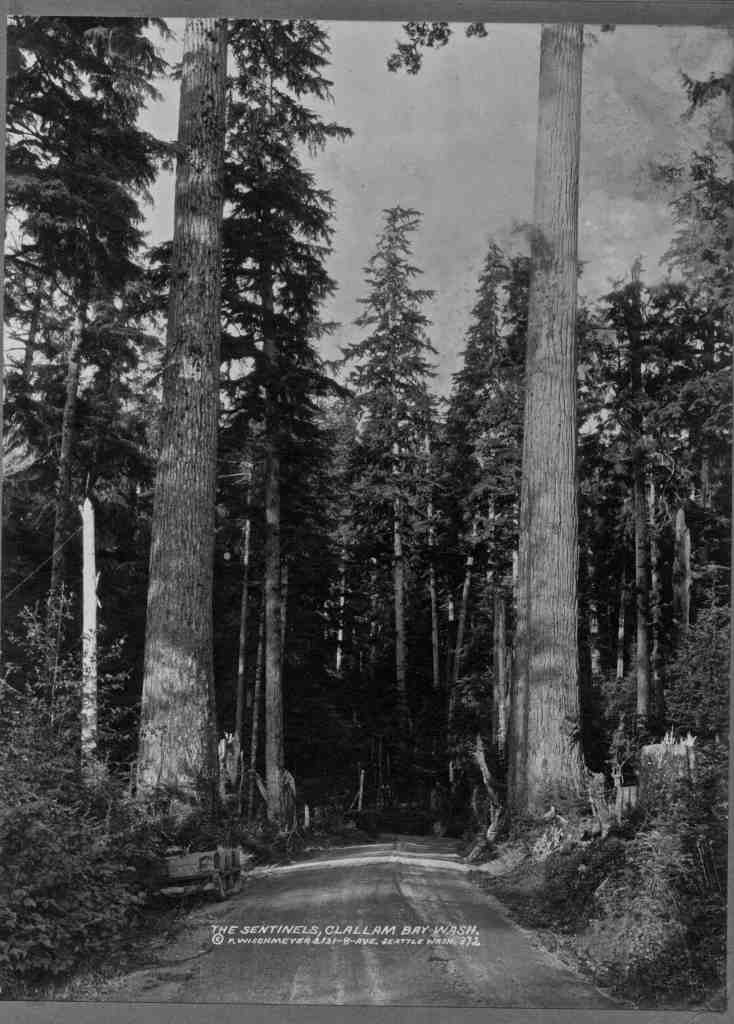
This image has an empty alt attribute; its file name is Clallam-Bay-Roads-1920s-734x1024.jpg
1930s roads in Clallam Bay

First off, Neal does not seem to understand that the efforts of restoration will take far longer and far more than the little we have already done. Why? Because we are dealing with 150 years of rampant exploitation of the Peninsula and it’s environment by a variety of people and companies operating with a worldview of “unlimited resources.” They were people of a very different time, legal framework and perspective.

Logging companies commercially cut over 95% of the old growth timber here. While doing that, they destroyed the 12,000 year old forest floors right down to the streambeds. A recovery from this destruction will take over another 100 years, if ever. This ecosystem was where the salmon (and numerous other unique species) thrived. They couldn’t and can’t live without it. There is no “blame” here, these people did not have a scientific understanding of how the ecosystem worked. They simply thought there was so much abundance, it could never end. The last “one log” truck went out on this peninsula as late as the early 1970s, while the Congress allowed raw logs to go out to Japan without using our sawmills. I watched as the ships were loaded with giant cedar and fir. Who profited from those decisions? Yet many still want to blame the Spotted Owl or the Boldt Decision for the end of the logging era and the almost simultaneous collapse of the salmon runs. The Spotted Owl fiasco was an outcome, not a cause. The Boldt Decision simply recognized that our neighbors indeed had “Treaty Rights” and they were going to be asked to help manage a fishery they had historically successfully managed for centuries.

One Log Truck c1960s. Photographer unknown.

Additionally, well meaning farmers gutted the rivers for irrigation, especially in the Sequim/Dungeness basin. One long time fisherman named Vince Cameron I interviewed for “Voices of the Strait”, told me that as a young boy, growing up on the Dungeness, he witnessed a tractor come into the river and cut a channel to create an irrigation ditch, during the middle of a salmon run, stranding thousands of fish as they moved upstream to spawn. He also discussed that channelizing the river, to end the flooding of the valley, created a high pressure hose effect, essentially scouring the banks where the salmon spawned.

Vince Cameron on the Dungeness River. Photo by Al Bergstein

The reversal of this entire mess has taken hundreds of millions of dollars, decades of the efforts of the Jamestown S’Klallam and the collaborative work of the Dungeness River Management Team, which included the Tribes, fishermen, hunters and farmers. It has been a successful effort. But it will likely take many more decades before we see significant numbers of salmon, especially the runs of Chinook. Neal would apparently rather sit on the sidelines and complain than take part in these efforts.

Another old timer told me that once the Hood Canal Floating Bridge came in, he noticed that the fishing in Hood Canal seemed to collapse. Since that comment to me, we have scientifically found out he was right, that the bridge is contributing to deaths of millions of fry on their way out to sea. Efforts to understand how we can keep the bridge and yet make it safe for salmon fry are ongoing.

Alexandra Morton in Canada scientifically proved that net pens were contributing to sea lice that were killing and weakening salmon as they passed by on their way to the sea. I witnessed the PR people employed by major aquaculture companies we all love here in Puget Sound, denounce her and her work over and over again. She was finally, after decades of work, successful in getting the Canadian Government to remove these farms. The runs this year, the first year that returns came back having not passed the farms, were spectacular. The people who denounced her have continued to be members of influential committees here on the Peninsula and continue to denounce efforts to reign in their ongoing takeover of our beaches.

We also have witnessed extensive construction of homes and businesses along the banks of salmon streams, destroying the natural habitat for a mixture of concrete and lawns. The reversal of that is taking decades as homes are bought out, removed and flood plains put back in place. Flood plains are the “lungs” of the river, and our destruction of them was incredibly bad news for salmon. Now we are on a path to restoration with best available science helping guide decisions being made by large groups of representatives from our cities, counties and environmental organizations.

I interviewed men who ran sports fishing boats out of Sekiu and other places. Herb Balch told me how he and other sports fishing fleet owners begged the Department of Fisheries to put limits on the salmon fishing during the 50s and 60s because they felt it was wasting the resource. He mentioned to me he would take out a boat of Boeing executives who would want to fish the “limit” and would come back with a boat of 30 to 50 fish. The customers might take one or two leaving him needing to gut and give away the rest. He could never find high school kids to be ready to do the work and in disgust, would dump the remaining fish over the side. This went on, day in and day out during fishing season.

Herb Balch, photo by Al Bergstein

Dick Goin, the late long time fisherman who was the spark for removing the Elwha dam, also documented the dramatic decline in salmon from the 1930s, when he arrived, to when he ended his fishing career. I have a copy of his legendary document, “Roll Call of the Lost” if anyone would like to see it.

Dick Goin photo by Al Bergstein

Ray Hunter, who grew up in Dungeness Bay, recalled the day that the boats came in and swept across the bay, dragging nets that destroyed the bottom and brought an end to many of the fisheries that he experienced growing up in the 40s and 50s.

Ray Hunter photo by Al Bergstein

Peter Becker told me of being on fishing boats in the late 70s with the latest fish finders and him and the crews wondering who would catch “the last salmon”.

Peter Becker photo by Al Bergstein

None of these men were environmental radical activists. They were simple fishermen, paper mill workers, truck drivers and businessmen that were appalled by the destruction they watched. They watched the ‘baseline’ as it’s called in science, move, and understood what was happening. From a baseline of virgin forests to a pillaged clear cut, from dozens of dead salmon floating away in the Strait, it was clear to them what was happening. Dick worked hard to reverse it, and the removal of the Elwha Dam and the return of the chinook and other fish to the upper reaches is now being seen. It’s not yet to a place where river guides can make a living, but we are headed that way. Unfortunately, it is not likely to be done in Pat Neal’s lifetime. It just isn’t that simple.


You can watch my film, “Voices of the Strait” on YouTube. Unfortunately, I was requested at the time to keep the running time short, and had to cut many interviews. I’m hoping to return to the film someday and make the running time long enough to include much of what was left “on the cutting room floor”.

You can watch my film, “Working for the River” about the Dungeness recovery efforts, on Vimeo.

Groups Sue USFWS for Failure to Protect Dungeness Spit

DUNGENESS NATIONAL WILDLIFE REFUGE UPDATE (DNWR): Groups Sue USFWS For Failure to Protect the Dungeness National Wildlife Refuge 

On August 17, Protect the Peninsula’s Future (PPF) was joined by The Coalition to Protect Puget Sound Habitat and the WA D.C. national organization Beyond Pesticides in a legal action to hold the U.S. Fish and Wildlife Service (USFWS) accountable to follow its regulations and protect the Dungeness National Wildlife Refuge. They were represented by the Seattle WA law firm Bricklin and Newman 

Beyond Pesticides Press Release

The August 17 federal complaint, submitted to the United States District Court For The Western District of Washington, states that the USFWS must “take action that is required by the Refuge Improvement Act and conduct a compatibility determination and require a special use permit for a proposed industrial aquaculture use” that will abut and impact the Refuge. 

Plainly, the compatibility determination would decide whether this industrial- shellfish operation is compatible with the mission of the Refuge.The Dungeness National Wildlife Refuge was created in 1915 by President Woodrow Wilson. The Refuge provides habitat, a preserve, and breeding grounds for more than 250 species of birds and 41 species of land animals. The shellfish operation lease is for 50 acres of Washington State bottomlands. 34 acres would be covered with up to 80.000 plastic grow-out bags of non-native shellfish spat, staked into the bottomlands and potentially killing all marine life underneath and snaring wildlife in the netting. These plastic bags will cover the primary feeding grounds for the birds, essentially starving them as they peck through the plastic trying to reach nutrients. This operation would shift the natural year-round-sediment drift, moving the sediment into and covering the eelgrass beds – beds protected for rearing salmon for whales and nourishment for particular migratory ducks. To protect the birds, the area is closed to the public during the migratory bird season.  However the USFWS will allow the shellfish operation in to the area all year long to the detriment of the birds.

Please see this publication for further detail. https://www.ehn.org/dungeness-national-wildlife-refuge-oyster-2660613389.html

Coalition Takes Legal Action to Stop Logging in the Elwha River Watershed

Commissioner Franz continues to work against the concerns of the local constituents. And this woman wants to be governor?


Timber Sale threatens drinking water access, wildlife habitats, and biodiversity – Washington DNR ignores community requests to pause logging. 

FOR IMMEDIATE RELEASE: June 30, 2023

Contacts: Elizabeth Dunne, Esq., Director of Legal Advocacy, Earth Law Center edunne@earthlaw.org

Port Angeles, WA – On June 30, 2023, a coalition of groups–Earth Law Center, the Center for Whale Research, and the Keystone Species Alliance–filed a notice of appeal to challenge the “Power Plant” timber sale, currently set to be auctioned on July 26th, 2023, by the Washington Department of Natural Resources. The proposed “Power Plant” timber sale is a 126-acre timber sale that borders popular recreation routes such as the Olympic Adventure Trail, the Colville MBT, the trail to access the old lower dam site, and nearby climbing areas.

The forest is in close proximity to the Elwha River with a diverse mix of Douglas fir and Western redcedar, many at least a hundred years old, and a diverse, naturally regenerated understory. This timber sale is incompatible with the restoration of the iconic Elwha River, which underwent the largest dam removal in US history, completed in 2014. $327 million of federal funding has been invested in the river’s restoration to date. The legal action alleges that DNR has systematically engaged in extensive logging of older legacy forests in the Elwha River Watershed without studies or consideration of impacts to instream flows, groundwater recharge, and water temperature. Past, current, and future planned timber sales will remove hundreds of acres of forest.  

The lawsuit also alleges that DNR failed to consider how the logging could impact this critical riverine wildlife corridor, soil health, salmon and orca populations, and ongoing Elwha river restoration. The Elwha River is City of Port Angeles’ residents only source of drinking water

The forest is in the headwater area for Colville Creek and small tributaries of the Elwha River, areas critical for the recharging of groundwater to feed these streams. The Forest, its streams, and the rejuvenating Elwha River work together to support two keystone species: returning salmon populations and the critically endangered Southern Resident Orcas, who depend upon consuming salmon for their survival. Given their proximity to the Elwha River, these older forests provide critical habitat for endangered and threatened species, including Southern Resident orcas, Chinook salmon, and the Marbled murrelet. In fact, a juvenile Marbled murrelet was recently found just miles from the proposed harvest.

The legal action specifically identifies Public Lands Commissioner Hilary Franz’ pattern of skirting community input to push through unlawful timber sales, including the Power Plant sale. This forest could be saved today if Public Lands Commissioner Hilary Franz directed the harvest to stop. 

Community groups launched an ambitious campaign today to raise funds to negotiate for the protection of the forests from imminent logging. Pledged funds from the “Elwha Forest Fund” will go solely to replace the revenue that would have come from the extractive timber harvest auction. 

This legal action is by no means the first action taken by community groups in opposition to timber sales in the Elwha watershed. In addition to public comments formally submitted to DNR, community members have come out in droves to DNR’s meetings to speak during the open comment periods in opposition to this timber sale. Additionally, on March 5, 2023, over a hundred community members, largely from Port Angeles, the lower Elwha Klallam Tribe, the Jamestown S’klallam Tribe, the Lummi Nation, and surrounding areas in the Olympic Peninsula, joined together in a peaceful rally at the Elwha River Observation Area near an active timber harvest site called “Aldwell.” Aldwell was logged earlier this year by the DNR. 

The Port Angeles City Council in particular submitted letters to DNR to plead for the “Aldwell” auction to be put on hold. Despite community advocacy, DNR and Commissioner Hilary Franz did not adhere to local concerns and logged “Aldwell” without meaningfully considering community input. The city once again wrote to Franz to request delaying the auctions for “Power Plant” and “TCB23,” along with letters from many concerned local residents. For example, see the Mayor’s June 1, 2023 letter about the Power Plant sale. 

Opinion: A national wildlife refuge at risk of industrialization

This article originally was published in Environmental Health News. We use it with permission of the author.


SEQUIM, Wash.—Jutting out into the Strait of Juan de Fuca is a fragile, slender spit of sand and glacial till leftover from the Pleistocene Epoch nearly 1.2 million years ago.

It is the longest spit in North America, a refuge and protective barrier for marine mammals and some 250 breeds of shorebirds, several of whom stop on their way between South America, Alaska and beyond to build up fat to fuel their long journeys.

And it is also about to become commercialized for private profit by an industrial oyster corporation.

The Dungeness Spit, part of the Dungeness National Wildlife Refuge, extends for five miles. Declared a refuge in 1915, its lush eelgrass beds are a pantry for waterfowl and a nursery for salmon that eventually feed whales and other wildlife. The Dungeness Bay itself is considered an important bird area by Audubon, for its significance for bird population conservation.

The refuge attracts birders and other recreationists from around the world. Territory enjoyed and cherished and serving as a nursery and refuge for wildlife that literally span the globe, will be subsumed for private gain. It is like a war on our marine ecosystem.

The Washington State Lands Commission, the Washington State Department of Ecology and the U.S. Army Corps of Engineers (Corps) issued permits for the Jamestown S’Klallam Tribe to commercially grow non-native oysters in Dungeness Bay. These will be sold to restaurants, consumers and exported to other countries.

The operator will initially anchor 20,000, with a buildup to 80,000, on-bottom toxic plastic bags of non-native oyster spat over tens of acres smack dab in the primary mudflat bird feeding area – an area that today is off-limits to human access. Tens of thousands of shorebirds from across the Western Hemisphere depend on the mudflat as a critical feeding stop during migration.

The bags will be anchored into the sediment, smothering the intertidal zone benthic life underneath, and will affect the nearby eelgrass. This plastic is a type of PFAS, the group of chemicals also known as forever chemicals, able to contaminate the water that the filter-feeding oysters will ingest. This chemical could then move up the food chain to unsuspecting consumers.

The plastic nets are known to have ensnared birds and fish at other industrially-operated shellfish farms.

The Corps refused to conduct an environmental impact study, yet in an internal 49-page Memorandum to Record, the Corps admitted to the destruction the shellfish operation will have, but still permitted it.

The U.S. Fish and Wildlife Service (USFWS), a division of the U.S. Interior Department, with authority to protect its refuges, withdrew its opposition to the operation. To protect the birds and their primary breeding and feeding grounds, this section of the refuge is closed six months of the year to human activity. Now the USFWS is permitting the industrial shellfish operator access to this protected area year-round, day and night.

As well, the USFWS is circumventing its own mandatory step of writing a compatibility determination.. Since this operation is incompatible, to write the determination would force the agency to publicly disallow the shellfish operation.

Violated, as well, are the Migratory Bird Treaty Act, the Endangered Species Act and the Clean Water Act. Organizations and individuals throughout the United States submitted comments, spoke out and petitioned to stop this shellfish operation. No agency acknowledged the public outcry.

The Dungeness National Wildlife Refuge industrial operation will be precedent-setting for our nation’s refuge system – and bodes poorly for what can happen in other protected areas.

Public funds upkeep national refuges. We have seen this sad song repeated over and over: When private corporations destroy public lands, the public is taxed to clean up the damage.

Today we are spending millions of dollars annually to clean up Washington state’s Puget Sound, the second largest estuary in the United States. Yet our state and federal agencies are opening these wildlife intertidal zones to more pollution and industrial activity. One third of Washington state’s coastal waters are filled with industrial shellfish aquaculture and plastic, leaving wildlife to forage elsewhere.

“In wilderness is the preservation of the world,” Henry David Thoreau wrote in 1862.

We should heed his words and protect rather than pollute our natural world. The state and federal governments should get back to protecting our wildlife refuges rather than acquiesce to their destruction.

Darlene Schanfald

Darlene Schanfald, Phd, has been active in environmental campaigns for more than three decades and is a board member of Protect the Peninsula’s Future.

WA Dept of Ecology & Rayonier Port Angeles Superfund Site

The Washington State Department of Ecology recently mailed out the first report in a long time to residents near Ennis Creek in Port Angeles. This report covers the update to the work that has been going on for over a decade to try and restore the superfund site at Ennis Creek. There has been feedback from concerned citizens on the issue.

Status Update: Port Angeles Cleanup Sites and Natural Resource Damage Assessments

It’s the first report we’ve seen from Ecology since 2019 about what’s happening at the Rayonier site, Port Angeles Harbor and several other contaminated sites in the PA area that are being cleaned up, or will supposedly be cleaned up.

Here is the reply from the Friends of Ennis Creek.

ECOLOGY MAILING PROMPTS QUESTIONS, COMMENTS.

You may have recently received a 4-page mailing titled “Status Update: Port Angeles Cleanup Sites and Natural Resource Damage Assessments.”

It was sent out to North Olympic Peninsula residents and other interested parties by the state Department of Ecology (ECY) the first week of April.

The mailing came as a result of requests from Friends of Ennis Creek and others concerned about how long it’s taking to deal with toxic contaminants at the Rayonier mill site and in Port Angeles Harbor and impacts on Ennis Creek, our last best chance of a salmon stream in Port Angeles.

Here’s a link to the 4-page mailing Ecology sent — https://apps.ecology.wa.gov/cleanupsearch/document/123269.

The mailer provides a great deal of information — but it’s also concerning.

Robbie Mantooth, co-founder of Friends of Ennis Creek, found the Ecology mailing wanting in several areas:

“The city of Port Angeles, area tribes, Friends of Ennis Creek and many other governmental and non-governmental entities have told ECY leaving a toxic landfill on the Port Angeles waterfront is unacceptable.

“Public concerns have included how contaminants are likely to spread on water and land because of sea level rise and extreme weather.

“This mailing doesn’t provide enough detail to make the public’s overwhelmingly consistent demands clear.

“We have asked for speeding up actions, including doing cleanup and restoration whenever possible.”

Your comments about the mailing would be appreciated.

Please post them in this post’s comments section, below, and also email them to Barry Rogowski, program manager of state Ecology’s Toxics Cleanup Program. His email is brog461@ecy.wa.gov.

You also can email Robbie at ennis@olypen.com.

Here is Robbie’s reaction:

The public needs information about negotiations with Rayonier to restore land and water harmed by the company’s mill operations. If they must be confidential, the public deserves an explanation.

The public needs assurance that the change in property ownership, from Rayonier Properties LLC to Rayonier Advanced Materials (AM), will not affect the company’s financial responsibilities to pay for cleanup and restoration.

The public needs clarification of such subjective terms ECY is using — such as “maximum extent practicable” — and assurance this doesn’t mean a limit to the company’s responsibilities.

The public needs assurance that ECY is responsive to concerns expressed in more than 160 comments sent to ECY during the last public comment period.

Almost every comment demanded the removal of ALL contaminants from the former Rayonier mill site — but the ECY Model Toxic Control Act (MTCA) team’s most recent preferred alternatives would continue to cover and leave toxic wastes in our community rather than removing them.

We are also concerned that existing signage on the Rayonier fence does not adequately inform the public about the level of contamination and about toxic exposures to human health.

(Darlene Schanfald of the Olympic Environmental Council would like new signs at the Rayonier site and along the Olympic Discovery Trail that parallels it: “Eye-catching, informative signage is needed on the fences around the Rayonier site to inform the public why they should not enter the site.”)

The city of Port Angeles, area tribes, Friends of Ennis Creek and many other governmental and non-governmental entities have told ECY leaving a toxic landfill on the Port Angeles waterfront is unacceptable.

Public concerns have included how contaminants are likely to spread on water and land because of sea level rise and extreme weather.

This mailing doesn’t provide enough detail to make the public’s overwhelmingly consistent demands clear.

We have asked for speeding up actions, including doing cleanup and restoration whenever possible.

ECY has reported dissatisfaction with Rayonier’s failure to include some of the agency’s proposals into what is called the Interim Action Plan.

We have asked ECY to make those concerns available to the public as well as what Rayonier has proposed.

Ecology says 30,000 tons of contaminated material have been removed — but doesn’t describe the amount or contents of what remains.

When will the cleanup be finished?

A report to the federal Environmental Protection Agency (EPA) included a revised timeline much more specific than what was in the ECY mailing this month.

The timeline is especially concerning since the mailing says ECY doesn’t “yet know how far the contamination from the mill spreads.”

We have asked ECY to focus on land and water affected by the Rayonier mill — even though we share interest in the Port Angeles Harbor to the west.

Although we commend the agreement among those who have agreed to pay for the western harbor cleanup and restoration, we want to be sure that progress doesn’t detract from what remains be done for people, fish and all other life continuing to be affected by what Rayonier left behind.

We also need to clarify how the cleanup under Washington State’s Model Toxics Control Act (MTCA) is related to the federal EPA.

Darlene Schanfald, who has led public involvement efforts with a grant under MTCA through the Olympic Environmental Council, provided some history of what happened after the Rayonier mill closed in 1997.

“The U.S. Environmental Protection Administration considered a Superfund designation for the land and water impacted by Rayonier Pulp Mill operations.

“EPA agreed to let the state Department of Ecology lead the cleanup under the state’s Model Toxics Control Act, but EPA would oversee actions and would have to sign off on a delisting.”

Friends of Ennis Creek and others have asked for copies of the annual report EPA requires from Ecology.

We’ve received only the one for October 2022 but have asked to be notified when others are made available, as we were told they would be, on the ECY website ( https://ecology.wa.gov/Rayonier ).

We have asked our congressman, Derek Kilmer, who grew up in Port Angeles, to help us meet with an appropriate EPA representative.

Volunteer environmental opportunities in Clallam County

These are openings in environmental oriented boards. Here’s your opportunity to impact policies that affect your county.

• Conservation Futures Program Advisory Board: One position — a representative of commissioner District II.

The board makes annual or more frequent recommendations to the Board of County Commissioners for projects to be funded as part of the conservation futures program and develops strategic, long-term plans for the program.

• Marine Resources Committee: Three positions — for a representative and an alternate representative of the Makah Tribe; and for an alternate representative of commissioner District III.

The panel advises the commissioners on marine resources within the county.

• Noxious Weed Control Board: Three positions — representatives of geographic area 1, geographic area 2 and geographic area 4.

The board oversees the control and eradication of noxious weed infestations in the county.

Permit Advisory Board: Twelve positions — Representatives of architects, building designers, building trades, certified septic designers or installers, engineer (structural/civil); Economic Development Council, environmental consultants, homebuilders association, propane and wood stove contractors, manufactured/mobile home associations, a land surveyor and an ex officio planning manager.

The panel makes recommendations to the commissioners and the director of Community Development for changes to the building code and permitting.

• Planning Commission: One position — one representative each from representative of District IIb.

The panel reviews land use policy and planning ordinances.

• Solid Waste Advisory Committee: Six positions — representative and alternate representative of West Waste Recycling and alternate representatives of tribal government, city of Forks and the business community and an alternate at-large member.

The committee assists with implementation of programs and policies concerning solid waste handling and disposal.

• Trails Advisory Committee: Four positions — representatives of Olympic National Park, a large private forest company, a commercial trail business and off-road motorized user groups.

The committee makes recommendations to the commissioners and other county bodies regarding non-motorized transportation and trail-related issues.

To apply, call 360-417-2233, download forms from www.tinyurl.com/PDN-Clallam-Volunteer or visit the county commissioners’ offices in the courthouse, 223 E. Fourth St., Suite 4.

Olympic Coast National Marine Sanctuary Advisory Council Seeks Members

COMMUNITY ANNOUNCEMENT – Please post and distribute

April 7, 2023

Olympic Coast National Marine Sanctuary Advisory Council seeks members

Olympic Coast National Marine Sanctuary is seeking applicants for the Sanctuary Advisory Council (SAC). The council ensures public participation in sanctuary management and provides advice to the sanctuary superintendent. The SAC holds meetings every two months within the regions of the Olympic Peninsula and occasionally Puget Sound. 

Sanctuary staff are currently accepting applications for the Fishing: alternate, Research: alternate, and Citizen-at-Large: primary and alternate seats. Candidates are selected based on their expertise and experience in relation to the seat for which they are applying, community and professional affiliations, and views regarding the protection and management of marine resources. Applicants who are chosen should expect to serve a three-year term. Primary seats represent a certain agency, tribe, user, or stakeholder group. Alternate seats fill a particular seat in the absence of the primary seat.

Applications will be accepted through Monday, May 22, 2023.

Advisory Council Seat Application Form (pdf 402 kb)

For more information or to obtain a copy of the application package, contact Chris Butler-Minor 360-406-2079, Chris.ButlerMinor@noaa.gov.

On the Web:

NOAA Office of National Marine Sanctuaries: http://sanctuaries.noaa.gov

NOAA’s Olympic Coast National Marine Sanctuary: http://olympiccoast@noaa.gov

Sanctuary Advisory Council: https://olympiccoast.noaa.gov/involved/sac/

# # #

How a River Breathes

Filmmaker John Gussman caught two views of the new levee project on the Dungeness River recently. This is what is also known as a floodplain. By allowing the river to “breathe” and overflow it’s banks, without endangering manmade structures like homes and farms, you save the river and the ecosystem that it exists in. As you can see, this is less than one month apart. Allowing home development in such a location is asking for problems, and problems were what the Dungeness valley had for many decades after white people attempted to tame the river. This is a compromise. The river is allowed to breathe, a few farms and homes are paid to relocate, and moving forward, the likelihood of more salmon coming back to a habitat that they can survive and reproduce in is given a much higher probability of success. In addition to fish, this promotes a wide array of flora and fauna, including ducks, geese, and many others. The Dungeness River Management Team (DRMT), which includes farmers, duck hunters, and with help from the Jamestown S’Klallam Tribe worked for decades to make this possible, with millions in help from the federal and state government and our State and Federal representatives. For a more detailed look at this issue, you can watch my 2010 film, “Working for the River” that covers the issues in recovering the Dungeness. https://vimeo.com/80651319

Thanks to John Gussman for use of the drone photos. John is available for video and still work. Check out Doubleclick Productions – Photography-Video Production-Stock Imagery-UAV Drone Services located on the Olympic Peninsula (dcproductions.com) for his other projects.

Cooke Aquaculture files appeal of DNR decision

As this blog stated over a week ago, the saga of net pens on the Olympic Peninsula is not over yet. 

Cooke Aquaculture Pacific, LLC has filed an appeal of the state Department of Natural Resources’ denial of its leases for steelhead farms in state waters.

https://www.peninsuladailynews.com/news/cooke-aquaculture-files-appeal-of-dnr-decision/