Marlin Holden Walks On

Marlin D. Holden October 2, 1942 – November 11, 2025

Jamestown S’Kallam elder Marlin Holden passed away peacefully at home on November 11th. Marlin was a former Tribal Council member during the incredibly important work that created the Tribe’s first Tribal Constitution in 1975. His work helped the Tribe get federal recognition, a reversal of the mark of shame on our country that negotiated the Treaty with the S’Kallam peoples and other Tribes in 1855. But there was so much more to this man.

Marlin’s heritage was a Northwest mix of Jamestown and Norwegian. His mother’s side of the family traced back through her parents, David and Elizabeth (Hunter) Prince, and he was the great-great grandson of Chief Chetzemoka, the signer of the 1855 Treaty of Point No Point. Marlin was very proud of this fact and felt his life needed to honor that legacy and also the future generations of the Tribe.

While you can find a full official obituary at this link, I want to focus on my experience being a filmmaker who worked with Marlin, and the friendship he and I had starting around 2010.

I met Marlin while filming the documentary “Voices of the Strait”, funded by the Puget Sound Partnership. The goal of the film was to interview people who had been raised and lived their whole lives on the Olympic Peninsula, and have them describe the changes to the environment that they had seen. Marlin was recommended to me as someone that was worth interviewing.

Marlin was a natural storyteller. By his own words, he never was a good reader, a fact he admitted to some laughter at a lecture he gave at the Centrum Writers Workshop one year. But Marlin had many great stories, and they often reflected the tribal worldview of being in touch with nature. I chose his story of two seagulls fighting over a piece of bait as the final word in Voices. When I heard it I instantly knew that it represented exactly the way to end the film on a positive and happy note. You can hear that segment here.

Marlin’s deep voice and commanding presence conveyed an authority. He was also a very deeply religious man. He not only strongly believed in his faith but gave an enormous amount of himself to his Tribe and community.

In his “retirement” he felt the need to honor the tradition of shellfish harvesting, and was very proud of his small allotment of beach in Sequim Bay where he harvested oysters. It was hard work and even as he turned 80 he was still out there, buckets, boots and shovel in hand. He refused any help to carry the heavy full buckets back to his pickup, laughing that it was his only form of exercise.

He also was a founding member of the Tribal Canoe Journey not only training crew and skippering the canoes, but in his later years would be part of the greeting ceremony on the beaches at Fort Worden and Sequim Bay. It was a task of great pride for him. He believed it was a way to help the younger generation focus on their heritage and avoid drugs and alcohol. Marlin knew full well what lay down that road for them, as he had been a correctional officer for the State and befriended many who were behind bars. He worked very hard to reach out to kids who were at risk, and help them find their way into the tribal circle. We often talked about the pain he felt when he would hear of a youth that was arrested for drugs, or one that had died in a car accident. The tribe is small enough that every single lost life is a major tragedy. Marlin felt those losses deeply.

He was incredibly proud of his life with his wife Patty, a nurse and master quilter who ran a “long-arm”in their home outside of Sequim. He would tell me the stories of them running short 3 and 5k runs in their sixties together. His small dog was always nearby when he was at home.

As we got to become friends after the filming of “Voices” he talked to me over coffee one day of how cool he thought it would be if there were films of the Tribes’ peoples harvesting the various natural resources back at the time of the Treaty signing. We discussed making a film that would be a snapshot of the current natural resource usage by tribal members, and I said I was excited to think about doing the project. He helped shepherd the proposal through the Tribal Council, insisting that I should be the filmmaker. Obviously, it was beyond an honor as many native filmmakers existed in the region he could have chosen. We scripted and he insisted on narrating “Treaty Resources”. The film can be viewed at the Jamestown S’Kallam library but the opening sequence is here.


Over the ensuing years I would get an occasional call from Marlin for help with his computer, since he admitted he was a luddite and did his best to get by with them, and we would go out for coffee and a chat every six months or so. Once I called asking to buy a bucket of his clams for a party we were hosting but he insisted on simply giving me two buckets. He would never take my money, even though he was giving up selling it to the restaurants he contracted with in the area. During the canoe journeys I would always swing down to the beach to say hi. I called him in late July but he never returned my call. I wondered if he was ok, as it was not like him to not call back, but forgot to get back to him to try again.

Marlin was one of the generation of Tribal peoples who fought against incredible odds to take back their rightful place in America and especially the Pacific Northwest. He told me of the green cards that the State required for Tribal members to carry to prove that they could legally fish, and how people like himself would sneek around these outrages carried out by the powers in Olympia and elsewhere that wanted to keep them in poverty and shame. He told me that his grandmother insisted that he not speak the S’Klallam language, likely for fear of him being taken to one of the notorious boarding schools. It was a very real concern as we all have found out. But he told me he was sad that he was not taught the language of his ancestors.

I will miss not hearing his booming voice and his hearty laugh over coffee or out at the beach digging for clams. But he and the others of his generation have taken the Tribe to a point of leadership and strength; in its restoration of fishing and aquaculture in the area, the financial strength of their various enterprises and healthcare center that they open to the county residents and many other accomplishments.

Marlin will sorely missed by his family and tribe. It was an honor to have called him a friend.

Risk Specific Farm Salmon Pathogens (new)

Just in from Alexandra Morton, the leading net pen researcher in the world. Now the science gets even clearer as follows:

Just published! In-depth review of the risk specific farm salmon pathogens causes BC salmon populations. It’s no coincidence the 1st generation of chum that went to sea after salmon farms were removed from the Discovery Islands are returning in larger numbers than we have seen in a long time. We explain why some DFO fish farm science cannot be relied on if you want wild salmon. Huge thanks to my incredible co-authors! This entire edition of Science Advances examines the real cost of salmon farming… https://www.science.org/toc/sciadv/10/42..

Contents | Science Advances 10, 42

Our local representative from Taylor Shellfish has long trashed her in public and is always given a free podium at local Marine Resources Committee meetings to promote his opinions which have never been based in science, but what appears to many as simple character assassination (he has stated numerous times she is not a “real” scientist). The next time you buy shellfish, remember that Taylor Shellfish has been at the forefront of working to discredit her work. Because of the work of businesses attacking her like that, it took years longer to deal with the problems our salmon are facing.

Aquaculture Continues Its Global Rise

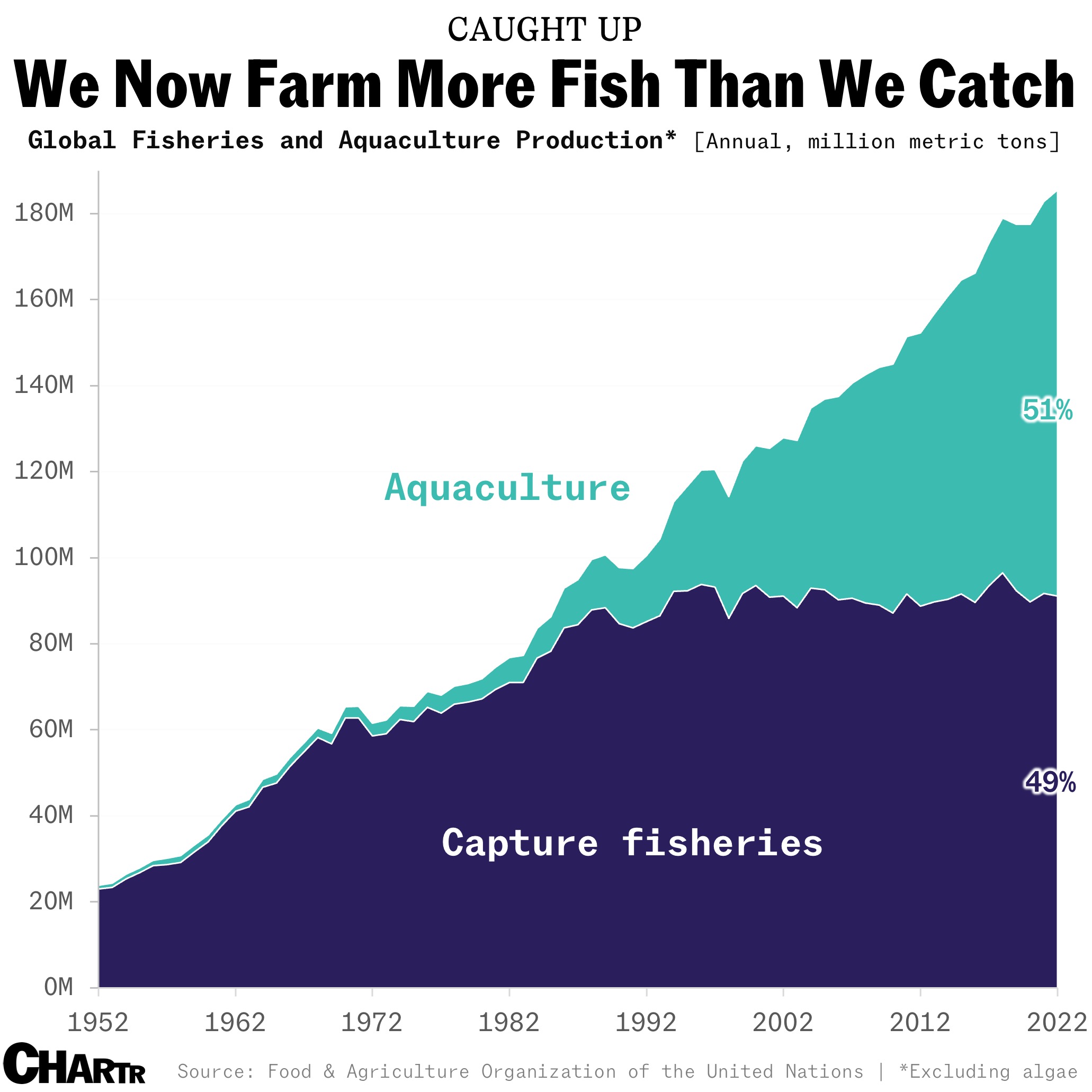
A recent article in Sherwood titled, “Aquaculture is Making History” (subtitled “We now farm more fish than we catch”) spoke to the amazing growth of aquaculture worldwide. While the good news is that Americans, the most morbidly obese country on earth, are eating 5 lbs. more seafood per year than they had in the 1990s, the downside to all this is that farmed fish are perhaps the most destructive farming imaginable. Along with land-based farming’s effect on the planet, including the destruction of rain forests, the oceans have witnessed an across-the-board destruction in wild places needed to support wild fish and other wild seafood we eat.

Note: Total aquaculture production, which includes algae and aquatic plants like seaweed, overtook wild fishing efforts more than a decade ago (the more recent milestone excludes sea plants).

From the destruction of mangrove forests along the coasts of tropical waters, where the shrimp farms destroy miles of fish nurseries for the bland shrimp we eat, to the conversion of hundreds of miles of virgin shoreline for the monoculture of various bivalves like geoduck, from the fish farms off the coast of South America to the net pens in Sweden, Norway and Canada creating vectors for disease, we are in the process of radically altering our seas. Eating wild fish is the best thing you can do to stem this trend. Avoiding farmed shrimp and salmon makes an economic statement to those engaged in it.

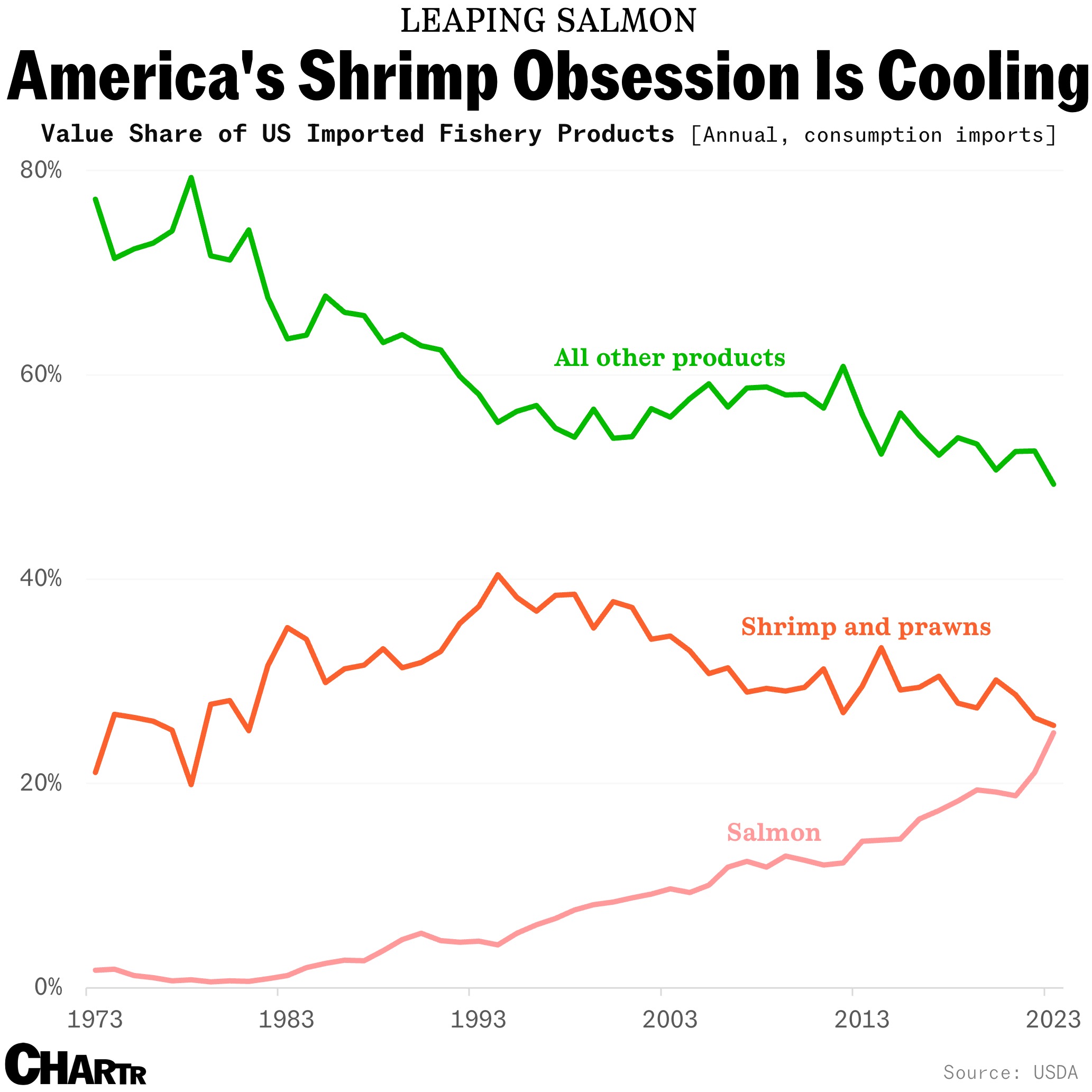
Salmon in particular is a huge problem. While the global community outside of Alaska have decimated salmon runs, salmon net pens continue to provide a growing number of fish to the American market. Salmon has now met the demand of shrimp in our diets.

This rise in farmed salmon, while good for our diets, poses the huge threats to wild salmon, who of course swim past the nets to get a free lunch and then contract whatever disease is happening to the confined fish inside the nets. Think this is just supposition? When net pens were recently banned and removed in specific Canadian waters, the next years that fish that had migrated past since the removal of the pens the runs were huge and healthy, showing virtually no signs of sea lice or disease. Sea lice were huge problems for the net pen industry and attached themselves to wild fish swimming nearby.

What is to be done? Even the Nature Conservancy recently hired an ex-aquaculture industry person who unequivocally supports fish farming globally. Are you really going to fund such an organization?

It is worth noting that the rise in aquaculture also supports seaweed and other plant-based farming. With a push by NOAA (who officially sees the Puget Sound as worthy of turning into an aquaculture farm) to open seaweed farms here, the possibility of even more waters being turned off limits to all of us so floating farms and shorelines can continue to be converted to industrial use is very real.

In 1999 & 2000 the Governor of Washington State and the shellfish industry opened the floodgates to industrial geoduck farming, given that the Chinese market was exploding with a crazy belief in the aphrodisiac properties of eating geoduck. What was never discussed in that law was “how much is enough? When do we say we have converted enough shoreline to aquaculture?” The industry influences our rural politicians by contributing to their campaigns and seeds their people into environmental organizations both by sitting on their councils, and donating to their “recovery” efforts, as long as it does not impact their ability to make money. In discussions with environmental organizations about this very issue, all but one of them would consider talking up against aquaculture, because they all rely on grants from the industry to support their non-profit work.

Tribes have shifted into commercial aquaculture, some doing good work in raising relatively benign fish such as sablefish (aka black cod) but have also taken on extremely controversial acts such as pressing to put a large-scale aquaculture farm inside the federally protected Dungeness Spit. While scientists from the Spit were threatened with their jobs by national managers (during the Trump presidency), local leaders and environmentalists were unwilling to criticize the tribes for any reason whatsoever.

All this means that while some environmental organizations may be crowing about the growth of aquaculture to feed a hungry planet, the increasing threats to our seas and wild fish continue unabated.

Read the whole article on Sherwood and sign up for their newsletter.

Sherwood News

Note: Some of you regular readers may note that The News has not been publishing as much lately. While I have made an effort to keep up, bad news has been in much greater volume than good news, and I strive to find positive environmental stories to share with you, along with efforts by concerned citizens to protect our fragile and decreasing natural resources. So, my feelings are “less is more”. I’ll continue to bring you the News as it matters. Today’s article I felt was more educational in nature, helping put in perspective the larger forces that are affecting our region. Have a great 4th of July. Our democracy means we have voices that can dissent against this wholesale destruction and not find ourselves in a “re-education” camp, or worse. This November, vote for candidates who actually deliver and not just talk. There are too many of the talk, not deliver on both sides. We will be posting our picks for true environmental candidates in an upcoming post. Thanks again for reading.

Jefferson County shorelines needs your help now

Jefferson County is updating its Shoreline Master Plan and is being heavily lobbied by the shellfish industry to allow for the approval of additional geoduck farms in our tidelands without public input.  Neighboring counties–Kitsap and Clallam–allow for public input but Jefferson hasn’t yet committed to this.  Find out what’s at stake as this multimillion dollar export business looks to expand here.   Local environmental activists will talk about their work and how you can get involved.

With a growing multimillion dollar marked in Asia, the shellfish industry is eyeing Jefferson County’s tidelands for increased geoduck cultivation. Geoduck cultivation involves the intense use of plastics—some seven miles and eleven tons of tubing per acre.  Each tube fosters a wholly unnatural density of the large clams that are then “harvested” using hydraulic hoses to liquify the tidelands down to three feet.  Then the whole process starts over again.  Geoduck cultivation raises many environmental concerns, among them: competition for marine nutrients, displacement of tideland marine life, and plastics pollution.  Sierra Club is asking the Jefferson County Commissioners to require a thorough review and public input before issuing any permits to farm geoducks.  A standard “Conditional Use Permit”, as is required in neighboring Kitsap and Clallum counties, should be the norm.  

 When:  Thursday January 18, 7PM on Zoom

https://act.sierraclub.org/events/details?formcampaignid=7013q000002Hy4YAAS

ACTION item: Stopping the industrialization of the Dungeness Wildlife Refuge

Time after time, citizens have had to sue the U.S. Fish and Wildlife Service (USFWS) for failing to protect the animals and their habitat as required by law, in areas that the nation has recognized as critical to preserve as habitat and for public recreation. Now USFWS is willing to allow, for private profit, the industrialization of refuge lands for shellfish operations. 


>>Tell the U.S. Fish and Wildlife Service and U.S. Secretary of Interior Deb Haaland that the Dungeness National Wildlife Refuge lease for industrial aquaculture must be rescinded.


In spite of demonstrated harm to birds, salmon, forage fish, and shellfish, and a recommendation by the National Marine Fisheries Service that “an alternative site be identified in a location that results in less potential impacts to wildlife that is more appropriate for aquaculture and meets the goals of the tribe,” USFWS approved a lease for an industrial oyster farm inside the Dungeness National Wildlife Refuge. This decision, which is in violation of the Clean Water Act and the Migratory Bird Treaty Act, must be reversed. 


In the words written of an October 2022 USFWS internal memorandum, “Forgoing a compatibility determination in order to facilitate incompatible commercial activities by any entity would be a subversion of the fundamental requirements in the [USFWS] Improvement Act.” 


We are targeting the most recent case of the USFWS’s permissiveness in one of the country’s most pristine nature lands, the Dungeness National Wildlife Refuge in the small rural town of Sequim Washington, just below the Olympic National Park. In this case, the shellfish corporation raises shellfish on other sites. They do not need to operate in a national refuge and deny wildlife their feeding and breeding grounds. 


The Dungeness National Wildlife Refuge was created by Executive Order in 1915 by Woodrow Wilson, directing the area to be set aside as a “refuge, preserve and breeding ground for native birds and prohibits any disturbance of the birds within the reserve.” The front page of the Refuge website states: “Pets, bicycles, kite flying, Frisbees, ball-playing, camping, and fires are not permitted on the Refuge as they are a disturbance for the many migrating birds and other wildlife taking solitude on the Refuge.” With this level of concern, it is counterintuitive to allow destructive industrial aquaculture.  


Industrial shellfish aquaculture is known to reduce or eliminate eelgrass with the use of pesticides. Shellfish aquaculture also involves large-scale use of plastics—PVC tubes and plastic netting—that are hazardous to marine organisms and can trap and entangle wildlife. Commercial shellfish aquaculture is a major industry in Washington state that has significant impacts on the nearshore marine environments, which provide essential habitat for many species, including invertebrates, fish (including herring and salmon), and birds (migratory and shorebirds). 


Among the negative impacts of this project are: 50% reduction in bird primary feeding grounds; plastic oyster bags that exclude the probing shorebird flocks from feeding deeply into the substrate, entrap fish and birds, add macro- and micro-plastic bits to the sediment throughout the refuge, and shift the benthic community composition; diminishing of the ecological benefits provided by eelgrass to threatened fish and birds, such as nourishment and cover from predators; and increased algal blooms that will leave a graveyard of dead oysters. These detrimental effects to the Dungeness National Wildlife Refuge are NOT minimal. Decisionmakers should not place financial benefits to the corporation above the long-term and cumulative impacts to the refuge. Half of the world’s 10,000-odd bird species are in decline. One in eight faces the threat of extinction. 2.9 billion breeding adult birds have been lost from the United States and Canada in only 50 years. 


Let’s raise our national voice and try and stop this refuge destruction with public persuasion. This is a public space we pay to protect. For more information, check out the Daily News post from last August, “Groups Sue U.S. Interior Department to Protect the Dungeness National Wildlife Refuge from Industrial Aquaculture.” 


This action follows a lawsuit filed by three environmental organizations against the U.S. Department of Interior for failing to protect the Dungeness National Wildlife Refuge from industrial aquaculture. The groups, including Protect the Peninsula’s Future, Coalition to Protect Puget Sound Habitat, and Beyond Pesticides, filed their complaint in the U.S. Western District Court of Washington State. The complaint states that the U.S. Fish and Wildlife Service (USFWS), U.S. Department of Interior, must “take action that is required by the Refuge Improvement Act and conduct a compatibility determination and require a special use permit for a proposed industrial aquaculture use” that will abut and impact the Refuge. The plaintiffs are represented by the Seattle, WA law firm of Bricklin and Newman LLP. 


>>Tell the U.S. Fish and Wildlife Service and U.S. Secretary of Interior Deb Haaland that the Dungeness National Wildlife Refuge lease for industrial aquaculture must be rescinded.


We are focusing this Action against the U.S. Environmental Protection Agency and the U.S. Secretary of State.  


Thank you for your active participation and engagement!


Please take this ACTION and circulate it to your family, friends and colleagues.

https://secure.everyaction.com/WMJxQmNjDUqarx4FmLzUrA2

also, to support the lawsuit, you can send checks to:

Send a check to: PPF, POBox 421, Sequim WA 98382 or through PayPal: https://www.protectpeninsulasfuture.org/donate/

        PPF is a federal recognized 501c3 non-profit.

Cooke Aquaculture leaves Puget Sound

(From Wild Fish Conservancy) -Cooke Aquaculture, is pulling up stakes, hitting the road, and leaving Puget Sound forever. All week, local residents and members of the public stood on the shores of Bainbridge Island watching workers operating loaders and cranes packing up nets, removing debris, and pulling up anchors and chains that have been holding the industry’s net pens in place for over forty years.  Across the Sound, in Kiket Bay, local landowners watched as the Hope Island net pen was rigged up to a towboat and pulled out of sight and away from the waters it polluted daily at the mouth of the Skagit River. Below is a photo taken on Wednesday immediately after the Hope Island net pen was removed, showcasing the bay’s first moments free of commercial net pens.

In November, Commissioner of Public Lands Hilary Franz made clear she heard the voices of the nearly 10,000 individuals and hundreds of organizations and businesses working together under the Our Sound, Our Salmon coalition when she issued her groundbreaking decision that the Department of Natural Resources was taking bold action to protect Puget Sound from commercial net pen aquaculture. Not only did Commissioner Franz deny the industry’s request for new decade-long leases to operate in our public waters, but she took an even bolder step by enacting a new policy banning commercial net pen aquaculture in Washington marine waters indefinitely. 


Whether this will hold up to the court challenge being brought by some Tribes remains to seen. Franz, running for Governor against Attorney General Bob Ferguson and facing criticism by some environmental organizations for her forestry policies, needed to bolster support from the environmental wing, while deciding that alienating tribes like the Jamestown S’Klallam would not cost her much in the way of votes. Certainly this will play well on “The eastside of the Sound” where her fundraising will be primarily done, as Seattleites rarely understand the subtleties of the issues raised by those on the Peninsula. Why? The Jamestown have been working with Cooke on changing the net pens to native Black Cod (Sablefish). So they are not happy about this decision. Other tribes have supported this decision, once again highlighting that the Tribes of the Salish Sea are not a single entity in their decision-making, but a coalition of individual political entities with unique needs. It is unclear of how this may play out as the State works with the Tribes on future negotiations around fishing regulations.

Years ago, I interviewed a local elderly fisherman, who had fished the areas around Agate Pass. His belief was that after the net pens came in, he noticed a significant drop in wild salmon the following years. Of course, this could have been coincidental, given the amount of destruction happening through rampant development about the same time to the spawning streams of Puget Sound and overfishing off the coast. But I was also hearing similar things from other older fishermen about the Hood Canal Floating Bridge, which then turned out to be true. A large sum of money is being spent right now to mitigate what has only lately proved out to be the correct assumption of that “old timer” regarding Hood Canal. We’ll get to see if salmon numbers recover in the Agate Pass area, now that Cooke is gone.

DNR approves oyster farm in National Wildlife Refuge. Time to take action.

A Department of Natural Resources head who claims to be an environmentalist has “no knowledge” of her office letting commercial aquaculture invade a National Wildlife Refuge.

Photo of Dungeness Spit by Al Bergstein

Hilary Franz who is the head of the department of natural resources here in Washington state, approved putting a commercial shellfish aquaculture business inside the Dungeness Spit wildlife refuge just to the right in this photo. Up to 80,000 oyster bags covering the bottom. This refuge was created for diving birds and other wildlife that feed here. You and I can’t even fly a kite in there and haven’t been able to for 100 years.

As this author wrote back in 2018:

New concerns over the possible permitting of an oyster aquaculture farm within the Dungeness Spit Wildlife Refuge have been raised by the Department of the Interior, which manages the refuge. In a letter written to Steve Gray, the Clallam County Deputy Director and Planning Manager, Jennifer Brown-Scott, the Project Leader for the Department of the Interior, has raised significant questions about issues concerning the application.

Of concern to the Department are a number of issues relating to wildlife in the refuge. The applicants have asked for permission to place approx. 150,000 (it appears that 80,000 is the current number at most) of “on bottom” oyster bags on the central west side of the bay, in approximately 34 acres of the tide flats 1141 acres of the inner spit. This appears to be approx. 3.35% the inner bay area.  The applicants propose to raise non-native oysters. To be clear, a significant number of cultivated oysters in the Salish Sea are non-native, so this is not a surprise.

Within the area of the Dungeness Spit Wildlife Refuge are federally listed species that are protected or have environmental listings of concern. They include but aren’t limited to: Bull Trout, Marbled Murrelet, Puget Sound Chinook and Hood Canal Summer Chum. Also within the area is significant state listed wildlife habitat. Of somewhat lesser concern is the impact on the public to the scenic beauty of the wildlife preserve, which is one of the main reasons most visitors go to the area in the first place.

Herring also spawn at the west end of Dungeness Harbor and the Department of Interior raised questions about protecting Strait of Juan de Fuca herring, which have been designated “critical” (as in critically low).  Sand Lance and Surf Smelt spawning grounds are also found in the area of the application. These species have been identified as “Washington Species of Greatest Conservation Need within the State Wildlife Action Plan (WDFW 2015). A worry related to this is that these spawning fish will be competing with the oysters for plankton. A failure to find enough food could lead to a significant reduction in the survival rates. There is no know mitigation for this, other than limiting the size and scope of the project.

The area just to the east of the proposed site is the location of the highest infestation of European Green Crabs in the Salish Sea. Another concern is that the proposed oyster bags may provide habitat for green crabs, allowing them to be moved to other areas outside the Spit the bags are transported.

This shoreline has been designated “Natural” in the Critical Areas Ordinance, as far back as 1976. That designation limits activities to those that preserve the national features unchanged. One would assume that the tidelands are also part of that designation.

Noted bird biologist George Divoky commented:

When birds can’t find their food in an area they have used in the past they will not die at that location but fly elsewhere to find suitable habitat. Mortality could occur due to the costs of involved in seeking out that habitat. Certainly, the aquaculture being proposed would modify the habitat used by the birds and all of the far less visible components of the nearshore ecosystem. People tend to focus on birds being affected by anthropogenic changes to the marine environment – since they are visible and warm-blooded vertebrates – but this sort of exploitation of the marine environment by the growth economy would have ecosystem effects.

George Divoky

It is certainly reasonable for the applicants to want to return to aquaculture in the Bay, however the scale is being significantly increased. Science has learned a lot about the environment since the time when the State allowed the use in this location, dating back to around the time of WWII. In many other locations we have decided that the tradeoff of commercial activity is outweighed by a newer appreciation of the value of the natural landscape for a variety of species.  One example of this is that we have ended other bad practices, such as gold mining in salmon streams, which was accomplished not that long ago.

It is up to all of us to question our elected officials and bureaucrats, not the applicants, as to why they believe that this is in all our best interests, when we so clearly have set this aside this location for wildlife protection and enhancement.

What the Dungeness Spit Wildlife Reserve will soon look like. As many as 80,000 of these bags will be located on the bottom.

The head of DNR, Commissioner Franz, when recently asked at a fundraiser for Jefferson County Democratic supporters about her department permitting this controversial site, said, “I have no idea what you are talking about.” However, the Department approved it on her letterhead. She also had a direct report of hers send out a response letter to an environmentalist who was expressing their concern in August. The letter stated that “Commissioner Franz has asked that I respond to your concerns on her behalf.

As the old saying goes, “The buck stops here.” Commissioner Franz, in her second term, has run on being an environmental supporter if not an activist. Her campaign web site states” Hilary is on the front lines protecting our lands and waters and standing up for our communities.” A search of her campaign finance contributions showed both the Grantee, along with Pacific Seafood and Taylor Shellfish as donors. That in and of itself seems unseemly, if not worse, to be taking donations from the very people who you are regulating. But we all know it happens all the time. However, her ongoing blanket approvals of the ever-expanding shellfish industry now has apparently been a bit of environmental protection that she does not even pay attention to in her department.

What could she have done instead? Land swap. It’s being done by her department all over the State, where environmentally sensitive areas are being protected. That it wasn’t even a point of discussion is irresponsible.

In a letter to local activists, by Katrina Lassiter, the Interim Deputy Supervisor for Aquatic Resources it was stated that “These measures were created through collaboration and input from scientists, regulatory agencies, and the environmental community including the Audubon Society.”

On 8/20/21, Ms. Lassiter was asked to provide documentation for the statement: She has not responded. No environmental organization that was contacted offered any support for that statement.

Where were the local Audubon Society and Sierra Club members? They both apparently thought it was too controversial and choose to take no action. Why be a member of groups that were created to protect the environment and now can’t even take verbal stand against an action like this? Where is the Washington Environmental Council and their People For Puget Sound Campaigns? Silent. Remember this as you consider your end of the year donations.

Want to put your money where it works? Try starting with the Protect Our Peninsula’s Future, or the Olympic Forest Coalition, or Sea Shepard’s legal fund, or the Wild Fish Conservancy, or the Center for Environmental Law, or any of the other organizations who will sue for change, since we cannot rely on paper “environmentalists” to do the work we expect of them. They all seem to be beholden to the people continuing these policies of destruction. Everyone seems to want to restore destroyed environments but few want to stop them from being destroyed in the first place.

The call to action on your parts, if you choose to take one, is to call Commissioner Franz’ office and let them know your dissatisfaction with this decision. When she comes to your county looking for donations for her future political ambitions, tell her when she reverses this decision, you’ll consider funding her next campaign.

Her number is (360) 902-1000.

Norwegian company to build large, land-based salmon farm in Belfast Maine – Republican Journal

News from Maine, shows that fish farming corporations have finally come to grips with the fact that it’s net pen aquaculture doesn’t work, and are moving to build upland facilities that are financially viable. We hope that the Tribes here in Puget Sound, who are holding off support for banning net pens, can use this information to press State Senators Ranker and Van de Wege to add funding for a couple of experimental sites to prove the viability here in Puget Sound. The use of our waters for ‘feed lot’ kind of fish farming, pouring vast arrays of chemicals and fish food must end. We know that the Tribes ‘do the right thing’ as it comes to aquaculture and we hope that they can exert pressure to help them get from this dying technology of net pens, to a new way forward with upland containment.

A Norwegian company plans to build one of the world’s largest land-based salmon farms in Belfast, a project that would create 60 jobs within two years and up to 140 once it is completed, according to the company’s chief executive officer.

https://www.pressherald.com/2018/01/30/norwegian-company-to-build-large-land-based-salmon-farm-in-belfast/

The B.C. Scallop Farmer’s Acid Test – The Tyee

More on the emerging ocean acidification issues of aquaculture. 

Rob Saunders points a flashlight into the depths of an immense plastic tank at his hatchery, illuminating millions of scallop larvae as tiny as dust particles. “Think of these as canaries in a coal mine,” says the marine biologist turned embattled shellfish farming CEO. It is here at Island Scallops’ facility in Qualicum Beach, located just inland from British Columbia’s shellfish farming epicentre of Baynes Sound, that ocean acidification wreaked havoc. Beginning in 2011, the company’s scallop brood stock (adult shellfish bred over 25 years to be disease-resistant and exceptionally meaty), began to die. Christopher Pollon reports. (The Tyee)

http://www.huffingtonpost.ca/2015/11/19/climate-change-scallops_n_8597502.html

Gear, not geoducks, impacts ecosystem if farming increases – UW Today

Worth noting. The controversy over the conversion of natural shoreline to industrial aquaculture because of the current high prices being commanded in the Far East, is given new ammunition by a study done by the UW. This study should be read with the earlier 7 year study by Washington Sea Grant, that showed that impacts to the nearshore were reversible. That does not mean that they were non-existant. The biggest concern many people have is that entire bays are being converted to what amounts to a commercial farm, with near shore habitats being converted from natural to endless seas of tens of thousands of plastic pipe, which is used to protect the immature geoducks from predators. Harvests are done at low tide, meaning that in the winter, a homeowner may find themselves being kept awake by the compressors that are used to blow air to get to the ducks. With the value of the near shore properties and a lack of transparency by many real estate agents, it often comes as a very unpleasant surprise to new home owners. Once converted to aquaculture, the shorelines will never be allowed to return to a natural state, unless the market collapses permanently. And the state of Washington bureaucrats are really not interested in stopping this growth, being very much supportive of commercial aquaculture over natural shores. They believe that the carrying capacity of the Sound is able to handle it, but they have made these decisions with little science to back it in the past. With all these new studies, it’s now up to citizens in the various locales to raise these issues as policy decisions rather than trying to stop the new farms based on environmental concerns alone. Balancing this is the fact that the Tribes are entitled do aquaculture based on historical treaty rights, and aquaculture is one of the core protected activities of our state constitution, because the founding fathers recognized food production over all other concerns. As usual, there is no simple answer here.

The equipment used to farm geoducks, including PVC pipes and nets, might have a greater impact on the Puget Sound food web than the addition of the clams themselves. That’s one of the findings of the first major scientific study to examine the broad, long-term ecosystem effects of geoduck aquaculture in Puget Sound, published last week in the International Council for the Exploration of the Sea’s Journal of Marine Science. Michelle Ma reports. (UW Today)

Though these results show that Puget Sound can generally support more geoduck aquaculture, if effectively managed, the model can’t drill down to specific inlets or bays and predict how organisms would react at a finer scale to increased farming, researchers said. Further studies are needed to determine the potential impact of more aquaculture activities on specific areas of the Sound, they added.

http://www.washington.edu/news/2015/10/21/gear-not-geoducks-impacts-ecosystem-if-farming-increases/

Kuterra aquaculture by ‘Namgis First Nation raises hope for wild salmon— and some hackles – National Observer

An update on the attempt to create a financially viable closed-containment aquaculture in BC. Ramifications for the Olympic Peninsula because of the push to bring open water net pens to the Straits and expand use in the Sound continues.

The ’Namgis First Nation, with advice and support from a large number of groups, including Tides Canada, conservation groups, and funding agencies, has launched Kuterra, a land-based, “closed-containment” aquaculture project that keeps their Atlantic salmon out of contact with the larger marine ecosystem.

http://www.nationalobserver.com/2015/07/23/news/kuterra-aquaculture-%E2%80%98namgis-first-nation-raises-hope-wild-salmon%E2%80%94-and-some-hackles

Scientific Study Shows Effects of Geoduck Farming on Beaches

In 2007, the Washington Legislature, at the prompting of environmental organizations such as People For Puget Sound, and the shellfish industry, funded a long term study of the effects on geoduck aquaculture on beaches. This highly politicized issue, due to the expansion of  long term geoduck farming on ever increasing locations in the South Sound in particular, was viewed as the best way to resolve the bitter disputes over the industry. Some environmentalists were hoping this would be a ‘smoking gun’ of the issues that the industry is having, while the industry assumed it would vindicate them. It appears that the results do not do either, but do point to concerns that need to be researched over a much longer period in time, and about the trade offs in expanding this industry while attempting to save eelgrass beds for salmon habitat. This is the first real long term study ever attempted here in Puget Sound. Fifteen scientists took part in the study over a six year period.

The short conclusion to the data was that it appeared that there was no immediate concern that geoduck farming is distinctly doing long term negative affects on the ecosystem. Concerns were raised over possible effects that were longer than the scope of this project, and recommendations for further research on these were stated.

There were six priorities to investigate, as mandated by the Legislature:

1. the effects of structures commonly used in the aquaculture industry to protect juvenile geoducks from predation;

2. the effects of commercial harvesting of geoducks from intertidal geoduck beds, focusing on current prevalent harvesting techniques, including a review of the recovery rates for benthic communities after harvest;

3. the extent to which geoducks in standard aquaculture tracts alter the ecological characteristics of overlying waters while the tracts are submerged, including impacts on species diversity and the abundance of other organisms;

4. baseline information regarding naturally existing parasites and diseases in wild and cultured geoducks, including whether and to what extent commercial intertidal geoduck aquaculture practices impact the baseline;

5. genetic interactions between cultured and wild geoducks, including measurement of differences between cultured and wild geoducks in term of genetics and reproductive status; and

6. the impact of the use of sterile triploid geoducks and whether triploid animals diminish the genetic interactions between wild and cultured geoducks.

Conclusions of the study indicated that the farms do impact eelgrass while the farms are in place, but that the grass recovers when they are removed.  But more research on the effects is needed they added. 

Effects of harvest on the benthic layer showed little negative impact, but there are a variety of other issues around this topic that need further study, such as spatial and temporal cumulative effects, the report added.

Effects of Nitrogen and Phosphorus accumulation was ‘mixed’ but did not show any kind of damning evidence that would be cause for immediate action. It appears that the beds do lead to a small increase in both these elements.

Disease issues included finding of several previously unreported parasites in geoducks. However, this data only creates a baseline for future studies. There was no conclusion as to the long term negative effects and whether the farms are contributing in any signficant way to the parasites presence.

Issues related to destruction of eelgrass beds showed that the long term effects seemed minimal, but the short term effects were significant. This raises the issue, given the efforts to recover and protect eelgrass beds, that there is a trade off on a yearly basis between salmon habitat and geoduck planting. There is no conclusion as to how significant this is. More research is needed on this topic, the report stated.

More research was recommended on cumulative effects longer time frames, water column effects, disease identification tools and prevalence in farmed populations, contribution of issues of reproductive effects on natural populations, and genetic effects on native stocks.

The entire report can be viewed at:

http://wsg.washington.edu/research/geoduck/

State Department of Natural Resources announces trial geoduck aquaculture lease initiative on state owned lands – DNR

It is not clear where these trial tracks are located. Expect followup when known.

STATE DNR ANNOUNCES TRIAL GEODUCK AQUACULTURE LEASE INITIATIVE ON STATE-OWNED AQUATIC LANDS

OLYMPIA – The Washington State Department of Natural Resources (DNR) announced today that it is initiating a small pilot program to allow geoduck aquaculture on a limited number of state-owned aquatic lands.

DNR anticipates entering into lease agreements with existing applicants once all environmental review and permitting processes are complete. This effort is a follow-up to commitments made by the agency in 2007. Numerous steps remain before active aquaculture would begin on public lands including potential site assessment; State Environmental Policy Act review; issuance of local government conditional use permits; U.S. Army Corps of Engineers Title 401 permitting; and Washington Department of Health Certification.

In 2007, the Legislature established a geoduck aquaculture research program under Washington Sea Grant and established a regulatory advisory committee with participation from government, Treaty Tribes, and citizen representatives to help guide related research. DNR plans to require monitoring at geoduck cultivation sites on state-owned aquatic land to provide further opportunity to study the effects of geoduck aquaculture on the aquatic environment.

http://www.dnr.wa.gov/BusinessPermits/News/Pages/2013_08_02_dnr_announces_trial_geoduck_aquaculture_leases_nr.aspx

Dr. Lawrence Dill Net Pen Presentation Now Online

If you are concerned about the latest proposals to bring net pen aquaculture to the Strait of Juan de Fuca (5 miles west of Port Angeles), or are concerned and unclear about the current standoff by the Department of Ecology and the Jefferson County Commissioners over allowing in water net pen aquaculture in Jefferson County (through the Shoreline Master Program updated), then you should take the time to listen to this lecture (it runs over an hour in total). It is, to be sure, one of the most comprehensive overviews of the possible negative impact of net pens I’ve ever heard, and is based on research done just north of us, in BC. While Dr. Dill clearly states that there are variations of environment between there and here, the issues are ones that we may face if they are allowed here. Then again, as pointed out in the Q&A session at the end, by the manager of one of the net pen companies south of Bainbridge Island, some of these issues have not shown up (though that comment was not based on peer review independent scientific research, but on experiential information. It was not independently verified and simply is presented as the point of view of the farm manager).

Dr.Dill is one of the foremost researchers on sea lice, and has a lot to say about the “possible” negative impacts of net pen aquaculture based on years of scientific, peer reviewed, published work. He was brought to lecture in Port Angeles last week, by a consortium of environmental groups concerned about the proposals for net pen aquaculture in Jefferson and Clallam counties lately. The event was sponsored by the Coastal Watershed Institute, Wild Salmon Center, Sierra Club Activist Network, and Olympic Peninsula Chapter Surfrider Foundation.

His talk was titled:
Evolutionary & Behavioral Ecology and Earth2Ocean Research Groups of Simon Fraser University, British Columbia, Canada presented:
POTENTIAL NEGATIVE ECOLOGICAL CONSEQUENCES OF OPEN NET PEN SALMON AQUACULTURE: LESSONS FROM BRITISH COLUMBIA

The discussion included:
• The impacts that salmon farms can have on wild salmon stocks
• Recent research on sea lice and other pathogens.
• How the iconic Fraser River sockeye salmon have been put at risk by salmon aquaculture.
• Degradation of the bottom communities below the farms.
• Pollution, by-catch of other fish species, escapes, and inadvertent or intentional reduction of marine mammal populations.
• New potential open pen aquaculture projects near Port Angeles.

The introduction by Anne did not have a microphone so it’s a bit noisy. Dr. Dill did have a microphone on, so it sounds better when you get to him speaking. The video was published in two parts. A shorter 10+ minutes to allow you to get the gist of the presentation, and the rest of the presentation in Part 2. The audio podcast is presented in it’s entirety.

You can view Part 1 of the lecture online at https://vimeo.com/47903851.

Part 2 is located at
https://vimeo.com/47906547

Or you can listen to it online at:

http://soundcloud.com/mountainstone/dr-lawrence-dill-netpens

I am adding the links above to the “Educational” links on the left hand side of the front page. You can always find it there if you need to refer to it later. Thanks to Dr. Dill for allowing the sponsoring groups to videotape the presentation, and offer it to those who were unable to make it to the discussion.

Dr. Larry Dill on Net Pens