Shipping Industry to Begin Footing Bill for Rescue Tug

After 10 years, finally, an agreement.

6/22/10 Kitsap Sun
Shipping Industry to Begin Footing Bill for Rescue Tug
By Christopher Dunagan

NEAH BAY
Oil shippers will pay 57 percent of the cost of an emergency rescue tugboat at Neah Bay when private industry takes over paying for the tug operation on July 1.

Representatives of the tanker and non-tanker sectors of the shipping industry have reached an agreement on cost allocation. They have signed a contract with Foss Maritime to provide a rescue tug for the coming year.

“It was a yearlong process (of negotiation),” said Frank Holmes, Northwest manager for Western States Petroleum Association. “In the end, the industry stakeholders were able to reach a cost-sharing agreement.”

More at
http://www.kitsapsun.com/news/2010/jun/22/shipping-industry-begins-footing-bill-for-rescue/

NOAA finds new deep-sea habitat off Olympic Peninsula – Seattle Times

Great news!

6/20 Seattle Times
By Cassandra Brooks
Seattle Times staff reporter

A federal research cruise off the Olympic Peninsula coast has revealed new deep-sea boulder fields peppered with bright sponges, small corals and rockfish.

The National Oceanic and Atmospheric Administration cruise, which returned last week from the Olympic Coast National Marine Sanctuary, was the first in a series of summer cruises looking for new deep-water rocky habitats and deep-sea coral fields.

Using high-tech underwater vehicles that take video and still photos, researchers examined critters in the sanctuary’s depths, including petite deep-water corals, bright green sponges and a variety of fish.

More at
http://seattletimes.nwsource.com/html/localnews/2012168334_coral21m.html

Puget Sound Oil Spill Prevention Phone Conference Call in – Wednesday June 23rd

Kathy Fletcher, the Executive Director of People For Puget Sound, and Bruce Wishart,  Policy Director of the group, will hold a call in conference to discuss the state of oil spill preparedness for Puget Sound on Wednesday evening, at 7PM.  Here’s the invitation from Kathy. Please preregister!

Thankfully, underwater oil drilling is not allowed in Washington waters. Instead we have major oil refineries bringing in millions of gallons of crude oil, barges taking out millions of gallons of petroleum product, and large cargo vessels and cruise ships each carrying thousands of gallons of fuel on our inland waters.

A state oil spill advisory council reported that the state and these industries are not prepared for a major oil spill in Puget Sound and the Straits.

I’d like to invite you to a phone conference briefing on the state of our Puget Sound oil spill prevention and spill preparedness with policy director Bruce Wishart and myself on Wednesday, June 23, beginning at 7 PM and lasting for about an hour.

We can accommodate 1,000 phone participants at this phone briefing. To participate, please RSVP online and a call-in number and access code will be sent back to you.

I think you will find this briefing informative and inspiring. Whether you are able to call in or not, I urge you to help us make the state’s spill prevention and response measures stricter.

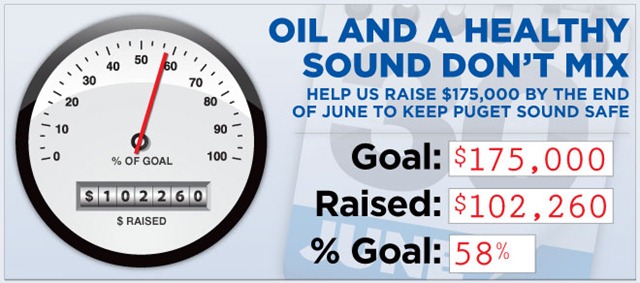
Before the end of this month, please donate to our $175,000 Spring Clean Water Campaign so we can continue our work to keep our Puget Sound waters and shorelines oil-free and healthy.

Matrix of Olympic Peninsula Environmental Education groups

The Feiro Marine Life Center created this handy matrix of the educational groups (all of which are listed on the left side of this page under “educational” links) operating on the Peninsula. This document goes into greater detail of what they are doing, who they serve, etc.  Updated as of June 2010. Feiro_EE_matrix_final 3_30_10

Video -People For Puget Sound – Orcas & Salmon

From People For Puget Sound…How it all fits together.

People for Puget Sound | Orcas and Salmon from eric becker on Vimeo.

Help People For Puget Sound raise $175k by June 30th!

Did you like the video on salmon? If you appreciate that and also the work I do on this blog, invest in this campaign.If you want more info on People For Puget Sound, go here…

http://pugetsound.org/pps-home-page/cleanwater

cw_0610

Dungeness Crab Mortality Due to Derelict Pots

From the NW Straits June Newsletter

People at the Crab Mortality PresentationJeff June, Natural Resources Consultants, is the derelict fishing gear removal field manager for the Northwest Straits Foundation. Jeff presented results from the recent study of Dungeness crab mortality from derelict pots supported by the Stillaguamish Tribe and Northwest Straits Foundation.

Jeff reported that the Washington Department of Fish and Wildlife estimates that 12,193 crab pots are lost each year in Puget Sound. Each lost crab pot without escape cord kills approximately 30 crabs each year until deterioration. Jeff provided several ways to prevent crab pot loss:

· Don’t fish in marine transit zones

· Weight your pots so they don’t move in high currents

· Make sure line is long enough for the depth you are fishing

· Use multiple floats in high current areas

· Don’t set pots too close together

· Always use escape cord – 120 thread count is regulation but a better rule of thumb is to use 1/8 inch diameter cord.

· Report lost pots

A recent change in regulations allows enforcement agents to ticket crabbers for transporting illegal pots on marine waters, instead of only ticketing for actively fishing illegal pots. Jeff explained that there are some areas of concentrated accumulation of crab pots that will be targeted for this enforcement.

Click here for a pdf copy of the presentation.

Crab Management in Washington State

From the NW Straits June Newsletter

Rich Childers, Shellfish Manager with the Washington Department of Fish and Wildlife, recently gave a presentation on the management of Puget Sound’s Dungeness crab fishery. This is one of the most complex fisheries in the world to manage, involving 17 tribes and three natural resource agencies. This year the state will assess a $10.00 penalty for failure to report crab catch, in an effort to more accurately estimate the recreational harvest. Rich reported that the crab fishery is sustainable, and currently all marine areas except for South Hood Canal have the highest catches on record.

Click here for a pdf of Rich’s presentation.

If you are interested in crabbing at all,you should read Rich’s great presentation.

Plastics Summit Draws a Crowd

From the NW Straits Commission June Newsletter:
A dynamic group of over 70 field volunteers gathered at Fort Worden in May for the Citizen Science Summit on Plastic Pollution in the Salish Sea, hosted by the Port Townsend Marine Science Center and co-sponsored by the Northwest Straits Commission. Since 2008, these and other committed citizen scientists around the region have sampled beach sediments at 15 sites to study tiny fragments of plastic (known as microplastics) in the sand. Early results of the Center’s project provide shocking numbers: an estimated six metric tons of microplastics, plus 3.4 tons of glass, cigarette butts and other debris, have washed up on Puget Sound beaches. Dr. Joel Baker, an expert on chemical pollutants at the University of Washington/Tacoma, served as the event’s keynote speaker. For more information on the summit and the microplastics project, contact Jen Kingfisher at jkingfisher@ptmsc.org.

Group attended the Marine Science Summit on Plastic in the Salish Sea

Brinnon Group Meeting in Quilcene – 6/23 4 to 6 PM

The Brinnon Group will be meeting at the Timberhouse in Quilcene from 4 to 6 on June 23.  Ben Gruel from the Sierra Club plans to attend and to talk with us about our "challenges and opportunities."  Other topics will include the EB 5 funding program the developer wants to use, MOUs being developed, water-related issues, and communication strategies.  Let me know if you have any questions or any suggestions for the agenda.  Thanks.  Barbara

Oyster Poaching Case Reveals Shellfish Safety Gaps

I visited Peter Downing at his Geoduck farm the other day, and he alluded to this situation. A real dark side to the whole aquaculture world. And the state funding for enforcement is virtually non-existant.  You can’t just legislate stuff, you have to provide money for enforcement, which has been a weak spot for years. Demand enforcement! – Editor

6/17 KPLU-FM

Austin Jenkins
OLYMPIA, WA (N3) – If you ever eat shellfish, you’ll want to listen to this story. A major oyster and clam poaching case has revealed gaps in the system that’s supposed to ensure Washington shellfish are safe to eat. Washington Fish and Wildlife cops recently raided a seafood operation on Hood Canal. They allege an outfit called G&R Quality Seafood was a front for a nighttime shellfish theft ring. KPLU’s Austin Jenkins has our story.
Listen at
Oyster Poaching Podcast

Puget Sound area icons of the past split $750,000 grant

Congratulations to our friends at the Adventuress, who use the boat as a floating environmental training facility. If you have never taken a ride on her, you should do so this summer. With the economy in tatters, it’s a good idea to spend your vacation dollars closer to home. It’s also environmentally the best thing to do!- Editor

6/15 Seattle Times

By Craig Welch
Seattle Times staff reporter

”…Nearly two dozen icons of Puget Sound’s past will split $750,000 in grants as runners-up in a public contest to boost historic preservation in the Seattle area.
… The first place winners — Town Hall on Seattle’s First Hill and a 136-foot wooden ship called Schooner Adventuress — were chosen by the public in a campaign that ended last month. Each was awarded $125,000.
More at
http://seattletimes.nwsource.com/html/localnews/2012126779_preservation16m.html

Olympia Oyster Training at Seal Rock

About 15 of us showed up at Seal Rock State Park to be trained by two of the top experts in the Olympia Oyster in the state. Brady Blake, Washington Department of Fish and Wildlife, and Betsy Peabody, Puget Sound Restoration Fund were the primary trainers.

You can read the whole story at the Jefferson County Marine Resource Committee blog site:


Beaches closed due to Red Tide

6/11 Seattle Times
Red tide closes beaches in Clallam, Whatcom counties
By Susan Gilmore
Seattle Times staff reporter
The state Department of Health has closed the recreational shellfish harvest on beaches in Clallam and Whatcom counties due to dangerous levels of red tide.
Paralytic Shellfish Poison (PSP), or red tide, has been detected at dangerously high concentrations in shellfish samples collected from coastal beaches, the Strait of Juan de Fuca in Clallam County and throughout Whatcom County, said the Health Department.
Commercial beaches are sampled separately and commercial products should be safe to eat, said health officials.
More at
http://seattletimes.nwsource.com/html/localnews/2012089396_redtide12m.html

North of the Border news…going to bat for Orcas

6/12 The Province
Environmentalists in court to extend protection for killer whales
By Judith Lavoie , Canwest News Service
VICTORIA — Environmental groups will be in court this week arguing the federal government is failing to adequately protect critical habitat for endangered and threatened pods of killer whales.
Ecojustice lawyer Margot Venton is asking the Federal Court of Canada for a judicial review, claiming the government is acting unlawfully by interpreting critical habitat only as physical space, instead of ensuring there is salmon for the whales to eat, the water is not overly polluted and whales are not subjected to excessive noise.
“The reason that this is critical habitat is that the areas are natural funnels for migrating salmon — that is why the whales are there,” said Venton, who is acting for the David Suzuki Foundation, Dogwood Initiative, Environmental Defence Canada, Greenpeace Canada, International Fund for Animal Welfare, Raincoast Conservation Society, Sierra Club of Canada and Western Canada Wilderness Committee.
Declines in chinook salmon runs, together with chemical pollution and noise in the ocean that makes it difficult for whales to echolocate prey, have been identified as affecting the survival of the endangered southern resident killer whales and the threatened northern resident pods.
More at
BC court challenge to protect Orcas

Port Susan cleanup a victory for treaty rights

While not directly related to the Peninsula, this article brings up many issues we face as we move forward in partnership with the tribes to restore the Sound, Straits and Canal. And it shows that with cooperation, and dedication, we can actually make progress. A worth quick read.

——

6/6 Bellingham Herald Guest Editorial
Port Susan cleanup a victory for treaty rights
BILLY FRANK, JR. /     THE BELLINGHAM HERALD
Our treaties with the U.S. government were supposed to guarantee that we Indians could continue to fish, gather shellfish and hunt as we always have. But sometimes, development and pollution deprive us of those rights.
Take Port Susan, a protected bay where the Stillaguamish River meets Puget Sound. Traditionally, the Stillaguamish and Tulalip tribes harvested shellfish there. These days, the bay is surrounded by dairy farms, a heavily developed community called Warm Beach and three wastewater treatment plants. In 1987, the state Department of Health closed the area to shellfish harvest because of fecal coliform pollution. That’s the stuff that’s found in human and animal waste.
More at
http://www.bellinghamherald.com/2010/06/03/1461436/port-susan-cleanup-a-victory-for.html

Drill, Baby, Drill …where are they now?

Recent articles in the NYTimes  and Huffington Post recall the stupid chanting that, two years ago, accompanied the Republican candidates as they traveled around the country. Now, as we watch an unending stream of oil destroy the southern coast of America, home to upwards of 40% of our fisheries, it seems like a dream of a crack addict. And Sarah Palin and the others want to blame Obama. Puleeeze….

I am not against drilling for oil, but the imbecils who deregulated this industry and allowed the oil companies to call the shots, ought to have their massive wealth stripped from them to pay for the cleanup, and then put them in stocks in a public place near the Gulf, so the folks down there can take some revenge. It won’t bring back the shrimp (which are likely to be wiped out by this, goodbye Forest Gump), nor the turtles, nor the millions of migratory birds that may die between now and next year, nor the other fish and not the bottle nosed dolphins, who are trying to breed there right now. But it will make us feel a bit better.

All of us expect that our heart defibrillators, our medicines, and our cars, are regulated enough to not allow the equivalent of this fiasco to happen to you. It’s time to demand regulation that will never allow this to happen again. Do we really want to be wading around in a dead sea of oil? Do you think it couldn’t happen here? Hundreds of freighters pass through the Strait yearly. It will only take one. The rescue tug at Neah Bay can’t be everywhere at once. It’s a long ways from Neah Bay to the turn at Admiralty Inlet. 85 miles to be exact. At 10 knots that’s what, 8 to 9 hours without a bad tide? And we haven’t yet discussed that in 2012, with all oil tankers finally having double hulls, the escort tugs will be ended, unless we demand they remain. To think that a double hull will protect from any and all groundings is naive, at best.  Demand proper protection of our waterways while we still have a chance.

Ecology unveils modernized shoreline master program website

This can only help. The public misunderstanding of the SMP process and goals couldn’t be worse. To re-iterate a recent court ruling,

Article XVII, section 1 of the Washington Constitution declares that shorelines were originally owned by the State, and therefore
subject to State regulation. Even after sale or lease of shorelines, the State continues to hold remaining sovereign interests of the
public. Indeed, the SMA was expressly based on the proposition that shorelines are of “statewide significance.” Local governments
do not possess any inherent constitutional police power over state shoreline use.

OLYMPIA — The Washington Department of Ecology (Ecology) has launched a new shoreline master program website designed to help the public, local governments and the media better understand and get involved in the process of updating shoreline master programs. The shoreline master programs website, includes:

  • A citizen guide for the public to learn more and help shape the future of Washington’s shorelines — including frequently asked questions.
  • A shoreline planner’s toolbox to provide guidance and resources for local governments to help them update their shoreline master programs.
  • Information about shoreline permits and enforcement.
  • Media kit to find news releases and related information about shoreline master programs.

Gordon White, manager of Ecology’s Shorelands and Environmental Assistance Program, said: “Managing how state shorelines are used and developed is important. It helps preserve what we value and protect life and property. Sharing and caring for shorelines is everyone’s responsibility.”

He added, “Washingtonians treasure their beaches, their shorelines, and the waterways that define so much of what makes our state a wonderful place to live, work and play.”

Washington has about 28,000 miles of shorelines — more than the distance around the globe. In 1972, voters approved the state Shoreline Management Act (SMA) which established a bill of rights regarding Washington’s shorelines.

The act has three basic goals — protect the environmental resources of state shorelines, promote public access and enjoyment opportunities, and give priorities to uses requiring shoreline location.

It largely relies on locally tailored land use policies and regulations called shoreline master programs — adopted by more than 260 towns, cities and counties with marine or freshwater shorelines and approved by the Washington Department of Ecology (Ecology) — to achieve the goals of the act.

State law requires jurisdictions to periodically review and revise their shoreline master programs. Most haven’t done so since the 1970s. Since the SMA was adopted, Washington’s statewide population has nearly doubled to an estimated 6.6 million people. White said, “The old master programs have lead to the unsustainable development of our state shorelines and an outdated set of standards for shoreline land owners to work through. Updating our shoreline programs also will improve our water quality and keep our shorelines and beaches clean and available for our citizens to use and enjoy now and for future generations.”

The 2003 Washington Legislature set up a timetable for all local governments to comprehensively update their shoreline master programs by December 2014. Lawmakers have provided towns, cities and counties about $12 million since 2005 to modernize their shoreline master programs.

The update process is designed to bring diverse local interests to the table to work collaboratively including waterfront property owners, builders, farmers, environmental and conservation interests, recreation users, local governments, tribes and state agencies. The guidelines also require local jurisdictions and the state to ensure the regulations do not infringe on private property rights.

More than 250 towns, cities and counties are making decisions that will affect our future relationship to shorelines. They are deciding where parks and marinas, waterfront homes, and fishing spots will be. Ecology’s new website gives people the ability to track the status of all the shoreline master program updates going on across the state.

Several counties including Douglas, Whatcom and Yakima have comprehensively updated their shoreline master programs and more than 25 cities have already modernized their shoreline policies and regulations.

On May 21, Ecology published a blog, Be the wave in your local shoreline master program, urging local residents to get involved in adding their voice to the shoreline master program update process.

Spill could be boon for local shellfish producers – Tacoma News Tribune

5/18
Rolf Boone
The oil spill disaster in the Gulf of Mexico could turn into a boon for Puget Sound shellfish companies.
Inquiries about Puget Sound oyster supplies have started to come in from the southeastern United States, a result of the massive oil spill in the gulf, which is on the verge of becoming the worst in U.S. history.
Representatives of Taylor Shellfish Farms in Shelton, Coast Seafoods in South Bend and National Fish & Oyster Co. of Olympia say it is too early to tell how the oil spill will affect Puget Sound oyster growers, but if the spill widens, the increase in business volume and prices could be similar to that experienced after hurricanes Rita and Katrina. In some cases, oysters rose $4 to $5 a gallon after Katrina.
More at
http://www.thenewstribune.com/2010/05/17/1190326/oil-spill-could-be-boon-for-local.html

Northwest ‘extinction epicenter’ for ocean-going fish – Seattle PI

By Joel Connelly

Scientist-author Dr. Carl Safina, swimming against a tide of upbeat news at a Seattle breakfast, on Tuesday characterized the Pacific Northwest as "the world’s extinction epicenter for ocean-going fish."
     

Safina based his judgment on what has happened to the region’s salmon runs, extinct or threatened over two-thirds of the river habitat where they once ranged.  He quoted an observation from Pulitzer Prize-winning poet Gary Snyder:  "Death is one thing. An end to birth is something else."
    

Casting a wider net, Safina argued that two-thirds of the world’s fisheries "are crashed and/or over-exploited."
    

Safina has written a series of acclaimed books, Song for the Blue Ocean and Eye of the Albatross and Voyage of the Turtle.  He spoke to the annual spring breakfast of People for Puget Sound.
More at
http://blog.seattlepi.com/seattlepolitics/archives/206400.asp