John Bailey Sr. 1929- 2010

John Bailey Sr. passed away today, July 11th at Kai Tai in Port Townsend.  John was the partner of Betty Champlain of Port Townsend. He was the father of my wife, Megan, her brothers John Jr. and Bill, along with two sisters, Debbie and Robin.

John and Betty had many happy years together in Port Townsend. They  enjoyed gardening together and sailing a small sailboat around the bay. John was an accomplished woodworker and sailor.

John and his ex-wife, noted sailing writer Jo Bailey, burned a love of sailing into the whole family by sailing the Sound and San Juans in the late 50s and 1960s.

John was a professional photographer, and worked for a number of newspapers in the northwest, ending as a reporter and city editor with the Tacoma News Tribune.

John was the father of not only my wife, who is a Physician’s Assistant, but of esteemed local sailor John Bailey Jr, who many of us have chased around the buoys watching the stern of “Pinger” shame us into becoming better sailors. Son Bill, sailed away from Port Townsend in the late 80s, and has voyaged around the world with his wife, Lisa, and they are currently skippering big sailboats for the elite in Europe.

Debi lives in Olympia, where she is a family counselor.  Robin and her husband, Doug, live in Long Branch, WA, and sews professionally for a living.

John was lately living in Port Townsend, and did a bit of photography for the local sailing club.

Rest in peace, John Sr.

IMG_0051

John and Betty 2006

Peninsula Doctor’s Son Killed in Afghanistan

Dr. Richards, the father of the fallen marine detailed in this story, is a very close friend of our family, and a musical partner of mine in many weekly jam sessions. It is easiy to forget, with a volunteer army, that there are real sacrifices having to be made on behalf of this 8+ year war. This is truly another tragic reminder, of the very real human cost to the US for this war. A father and son is lost, and his musical voice is gone forever.  I have raised a son, and the long memory of all the events, little and big, that went into his life is what we are left with. We can tax ourselves forever and a day and  eventually recoup the monetary costs of this war, but we will never recoup our human losses. Megan and my heart goes out to Dr.Richards. And to all the families of soldiers who will never come home again, or have come home radically altered from the way they left, either emotionally, physically, or both.

Click here to zoom...

An obit of William Taylor Richards is found here.

http://www.peninsuladailynews.com/article/20100708/news/307089991/peninsula-doctors-son-killed-in-afghanistan

Public input needed on DNR plans for Olympic Experimental State Forest

A brief comment period to the proposed forest land management plan for the Olympic Experimental State Forest (OESF) has begun and will end July 15.
Washington state’s Department of Natural Resources (DNR) is evaluating management alternatives that will determine the future of this important area, home to five species of salmon and steelhead, bull trout, endangered Marbled Murrelets and Northern Spotted Owls, and hundreds of other species that have evolved in this complex and wet environment.
Two alternatives are included in the Draft Environmental Impact Statement (EIS): the No Action Alternative (the status quo) and the Landscape Alternative. The conservation community has drafted a better alternative with fewer environmental impacts.

Background: The best remaining older forest and aquatic habitats on land managed by DNR are found in the Olympic Experimental State Forest (OESF). Streams and rivers flowing through forest lands in this region sustain the strongest populations of salmon and bull trout in Washington. Unfortunately, this area—with its steep and unstable slopes—has been left badly damaged by overharvest of ancient forests, roads (and the enormous sediment inputs they cause), and inadequate buffer protection for streams and wetlands The original mission of the OESF was to evaluate current conditions and apply conservation or restoration strategies to bring back healthy salmon and endangered bird habitat, while continuing to permit logging operations. Instead, DNR now proposes to double the level of harvest without funding for research, especially in riparian zones. But DNR has not conducted the research or monitoring to show that this will work over time.
OFCO is conducting an environmental and legal review of the Draft EIS, and we ask that you please support our comments.

Why This Is Important: Your comments will show widespread public support for a conservatively managed Olympic Experimental State Forest.

What You Can Do: OFCO is requesting your support in commenting to DNR by July 15. Points to make in your comments:
Support the OFCO comments with its own conservation alternative which has articles and support from across the environmental community.
Support the Conservation Alternative, which reduces the impacts from DNR’s commercial harvest and closely follows DNR’s Habitat Conservation Plan (HCP). Reject the Landscape Alternative.
The No Action Alternative must reflect current management, not the modeled harvest level 30% greater than that currently allowed. It must be redone.
Timber harvest is not a riparian conservation or aquatic ecosystem restoration strategy! The HCP requires DNR to implement both: “All conservation, research, and management strategies were designed in concert to achieve an integrated management approach.” (HCP, IV.106)
DNR needs to either complete the stalled Marbled Murrelet Conservation Strategy BEFORE completing the OESF Landscape Plan or defer harvest in all those areas identified as potential habitat for this threatened species.
“Current conditions” and “minimum thresholds” are not appropriate points from which to assess healthy riparian function that is intended to provide habitats for fish and wildlife and to restore and protect water quality. The Draft EIS alternatives should use reference conditions from unharvested, healthy riparian habitats.
Landscape planning is a good concept, but requires good baseline data to inform future management. DNR needs to update its site-specific landscape-level analysis program to identify the current condition of watersheds and forest stands, and to tailor future harvest plans and road construction to restore impacted habitats to good condition.
Please send your comments to sepacenter@dnr.wa.gov
with Subject: OESF comments.

For further information:
DNR Site
Settlement Agreement

Remember, the deadline for comments is July 15.

Dept of Ecology Sends Oil Spill Equipment to Gulf – NW oil spill safety net frayed

A fallout of the Gulf fiasco is now that our state is sending both Navy oil skimming vessels, temporarily lowered our oil spill preparedness standards,  and sent essentially our  entire stock of boom and dispersants to the Gulf as well as barges that could be used in the event of a spill here.  This seems like a very bad idea. While personnel can be rapidly deployed, the notion of emptying our supplies and lowering standards is exactly the wrong idea. Accidents and mechanical failure are what this is all about. You have to be prepared for accidents. By emptying our stocks for this futile effort in cleaning up the Gulf, it leaves us more vulnerable to it happening here. We have this beautiful environment here because we didn’t lower our standards or enforcement, we raised them! The Gulf is in this predicament because they have allowed themselves to be controlled by the oil industry and it’s cheerful, “can’t ever happen here” lobbyists and spokespeople, and regulators who lowered the standards!.  We need to not let our guard down. The tragedy in the Gulf is not going to be changed one bit by our sending all our supplies there, but it could be a fiasco for us.

Update – 7 July: It appears that DOE is also considering  sending our rescue tug to the Gulf. I am checking today with DOE on this and other issues.  It appears that neither the Port of Port Townsend, nor county officials were alerted in advance, nor asked if this was a concern to them locally. Discussions appear to be under way with the State, the Feds, our elected federal officials, the Navy, the Tribes and others. There should be clarification on this coming later today, or tomorrow.

——————————————————————————————

OLYMPIA – Navy Region Northwest will soon send five oil-skimming vessels to help with the BP Deepwater Horizon oil spill response in the Gulf of Mexico, pending receipt of Washington Department of Ecology’s (Ecology) official notification on Tuesday, July 6.

Oil-skimming vessels collect oil spilled on water. The Navy earlier sent two of its nine skimmers as well as several smaller work boats from Washington to the Gulf.

Ecology regulates two Navy oil-transfer facilities in Puget Sound. The Navy will keep its two remaining Puget Sound skimmers at their regular stations.

Ecology and the Navy have agreed that the Navy will maintain standing measures, and add interim measures, to help prevent and be sufficiently prepared for any spills that might occur in Washington while the skimmers are helping the Gulf response. These standing or interim measures include:

  • Continuing the requirement for all Navy vessels to be pre-boomed while in port, even if the vessel is not being fueled.
  • Restricting fuel transfers over water to daylight hours – unless there is a documented necessity to support an operational mission. Non-daylight transfers must be approved by a Navy on-scene spill coordinator.
  • Following established Navy directives, orders and other measures that already apply to fuel transfers while in port. These include enhanced staffing levels during all fuel transfers, to include having supervisory personnel on deck and watching from topside to prevent spills. It also means ensuring fueling crews are fully qualified in the Navy’s spill prevention and response procedures.
  • If an oil or hazardous material spill occurs, the Navy must ask the U.S. Coast Guard to activate the services of the Marine Spill Response Corp., National Response Corp. or other private spill-response contractors in Washington to assist with response equipment and personnel. The Coast Guard has confirmed this action will be taken, if requested. Both Ecology and the Coast Guard have agreed to adopt an aggressive, enhanced response posture until the Navy equipment returns from the Gulf.
  • Updating the Navy’s state oil-spill contingency plan that outlines the response actions it will take to minimize environmental impacts from a spill.

“We believe these spill prevention and preparedness measures will help ensure Navy is ready and capable of mounting a rapid, aggressive and well-coordinated response to any spill that might occur while their skimmers are out helping with the Gulf spill response,” said Ecology Spills Program Manager Dale Jensen.

Earlier this week, the U.S. Coast Guard and Environmental Protection Agency announced they had lowered federal oil-spill preparedness standards, including cleanup equipment, to get more resources – especially skimming vessels and other skimming systems – to the Gulf.

The new temporary measures require industry and entities like the Navy to maintain enough equipment to respond to a much more modest but more likely spill of 2,100 gallons.

Washington state law, however, requires the oil industry and other entities that transfer large amounts of fuel over state waters, to be able to respond to a worst-case spill scenario. In some instances, that means oil-handling facilities must be prepared to respond to spills involving millions of gallons of oil and other petroleum products.

Jensen said Ecology has received numerous requests by private spill contractors to send equipment to the Gulf. Ecology quickly established a process to track and evaluate each request from the regulated community. The state agency also is tracking what its federal response partners, including the U.S. Coast Guard and National Oceanic and Atmospheric Administration, have sent.

Ecology has let experienced response personnel, the state’s entire stock of about 15,000 gallons of chemical dispersants and 1,400 feet of fireproof oil boom, several shallow water barge systems, and more than 50,000 feet of oil containment boom go to the Gulf so far. See how Washington is helping the Gulf spill response.

Jensen said, “We are doing all we can to help our neighbors in the Gulf while preserving a core level of spill response readiness in Washington. It also means, however, that everyone must be extra vigilant about keeping oil out of Washington’s waters. It doesn’t matter if you’re at the helm of an oil tanker or if you’re a weekend boater. We need your help in preventing all oil spills, regardless of size.”

A 2004 draft study commissioned by Ecology estimates that if a major spill were to occur in Washington waters, the state could suffer nearly $11 billion in economic losses, and more than 165,000 jobs across the state would be adversely affected, along with the environmental damage.

On May 10, Ecology and the Marine Spill Response Corp. held unannounced oil-spill response drills in five critical locations in Puget Sound to test the company’s agreement with Global Diving & Salvage Inc. to temporary backfill for more than 25 experienced responders as well equipment MSRC had sent to the Gulf. The call-out test was successful.

Salmon running Dagger Falls on the (Salmon) not Snake River

I stand corrected on this, as I think I actually got this originally from someone who mis labeled it. While not directly related to us here on the Peninsula, it’s all about what we are working to save and restore. Enjoy the weekend and get outside!

Major action by U.S. Senate to help Puget Sound

We still need to get this bill passed. The bill now moves to the Senate floor for a vote. – editor

July 1, 2010

OLYMPIA – The Federal Government today took a major step to augment the monumental collaborative efforts already underway to restore Puget Sound by 2020.  The Puget Sound Recovery Act, sponsored by Senator Maria Cantwell and co-sponsored by Senator Patty Murray, is designed to strengthen cleanup of the Puget Sound. It won the approval Wednesday of the key Senate Committee on the Environment and Public Works (EPW).
“As the second largest estuary in the nation and the core of our region’s identity and prosperity, it is absolutely critical to restore and preserve this important body of water for generations to come,” Senator Cantwell said. “With the passage of the Puget Sound Recovery Act, the ongoing cleanup of Puget Sound will benefit significantly from the creation of a federal grant program to support a more comprehensive effort and complement the great work of the Puget Sound Partnership. I am proud that with the committee’s passage, we have taken a significant step toward restoring Puget Sound and protecting everything from animal habitats, to tourism, to our precious environment and our regional economy.”
"Yesterday’s passage is an important step in giving Puget Sound the protection it deserves," said Governor Gregoire. "I applaud Senator Cantwell and Senator Murray for their leadership and continued support as this bill moves forward."
“This is a big step forward,” said David Dicks, executive director of the Puget Sound Partnership. “We are on the path to move from the kids’ table to the big table with the Great Lakes and the Chesapeake Bay in terms of the federal government’s commitment to our national treasure – Puget Sound.”  
The Great Lakes, Chesapeake Bay and a handful of other “great water bodies” have enjoyed formal Clean Water Act “program” status for years, ensuring consistent federal attention and funding.  
Achieving this federal status was one of the goals that Governor Gregoire and the Washington State Legislature had in mind in 2007 when they created the Puget Sound Partnership and mandated the creation of an Action Agenda to restore Puget Sound by 2020.  That plan was finished in December 2008 and has been widely supported.
Recognizing Washington’s leadership, the Puget Sound Recovery Act takes a new approach that would provide the national attention and strong federal involvement, up to $90 million per year, while supporting Washington State’s leadership and existing stakeholder effort.
“Federal support will be tethered to the Action Agenda’s priorities and therefore result in greater coordination and leverage for both State and Federal efforts.  This codifies our Action Agenda’s citizen-based effort.  I applaud Senators Cantwell and Murray for this achievement” said David Dicks.  
Bill Ruckelshaus, chairman of the Puget Sound Partnership’s Leadership Council and the first head of EPA, said “We in Washington State greatly appreciate the efforts of this committee to fashion legislation that will put the federal government on a course to play a major supportive role in the restoration of Puget Sound.  Congressman Dicks and Senators Murray and Cantwell have already helped get a major increase in federal funding, this bill will take the Puget Sound Partnership’s efforts to the next level.”
The bill now moves to the Senate floor. 

Big Oil’s History in Puget Sound

Wondering how Puget Sound fares with Big Oil? From People For Puget Sound: Here’s how Puget Sound’s Big Oil industry has over the years lobbied against environmental protections, put its workers at risk, and spilled product on the Sound’s waters:

http://pugetsound.org/sound-spotlight/062110oil/

Oil Spill Activism: A Hole in the Bottom of the Sea

*6/28/10 Huffington Post
Brenda Peterson
What can we do, besides sit paralyzed before Gulf oil spill images of BP burning sea turtles alive, desperate fishermen waiting for clean-up jobs, and a toxic gusher hours away from the threat of gale-force winds? For those of us who also live by water, we can get involved in protecting our own shores from increased offshore drilling and future oil spills.
That’s why I joined my Seattle neighbors here on the serpentine Salish Sea (Puget Sound) for the "Hands Across the Sand" <http://http://www.handsacrossthesand.com/>&#160; event. On Alki Beach, 168 of us joined hands at low tide. It was high noon and we stood, mostly barefoot in the cool, sinking sand, chanting "No More Offshore Drilling!" and "We Need Clean, Alternative Energies!"
…"Talk to each other," one of the organizers advised. And we did. A Sierra Club <http://http://www.sierraclub.org/welcome/>&#160; volunteer handed out bumper stickers: "Chill the Drills in the Arctic." People for Puget Sound <http://pugetsound.org/>  handed out postcards to our governor and legislature, "No Oil Spills in Puget Sound: Fully Fund Washington State’s Oil Spill Program." Though we have no offshore drilling here, 15 billion gallons of oil travel through our waters. We have four huge refineries to receive and process them.
More at
http://www.huffingtonpost.com/brenda-peterson/oil-spill-activism-a-hole_b_627076.html

PT Marine Science Center Brown Bag – Tuesday Noon to 1

Volunteer Brown Bag LunchTuesday, June 29, noon to about 1pm, Marine Exhibit classroom.  Our volunteer brown bag lunches are like ‘continuing ed’ and ‘party’ wrapped into one.  Jen Kingfisher will give an update on the plastics projects, and volunteer Rachel Gaspers will talk about the flotsam exhibit on the dock.  There will be time for questions, general volunteer announcements, and socializing.  Bring your lunch, (microwave is available) we’ll provide drinks and cookies. RSVP requested but not required.

Whatcom County program helps farmers pay for projects to protect creeks

In stark contrast to the somewhat incoherent rant of a county farmer  in the Leader last week who has opposed many of the efforts to restore creeks here in Jefferson County, is this positive article from Bellingham (Whatcom county), about the efforts there to pay farmers to protect streams. This is what we likely will see more of as the efforts to fix a century of damage both from bad and good intentions continue. Canary grass, as an example, was promoted by state and county officials in the 40s, if I have my decade right. A nice piece of positive news for a change!  Click through to read the whole article and help protect local journalism…

6/24 Bellingham Herald

JOHN STARK /     THE BELLINGHAM HERALD
The tall shrubbery along the bank of Four Mile Creek probably doesn’t attract much notice from the motorists who whiz past it on Hannegan Road, but it’s a piece of a broad effort to help Whatcom County farmers improve water quality in the streams that cross their land.
The willows and other vegetation along the banks almost completely conceal the creek below. That’s part of the idea, said George Boggs, executive director of the Whatcom Conservation District.
"It shades out the canary grass," Boggs said. "The canary grass slows down the water, which makes drainage more difficult for the farmer."
More at
http://www.bellinghamherald.com/2010/06/25/1496775/whatcom-county-program-helps-farmers.html

Shipping Industry to Begin Footing Bill for Rescue Tug

After 10 years, finally, an agreement.

6/22/10 Kitsap Sun
Shipping Industry to Begin Footing Bill for Rescue Tug
By Christopher Dunagan

NEAH BAY
Oil shippers will pay 57 percent of the cost of an emergency rescue tugboat at Neah Bay when private industry takes over paying for the tug operation on July 1.

Representatives of the tanker and non-tanker sectors of the shipping industry have reached an agreement on cost allocation. They have signed a contract with Foss Maritime to provide a rescue tug for the coming year.

“It was a yearlong process (of negotiation),” said Frank Holmes, Northwest manager for Western States Petroleum Association. “In the end, the industry stakeholders were able to reach a cost-sharing agreement.”

More at
http://www.kitsapsun.com/news/2010/jun/22/shipping-industry-begins-footing-bill-for-rescue/

NOAA finds new deep-sea habitat off Olympic Peninsula – Seattle Times

Great news!

6/20 Seattle Times
By Cassandra Brooks
Seattle Times staff reporter

A federal research cruise off the Olympic Peninsula coast has revealed new deep-sea boulder fields peppered with bright sponges, small corals and rockfish.

The National Oceanic and Atmospheric Administration cruise, which returned last week from the Olympic Coast National Marine Sanctuary, was the first in a series of summer cruises looking for new deep-water rocky habitats and deep-sea coral fields.

Using high-tech underwater vehicles that take video and still photos, researchers examined critters in the sanctuary’s depths, including petite deep-water corals, bright green sponges and a variety of fish.

More at
http://seattletimes.nwsource.com/html/localnews/2012168334_coral21m.html

Puget Sound Oil Spill Prevention Phone Conference Call in – Wednesday June 23rd

Kathy Fletcher, the Executive Director of People For Puget Sound, and Bruce Wishart,  Policy Director of the group, will hold a call in conference to discuss the state of oil spill preparedness for Puget Sound on Wednesday evening, at 7PM.  Here’s the invitation from Kathy. Please preregister!

Thankfully, underwater oil drilling is not allowed in Washington waters. Instead we have major oil refineries bringing in millions of gallons of crude oil, barges taking out millions of gallons of petroleum product, and large cargo vessels and cruise ships each carrying thousands of gallons of fuel on our inland waters.

A state oil spill advisory council reported that the state and these industries are not prepared for a major oil spill in Puget Sound and the Straits.

I’d like to invite you to a phone conference briefing on the state of our Puget Sound oil spill prevention and spill preparedness with policy director Bruce Wishart and myself on Wednesday, June 23, beginning at 7 PM and lasting for about an hour.

We can accommodate 1,000 phone participants at this phone briefing. To participate, please RSVP online and a call-in number and access code will be sent back to you.

I think you will find this briefing informative and inspiring. Whether you are able to call in or not, I urge you to help us make the state’s spill prevention and response measures stricter.

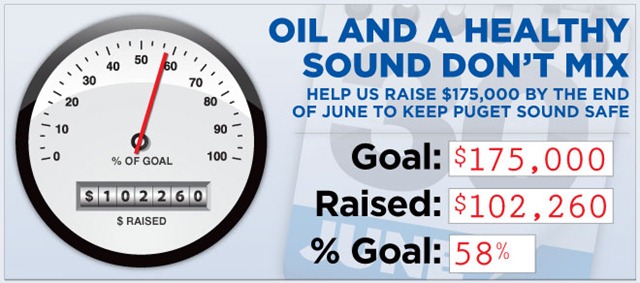
Before the end of this month, please donate to our $175,000 Spring Clean Water Campaign so we can continue our work to keep our Puget Sound waters and shorelines oil-free and healthy.

Matrix of Olympic Peninsula Environmental Education groups

The Feiro Marine Life Center created this handy matrix of the educational groups (all of which are listed on the left side of this page under “educational” links) operating on the Peninsula. This document goes into greater detail of what they are doing, who they serve, etc.  Updated as of June 2010. Feiro_EE_matrix_final 3_30_10

Video -People For Puget Sound – Orcas & Salmon

From People For Puget Sound…How it all fits together.

People for Puget Sound | Orcas and Salmon from eric becker on Vimeo.

Help People For Puget Sound raise $175k by June 30th!

Did you like the video on salmon? If you appreciate that and also the work I do on this blog, invest in this campaign.If you want more info on People For Puget Sound, go here…

http://pugetsound.org/pps-home-page/cleanwater

cw_0610

Dungeness Crab Mortality Due to Derelict Pots

From the NW Straits June Newsletter

People at the Crab Mortality PresentationJeff June, Natural Resources Consultants, is the derelict fishing gear removal field manager for the Northwest Straits Foundation. Jeff presented results from the recent study of Dungeness crab mortality from derelict pots supported by the Stillaguamish Tribe and Northwest Straits Foundation.

Jeff reported that the Washington Department of Fish and Wildlife estimates that 12,193 crab pots are lost each year in Puget Sound. Each lost crab pot without escape cord kills approximately 30 crabs each year until deterioration. Jeff provided several ways to prevent crab pot loss:

· Don’t fish in marine transit zones

· Weight your pots so they don’t move in high currents

· Make sure line is long enough for the depth you are fishing

· Use multiple floats in high current areas

· Don’t set pots too close together

· Always use escape cord – 120 thread count is regulation but a better rule of thumb is to use 1/8 inch diameter cord.

· Report lost pots

A recent change in regulations allows enforcement agents to ticket crabbers for transporting illegal pots on marine waters, instead of only ticketing for actively fishing illegal pots. Jeff explained that there are some areas of concentrated accumulation of crab pots that will be targeted for this enforcement.

Click here for a pdf copy of the presentation.

Crab Management in Washington State

From the NW Straits June Newsletter

Rich Childers, Shellfish Manager with the Washington Department of Fish and Wildlife, recently gave a presentation on the management of Puget Sound’s Dungeness crab fishery. This is one of the most complex fisheries in the world to manage, involving 17 tribes and three natural resource agencies. This year the state will assess a $10.00 penalty for failure to report crab catch, in an effort to more accurately estimate the recreational harvest. Rich reported that the crab fishery is sustainable, and currently all marine areas except for South Hood Canal have the highest catches on record.

Click here for a pdf of Rich’s presentation.

If you are interested in crabbing at all,you should read Rich’s great presentation.

Plastics Summit Draws a Crowd

From the NW Straits Commission June Newsletter:
A dynamic group of over 70 field volunteers gathered at Fort Worden in May for the Citizen Science Summit on Plastic Pollution in the Salish Sea, hosted by the Port Townsend Marine Science Center and co-sponsored by the Northwest Straits Commission. Since 2008, these and other committed citizen scientists around the region have sampled beach sediments at 15 sites to study tiny fragments of plastic (known as microplastics) in the sand. Early results of the Center’s project provide shocking numbers: an estimated six metric tons of microplastics, plus 3.4 tons of glass, cigarette butts and other debris, have washed up on Puget Sound beaches. Dr. Joel Baker, an expert on chemical pollutants at the University of Washington/Tacoma, served as the event’s keynote speaker. For more information on the summit and the microplastics project, contact Jen Kingfisher at jkingfisher@ptmsc.org.

Group attended the Marine Science Summit on Plastic in the Salish Sea

Brinnon Group Meeting in Quilcene – 6/23 4 to 6 PM

The Brinnon Group will be meeting at the Timberhouse in Quilcene from 4 to 6 on June 23.  Ben Gruel from the Sierra Club plans to attend and to talk with us about our "challenges and opportunities."  Other topics will include the EB 5 funding program the developer wants to use, MOUs being developed, water-related issues, and communication strategies.  Let me know if you have any questions or any suggestions for the agenda.  Thanks.  Barbara