By donating to the News you help us bring more news to you! We will use the donations to pay additional reporters, and spend more time on stories! Want to donate more than $10? Under the $10 is a dropdown box, choose multiples of 10. (i.e. Qty 3 at $10)
*DataGovArchive
archive of data.gov on Source Cooperative. The 16TB collection includes over 311,000 datasets harvested during 2024 and 2025, a complete archive of federal public datasets linked by data.gov. It will be updated daily as new datasets are added to data.gov.
-Alexandra Morton's Web Site (NEW)
The new web site for the work of Canada’s leading researcher in to farmed Atlantic Salmon and it’s effects.
-The Cove
One of the most important environmental documentaries ever created. If you value dolphins, then you must see this film.
North Olympic Peninsula Skills Center Natural Resources
To provide a program that provides hands-on, relevant natural resources research experience while meeting the needs of and building capacity within individual students and the North Olympic Peninsula region.
openchannels.org
OpenChannels is designed to become a comprehensive source for news, guidance, and community discussion on sustainable practices in ocean planning and management.
River of Kings – Video
Part 1 of 2 part series by Carl Safina on the Nisqually River Restoration.
Salish Magazine
Salish Magazine is a free online magazine that takes inquisitive readers outdoors with visually rich storytelling about features people can see firsthand in our public forests and beaches.
Victoria Sewage Project
The official city site on the project. The latest scoop on the Canadian poop!
WA State Family Forest Fish Passage Program
The Family Forest Fish Passage Program provides funding to small forest landowners to repair or remove fish passage barriers. Download the film.
Green Acre Radio on KBCS
Green Acre Radio on KBCS — Sustainability, local food production, restoration & environmental talk radio.
NW Indian Fisheries Commission
The Northwest Indian Fisheries Commission (NWIFC) is a support service organization for 20 treaty Indian tribes in western Washington.
Brinnon Group
Local group opposing Black Point resort
Clam Gardens
Network of researchers exploring First Nation gardening of clams in history, and it’s relationship to today.
Coastal Watershed Institute
“To promote long term, ecological, community based stewardship of marine and terrestrial ecosystems thru scientific research and local partnerships.”
League of Women Voters – Clallam County
a nonpartisan political organization, encourages the informed and active participation of citizens in government, and influences public policy through education and advocacy.
League of Women Voters – Jefferson County
The League of Women Voters, a nonpartisan political organization, encourages the informed and active participation of citizens in government, and influences public policy through education and advocacy.
Local Food Access Network
North Peninsula local food org with an emphasis on developing and supporting increased and sustainable capacity for production, distribution, and consumption locally.
North Olympic Salmon Coalition
The mission of the North Olympic Salmon Coalition is to restore, enhance, and protect habitat of North Olympic Peninsula wild salmon stocks and to promote community volunteerism, understanding, cooperation and stewardship of these resources.
Northwest Watershed Institute
NWI’s mission is to provide scientific and technical support to protect and restore fish and wildlife habitats and watershed ecosystems of the Pacific Northwest.
Olympic Environmental Council
The Olympic Environmental Council works on issues related to the environment and health that affect our North Olympic Peninsula communities.
Olympic Park Associates
If you share with us a passion for Olympic National Park, a concern for the Park’s future, and a vision that Olympic National Park should always be a wild and natural place, we invite you to join Olympic Park Associates.
Washington Environmental Council
WEC has been working for a couple of decades on environmental activism. A great group of people actually getting things done.
Whale Trail
Signs along the way to take you to great whale viewing locations
Wild Fish Conservancy
Wild Fish Conservancy seeks to improve conditions for all of the Northwest’s wild fish
A controversial finding in recent chinook research.
Researchers made a surprising discovery while tracking Chinook salmon in both the foraging areas of endangered southern resident orcas and the growing, healthy population of the northern resident orcas in B.C. In a study published last week in the Canadian Journal of Fisheries and Aquatic Sciences, the researchers stated they expected to find the robust population of northern residents fat with fish, and the southern residents stuck with lean pickings. Instead, the team found four to six times the density of big Chinook in the area they tested in the Strait of Juan de Fuca, part of the southern residents’ core foraging area, compared with the area they sampled in the northern residents’ territory, in the Johnstone Strait. Lynda Mapes reports. (Seattle Times)
Not really a “mystery” to the tribes who lived and continue to live along this coast. Great work by regional archeologists in uncovering the stories of this incredible aquatic farming by the tribes. What we lost by the European invaders ignorance of the people’s they were conquering is still an unfolding story.
Tens of thousands of wooden stakes poking up from British Columbia’s shoreline have smashed a long-held stereotype of Canada’s First Nation people.
Good overview of one of the most critical issues facing recovery of endangered salmon. Rising temperatures in streams.
In the Puget Sound region, elevated stream temperatures are believed to be one of the great downfalls for salmon, especially in areas where streamside vegetation has been removed by farming, forestry or development.
An online publication of a long term look at studies of cellular use and it’s possible correlation to brain cancer was published recently. There is apparently increasing evidence that long term use of cell phones pressed against the ear may be statistically significant. While only one data point, I have had a couple of friends who died of brain tumors and were long term heavy cell phone users. On the other hand, I have used cell phones heavily since their introduction and have not yet encountered any cancer. But here’s some suggestions from the authors of the study.
Use texts, a phone’s speaker, or wired headphones. Keeping a smartphone 10 inches (25cm) from your body instead of one-tenth of an inch reduces your radiation exposure to 1/10,000th as much as when it’s pressed against your head. When moving about, store your phone in a bag or purse. If you must carry a phone in your pocket, temporarily turn on airplane mode, which disables the transceiver and sends your incoming calls to voicemail.
Cellular Phone Use and Risk of Tumors: Systematic Review and Meta-Analysis
ABSTRACT
According to estimates from the International Telecommunication Union, the number of worldwide mobile cellular subscriptions increased from 68.0 per 100 inhabitants in 2009 to 108.0 per 100 inhabitants in 2019 [1]. With the increasing use of cellular phones, concerns have arisen over the carcinogenic effects of electromagnetic fields (EMFs) emitted from cellular phones [2]. Since 1999, observational epidemiologic studies, specifically case-control studies have reported inconsistent findings on the association between cellular phone use and tumor risk, and several meta-analyses [3,4,5,6] of case-control studies on this topic have been published before 2011.
Among these studies, Myung et al.’s meta-analysis [5] of 23 case-control studies concluded that mobile phone use was associated with an increased tumor risk in high quality studies and studies conducted by a specific research group, and that long-term mobile phone use of 10 or more years increased the risk of tumors regardless of methodological quality or research group. Similarly, Khurana et al. also reported that cellular phone use of 10 or more years doubled the risk of brain tumors in 11 epidemiologic studies [6].
Based on evaluation of the available literature including experimental animal studies and epidemiological studies in humans, in 2011, the World Health Organization (WHO)/International Agency for Research on Cancer (IARC) classified radiofrequency electromagnetic fields (RF-EMFs) associated with cellular phone use as possibly carcinogenic to humans [7]. Recently, an advisory group of 29 scientists recommended that IARC prioritize a new review of the carcinogenicity of RF-EMF by 2024 due to mechanistic evidence of the carcinogenicity of cell phone radiation published since 2011 [8]. Although many case-control studies and several meta-analyses have been published regarding the association between cellular phone use and tumor risk, the findings remain inconsistent.
Conclusions
The purpose of this study was to evaluate the associations between cellular phone use and tumor risk using a systematic review and meta-analysis of case-control studies according to various factors including differences in response rates between cases and controls, use of blinding at interview for ascertainment of exposure, methodological quality, funding sources, type of case-control study, malignancy of tumor, and dose–response relationship.
In sum, the updated comprehensive meta-analysis of case-control studies found significant evidence linking cellular phone use to increased tumor risk, especially among cell phone users with cumulative cell phone use of 1000 or more hours in their lifetime (which corresponds to about 17 min per day over 10 years), and especially among studies that employed high quality methods. Further quality prospective studies providing higher level of evidence than case-control studies are warranted to confirm our findings. (emphasis by Olyopen.com)
An interesting interview with one of the scientists who early on figured out the differences between a “forest” and a “tree farm”.
From eating dirt as a child to discovering the mycorrhizal network below the forest floor, Simard has spent her entire career trying to find answers about how forests work; now, armed with those answers, she’s calling for change. Matt Simmons report. (The Narwhal)
We hear from our Puget Sound Partnership that things are doing “better” from their indicators. However, this new study sheds another perspective on the issue. I’m wondering after the recent heat wave, whether shellfish are going to remain a “positive” indicator.
A joint Canada-U.S. report on the health of the Salish Sea has found either an overwhelming decline or stable trend in nine out of 10 environmental indicators tracked by researchers. The only positive? Shellfish. Stefan Labbe reports. (Coast Reporter)
We are just beginning to understand the incredible loss of shellfish from the latest heat wave.
The putrid smell of rotting shellfish on some beaches in Puget Sound and elsewhere along the West Coast were a clear sign that large numbers of clams, mussels, oysters and other intertidal creatures were killed from exposure to extreme low tides, record-breaking temperatures and a blazing hot sun. The total losses of shellfish that perished late last month may be difficult to estimate, but experts are beginning to piece together evidence from shoreline residents, state and tribal biologists, and commercial shellfish growers. Their goal is to describe what took place during the record-breaking temperatures of June 25-29 during some of the lowest tides of the past century. Christopher Dunagan reports. (Puget Sound Institute)
Why continuing scientific research on the Salish Sea is so important to continue funding.
In July of 2018 and 2019, large numbers of oysters, cockles and clams died on beaches all around Puget Sound. No one knew why. It was a particularly bad couple of years, but summer mortality events with mass die-offs of shellfish happen regularly. They’ve been recorded by researchers in western Washington as far back as the 1930s. The source has remained a mystery. Now, scientists have pinpointed the cause: two species of toxic algae that don’t threaten people much — but can wreak havoc on the ecosystem. Beginning to figure out what’s killing so many shellfish is a breakthrough for growers and communities who live near the beaches. Bellamy Pailthorp reports. (KNKX)
Yesterday, I published an article here about new research findings of the spread of Picene Orthoreovirus from farmed salmon to wild stocks. In it, I described some of the work that Alexandra Morton had done to bring this to the attention of the world. After reading the article, a local radio host has reached out to her to have her on and discuss her work. During the email exchange, Alexandra talked about the history of the attacks by the salmon farming industry on her, which I had mentioned happening in our local Marine Resources Committee. Here is an excerpt of her response. Unfortunately my blog entry does not allow me to publish PDFs, so I am posting a link to the folder on my web site to download and view the documents if you are interested.
From Alexandra: “Yes, they like to say I am not a scientist, and yet I was the first to publish that the PRV in British Columbia was a match for PRV in Lofoten Norway (attached), and now 8 years later it would appear I was right. I have also published on the spread of the virus into wild salmon… The trouble with these claims is that I am published in some of the top scientific journals in the world, and despite their efforts to get my papers retracted, they have failed.
They have been completely silent about my new book wherein I detail internal DFO/industry communications.”
The link to the files is here. I’ll leave it up for 14 days, and then if you want it contact me directly. The radio interview will come out later this month or next. I’ll post when it does.
The latest whale die-off on our coast continues with no end in sight. Malnourishment seems to be the root cause, but it is still unclear.
The recent sighting of an emaciated grey whale off Vancouver Island and the discovery of a dead whale washed up on a B.C. beach highlights concerns that the marine mammals are dying in increasing numbers…Officials have not released a cause of death, but they say dead grey whales on the West Coast of Canada have been increasing in number since 2018. (CBC)
Our monthly report from Al Latham here in Jefferson County. Always a fun and interesting read!
_______________________________________
Greetings and happy La Nina spring from http://www.cocorahs.org station WA-JF-1 located 5.1 miles south of the Chimacum metropolis.
As Mark Twain said “In spring I have counted 136 kinds of weather inside of 24 hours”… That pretty well describes the past March.
We recorded 2.42″ rain here with 3.8″ average. For the water year so far we accumulated 23.84″ with 25.2″ being our average.
La Nina means cooler/wetter winter/spring. It has definitely been cooler around here but we haven’t experience more rainfall – except for January of course, but that’s ancient history.
According to http://www.cliffmass.blogspot.com “Most of western Washington, Oregon, California, and the southwest states were more than 2F cooler than normal. Chilling statistics”. NOAA Climate Prediction Center is forecasting cooler temps for the next 3 months but they are on the fence about weather it will be wetter, drier or normal rain wise. So that’s it for now – enjoy whatever weather we get, but don’t put those tomatoes out too soon! Al
“April’s air stirs in Willow leaves…a butterfly Floats and balances” Basho
What do you call it when you get mugged on the vernal equinox? The first robbin of spring!
When all the world appears to be in tumult, and nature itself is feeling the assault of climate change, the seasons retain their essential rhythm. Yes, fall gives us a premonition of winter, but the, winter, will be forced to relent, once again to the new beginnings of soft greens, longer light, and the sweet air of spring! Madeline M. Kunin
In December, sunflower sea stars were declared critically endangered by an international union of scientists…But there is hope. Pockets of healthy populations of sunflower sea stars still exist in parts of the Salish Sea. And a scientist working at the University of Washington’s Friday Harbor Labs on San Juan Island is pioneering new techniques to breed them in captivity. Bellamy Pailthorp reports. (KNKX)
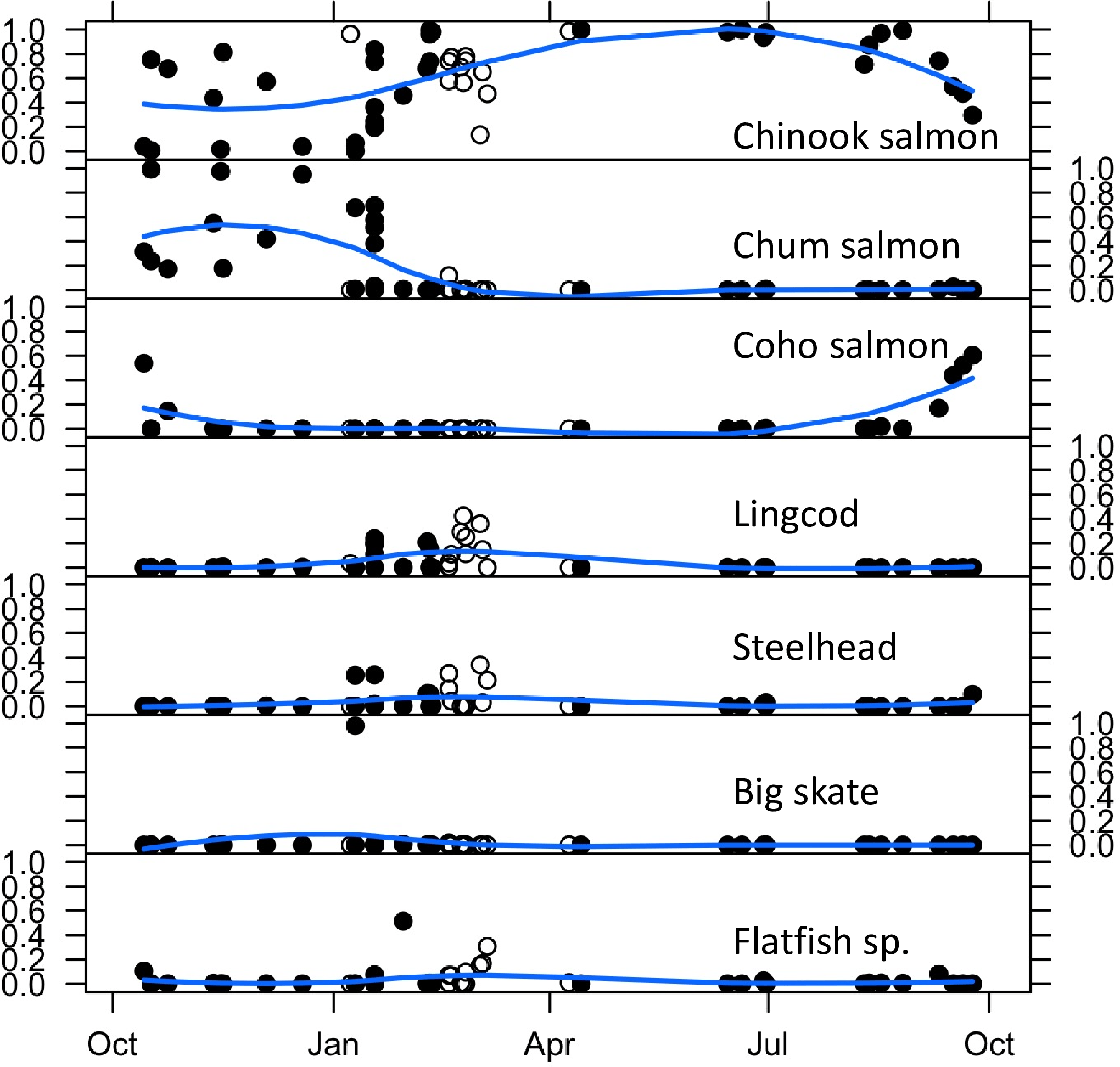
New research out regarding Southern Resident killer whales and their needs for chinook. Very good research here, based on scat samples over long periods of time.
Abstract
Understanding diet is critical for conservation of endangered predators. Southern Resident killer whales (SRKW) (Orcinus orca) are an endangered population occurring primarily along the outer coast and inland waters of Washington and British Columbia. Insufficient prey has been identified as a factor limiting their recovery, so a clear understanding of their seasonal diet is a high conservation priority. Previous studies have shown that their summer diet in inland waters consists primarily of Chinook salmon (Oncorhynchus tshawytscha), despite that species’ rarity compared to some other salmonids. During other times of the year, when occurrence patterns include other portions of their range, their diet remains largely unknown. To address this data gap, we collected feces and prey remains from October to May 2004–2017 in both the Salish Sea and outer coast waters. Using visual and genetic species identification for prey remains and genetic approaches for fecal samples, we characterized the diet of the SRKWs in fall, winter, and spring. Chinook salmon were identified as an important prey item year-round, averaging ~50% of their diet in the fall, increasing to 70–80% in the mid-winter/early spring, and increasing to nearly 100% in the spring. Other salmon species and non-salmonid fishes, also made substantial dietary contributions. The relatively high species diversity in winter suggested a possible lack of Chinook salmon, probably due to seasonally lower densities, based on SRKW’s proclivity to selectively consume this species in other seasons. A wide diversity of Chinook salmon stocks were consumed, many of which are also at risk. Although outer coast Chinook samples included 14 stocks, four rivers systems accounted for over 90% of samples, predominantly the Columbia River. Increasing the abundance of Chinook salmon stocks that inhabit the whales’ winter range may be an effective conservation strategy for this population.
A good look at the state of shellfish bed recovery over the last 10 years, as measured by the Puget Sound Partnership. This is one indicator that seems to be going in a positive direction. Of course, the goal of this is to promote the conversion of public beaches into industrial aquaculture, so it’s a mixed bag. Some day we’ll see a real discussion in the public sphere about how many acres we are going to convert to industrial aquaculture before they are all turned into off limit farms for the profit of a few large aquaculture organizations. Good reporting from the Puget Sound Institute. Worth reading.
Interesting new marine hospital comes to the Pacific NW with the help of a number of non-profits from here. The head of this project appears to be Dr. Sylvia Earle one of the legends of Marine Science and environmental education. All good news.
For Immediate Release SALISH SEA DECLARED A HOPE SPOT IN CELEBRATION OF NEW MARINE ANIMAL HOSPITAL
Executive Director and Veterinary Nurse Casey Mclean examines an elephant seal’s vital signs. NOAA Permit 18786
Connecting the waters between Seattle, Washington and Vancouver, Canada, the Salish Sea is bursting with iconic and beloved creatures like the endangered Southern Resident killer whales and humpback whales. As the original inhabitants of the sea, these mammals called the region home thousands of years before human beings walked to draw borders between countries, build ports, and develop commercial fishing to feed the rest of the two-legged world. Today, man’s impact on the ocean has created increasing threats for marine wildlife in the Pacific Northwest.
Dr. Sylvia Earle, Founder of Mission Blue, says, “The Salish Sea holds immensely important biodiversity. This body of water has provided the residents of Seattle up to Vancouver with vital natural resources for millennia. We must act now if we want to protect the ocean and its inhabitants from the destructive effects of human interference. I want to thank SR³ and their partners for their important work in marine animal research and rehabilitation – it’s so important that people are aware of the creatures that they share the ocean with. If the whales, seals and dolphins aren’t healthy, humans won’t be healthy, either.”
Casey Mclean, Hope Spot Champion and Executive Director of SR³, explains how marine animals serve as important indicators of ocean health and of environmental changes that can impact humans. She elaborates, “From warming ocean waters to entanglements, marine animals are increasingly suffering.” She continues, “Without a specialized marine wildlife hospital in the region, many sick and injured animals are left without hope for survival. It also limits our ability to gain insights that would drive protections for many more animals.”
From injured seals to entangled whales, SR³ works to ensure that struggling marine animals receive the expert help they need. Their SeaLife Rescue Center – the first marine wildlife specialty hospital in the Pacific Northwest – is opening soon. As a community-supported nonprofit, SR³ relies on donations from individuals who wish to invest in the health of their blue backyard.
The Salish Sea is home to some of the largest and longest-lived marine species on Earth, including the North Pacific giant octopus (Enteroctopus dofleini), the giant Pacific chiton (Cryptochiton stelleri), the largest barnacle (Balanus nubilus), plumose anemone (Metridium senile), the largest sea anemone, cabezon, lion’s mane jellyfish, and 25 species of rockfish that have life spans of 50-200 years.
Protecting the animals of the Salish Sea will benefit the entire ecosystem – regardless of human boundaries. New conservation policies and activities can draw attention to the many rivers and streams that feed into the sea that are in desperate need of habitat restoration and protection.
Cristina Mittermeier, internationally acclaimed wildlife photographer, Managing Director and Co-founder at SeaLegacy, describes SeaLegacy’s work as a Hope Spot partner. “If we want to live in a healthy and abundant Salish Sea, we must first imagine what that looks like. With images and stories, SeaLegacy is inviting us to imagine a different balance between business and nature. If we can ignite an imagined future in which orcas are thriving, fish populations are revered, coastal communities re-engineer their economies to sustain tourism instead of squandering our finite resources, and the knowledge and rights of the First Nations of this land are honored, then I am sure we can turn the hope encapsulated in the idea of this Hope Spot, into a reality we can gift the next generation.”
Mclean elaborates, “By teaching people how their everyday actions are connected to local marine health – and ultimately their own health – we can make the Pacific Northwest a safer and healthier home for marine animals – and for all of us!”
“We live, work and play near and in these waters and recognize that the region is on the brink of something incredible. We can achieve a resilient, sustainable, and healthy Salish Sea by bringing together diverse voices, building a movement around a shared ocean ethic, and by igniting hope,” said Dr. Erin Meyer, Director of Conservation Programs and Partnerships at the Seattle Aquarium. “Designating the Salish Sea as a Mission Blue Hope Spot connects us to communities around the world who are working together to catalyze positive change.”
As SR3 delivers emergency response for sick, injured or entangled marine animals, they collect critical data in the process that helps drive broader protections. For instance, as they work to free entangled whales, responders also learn how they became entangled and work closely with fishermen and government agencies to develop ways to prevent entanglements in the future. Using drones to conduct scientific research, SR³ collects important health data that informs protections for dwindling populations such as the critically endangered Southern Resident killer whales.
SR³ and their partners believe that improving the health of the Salish Sea will require a hands-on approach from all angles. Their goals for the Hope Spot also include to deepen working relationships with local tribal entities, create a place of union between the many non-government organizations (NGOs) working to protect the life within the Salish Sea, and increasing public action for the support of legislation that impacts the Salish Sea and its inhabitants. In order to ignite the public’s response, they’re working to educate residents within the Salish Sea watershed about how its protection is critical for human health.
Despite the decimation of its species, the inundation of pollution from poorly planned development, and elimination of some critical habitats, the Salish Sea has survived.
“All is not lost,” stresses Mclean. “This ecosystem is still alive. It is resilient, and we have the opportunity to restore it. Our lives and livelihoods depend on it.”
About SR³ – SeaLife Response, Rehabilitation, and Research (SR³) rescues and protects marine wildlife in the Pacific Northwest. With a marine wildlife ambulance, response vessel, and specialized veterinary staff, SR³ fills a unique role in the West Coast’s marine mammal stranding network. The organization’s expert first responders stand ready to deploy every day to ensure suffering marine animals receive the expert care they so urgently need. SR³ also works to address the root cause of marine animal health issues through scientific research projects. A major focus of this program is the endangered Southern Resident killer whales, using drones to collect health data that inform conservation actions important to their survival. The organization will open the region’s first marine wildlife specialty hospital early this year. www.sr3.org
About Mission Blue – Mission Blue inspires action to explore and protect the ocean. Led by legendary oceanographer Dr. Sylvia Earle, Mission Blue is uniting a global coalition to inspire an upwelling of public awareness, access and support for a worldwide network of marine protected areas – Hope Spots. Under Dr. Earle’s leadership, the Mission Blue team implements communications campaigns that elevate Hope Spots to the world stage through documentaries, social media, traditional media and innovative tools like Esri ArcGIS. www.mission-blue.org
Please contact Casey Mclean, SR³ Executive Director at casey@sr3.org or (425) 346-9798 for high resolution images, interviews or more information.
Good news here. SeaDoc is a critical scientific resource to our region and the world. Looks like they have hired a good one to fill this important role. Congratulations to Leigh Ann.
The SeaDoc Society has hired Leigh Ann Gilmer to fill its regional director position. She began on Feb. 1 and has hit the ground running.
Prior to joining SeaDoc, Gilmer served as executive director of Cascadia Art Museum in Edmonds, Washington, and development director and chief operating officer at Conservation Northwest. In addition, she’s held key roles at the Museum of Pop Culture and Seattle University, where she completed her master’s degree while working full time in fund development.
We continue to find out more about the wild life that lives just off our beaches. No need for looking for extra terrestrial life. It’s right here.
Every spring, a small group of about a dozen gray whales pauses along an epic migration from calving lagoons in Baja California to their feeding grounds in the Artic. They travel more than 170 miles off their coastal migration route, to stop off in northern Puget Sound. There, they linger from about March through May. Now scientists think they know why the Sounders, as this beloved group of regulars is known, likes to visit — and hang around. New research confirms these whales have figured out a brilliant feeding strategy. Lynda Mapes reports.
Filed under: environmental education, Environmental Science | Comments Off on Gray whales learn daring feeding strategy in Puget Sound: Digging for ghost shrimp at high tide – Seattle Times
More good news on the kelp monitoring project. This is a key indicator species that the Northwest Straits Foundation, the State of Washington and the Marine Resource Committees have been helping monitor, and now it looks like we will get better satellite data on the whole coast.
An ambitious project to map and monitor sea kelp forests along the entire B.C. coast is afoot, and scientists are using seemly disparate tools — both ancient and modern — to do it. Researchers are using centuries-old British sea charts and advanced technology, such as camera drones and satellite images, to trace shifts in the abundance and distribution of kelp beds over time, said geographer Maycira Costa. Rochelle Baker reports. (National Observer)
The focal point for environmental news & perspective on the news. Our goal is to help educate and connect the public on the Peninsula. We are not a non-profit so donations are not tax deductible. Maybe someday with your help!
This site is based on news and my opinion on that news. I come with over 50 years of experience in various environmental and tribal involvement. You may not agree with my POV. At my age, I am willing to listen to your POV and put it in comments. But I might not agree with you and that's the way it works.
HOTLINES FOR REPORTING SPILLS
WA State Emergency Management Division: 1-800-258-5990
National Response Center: 1-800-424-8802
Pacific States & British Columbia: 1-800-OILS-911 (1-800-645-7911)
Local Events
Add your local event here. Contact us to include your next event.
—————————————————
TSUNAMI DEBRIS HOTLINE:
1-855-WACOAST (1-855-922-6278)
—————————————————
Event Date:
NATURE NOW
A Program About the Natural World.
KPTZ.ORG 91.9
WEDNESDAYS AT 12:05
REPEATS: SATURDAYS 12:30 AND WEDNESDAYS
PODCASTS AT KPTZ.ORG