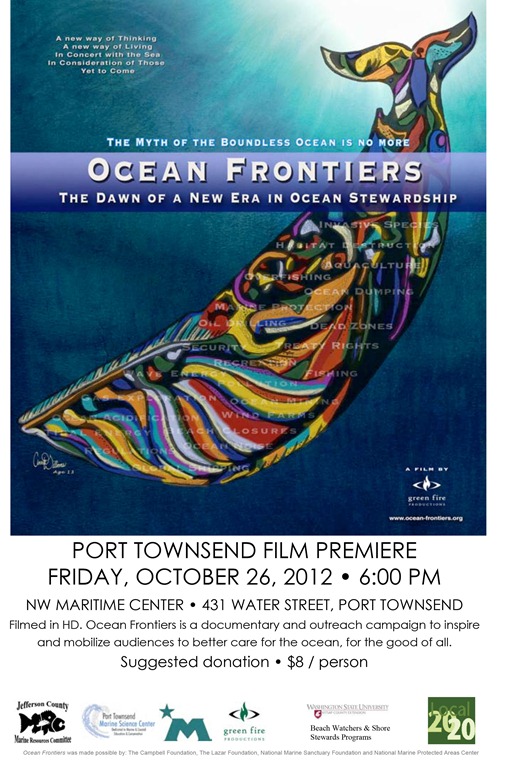
Movie Tonight at NW Maritime Center- Friday Oct.26

OCEAN-FRONTIERS-POSTER

Should be good. See you there!

Nature filled with unique animals–The News Tribune

When people ask me, “so who cares if animal whatever goes extinct”? I usually discuss that we don’t really know what these animals might teach us. Sometimes it might unlock an issue of great importance to us. There is an assumption by the public that we know everything there is to know about snail darters, or whatever species is on the Endangered Species list.   Here’s a good quick article about one such bit of knowledge, right here in our Sound.

Sometimes, it can be hard to tell the difference between what is real and what is only a myth. In the Northwest, we have some incredible natural wonders that sound almost too bizarre to be real. Aequorea victoria, a common jellyfish in the Puget Sound waters, can really make a statement when agitated. This amazing jellyfish combines two different proteins within its body to create bioluminescence and glow in the dark. Scientists have been able to extract one of these proteins and apply it to modern medicine to help researchers track proteins in living cells. 

http://www.thenewstribune.com/2012/10/14/2331617/nature-filled-with-unique-animals.html

Ocean Acidification issues documented by scientists

One way to measure the urgency of the scientific response to ocean acidification is by its carbon footprint. In 2004, 125 marine scientists gathered in a single room in Paris to ponder the effects that surging loads of human-generated carbon dioxide into the atmosphere might have on the sea below. They heard 24 research presentations, nearly the sum total of papers published on the subject worldwide that year. Four years later, 227 researchers gathered in Monaco for the second installment, with 44 presentations. Two weeks ago, 542 racked up the air miles to get to Monterey, California for the Third International Symposium on the Ocean in a High-CO2 World. Eric Scigliano reports. 

Science faces the fate of the sea http://crosscut.com/2012/10/09/environment/110889/science-faces-fate-sea/ 

At home: Ocean use planning, acidification subjects of Oct. 10 public meeting http://www.ecy.wa.gov/news/2012/336.html

Hood Canal report compiles oxygen studies–Kitsap Sun

Good analysis by Chris Dunagun on the latest findings on the issues of Hood Canal low oxygen and fish kills. I’ve already given my thoughts on this. If you want to, just read his blog post. My only addition is that Chris leads off saying that we’ve spent millions of dollars on research and still don’t know the answers. Well, sometimes, that’s going to be true. But at least we don’t have to spend more time and money trying to pursue solutions that are not going to give us positive results. This is precisely the kind of thing the Puget Sound Partnership was created to help foster.

http://pugetsoundblogs.com/waterways/2012/09/20/hood-canal-report-compiles-oxygen-studies/

Cut in Canadian government funds leaves whale group on shore–Times Colonist

The cuts to environmental organizations continue as the conservative governement that has taken control of all aspects of the Federal government of Canada continue to their attack on anything that smacks of environmental protection or slowing business interests in exploitation.This affects us as it affects Canada’s efforts to protect the Orcas that pass between us and them on a regular basis.

A non-profit group that keeps an eye on boaters and whale-watchers around Victoria and Alert Bay has been beached after being denied funding by Environment Canada The Straitwatch program, run by the Cetus Research and Conservation Society, has two Zodiac boats and does on-the-water education and monitoring to reduce disturbances to the endangered southern resident and threatened northern resident killer whales.

http://www.timescolonist.com/technology/government+funds+leaves+whale+group+shore/7235303/story.html

People For Puget Sound Folds– Where to from here?

Today,  People for Puget Sound announced it’s end. The most effective organization for protecting the Salish Sea, and educating people about it, is now gone.

What People For Puget Sound accomplished was best summed up  for me by Dave Peeler, who was the group’s policy director in Olympia for two years.

PFPS was the main and frequently the only environmental group participating in the various state and federal environmental policy forums and committees affecting Puget Sound, including those of the PS Partnership, Ecology, DNR and EPA.

Tom Bancroft’s comments to the press about not knowing the financial status of the organization are simply not accurate. There is nothing more needing saying than that I was there, on the board when he was hired. He knew full well what the situation was. He’s a smart guy, who knows how to read a financial report. But this isn’t about Tom. It’s about the Salish Sea.

People For Puget Sound did more in their 20 years to protect the Sound than any other organization.

People for Puget Sound got things done. Whether lobbying on behalf of the Sound in the halls of power, or cleaning up rivers and beaches, educating people on the Sound, or creating coalitions to solve problems. They were responsible for saving dozens of miles of shoreline, and rehabilitating many more.

People For Puget Sound was responsible for organizing the highly effective “Lobbying Day” in Olympia and brought thousands of citizens to meet their legislators face to face to lobby for environmental issues in regards to the Sound.To be clear, this was a coalition, but People For Puget Sound organized and effectively ran it. Who will fill that gap? 

When DNR wanted to expand the Aquatic Reserves a few years ago, it was People For Puget Sound that wrote the proposal, made the nominations and coordinated with DNR to develop the management plans. Many people, including myself, made presentations around the Sound that led to public buy-in and the establishment of the Smith and Minor Islands and Protection Island Aquatic Reserves. Tens of thousands of acres of ocean bottom were protected because of People For Puget Sound’s efforts. Who will fill that gap and do that next time?

Tens of thousands of people were educated through their “Pier Peer” Programs throughout the Sound.There are small but effective local efforts, such as the Marine Science Center in Port Townsend, and the Feiro Marine Life Center in Port Angeles, but across the Sound, Who will fill that gap?

But for now, all I see is a hole in the water, where once there was an organization that really mattered. Who can fill that gap? You can. There are dozens of other organizations needing your help and support. Go get involved. It won’t happen without you.  I hope to see you out there on the beaches, in the halls of power,  and in or on  the water doing the real work to Save Our Salish Sea.

People For Puget Sound Ceases Operations–Seattle PI Blog

Just in. As an ex-board member I will have an opinion piece on this tomorrow.

People for Puget Sound is ceasing operations

People for Puget Sound, one of the Northwest’s highest profile conservation groups, will cease operations later this fall and try to transfer its work to other environmental activists.

“We don’t have the runway to keep going,” said Tom Bancroft, People for Puget Sound executive director, who succeeded PPS’s founding boss Kathy Fletcher when Fletcher retired last year after 20 years at the post.

Bancroft explained that the organization experienced rapid growth in membership and activities over the past few years but that “our revenues did not keep up.”  The organization took out a $300,000 loan in 2010, which has come due.

People for Puget Sound endured a mass layoff last fall, which saw six full-time and five party time staff members — out of a staff of 25 — lose their jobs.


More at

http://blog.seattlepi.com/seattlepolitics/2012/09/11/people-for-puget-sound-is-ceasing-operations/

Bottom Trawlers Level the Bottom–Scientific American

While we knew that the bottom trawlers have done grave ecological harm to such places as Discovery Bay, we really didn’t understand exactly what that looked like. (in an interview I did with a long time resident of the Bay, he stated that the aquatic species were never the same after bottom trawling was allowed by the State, in the 1970s).

A very interesting piece just published. Rugged inexpensive cameras are showing us many new worlds that we couldn’t afford to see before. A really damning scene, since thousands of miles of bottom are being trawled daily. We have no idea what the ramifications really are. The author seems to be belittling the damage, though it could be just lost in translation.

http://www.scientificamerican.com/article.cfm?id=bottom-trawling-fishing-levels-ocean-bottom&WT.mc_id=SA_CAT_ENGYSUS_20120906

EarthFix Conversations: So, How’s Puget Sound?

A new report (http://www.scribd.com/doc/105128303/PSEMP-Marine-Waters-2011-Overviewweb-FINAL-1) brings together data collected from all around the Sound in 2011. It’s got information on river inputs, seawater temperature, salinity, nutrients, dissolved oxygen, ocean acidification, phytoplankton, biotoxins, bacteria, pathogens, shellfish….

Ashley Ahearn talks to Stephanie Moore, a biological oceanographer with the National Oceanic and Atmospheric Administration and the lead editor of the report.

http://earthfix.opb.org/water/article/earthfix-conversation-so-hows-puget-sound/

Japan to help pay for tsunami debris cleanup – CBC

Good to hear that Japan is going to give something back to our governments for the tsunami debris.

The Japanese government will help pay for the disposal of debris washing up on Canadian and American shores due to the catastrophic tsunami which hit the country last year, according to press reports from Tokyo. Japan does not have to take care of such debris under international law, but in a report on Monday the English-language Nikkei newspaper said officials would announce a plan to provide assistance to the U.S. and Canada later this month.

http://www.cbc.ca/news/canada/british-columbia/story/2012/09/03/bc-japan-pay-tsunami-debris.html

A trip to Maine in search of schooner’s roots – threesheetsnw

Another birthday celebrated this week was the 100th anniversary of the laying of the keel of the Adventuress. My wife and I, were invited along on Monday on a day sail, with some members of the board and significant donors from the Port Townsend area. Thanks to Kiwi Jim of Edensaw, and others.

And thanks to Catherine Collins at Sound Experience which runs the schooner Adventuress for sharing her blog:

“At a time when centennial anniversaries are ubiquitous, I’m on a personal journey to try to answer the question, ‘Why does it matter that Adventuress is turning 100 years old in 2013?’ Having committed the past seven years of my life to the schooner’s restoration — indeed, to her very survival — I’m eager to find the answer. A late summer road trip leads me and my intrepid 12-year-old niece (acting as photographer/videographer) to E. Boothbay, Maine to meet with 74-year-old historian Robert Rice. Robert is the grandson of Henry Rice, one of three brothers who founded the Rice Brothers Shipyard in 1891….”

http://threesheetsnw.com/blog/2012/08/a-trip-to-maine-in-search-of-adventuress-roots/

First Stewards Send Climate Change Resolution to Congress, President Obama

NW Tribes and those from Alaska, went to Washington D.C. in June to press for help in solving global warming issues. Here’s their resolution to Congress and the President.

Climate change is occurring rapidly, creating an urgent need for the world to make use of indigenous ways of adapting and maintaining the resiliency that has served ancient coastal cultures for thousands of years.

First Stewards Send Resolution to Congress, President Obama.

Representative Van De Wege has a challenger.–Sequim Gazette

Durgan to square off against Van De Wege — again Sequim Gazette Surprise! State Rep. Kevin Van De Wege, who ran unopposed in the primaries, is in a runoff for his District 24 seat in the Washington House of Representatives. The winner will be determined by voters in the general election, with ballots to be counted


http://www.sequimgazette.com/news/article.exm/2012-08-29_durgan_to_square_off_against_van_de_wege___again

Caffeine flushed into Pacific Ocean stresses marine life–CBC

So my question is: Is Caffeine ‘legacy’ as well as modern? Does it have a half life? Is this the caffeine that was dumped by our fathers in the 30s into the Sound after drinking coffee? Or is it modern?

Caffeine has become a significant pollutant in the ocean off the U.S. Pacific Northwest, according to a university researcher. Elise Granek, a marine ecologist at Portland State University in Oregon, sampled waters up and down the Oregon coast and found measurable levels of caffeine…Granek, who did all her initial research in the waters off Oregon, said she’s curious about caffeine levels in the Strait of Juan de Fuca between southern Vancouver Island and the Washington coast. That’s where Victoria pumps untreated sewage effluent directly into its coastal waters, and won’t have a sewage treatment facility in place until 2018.

http://www.cbc.ca/news/canada/british-columbia/story/2012/08/28/bc-ocean-caffeine.html

Gates Foundation Launches Effort to Reinvent the Toilet

Sometimes I have found myself oddly agreeing with radical anti-environmentalists. One place that happened was in a discussion on sewage. A woman who opposed all environmental protections had stood up and yelled that “we” should all figure out a way to stop dumping our sewage in the Sound first. I told her I’d love to have her help us figure that out and would gladly support that idea. I have felt that the real solution to our problems with Puget Sound is not “dilution”, but  to stop using the Salish Sea as our toilet bowl. Maybe the efforts of the Gates Foundation to bring sanitation to the third world with new toilets that don’t need water, can eventually lead to us finding a way out of this 19th century habit of pouring our waste into our rivers and waterways.

Crazy? Well people thought that we could never see an end to nuclear war, or DDT. Nuclear war was avoided and DDT is no longer used in the US. Eagle populations returned. So, if we can put a funny looking rover on Mars, we can do this folks. We need to.  Here’s a salute to Bill Gates for thinking out of the box, and doing something to help us get out off the toilet. Pun intended.

———————————————————————

New strategy promotes adoption of safe, affordable sanitation in the developing world

KIGALI, Rwanda — The Bill & Melinda Gates Foundation today announced the launch of a strategy to help bring safe, clean sanitation services to millions of poor people in the developing world.
In a keynote address at the 2011 AfricaSan Conference in Kigali, Sylvia Mathews Burwell, president of the foundation’s Global Development Program, called on donors, governments, the private sector, and NGOs to address the urgent challenge, which affects nearly 40 percent of the world’s population. Flush toilets are unavailable to the vast majority in the developing world, and billions of people lack a safe, reliable toilet or latrine. More than a billion people defecate in the open.

http://www.gatesfoundation.org/press-releases/Pages/safe-affordable-sanitation-110719.aspx

How Logging and Agriculture Affect Water Quality – Earthfix Podcast

Podcast: The Next Act II – How Logging And Agriculture Affect Water Quality –

Good podcast on the issues related to the problems (all fixable) of logging and agriculture. This is an ongoing tug of war with those engaged in the both, vs. what needs to be done to allow the activities to continue with minimal if any harm to streams that provide us with salmon.

http://earthfix.kcts9.org/water/article/podcast-the-next-act-ii-how-logging-and-agricultur/

New Director Aims To Shore Up Puget Sound Agency -KUOW

Note that there is reference to the fact that Puget Sound has bulkheads being added 10 times faster than shorelines are being restored, even with Shoreline Master Programs in place. This kind of thing has to be slowed, so we can get a handle on beach restoration, etc.

New Director Aims To Shore Up Puget Sound Agency.

The Northwest’s Salmon People Face a Future Without Fish–Earthfix

For Northwest tribes, fishing for salmon is more than a food source, it’s a way of life. Five populations of Pacific salmon are already on the brink of extinction and changes in the climate stand to make matters worse. Katie Campbell reports. http://earthfix.opb.org/communities/article/salmon-climate-change-video-environment/

New Action Agenda for Puget Sound Cleanup Released

The Puget Sound Partnership has released a new Action Agenda to replace the one they created in 2009. This new one is based on a huge amount of science input, and hundreds of meetings with regional stakeholders from governments, non profits, tribes and individuals.

A first take on it is by Chris Dunagan at the Kitsap Sun, a man who I consider a trusted source opinion. More to be added as the opinions pour in. I will also be reading the document and add my comments later next week. I was a member of the regional working group for the Partnership since it’s inception here on the Peninsula. To be clear, while I have supported these efforts, I have had my criticisms of them as well. But this is a baseline document, and as such, can be built upon in the future.

Here’s Chris’ news article.  As you can see, the anti-environmental crowd is out to jump on his posts with comments, almost as if they were in concert on doing that.

http://www.kitsapsun.com/news/2012/aug/09/new-action-agenda-approved-for-puget-sound/

Seeking nominations for the 2012 Eleanor Stopps Award

Seeking Nominations for the 2012
Eleanor Stopps Environmental Leadership Award

The Port Townsend Marine Science Center is seeking nominations for the 2012 Eleanor Stopps Environmental Leadership Award. This award recognizes significant contributions in the protection and stewardship of our North Olympic Peninsula natural environment. The award pays tribute to Eleanor Stopps whose vision, advocacy and determination exemplify the power and importance of citizen leadership.

In the 1960s and 70s she recognized the need to protect the uniquely important marine environment of the Salish Sea. With no special political base or powerful financial backers she testified before the Washington State Legislature and the United States Congress and was instrumental in getting legislation and public support for protection of the area. She was responsible for the establishment of the Protection Island Sanctuary, which was the only refuge created during the Reagan administration. Today, it is a critical link in the preservation of the whole Salish Sea region.

The Eleanor Stopps Environmental Leadership Award is awarded annually to a citizen of the North Olympic Peninsula (Jefferson and Clallam counties) who has:
Led a successful resource conservation effort that benefits the north Olympic Peninsula and its residents directly;
Acted as a community catalyst for programs, initiatives or ventures that demonstrate a commitment to the future of the earth and its biodiversity;
Become a model for future leaders in business and education; or has been an exemplary citizen or policy maker who has implemented decisions that, though they may entail risks, have helped our communities take the next step towards environmental sustainability.

Port Townsend Marine Science Center is pleased to sponsor this award and invites nominations so we can continue to recognize positive leadership. You may nominate someone by downloading the nomination form from http://www.ptmsc.org, info@ptmsc.org or calling (360) 385-5582 and requesting a form.

NOMINATIONS MUST BE SUBMITTED BY EMAIL OR BE RECEIVED IN THE
PTMSC OFFICES AT FORT WORDEN BY 5:00 PM AUGUST 31st, 2012.

Winner(s) will be honored at the PTMSC Stewardship Breakfast at the
Fort Worden Commons at 8 a.m. on Thursday, October 4, 2012.

Previous winners include: 2005: Katharine Baril, natural resource educator and planner Washington State University; 2006: Anne Murphy, Executive Director, Port Townsend Marine Science Center; 2007: Tom Jay and Sara Mall Johani, artists and environmentalists; 2008: Al Latham, Jefferson County Conservation District Ranger; 2009: Peter Bahls, NW Watershed Institute; 2010: Sarah Spaeth, Executive Director, Jefferson Land Trust; 2011: Dick & Marie Goin, lifelong Olympic Peninsula salmon habitat restoration activists