It’s official: Olympic Mountains — source of our water supply — in a state of drought – PDN

We assumed it was happening, and now the news is official. Even if you don’t believe in global warming, you are about to have a summer governed by it.

A stubbornly warm winter is still providing the Olympic Mountains with little snowpack, and the mountain range has been declared to officially be in a state of drought. After a short-lived storm restored about a foot of snow last week, the meager, melting snowpack in the Olympics is back to single-digit percentages of where it should be. The snow level is above the tops of most of the Olympics peaks, meaning that today’s rains are just that — rain — and not snow. Both the short- and long-range forecasts are for above-normal temperatures, according to the National Weather Service. Arwyn Rice reports. (Peninsula Daily News)

http://peninsuladailynews.com/article/20150311/NEWS/303119983/its-official-olympic-mountains-8212-source-of-our-water-supply

National parks set attendance record for 2014; Olympic 6th most-visited national park in system  – PDN

A good reason to not allow the Navy to expand their warfare simulations over the west end of the Olympic National Park, including the Hoh River, and Lake Quinault.

The national park system in the United States has a new attendance record for 2014. More than 290 million people visited one of the many national parks or recreational areas in the country. The old attendance record was set in 1999 when more than 287 million people visited the park system.  The 2014 record was an increase from 2013 by 7 percent, or 19 million.  The actual attendance for 2014 was 292,800,082 million people, 3,243,872 of whom visited Olympic National Park. (Peninsula Daily News)

http://peninsuladailynews.com/article/20150218/NEWS/150219955/national-parks-set-attendance-record-for-2014-olympic-6th-most

Navy seeks public comment on sonar use in training with supplement to environmental impact statement -PDN

This has to do with the previous EISA which involves the offshore training impacts primarily. But there are people reviewing this document to see what’s been added. One has to wonder that the odd timing of this isn’t somehow related to adding things for the Forest Service EA under this update to the EISA that is related to it. Confusing? You bet. And likely very well calculated to be.

The U.S. Navy has completed a supplement to an environmental impact statement that examines the proposed increased use of sonar in the Northwest Training and Testing Area. The Northwest Training and Testing Draft Environmental Impact Statement/Overseas Environmental Impact Statement is available for public review and comment online at http://tinyurl.com/PDN-eissonar. The Navy is accepting comments through Feb. 2. The draft environmental impact study and supplement for the Northwest Training and Testing Study Area are separate from a controversial electronic warfare training project in the Olympic Military Operations Area for which the Navy is seeking U.S. Forest Service permits.   (Peninsula Daily News)

http://peninsuladailynews.com/article/20141224/news/312249984/navy-seeks-public-comment-on-sonar-use-in-training-with-supplement-to

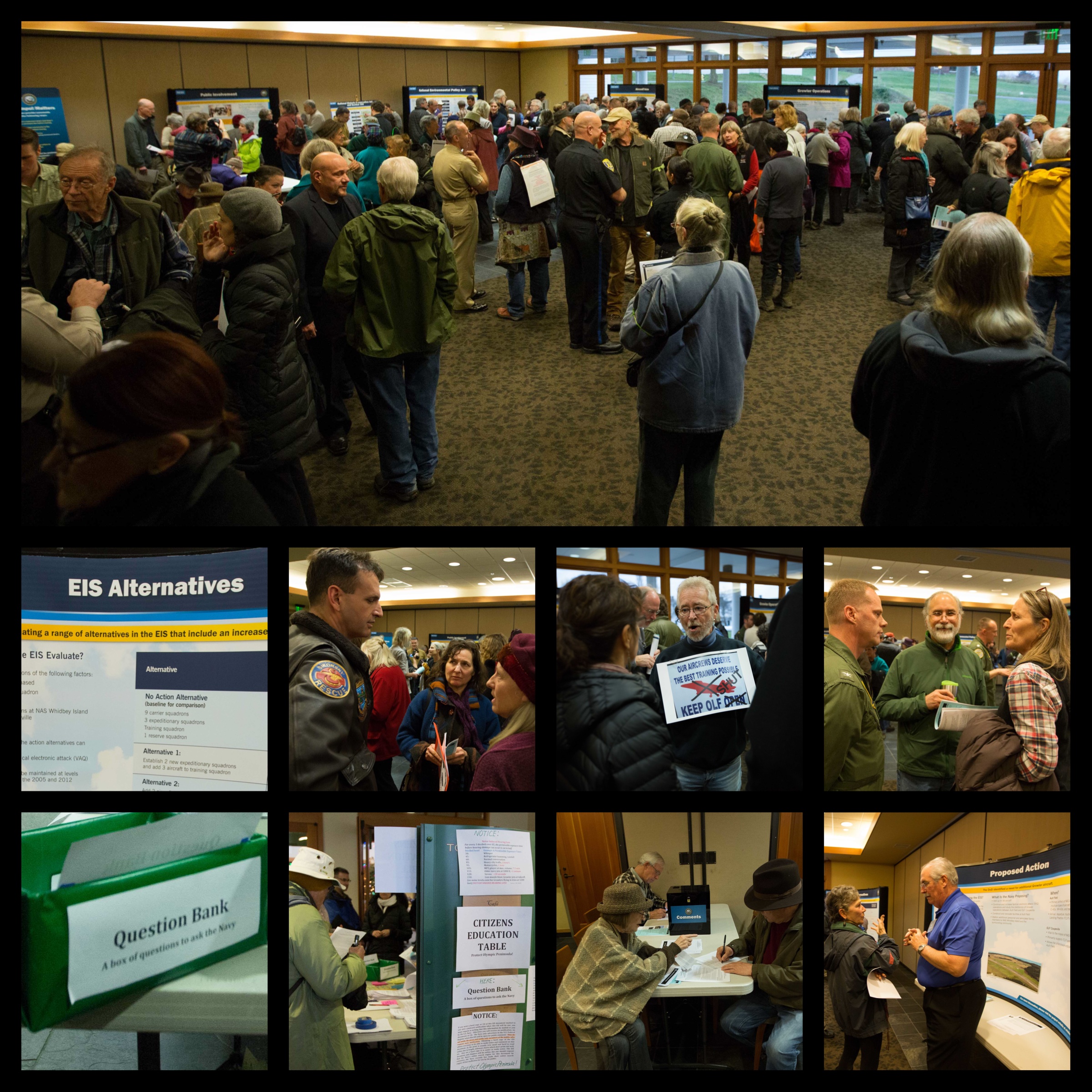
Hundreds turn out for Navy Growler EIS Scoping Meeting in Port Townsend Thursday.

Hundreds of people from the North Olympic Peninsula came to Fort Worden in Port Townsend Thursday afternoon to hear the Navy explain their plans for expansion of the Growler air fleet. The Navy had subject matter experts with signage to help explain their plans, which in some cases did clarify issues. (more on that later). Additionally, the Navy provided scribes and the ability for people to get their comments logged to the official record of public comment.

US Navy EIS EA-18G Growler Jet Expansion EIS Public Comment Meeting at Fort Worden.

US Navy EIS EA-18G Growler Jet Expansion EIS Public Comment Meeting at Fort Worden. Photos by Al Bergstein

Opponents of the expansion were out in force, and had stations with question banks so people could ask knowledgeable questions. The opposition groups have a great deal of concern about noise pollution, jet pollution, the tie in of this expansion with the Electromagnetic warfare training that the Navy plans to use these planes to test over the west end of the Olympic National Park and Clallam County.

Some interesting questions that were answered were that the Navy has traditionally only scoped a radius of 10 miles from the base. We and the San Juans are about 15 miles away. It took petitioning our government representatives to get the Navy to wave the distance requirement for San Juan and Jefferson County. Speaking of that, many of our local elected officials were present.

Also, the Navy spokesperson was quite clear that the multiple EIS, EAs etc. that the Navy currently has moving, while easily seeming to be a tactic to throw off the civilian opposition to the expansion, in their minds is a work load issue. They just couldn’t take on all of them simultaneously.

Another question that was answered was that the planes are currently not funded in the military budget. It’s assumed they will be, but they could see funding cut at some level. It appears that the plan is for the maximum they want to add with the money they assume will be there.

There appear that are no EIS alternatives that are “no expansion”. The “No action” choice is being used as a ‘baseline’ as they call it, for the others, and the Navy claims it would not meet the goals of the DoD for electronic attack capability. To be clear, the Navy expects to expand their fleet here. The only possibility standing between that expansion is citizen opposition at all levels to change the goals, or have them find another field elsewhere. The Navy seems not interested in those options at all.

It is clear that these folks see their job to sell this expansion to us, as a simple matter economic savings by bringing all the planes and pilots here. Some of the people I spoke with live on the East Coast, have lived with Navy jet noise for years and see it as just the way the world works. It’s up to people here to make the Navy understand that expansion of this base, in a heavily populated area, is not something we have been able to vote on, and  that seems to be unstoppable, as the Navy themselves gives no alternative option to growing the base. While people who are openly anti-military attended the meeting, it seemed as if the bulk of the people are simply concerned with the growing noise pollution, threat to the environment, possible unknown health risks from these secret devices on the planes, and feel that it’s better suited to another, more remote base. One where the local population is much smaller, and spread away from the jets and their training.

So there you have it. It’s up to you to decide. They have presented their case. Do you want an expanding world of unmuffled jets, flying an expanded array of sorties throughout the day and night, or will you take some action now to try and put some rational limits on the local growth of this particular base? Do you want to continue to trade away our environment, both as it affects humans and the natural world around us? Do you think that people will continue to come  here to camp, fish and sail as the jet noise continues to increase, when they can choose to go elsewhere where it’s quieter? It’s not just about the environment, but it’s also about economic issues.

It is worth noting that we put up with a huge amount of Navy now, and have for decades. Indian Island, Bangor Sub Base and the ongoing closures of the Hood Canal Bridge which ties up commerce, harassment by Coast Guard of recreational sailors for what seems like practice on their part rather than any real concern, noise pollution of jets waking us at midnight, and unknown deaths and injuries to Orcas, whales and other sea life.  The Navy admits they kill sea mammals. It’s just a question of how many, not if they will or not.

The Navy sees this all as part of their job to protect us. They are nice people, many with families too. They feel very patriotic about their job and they should. But they work for us, not a bunch of shareholders and stock. We are the ones that would have to say, “thanks’ but we have enough Navy here now, and your plans don’t fit this place. You are not actually saving us money if your consequences impact our economy. We have a unique environment with endangered species, some which are impacted severely by noise. We are not some part of the country that has already been trashed, and has nowhere to go but up. We really are in the middle. We’ve lost a lot, but have a lot more to lose. We can go either down or up in our quality of life.  We have families that come here from all over the world, because it’s quiet and beautiful. They can go outside to fabulous mountains, rivers, lakes and the ocean, and expect peace and quiet. It’s not Seattle, or some other noisy big city. If they need to do this, they need to go somewhere much more remote. ”

It’s a long shot to take this on, but if you don’t, no one else will.

Lyre River Property Purchased for Conservation Area

Great news from the North Olympic Land Trust. If you have not been to the Lyre, it’s a beautiful small river out west of PA.
——————————
A 280-acre property that is important to several salmon species and wildlife will be permanently conserved, thanks to its recent purchase by North Olympic Land Trust. The property abuts the Lyre River on the Strait of Juan de Fuca, about 20 miles west of Port Angeles. This property features an important estuary at the mouth of the Lyre River, streams, wetlands, tidelands, kelp beds and bluff-backed beaches. It also includes a large upland area with a diverse forest at various ages of growth.

“The Land Trust has been working with community partners for years to conserve this property,” said North Olympic Land Trust Board President Karen Westwood of Sequim. “This is the largest land protection project in the Land Trust’s almost 25-year history and will be a terrific place for the community to enjoy local forests and shoreline.”

The Land Trust and local partners bought the property with grants from the state’s Puget Sound Acquisition and Restoration (PSAR) Fund, Marine Shoreline Protection Fund, and Estuary and Salmon Restoration Program. The Land Trust also contributed its own money. The previous land owner has also provided a donation to pay for ongoing stewardship of the property. Critical partners include the North Olympic Peninsula Lead Entity, Washington Department of Fish and Wildlife, the Puget Sound Partnership, the Lower Elwha Klallam Tribe, and the Makah Tribe.

This project was ranked eighth among regional large-scale capital projects for 2013-15 PSAR funding by the Puget Sound Salmon Recovery Council. This ranking was based on impact to salmon recovery, project readiness, and how the individual project would advance Puget Sound Action Agenda targets.

Planning is underway for the use of the property. Visitors will be able to park about a mile from the beach and walk in from there. Visitors can enjoy day-use activities such as birdwatching, wildlife viewing, surfing, picnicking, and beach walking. The area will be closed to all motor vehicles.

This property purchase is a win not only for the community, but also for the mission of the Land Trust: conservation of open spaces, local food, local resources, healthy watersheds and recreational opportunities. Long-term goals of the Land Trust are to conserve lands that sustain the ecological and economic vitality of the communities of Clallam County.

The Lyre property includes the 3,000th acre that the Land Trust has conserved in Clallam County. This property will join other areas permanently conserved by the Land Trust through ownership, including properties on Elk Creek, Siebert Creek, and the Pysht River. The Land Trust also conserves land through voluntary conservation easements with private landowners. These agreements are in place on properties across the county, from the Bogachiel River to the Miller Peninsula.

This purchase pushes the value of total land conservation by the Land Trust to more than $14 million since 2007. For every unrestricted dollar donated by supporters to run the Land Trust, the organization has conserved $16 of land in Clallam County.

Letter to the Forest Service regarding the Navy Training Electronic Warfare Environmental Assessement

UPDATED FOR DECEMBER 1, 2016. Originally posted in 2014

Quick overview: Why is this an issue?

The DOD has stated they want permission from the Forest Service  to do this training.

To be clear, this is from the Forest Service EA on behalf of the Navy:

The Navy wants to run Electronic Warfare Training runs on the west side of the Olympic Peninsula, including over habitat for endangered Spotted Owls, towns such as Forks, areas very close to the Hoh River campgrounds, and generally all over the Peninsula’s west side.

From the Navy’s own documents:

-11.152 events per day
-2900 events per year. Current number in the Olympic MOA is 1200.
-Run up to 12 hours a day
-In use 45 minutes of each hour
-The equipment will be in use up to 260 days a year

The Navy claims that they will fly at a height no lower than 6000 feet. However, numerous eye witnesses from both inside the Olympic National Park and outside report that the Navy routinely flies much lower than that. Sometimes barely above tree top level.

The Navy’s own figures state that a jet flying at 1000 ft above ground level creates 113 decibels, which is far above the threshold for hearing damage.
So, 113 @ 1000 for one aircraft = 123 for two, and 128 for three. In other words, permanent damage instantly. (Twice as loud for two and an additional 50% louder for three.)
There are no answers, only questions at this point:

To whom it may concern:

I am writing to express my concern with substantive issues of  the Environmental Assessment being carried out by the Forest Service on behalf of the Navy’s Pacific NW Electronic Warfare Range.

There are number of issues that I am raising, starting with the 1988 DOD/Agriculture MOA:

DOD Department of Agriculture Master Agreement 1988 

  • DOD, Department of Agriculture (FS) Master Agreement on “Use of National Forest Service Lands For Military Activity” (1988)
    • As stated in this 1988 document: “Training activities on National Forest Service  Lands will be authorized when compatible with other uses and in conformity with applicable forest plan(s), provided that the Department of Defense determines and substantiates that lands under it’s administration are unsuitable or unusable.” 

I see nothing in the EA or the EIS that substantiates that the current lands in Eastern Washington or Idaho are unsuitable or unusable. In fact , It is clear on page 2-8 of the EA that Roosevelt and Okanagan are still possible to use. I see a case  made that it is too far for local pilots. But this is neither an unsuitable or unusable  argument as they are being used for this purpose now. Could the lands be used if necessary? The answer appears yes, but the Navy would prefer to do it in the Western Olympic Peninsula. That does not seem to meet the criteria as outlined in that foundational document between the DOD and the FS.

  • The 1988 agreement, noted above goes on to say that:
    • “This agreement does not apply to the airspace over National Forest System Lands unless directly associated with the land based training.”

Questions of overlooking the issue of aircraft

There is an implied issue that is not addressed in the current EA that I am commenting on, and seems critical to the EA.  IF there will be active flyovers of public land (USFS, ONF, WSDNR), and IF there will be active electronic engagement with mobile emitters then it seems that  potential adverse environmental impacts MUST be addressed in the EA. Any reasonable person would conclude that they are tightly coupled, and that one relies on the other, as they do in fact. Any attempt to suggest that these aerial activities are NOT a part of this Environmental Analysis and have been or are going to be addressed in a separate EIS are inexcusable considering potential adverse impacts to the human and natural environment.

Again, the airspace requirements for this EA are distinctly directly associated with the land based training, so while it is not addressed in the current EA, it is required by the 1988 Master Agreement to be considered in the EA and likely an EIS that would take into consideration both issues. That the Forest Service has not bound the airspace issues with the land based issues seems to be a significant oversight on behalf of the FS reviewer. Previous EISA entries from the DOD/Navy did not address this specific use of the airspace, which may significantly alter the altitude and noise impact to both the National Forest and the National Park. So the question I ask is “Why is it not bound to this EA?”

Also, the flight paths of these jets flying unmuffled at 1200 feet are not even shown on diagrams. What population areas, businesses and homes are going to be affected by these flights?

  • Section B of the 1988 Master Agreement states:
    • Military Training activities on Forest Service lands are actions that require the analysis of environmental impact in conformance with the National Environmental Policy Act (NEPA) and other statutory and regulatory requirements. The Department of Defense and the Department of Agriculture will cooperate to accomplish the appropriate NEPA compliance.

Questions of Noise

A question of whether the activities of the DOD are compatible with  other uses and conform with applicable forest management plans can be questioned, since hiking, fishing, camping and other human activities are expected to take place both on FS land and the adjacent Olympic National Park (ONP). The noise of the jets participating in the testing and training of the pilots, and directly associated with the land based training, flying at heights of 1200 feet, will be at decibel levels that are known to damage human hearing (greater than 80 decibels for example).

These planes, which are required to make deployment of the electronic gear being requested necessary, will be heard inside the Olympic National Park, in such locations as the Hoh River campground, and other campsites close to the deployed gear, according to the maps provided by the FS and Navy.

In earlier court cases, the National Park Service has found that snow plane noise (from planes landing in the snow in areas like Alaska) violated park standards. Has the Park Service weighed in on whether the noise of the unmuffled jets flying training sorties at 1200 feet will meet noise criteria in the areas of the National Park over which the jets will fly? And what about the noise levels generated adjacent to the Park? This has been successfully argued in court to be a violation of the Wilderness Act.

Questions of Fire 

There is no mention of possible fire, caused by either the jets themselves or the equipment. If a jet crashes, especially if it happens in late summer, what measures do the FS and the Navy expect to take to fight the subsequent fire?  This seems to be an oversight in the EA.

Quantities of training 

The DOD has stated they plan to do this training:

  • 11.152 events per day 
  • 2900 events per years. Current number in the Olympic MOA is 1200.
  • Run up to 12 hours a day
  • In use 45 minutes of each hour
  • The equipment will be in use up to 260 days a year
  • The Navy’s own figures state that a jet flying at 1000 ft above ground level creates 113 decibels, which is far above the threshold for hearing damage.
    • So, 113 @ 1000 for one aircraft = 123 for two, and 128 for three. In other words, permanent damage instantly. (Twice as loud for two and an additional 50% louder for three.)  

This cannot be construed to be “no harm” as exposing human and animal hearing to the directly associated unmuffled air training that is done in conjunction with the required land based equipment could cause human hearing impairment. There has been no Environmental Impact Statement done on the joint use of the two distinctly directly associated activities. I request that one be done.

A reasonable person who would live, work or recreate near such activity would not consider adding 260 days and 12 hours a day of unmuffled jet noise associated with this activity, along with the coming and goings of trucks at all hours of the day and night, to be “no significant impact”. So what was the criteria in establishing that ruling in the FONSI?

Question Of Conversion Of And Taking Of Private & Public Property 

An issue not addressed is the implied conversion of private property under the flight paths of these jets, in the vicinity of the transmitters. (Flight paths are not even considered in the EA) Citizens are being told that they will be living under a war training zone, that unmuffled jets may be going over their homes and businesses at 1200 feet as much as 12 hours a day and up to 45 minutes in those hours. Would they consider this an impact on their businesses and personal lives?

This seems to be a “taking” of the private property use, without properly addressing the issue of whether there is going to be a loss of value or reimbursement  to the homeowner, business person or property owner.  This kind of issue has been dealt with in many locales when flight paths in and out of airports brought jet traffic over homes. These homes often are purchased and destroyed. Seatac has two such locations, north and south of the runways.   When the Navy has created training ranges such as Yakima Firing Range, there was a condemning or purchase of the land there. This issue has not been raised in either the EIS nor the EA.

Loss of Wilderness Soundscape

The loss of wilderness soundscape over the ONP is also, per my comments above, a possible violation of the Wilderness Act. It could also be seen as a violation of NEPA because it appears there has been no adequate consultation with the Park Service prior to the EA nor documented on this issue in the EA.

Use of DNR Lands

It also appears that there are use issues with DNR lands in that vicinity, has that been documented somewhere other than this EA?

Loss of tourist trade

There are unknown losses that may occur due to tourist activities that may not happen due to the understanding by recreation users and others that low flying unmuffled jets are in the area. That is not addressed at all in the EA, nor the Navy’s EIS for the training areas. Are there similar locations in the Continental US that could be looked at for possible loss of incomes and tourist trade?

Issues with the Finding Of No Significance (FONSI) 

In the comments in the FONSI there is mention of having referred to the FS NW Forest Plan, but no mention of which sections of the FS NW Forest Plan the writer is referring to. Which ones is he referring to?

The FONSI appears to have been arrived at with no public input and insufficient scientific data, thus violating NEPA.

In the comments section of the FONSI there is no mention of jet aircraft in consideration of  the actions proposed on page EA-2.  However, the jet aircraft are required for this training. They are not a separate entity, but intrinsically part of the whole.  A reasonable person would assume that would be taking into consideration in this EA.

I request that the FS rewrite the EA to take into account the jet aircraft in use specifically for this training be done.The EIS that was originally done by the Navy regarding airspace did not consider or discuss this use, but was specifically calling out issues related to training at sea.

In the comments section of the FONSI the reviewer only considers the Navy’s needs in the alternatives, and not whether citizens who live and use the National Forests of the affected areas on the Olympic Peninsula would request an alternative.

In the comments section of the FONSI the reviewer states that there will be no effects on the human environment. Most reasonable people living, working or recreating on these lands would consider 200 training exercises a year requiring jets flying low enough to produce sound above the range of damage to human hearing to be a negative effect of any such activity.

IN CONCLUSION:

Given all these issues, I respectively suggest that the EA is inadequate in addressing the possible impacts to public health and safety, biological resources, Noise, Air Quality, and Visual Resources, along with the lack of proof that the use of Forest Service Lands by the Navy has not been adequately shown to adhere to the 1988 Master Agreement (referenced above), and wish to see it withdrawn and or rejected.

Navy defends electronic warfare training project in Pacific Beach public meeting – PDN

Related news on the Navy’s expansion of electronic warfare testing.

The town with the most direct impact from the Navy’s proposal to expand electronic warfare training in Olympic National Forest had its first public meeting on the plan this week. More than 175 residents of Pacific Beach in Grays Harbor County attended the Wednesday night meeting, with many voicing opposition. A five-person team from the Navy — the U.S. Forest Service declined an invitation to attend — defended the military agency’s finding in August that the project would have no significant environmental impact. Angelo Bruscas reports. (North Coast News)

http://peninsuladailynews.com/article/20141121/NEWS/311219979/navy-defends-electronic-warfare-training-project-in-pacific-beach

Return of the River – A homerun of a movie for Gussman and Plumb

Just got out of the world premiere of  ‘Return of the River”, the film that likely will be considered the definitive work on the Elwha Dam removal.  This film, years in the making, was a labor of love for the two Peninsula based filmmakers, John Gussman and Jessica Plumb. And it was great to see it premiered here at the Port Townsend Film Festival.

The film tracks in detail the history of the dam, but more importantly the place that is the Elwha River, the feel for the Olympic Peninsula then and now, and a great depth of interviews with people that were instrumental, on both sides of the controversial project.  It is impossible not to come away impressed with the idea that hard things to do take a long time, and a lot of consensus building. From the interviews with leading politicians, mill managers, environmentalists, writers, biologists, and most importantly, the tribal members of the Lower Elwha Tribe, who never gave up hope to bring back the historic runs. There were so many people who played significant small roles in this drama. Gussman and Plumb treated all with the respect they deserve. There are no demeaning ‘heroes and villains’ caricatures.

It is almost trite to say that certain stories are ‘epic’ and ‘pivotal’ but the removal of the Elwha Dam has been just that. It has galvanized world attention more than almost any other single environmental event of the last ten years, because it is a message of hope. Hope that we can restore what we have destroyed. Gussman and Plumb have captured that story, distilled it to 70 minutes, and given fair treatment to all sides, and points of view. More than ever, we need stories of hope in the face of ever mounting environmental problems to solve.

In the last week, I’ve posted the story that bull trout have been seen in the upper Elwha for the first time in a century. Also that the shores of the Elwha estuary are turning back into a clam bed capable  sand spit. The power of restoration is an amazing thing to watch.  The restoration of this river, with it’s unique short run from sea to protected park, is possible, and is happening, right now, in front of our eyes for just taking the time to go look.

Gussman and Plumb, along with the rest of their crew, have given us the story, in all it’s facets. A well crafted storyline, beautiful filmmaking, solid editing, a wonderful original soundtrack, animation when needed of the hard concepts.

Congratulations for a remarkable piece of work. A 5 star must see film.

EVENT: Premiere of “Return of the River” on the Elwha Dam Removal

My friend and fellow filmmaker John Gussman has completed his epic film on the removal of the Elwha dam. Come see his film in Port Townsend

Friday, 6:30 p.m., Rose Theatre
Saturday, 12:15 p.m., Peter Simpson Free Cinema

“Return of the River” is a feature documentary that tells the story of the largest dam removal and river restoration project in history, currently unfolding on the Elwha River in Washington State. The film explores an extraordinary community effort to set the river free, and shows an unlikely victory for environmental justice. Told by an ensemble cast of characters, “Return of the River” offers hope amid grim environmental news.

Find us on facebook at facebook.com/ReturnOfTheRiver

EVENT – Oct 7 – Community Forum on Ocean Health


Ocean_Health_Forum-100714

Please join us for a free evening event featuring guest speakers Dr. Simone Alin, Supervisory Oceanographer at NOAA Pacific Marine Environmental Lab; and Betsy Peabody, the Director of Puget Sound Restoration Fund. You’ll learn about changes in the marine waters of Puget Sound, and what’s being done to address them by some of the amazing people who live and work here.

Tuesday, October 7

6:30 PM-8:00 PM (Doors open at 6 PM)

Northwest Maritime Center

Maritime Meeting Room (2nd floor of yellow building)

Port Townsend, WA 98368

This event is sponsored by the Northwest Straits Commission, Jefferson County Marine Resources Committee (MRC), and Puget Sound Restoration Fund.

All are welcome.

Caroline Gibson    –    Marine Program Manager

Northwest Straits Commission

431 Water Street

Port Townsend, WA 98368

360.385.1153 (PT office)

www.nwstraits.org

EVENT -March to demand more climate change action – Port Townsend

Sent to me today: if you are on the Peninsula, this could be a good alternative to driving a long ways for a climate change event! Go by bike, take a bus, or walk! At least carpool.

Please join us at the People’s Climate March this Sunday, Sept 21, 3 – 4:30, at Pope Marine Park.  We will be joining thousands of people like us marching at the United Nations in NYC and at other marches around the world.  Our message is simple:

 
NOW IS THE TIME FOR STRONG ACTIONS TO CURB GLOBAL WARMING AND CLIMATE CHANGE
We will be joined by tribal representatives especially concerned about the future of the Salish Sea – our local waters.  Bring your family, friends, neighbors and co-workers so that all our voices can be heard.
PT Climate March

Wild Olympics Gets Starring Role in National TV Program on PBS

“This American Land” Spotlights Area and Advocates, Releases Video of Segment Online

QUILCENE, Wash. (June 24, 2014) Washington’s Wild Olympics and the local effort to safeguard its clean water and old growth forests are highlighted in an upcoming episode of the television series This American Land, which airs nationwide on PBS stations. The segment features interviews with a number of Olympic Peninsula community members working to permanently protect ancient forests and salmon streams on Olympic National Forest as wilderness and Wild and Scenic Rivers.

“This American Land” has posted the entire Wild Olympics segment for viewing/sharing HERE.

In the piece, Port Townsend City Councilor Michelle Sandoval explains that people are drawn to the Peninsula for the recreational opportunities and stunning scenery, and stay because of the clean water and high quality of life. Bill Taylor of Taylor Shellfish Farms in Shelton describes the importance of this clean water to his Hood Canal oyster beds, calling it the “lifeblood” of his industry. John Lockwood, owner of Pygmy Boats in Port Townsend, says that small manufacturers like him depend on the area’s incredible recreation opportunities to stay afloat. Port Townsend Fish biologist, and director of Northwest Watershed Institute, Dr. Peter Bahls explains how Olympic Peninsula salmon runs are still recovering from a hundred years of overfishing and heavy timber harvesting on the national forest. And retired logger Fred Rakevich of Elma says though he’s traveled all over, the ancient forests and free-flowing rivers of the Wild Olympics remain “something we need to protect and cherish.”

Connie Gallant of Quilcene, chair of the Wild Olympics Campaign, who also appears in the program, says, “We are delighted that This American Land has included our beautiful piece of the world in its series. The many local voices featured showcase the broad local support for safeguarding this stunning landscape. They come from different backgrounds and interests and use our public land in various ways, but they find common ground in the desire to permanently protect our ancient forests and salmon streams just as they are as a legacy to future generations.”

“Our mission is to bring our viewers the kind of serious yet entertaining conservation journalism that broadens their knowledge of critical issues with stories that they won’t see anywhere else,” says This American Land executive producer Gary Strieker. “Each segment focuses on unique and little-known places that deserve protection.”

Senator Patty Murray (D-WA) and Representative Derek Kilmer (D-WA) have introduced legislation to permanently protect more than 126,000 acres of ancient and mature forests on Olympic National Forest as wilderness, and 19 Olympic Peninsula rivers and major tributaries as Wild and Scenic. The bill is aimed at permanently safeguarding critical salmon habitat, outdoor recreation and sources of clean drinking water for local communities. Backed by over 450 sportsmen organizations, local elected officials, business owners, conservation & outdoor recreation groups, and members of the faith community, the measure was crafted with considerable local stakeholder involvement over several years.

The Wild Olympics segment will air as part of the fourth season of This American Land, which will begin broadcasting in the Seattle area in August.http://www.thisamericanland.org

Summer Volunteers Wanted for Trail & Road Survey on the Queets – OFCO

OFCO is looking for volunteers this summer, for important field surveys in the Queets watershed. If you’ve never done this kind of work, don’t worry—we’ll give you all the training you need. It’s a great opportunity to get to know the terrain while doing valuable work and enjoying the good fellowship of like-minded folks.
  OFCO is a long-time proponent of collaborative efforts to protect and restore our beloved Olympic Peninsula forests and streams. One of our most successful recent collaborative efforts has been our citizen road survey and monitoring program on Olympic National Forest (ONF) lands. For the past three years we have collaborated with the ONF and Great Old Broads for Wilderness to conduct surveys on the condition of roads and trails already existing or proposed for reconstruction in the South Fork Skokomish watershed. We have focused surveys on those roads and trails that have the greatest potential to impact the watershed’s streams and rivers and their inhabitants.

Success of this project depends on citizen volunteers-people like you! Even if you have never been a citizen road condition surveyor, we will train you in data collection, GPS use, map and compass reading, and identification of features such as tension cracks and post-construction channel adjustments that can contribute sediment to streams. And, thanks to a generous grant from The Burning Foundation and in-kind contributions of OFCO board members, we will be able to provide food for meals plus accommodations in a lovely cabin overlooking the Pacific Ocean. Each survey expedition will be for three days, with two overnights. The following are dates we are considering for citizen volunteer surveys: July 4-6August 1-3August 8-10; and/or August 15-17.
Please contact Shelley at saschar44@gmail.com if you are interested and willing to partake in this important work. It should be fun!

Lessons from the Oso Mud Slide

There are two articles in the last 48 hours on the Oso mud slide which are worth reading, especially as it relates to the Olympic Peninsula. Timothy Egan, a northwest based writer produced, “A Mudslide, Foretold”, in which he claims that logging over legal limits likely were part of the problems that caused the slide.

DON’T tell me, please, that nobody saw one of the deadliest landslides in American history coming… enough with the denial, the willful ignorance of cause and effect, the shock that one of the prettiest valleys on the planet could turn in a flash from quiet respite in the foothills of the North Cascades to a gravelly graveyard.

New York Times Article by Timothy Egan

http://www.nytimes.com/2014/03/30/opinion/sunday/egan-at-home-when-the-earth-moves.html?hp&rref=opinion&_r=0

We also now know that the State has been monitoring this very slope for over 25 years, with a very specific report given to DNR from the Department of Ecology in 1997, DNR chose to ignore that science and use data from 1988 to issue much greater logging areas than the scientists from Ecology recommended.

State used outdated data to allow logging on slope – Seattle Times

http://seattletimes.com/html/localnews/2023266702_mudslideloggingmapxml.html

How much the homeowners themselves knew about all this in advance are likely to range from nothing to choosing to ignore the issues. That would be understandable, as choosing to move out of harms way is a hard decision, and some folks likely couldn’t afford to. But the County knew, and the State knew. Likely the city of Oso knew as well. Could they have taken actions such as banning logging from the plateau above the river? Yes. Could they have offered buy outs to the homeowners at fair market value to plow these homes under and stop habitation of the land along the river corridor? Yes. Should increased setbacks from rivers and shores be implemented for future building, be implemented in local laws like Shoreline Master Programs? Yes.

Are there others in harms way in Snohomish County (and elsewhere)? Seems so.

Landslide risk widespread in county; 30,000 in hazard zones 

http://www.heraldnet.com/article/20140330/NEWS01/140339947/Landslide-risk-widespread-in-county-30000-in-hazard-zones
…. The approximately 50 houses east of Oso swept aside by the March 22 landslide were hardly the only ones built near unstable land in Snohomish County. Hazard maps show almost all of the county’s coastline and mountain valleys are in landslide danger zones. An estimated 30,000 people live in those places, according to a 2010 study commissioned by the county. By 2035, the county is expected to absorb roughly 200,000 more people. There are about 730,000 today…. The county can’t afford to buy out property owners in landslide areas. Plus, people have a right to stay and, under certain conditions, to build. Existing laws and policies governing development in Snohomish County didn’t keep people in Oso out of harm’s way. Under the county’s building regulations, the area where homes were built wasn’t even designated high-risk for landslides. Noah Haglund and Dan Catchpole report. (Everett Herald)

It’s also becoming known that many of the homeowners didn’t have flood insurance, probably because they lived within the boundaries of a known flood plain.

This also gets to the core of a bill recently supported by Representative Derek Kilmer, (Homeowner Flood Insurance Affordability Act), who proudly boasted of supporting the roll back of insurance costs and support by the Federal government for home and business owners along the shore who have seen a huge increase in their flood insurance due to the outcome of Hurricane Sandy. The insurance companies have obviously decided  to no longer take the risk to insure people who have been allowed, by the county and the State, to build homes and businesses at locations that are likely to be flooded  by Tsunami or global warming related storms. This is how the market should work. If the risk is too high, then you choose to live there at your own risk. This is what all the property rights people keep screaming for, that the government should get out of their lives. Now they and others seem quite happy to have us taxpayers pay for their risk.  And of course, Representative Kilmer says, ‘sure’.

If people want to live at sea level, or in a flood plain, since government seems incapable of stopping it, then the marketplace should. Or the marketplace should state that it’s at your own risk to do so. That’s what Representative Kilmer has stopped by supporting the House bill to rollback or nationalize the insurance risk. Now, people will continue to assume there is low or no risk in continuing to build and live in harm’s way.

As to Oso, The State and County should be held responsible for ignoring science and allowing logging to continue on the slope with outdated science. That is the only way we are going to get the government to do the right thing. But again, the failure of DNR to do the right thing will be a cost that you and I have to pay. The department heads that made that decision are likely long gone, and certainly won’t be held accountable for their  decisions. It’s you and I that will be.

And the people who rail about how the government should get out of their lives and stop making rules that take away their rights to do whatever they want whenever they want, should take a hard look at where they live, and whether they expect the public to foot the bill for the outcome of their demands.

‘Tides of Change’ explores the health of ocean waters off North Olympic Peninsula – PDN

“Tides of Change” is a new Science Minute Movie by the North Coast and Cascades Science Learning Network that takes viewers behind-the-scenes of Olympic National Park with coastal ecologist Steve Fradkin as he traverses “one of the most wild, scenic coastlines in North America” to monitor the health of the park’s rocky intertidal community. (Peninsula Daily News)

Read the whole story:

http://peninsuladailynews.com/article/20140317/NEWS/140319981/video-8212-tides-of-change-explores-the-health-of-ocean-waters

Controversial Olympic Peninsula Timber Sale Pits Environment Against Education – Earthfix

The battle to protect remaining stands of timber, that are home to the endangered marbled murrelet, continues. The State has decided to log off the stand, which are home to some pairs. A lawsuit is imminent. This is another good example of the environmental battle that happens as resources dwindle and we don’t have a proper modern taxing mechanism to fund our schools. The idea of cutting timber to fund schools was once a simple one, but now, it’s become a trade off of rare species vs. schools. It will take a brave legislator(s) to really end this practice and come up with a funding mechanism that properly funds our schools. It’s ironic, because the very district (Jefferson County) that probably thought this was a great idea once a 160 or so years ago, now is the one that brought the lawsuit demanding proper funding. And we are one of the most environmentally supportive counties in the state. I don’t see any legislators of the calibre to offer a new way forward. In fact, in conversations with them, they feel like they are unwilling to do anything more for the schools than they already have. Would love to be proven wrong.

SEATTLE — The Washington Board of Natural Resources voted unanimously Tuesday to approve the sale of 200 acres of the Olympic Peninsula that are home to the threatened marbled murrelet. The money from the timber sale will go to the University of Washington.

http://earthfix.kcts9.org/flora-and-fauna/article/controversial-olympic-peninsula-timber-sale-pits-e/

Study: Olympic National Park tourism brings in benefit to tune of $220 million – PDN

Another reminder that while many of us think that forestry is our largest industry, protecting those forests for tourism, is also a good return on our money. Read the whole story at the Peninsula Daily News.

The National Park Service says more than 2.8 million visitors to Olympic National Park in 2012 spent $220 million in the park’s surrounding communities.

http://peninsuladailynews.com/article/20140304/NEWS/303049981/study-olympic-national-park-tourism-brings-in-benefit-to-tune-of

Wild Olympics Campaign hails bill to protect peninsula’s ancient forests & rivers

11988879026_7f2700621e_z


Diverse Coalition of Local Business Leaders, Sportsmen, Elected Officials, Conservationists & Recreationists Praise introduction of Wild Olympics Wilderness and Wild & Scenic Rivers Act.


QUILCENE, Wash. (Jan. 17) A broad and diverse coalition of Olympic Peninsula community members cheered the introduction today of the Wild Olympics Wilderness & Wild and Scenic Rivers Act of 2014 by Representative Derek Kilmer and Senator Patty Murray.  The measure, similar to that introduced in the last Congress, by Senator Murray and former Congressman Norm Dicks would permanently protect more than 126,000 acres of ancient and mature forests on Olympic National Forest as wilderness and 19 Olympic Peninsula rivers and their major tributaries as Wild and Scenic.


“Senator Murray and Representative Kilmer deserve tremendous thanks for working to ensure that our beloved Olympic Peninsula will be here for our grandchildren,” said Connie Gallant, chair of the Quilcene-based Wild Olympics Coalition. “This landmark legislation will protect the Olympic Peninsula’s ancient forests, free-flowing rivers and stunning scenery for all time. It will safeguard critical salmon habitat and sources of clean drinking water for our local communities, protecting our unmatched quality of life on the Peninsula. We are extremely grateful to Representative Kilmer for continuing the work begun years ago by Representative Norm Dicks and Senator Murray to protect the Wild Olympics. It is testament to the commitment and hard work of Senator Murray and Representative Kilmer that we may — for the first time in nearly 30 years — see new wilderness on Olympic National Forest, as well as the first-ever protected wild and scenic rivers on the Olympic Peninsula.”


“Safeguarding our natural environment is a key to providing steady and sustainable income to our rural economies,” said Roy Nott, an Aberdeen Business Leader and former Timber Company Executive. “The Olympic Peninsula’s stunning scenery sport fishing, clamming, hiking, hunting, bird watching and other forms of outdoor recreation all contribute to our local economic health and are critical to attracting and retaining the highly skilled employees that growing, technology-based companies want and need.”


“This bill will protect and promote the same spectacular public lands and high quality of life that are helping to drive growth and create local jobs in real estate, construction and many other sectors of our economy today,” said Harriet Reyenga, an independent realtor for Windermere Real Estate in Port Angeles. “Our ancient forests, salmon, rivers and amazing landscapes are the north Olympic Peninsula’s competitive economic advantage over other regions.”  Reyenga, who won the 2012 Realtor Achievement Award from the Port Angeles Association of Realtors, added, “We should do all we can to protect and promote these natural treasures. The Wild Olympics legislation will do both.”


“People think that because these areas appear as they’ve always been, that they are safe,” said Dave Bailey, Past President of the Grey Wolf Fly Fishing Club in Sequim, WA and a co-founder of Sportsmen for Wild Olympics www.SportsmenForWildOlympics.org.  “Unfortunately, that is the furthest thing from the truth.  There is a determined effort in Congress to roll back safeguards on our public lands and open these sensitive spawning grounds to small hydropower development, industrial clear-cutting and more road building once more.  That’s bad for fish, game, and sportsmen.  This legislation is critical to preserve what we have.”


“Places like lower Gray Wolf, Lena Lake, South Fork Skokomish and South Quinault Ridge deserve the ‘gold standard’ of protection, and that is what this visionary bill provides,” said Tim McNulty, of Sequim, Wild Olympics Coalition member and author of Olympic National Park: A Natural History. “The conservation community has been working for decades to safeguard these unparalleled areas.  Today is a day to celebrate, but now we must work to get this important legislation passed by Congress and signed into law.  Future generations deserve no less.”


“The two largest shellfish hatcheries that supply seed to the West Coast industry are located on Hood Canal, said Bill Taylor President, of Taylor Shellfish in Shelton. “Well over 150 jobs are provided in Hood Canal alone by the industry, not including the indirect jobs such as processing, sales and shipping. By taking a watershed approach to protecting Olympic Peninsula forests and rivers we ensure clean and safe water so that shellfish companies can continue to grow and further benefit the economy and ecology of Washington state.”


“As an outdoor recreation business owner and an avid outdoorsman, my livelihood depends on clean, free-flowing rivers, said Morgan Colonel, the Owner of Olympic Raft and Kayak, Port Angeles. I managed a Jackson Hole river company during the designation of the Snake River as Wild & Scenic, and saw firsthand the benefits of safeguarding this vital waterway. Active outdoor recreation contributes more than $11.7 billion annually to Washington’s economy, and supports 115,000 jobs. Businesses like mine depend on access to the high quality natural resources the Olympic Peninsula is known for. Protecting these resources is an investment in our region’s economic future, and the smart thing to do.”


Wild Olympics is endorsed by more than 470 local businesses, farms, faith leaders, local elected officials, hunting, fishing and recreation groups: www.wildolympics.org/supporters/endorsements

photoCopyright All rights reserved by Wild Olympics Campaign

WSU Master Goat Farmer Program offered in Jefferson County in January

WSU Jefferson County Extension offers the Master Goat Farmer Program on Marrowstone  Island from January 17-19th , 2014. The 3-day advanced course, offered by WSU since 1988,provides goat farmers/owners in-depth training of goat production topics including nutrition, pasture management, health and disease, lactation, mastitis, reproduction, housing, breed  selection, and food safety.

Course presenters include Susan Kerr, WSU Northwest Regional Livestock and Dairy Extension Specialist; Gary Fredericks, WSU Cowlitz Extension County Director, and Lorrie Conway. Course participants will experience hands-on and classroom presentations, along with a field trip to neighboring goat dairy, Mystery Bay Farm. Participants will also receive a CD of educational publications related to goat care and management.

The Master Goat Farmer Program will be held at WSU Twin Vista Ranch on Marrowstone Island on Friday, Saturday and Sunday January 17th , 18th and 19th

Class size is limited. Cost is $60 per person, plus $30 for additional family members. To register, visit jefferson.wsu.edu.

For more information: Susan Kerr at kerrs@wsu.edu or 360-848-6151 or Kellie Henwood at (360) 379-5610 ext. 201.

Enrollment now open for environmental project work for high school to 21 year olds

imageThe Skills Center Natural Resources program gets you outside doing real work in the environment.  We offer project-based classes to high school-aged students (up to 21 years old without a diploma) across the North Olympic Peninsula.  All classes include hands-on field work, offer high school and college credit, and help students transition to the next step of internship, college or career.

Enrollment is open now for second semester, which starts at the end of January.

Classes in Port Angeles include the new ‘Cultural and Natural Resources 1’ class, which meets after lunch daily, and 5 different ‘Natural Resources Options’ that meet after school one day per week.  Sequim and Forks each have three different ‘Natural Resources Options’ that meet after school one day per week.

For more information or to enroll, please contact teacher Dan Lieberman at 360-565-1892, dlieberman@portangelesschools.org, or www.nopsc.org/naturalresources.


image