Local Call for donations for Standing Rock

Slightly off topic to the Peninsula, but worth noting. This in from members of Quimper Unitarian Universalist Fellowship who have returned from Standing Rock.

We are writing to bring attention to the great need (and opportunity) to support the Standing Rock Sioux, more than 300 other Indigenous Tribal Groups from the Americas, and many other American citizens. Thousands of individuals and groups have gathered at Standing Rock, joining there in peaceful actions to stop construction of the Dakota Access Pipeline across Sacred Tribal Lands and under the Missouri River, which is the source of the region’s drinking water.

A group from Quimper Unitarian Universalist Fellowship, led by Rev. Florence Caplow, journeyed to Standing Rock and suggest that it is best to contribute funds, so that Native Peoples can purchase what they know best is required to survive the Dakota winter, and so that they will be able to sustain opposition to the invasion of their sacred lands, and prevent significant risk of toxic contamination of their Missouri River drinking water supply.

The Pipeline is intended to carry large quantities of volatile Bakken oil from North Dakota to refineries in Illinois (1,172 miles).  Transportation of volatile Bakken oil was responsible for the huge, lethal explosions of an oil train in Lac-Megantic, Quebec, July 2013, resulting in the deaths of 47 citizens and destruction of most of the town’s buildings.

Peaceful, unarmed “Water Protector” Native Americans (Elders, Women, and their Children) have been pepper-sprayed, and attacked by guard dogs deliberately set upon them as they tried to keep bulldozers from destroying ancient gravesites.

Snow-filled Dakota winter days bring temperatures often as low as 40 degrees below zero.  Peaceful defenders of their land and water have  great need of warm clothing, supplies of water and food, firewood, etc.

Please contribute as much as you can, as soon as you can, to:

http://standingrock.org/news/standing-rock-sioux-tribe–dakota-access-pipeline-donation-fund/

Native Peoples Connections Action Group  –  Green Sanctuary Committee

Quimper Unitarian Universalist Fellowship, Port Townsend, WA

No on I-732

I have taken a bit of heat lately, over my decision to vote NO on I-732. I have been following the debate on this initiative for over a year, and feel I have a pretty good grasp on the issue. My analysis: It’s the wrong initiative at the right time. 

First, off. When I read a quote in the New York Times, by the person who is behind the initiative that says (the writer is talking about the initiative writer) :

This brings me back to my friend, Yoram Bauman, who sent me that headline. He is an environmental economist and stand-up comedian (yes, an unusual combo). He is also one of the leaders of the effort in Washington State to pass a carbon tax. He has been working tirelessly to build support.

Based on his experiences, he has a message for environmental activists: “I am increasingly convinced that the path to climate action is through the Republican Party. Yes, there are challenges on the right — skepticism about climate science and about tax reform — but those are surmountable with time and effort. The same cannot be said of the challenges on the left: an unyielding desire to tie everything to bigger government, and a willingness to use race and class as political weapons in order to pursue that desire.

That, my friends, is absurd on it’s face. Those of in the environmental movement (left right and center) have been stymied again and again by the Congress, controlled by the very same Republican Party that Yoram claims wants to solve the issue. They not only have offered no alternatives, but they deny it’s even a problem. You may remember that the last time they crafted an energy bill, under Dick Cheney, the did not even invite one environmental representative to the meetings. At that meeting, they put together legislation that allowed fracking to be done with no environmental oversight. They allowed fracking fluid to be dumped, and it is still dumped, in our rivers and oceans every day with no environmental oversight. Since then, over the last 8 years, they have stymied any attempt to put in place climate change law. They are boasting that they will overturn the Paris Climate agreement if Trump should win and they take over Congress and the Presidency. Luckily, that seems a long shot at this moment.

Mr. Bauman seems very naive about how the political sausage gets made. In this year of Donald (I will end the EPA) Trump, Dr. Jill (I’m not so sure about vaccines) Stein, and Gary (no need to worry about global warming as the sun will burn us up in a billion years) Johnson, is it surprising to find bad ideas made into an initiative by someone saying something like this? Is there something we are missing in his motives? According to his resume, he is a PhD in Economics. Frankly, I’m burned out on economists trying to force their voodoo on us. Think I’m alone in this thought? None other than the venerable David Suzuki supports this line of thinking. A quick thought on economists by David. https://www.youtube.com/watch?v=2wiZoGZJN3s

The initiative will give huge tax breaks to Boeing, will reduce the tax on all manufacturing businesses, while stripping tax revenues, if their predictions prove wrong, from the State just as the state needs it to fund basic education, something it has not been doing properly, well forever, according to the Supreme Court of Washington. The Seattle Times said, “state officials, who have forecast that instead of being revenue neutral as intended, I-732 would bring at least a short-term cut to the general fund of $797.2 million over six fiscal years.” We cannot afford a roll of the dice like that now. Education funding is at stake. In Jefferson County I’m finding  some of the same people wanting to McCleary fully funded supporting this initiative. Help me understand how this won’t affect the McCleary funding fiasco?

Reducing the B&O tax on manufacturing gives a huge tax break to Boeing. And what about the rest of the small businesses who pay B&O? They likely will find themselves right in the cross hairs of more tax increases because who else is going to be taxed to raise the money to meet the McCleary Decision?

It seems like a dream initiative. They say that no one gets hurt. I just don’t believe that for a minute.

Will the initiative actually help those affected by the rising prices of fossil fuel? The analysis by Siteline, which was generally in favor of I-732 glided over the following statement, “Still, it does have a hole in it: some 340,000 low-income families do not qualify for the Working Families Tax Credit. Some of them, perhaps many of them, will end up worse off by tens of dollars each year because the sales tax cut won’t fully offset their increased carbon costs. Some of them might come out as much as a few hundred dollars a year behind. The Working Families Tax Credits and sales tax cuts are important improvements on the status quo, but we lament I-732’s lack of additional funds to help low-income Washingtonians.” Really. So we should pass despite this failing? This is really the crux of the argument. It is a win for Boeing and a loss for perhaps 340,000 lower to middle income families who will have to pay the increased costs with no rebate from the State? If you were a single mom eking out a living watching all your cost of living go up while your pay is stagnant, would feel like a valid tradeoff? If you were having to choose between medication for your kids or paying higher costs at the pump to get to work would you think this is a fair choice? As I understand it, over 800 families are using the food bank in Jefferson County each week. Are those folks going to get the tax credit or just pay higher prices at the pump and/or on their electrical and heating bills?

Additionally, the initiative will do nothing to build new non polluting infrastructure to replace the bad carbon polluters.

The alternative is an initiative that was not put on the ballot (for fear that having two competing initiatives would kill both) that was widely supported by the environmental community, unions and minority communities, and would use the raised revenues to put in place new green infrastructure and create jobs.

To go along with the many environmental organizations opposing I-732, which include the Sierra Club, (see their letter of non support here  ) is the fact that State Senator Kevin Ranker, the most environmentally progressive senator in the state, has come out against the bill, should tell you something. He agrees that it doesn’t really change anything, and likely will stymie real progress for years.

So if it does not end up being revenue neutral, where will we come up with the money to fill that hole in the budget? Follow the money. Likely  no where, so look for additional cuts to environmental work, which is where a lot of McCleary’s funding is already being found.

The environmentally progressive network FUSE came out against the initiative with a very well laid out argument. Read it here.

http://fusewashington.org/why_we_cant_support_carbon_washingtons_i-732/

Can we do something about getting an initiative backed by a much larger coalition? You bet.  By this time next year we can have a much better initiative on the ballot. Who’s backing the Alliance for Clean Energy and Jobs, who are ready to go with it?  How about Greenpeace as a starter? The Sierra Club? Unions galore? Many Tribes?  Here’s their steering committee. And check out the vastly longer list of their supporters at their web site. http://jobscleanenergywa.com/about-the-alliance-for-jobs-and-clean-energy/

The Alliance Steering Committee

  • De’Sean Quinn | African American Community
  • Matt deGooyer | American Lung Association of the Mountain Pacific
  • Tony Lee | Asian Pacific Islander Coalition
  • Vlad Gutman | Climate Solutions
  • Aiko Schaefer | Front & Centered
  • Rosalinda Guillen | Community to Community
  • Cheri Cornell | CoolMom
  • LeeAnne Beres | Earth Ministry/Washington Interfaith Power & Light
  • Mark Liffmann | Environmental Entrepreneurs
  • Jill Mangaliman | Got Green
  • Peter Bloch-Garcia | Latino Community Fund
  • Nancy Hirsh | Northwest Energy Coalition
  • Rich Stolz | OneAmerica
  • Robby Stern | Puget Sound Advocates for Retirement Action
  • Rebecca Saldana | Puget Sound Sage
  • Kelly Hall | Renewable Northwest
  • Adam Glickman | SEIU 775
  • Bill Arthur | Sierra Club
  • Ricardo Gotla | Transportation Choices Coalition
  • Josh Meidav | Tulalip Tribe
  • Jason Barbose | Union of Concerned Scientists
  • Sarah Cherin |UFCW 21
  • Brenna Davis | Washington Businesses for Climate Action
  • Mauricio Ayon | Washington Community Action Network
  • Shannon Murphy | Washington Conservation Voters
  • Becky Kelley | Washington Environmental Council
  • Sarah Clifthorne | Washington Federation of State Employees
  • Ken Lans | Washington Physicians for Social Responsibility
  • Jeff Johnson | Washington State Labor Council, AFL-CIO

Think this through carefully before you vote. It’s damn complex and damn risky. If we are wrong here, and vote this into law and it fails to deliver, it will stymie real change for the good for over a decade.

Working for the earth: Students train for ecological projects – PDN

Good news, congratulations to the students and to the Northwest Watershed Institute.

Thirteen students from three high schools in East Jefferson County have finished field training for the newly accredited Watershed Science and Stewardship Class.

Working for the earth: Students train for ecological projects

Port Angeles, Combined Sewer Overflow system builder in $1 million dispute – PDN

It seems that Port Angeles can’t do any kind of city project without cost overruns or scandals. It makes one wonder is overseeing their project management and bid process. It’s worth noting that a leading environmental activist over there, Darlene Schanfeld,argued against spending the money on this project in the first place, as it’s being built on a piece of property that is very likely to be inundated in any kind of major earthquake. The taxpayers of PA can only hope that comes later than sooner.

A $1 million dispute centered on building delays and construction costs has bubbled up between city officials and the builder of key components of the city’s new $47 million Combined Sewer Overflow system, the priciest public works project in the city’s history. An auditing firm will review Bellingham-based TEK Construction Inc. records today for the city, Public Works and Utilities Director Craig Fulton told City Council members at their regular meeting Tuesday. Paul Gottlieb reports. (Peninsula Daily News)

Port Angeles, Combined Sewer Overflow system builder in $1 million dispute

Hood Canal awards honor local efforts to improve ecosystem – WOWW

Congratulations to Mike and Thom.

Mike Anderson, chairman of the Skokomish Watershed Action Team, and Thom Johnson, a leading expert in the recovery of Hood Canal summer chum salmon, have been named recipients of this year’s Hood Canal Environmental Awards. Other recipients of the awards, which are sponsored by Hood Canal Coordinating Council, are Shore Friendly Mason and Shore Friendly Kitsap, two programs that actively enlist waterfront property owners in the protection and restoration of their shorelines. Chris Dunagan reports. (Watching Our Water Ways)

http://pugetsoundblogs.com/waterways/2016/10/19/hood-canal-awards-honor-local-efforts-to-improve-ecosystem/

Outside Magazine Hilary Clinton and Trump Environmental Scorecards

Worth the read

Outside Magazine Hilary Clinton Environmental Scorecard

Outside Magazane Donald Trump Environmental Scorecards


EVENT: Ludlow Creek Project -Open House, Wednesday, October 26

Ludlow Creek Open House, Wednesday, October 26

5:30-7:30pm – Bay Club,  120 Spinnaker Place, Port Ludlow

Jefferson County Public Health & the Jefferson County Conservation District are hosting a public meeting at the Bay Club to provide residents information about a new water quality project on Ludlow Creek. This projects starts in October 2016 and runs for 12 months. We’ll also be offering information on financial support for septic system repair and/or replacement as well as other public health information and free water quality conservation gifts to people who attend. People can contact Anna Bachmann if they need more information: (360)379-4482 or abachmann@co.jefferson.wa.us


B.C. government’s lack of progress on oil spill response highlighted by tug accident- Globe & Mail

Just to the north of us, they are still struggling with the lack of resources that the Harper Government dedicated to oil spill prevention, along with the removal of Coast Guard stations. Doesn’t bode well for increased tanker traffic from Vancouver, as is planned.  BC Premier Christy Clark has, for years, done virtually nothing to fix the situation, while blaming Ottawa for a lack of funds. All the while BC profits from the shipping of the oil, the dock traffic, and jobs associated with the industry. And she still is blaming this on Ottawa.

In 2012 the B.C. government set out five conditions that must be met before the province supports two proposed pipelines that would greatly increase tanker traffic on the West Coast. No.2 on that list is the establishment of a “world-leading marine oil spill response, prevention and recovery system.” Last week the lack of progress on that point was underlined in dramatic fashion when U.S.-registered tug Nathan E. Stewart ran aground while pushing a huge fuel barge in a narrow passage just north of Bella Bella. Fortunately for the Great Bear Rainforest and the Heiltsuk people who live there, barge DBL 55 was empty. But an incident report filed in 2011 by the Alaska Department of Environmental Conservation gives a sense of how bad the accident could have been, had the 91-metre fuel barge been loaded. On Dec. 21 that year, the same tug and barge combination went adrift after an engine failed near Cape Fairweather, in the Gulf of Alaska. Mark Hume reports. (Globe and Mail)

http://www.theglobeandmail.com/news/british-columbia/bc-governments-lack-of-progress-on-oil-spill-response-highlighted-by-tug-accident/article32385299/

See also: Diesel spill near Bella Bella an ‘environmental disaster,’ says nearby First Nationhttp://www.cbc.ca/beta/news/canada/british-columbia/clean-up-continues-after-tug-sinks-near-bella-bella-1.3808493 (CBC)

EVENT RESCHEDULED: Public Hearing for Dabob Bay Expansion – Oct 25 6-8 PM

The Oct 13 public hearing for the Dabob Bay and  Devils Lake Conservation Area boundary expansions was cancelled and is re-scheduled  for Tuesday, October 25, 2016, at 6 pm at the Quilcene School. Please mark your calendars!
A show of public support for DNR’s proposal to expand important local Natural Resource Conservation Area boundaries is crucial to ensure this conservation success!
More information
Public Comment Period for Dabob Bay & Devils Lake
Ends Friday, October 21, 5 p.m.
Letters of support may be sent to AMPD@dnr.wa.gov, or to DNR, Attn: NRCA Boundary Proposals, PO Box 47014, Olympia, WA, 98504
Please send in your letter of support!
http://www.dnr.wa.gov/dabob-bay-natural-area-preserve

An overview of the project was also covered in the PDN.

State details conservation area expansion plans for Jefferson commissioners

Activists dispute Bryant’s claim that he’s an environmentalist – Seattle Times

I am not going to attack Bryant’s environmental record, as he has served with Billie Frank Jr. on the restoration efforts for the Nisqually River, along with other small projects. I do believe that he is sincere in thinking of himself as environmentally aware. I would like to question it though.  I even find myself supporting his notion that some of the events that the environmental community goes after, like the Shell port in Seattle, are more symbolic than real, and they put elected officials like Bryant, between a rock and a hard place, in that putting Shell in Seattle would have created hundreds of jobs, and it was his job to look at that issue from both sides. The Shell port issue was great for raising money from donors, but had little or nothing to do with Shell’s abandonment of the idea, given the economic collapse of oil prices globally and the long time frames needed to pull off projects like that one. And it hasn’t changed the demand curve of people driving cars more because oil and gas is cheap.

But it is very interesting to note that almost every major effort to push forward legislation in the State has always been stymied by donations and influence of Big Oil on our politics. We environmental activists  spend weeks or months driving decent,  often bi-partisan bills forward, to watch as Big Oil drives in and dumps a load of cash on the doorsteps of the legislators, and surprise, the bill dies. To Bill Bryant, all I can say is, “you can’t have it both ways.” Either you stop taking donations for your campaigns from the likes of Rainier Petroleum or stop pretending it doesn’t influence your voting.

As to his opposition to Sound Transit. Opposition to Sound Transit is not just a Republican vs. Democrat issue, the price tag is incredibly high and there seems no effort to find reasonably priced alternatives. This is because it’s a job creation mechanism and the unions that back the Democratic candidates demand that they support these efforts as a mechanism to greenwash the fact that it simply provides more union jobs, with very little change to the amount of cars on the road.  So be it. That’s politics in Seattle. You might remember that this same coalition attacked and destroyed the Monorail proposals, though some of the Monorail’s problems were self-inflicted.

But the bottom line is that Jay Inslee is willing to take hard stands and put his reputation on the line to go after the big picture as well as the small one. That’s the kind of leadership we need to really change the grim picture for our children and grandchildren, whom we are threatening with our addiction to oil. That’s why I support him, and will vote for Inslee in November. I recommend you do too.


The Republican candidate for governor sees himself as a conservationist in the mold of Teddy Roosevelt; critics say his record suggests otherwise. Lewis Kamb reports. (Seattle Times)

http://www.seattletimes.com/seattle-news/politics/activists-dispute-bryants-claim-that-hes-an-environmentalist/

Why the risk of the ‘Big One’ in B.C. is heightened every 14 months – CBC

This is a very good reminder to get your earthquake preparedness kit together and keep it up to date. Notice that the chart shows quakes running right through our area. Directly underfoot.

Roughly every 14 months, for about a two week period, seismologist Alison Bird won’t park underground. That’s because she knows the chances are higher of a big earthquake striking. Almost like clockwork, thousands of tiny tremors rumble unfelt across the Pacific Northwest indicating a ‘slow-slip’ event is taking place.   Bird, an earthquake seismologist for the Geological Survey of Canada, says it’s something scientists discovered at the office in Victoria when they noticed an unusual pattern on seismograms. “Every 14 months or so there’s a sudden reversal of movement [of Vancouver island] for a couple of weeks,” she said Johanna Wagstaffe reports. (CBC)

http://www.cbc.ca/beta/news/canada/british-columbia/earthquakes-bc-slow-slip-1.3794192

Batten Down the Hatches- Storms Coming

Get your projects done while you can.

Powerful October storms expected to pound B.C. South Coast this week

A series of powerful storms is expected to pound B.C.’s South Coast this week, including Metro Vancouver and Victoria, with heavy rains and strong winds expected to arrive Wednesday night and continue through Sunday…. Rainfall on the west and inland areas of Vancouver Island may exceed 200 mm, while rain in inner coastal regions could top 100 mm, Environment Canada warns. Winds over exposed coastal areas may exceed 80 km/hr. (CBC) See also: Typhoon remnants powering storm heading to NW: What to expect http://www.kiro7.com/news/local/stormy-weather-ahead-for-the-pacific-northwest/455882825Morgan Palmer reports. (KIRO)

http://www.cbc.ca/news/canada/british-columbia/powerful-october-storms-expected-to-pound-b-c-south-coast-this-week-1.3799176

Good news:Americans bought more Electric Cars last month than ever before -Auto Blog

With electric car sales continuing their upward trend, and wind and solar energy costs now cheaper than coal electrical generation, we are on our way to a renewable future, even without the help of the US Congress.

US plug-in vehicle sales reached a quarterly record for the three-month period that ended September 30, as demand improved for plug-in models such as the Tesla Model S battery-electric vehicle and the Chevrolet Volt extended-range plug-in, according to the Union of Concerned Scientists (UCS). September also marked a record month for plug-in vehicle sales. Now imagine if gas prices were high or if all the electric vehicles available for sale in California were on dealer lots in most US states?

Auto Blog Story

State Supreme Court: Whatcom must restrict rural wells to protect water supply – Bellingham Herald

The State Supreme Court has ruled that the cumulative effects of granting blanket water rights without taking into consideration their impact on water is illegal. The County Realtors fought this. They are affected by this because of it’s possible impact on sales (they weren’t concerned about whether the properties they sold had water, nor if the river could support salmon, apparently). This has impact here because both our county and Clallam, especially Clallam with the Dungeness River restoration, are affected by this. Luckily for Dungeness, a long standing group of concerned citizens has come together to work out the issues. Only a few outliers, mainly private property owners, are fighting it. The Dungeness River Management Team has been working together for over 20 years on the issue, and making great progress.

Whatcom County must make sure there is enough available water before issuing permits for new developments in rural areas, the Washington state Supreme Court ruled Thursday, Oct. 6. The decision overturned a February 2015 state Court of Appeals ruling, which had favored the county by saying, in effect, that the county did not need stricter rules to regulate water wells on rural properties. Kie Relyea reports. (Bellingham Herald)

http://www.bellinghamherald.com/news/local/article106834517.html

The core decision:

“The GMA requires counties to ensure an adequate water supply before granting a building permit or subdivision application. The County merely follows the Department of Ecology’s “Nooksack Rule”; 1 it assumes there is an adequate supply to provide water for a permit-exempt well unless Ecology has expressly closed that area to permit-exempt appropriations. This results in the County’s granting building permits for houses and subdivisions to be supplied by a permit-exempt well even if the cumulative effect of exempt wells in a watershed reduces the flow in a water course below the minimum instream flow. We therefore hold that the County’s comprehensive plan does not satisfy the GMA requirement to protect water availability and that its remaining arguments are unavailing. We reverse the Court of Appeals in part and remand to the Board for further proceedings.”

https://www.courts.wa.gov/opinions/pdf/914753.pdf

Studies focus on acidic ocean impact on Dungeness crabs – Vancouver Sun

More research to understand how our addiction to fossil fuels is affecting our food sources.

Millions of pounds of Dungeness crab are pulled from Pacific Northwest waters each year in a more than century-old ritual for commercial and recreational fishermen. But as ocean waters absorb more carbon dioxide in the atmosphere, U.S. scientists are worried that the ocean’s changing chemistry may threaten the sweet-flavoured crustaceans. Scientists with the National Oceanic and Atmospheric Administration are exposing tiny crab larvae to acidic seawater in laboratory experiments to understand how ocean acidification might affect one of the West Coast’s most lucrative fisheries. Research published this year found that Dungeness crab eggs and larvae collected from Puget Sound and exposed to higher levels of carbon dioxide — which increases ocean acidity — grew more slowly and larvae were more likely to die than those in less corrosive seawater. Now researchers at NOAA’s Fisheries’ Northwest Fisheries Science Center are taking the experiments a step further to study how the crabs respond to multiple stressors during various growth stages. They also plan to analyze the sublethal effects: Even if the crabs don’t die are they affected in physiological or other ways by ocean acidification? (Associated Press)

http://vancouversun.com/news/local-news/studies-focus-on-acidic-ocean-impact-on-dungeness-crabs

Department of Natural Resources issues plan to guide West End forest management -PDN

It appears that this new guide for forest management may be an improvement. The environmental community seems to be cautiously optimistic for this, and use of more site specific new technology to adapt forest management to the facts on the ground seems to be a good move.

“This roadmap for experimentation, research and monitoring will help DNR find new and better ways of reaching its timber harvest goals and ecological objectives …”

For those wonks wanting to read the document, go here:

The 171-page document is available on the DNR website, www.dnr.wa.gov.

Read the whole story at the Peninsula Daily News. Support local journalism. Subscribe to your local paper.

Department of Natural Resources issues plan to guide West End forest management

HOW I-1464 LIMITS CORPORATE CASH, LOBBYIST ACCESS, AND IES

Wondering whether you should vote for I-1464? Me too. Here’s the scoop, via Sightline.org. If the Supreme Court says (temporarily) that corporations are “people” then they should not be able to contribute anymore than people. You can’t have it both ways.

Very good article.  If you voted for Bernie, you will want to vote For I-1464.

HOW I-1464 LIMITS CORPORATE CASH, LOBBYIST ACCESS, AND IES
And the Washington Government Accountability Act is only getting started.

In 2012, the Spokane-based electric power utility Avista donated $92,000 via its main lobbyist, Collins Sprague, to influence state candidate races in Washington. That year, lobbied by Sprague, the Washington legislature passed anamendment to the state’s Clean Energy Initiativethat loosened definitions of clean energy to include energy produced from older biomass plants, such as Avista’s 1983-vintage Kettle Falls biomass facility…..

read the whole story at:

How I-1464 Limits Corporate Cash, Lobbyist Access, and IEs

and the first in the series

Introducing the Washington Government Accountability Act

Event: Oct 6 -Hoh River Trust – Preserving a last great American river and it’s corridor.

The JLT Natural History Society Presents: The Hoh River Trust—Preserving a last great American river and its corridor

img_20150204_134704104_hdrOn Thursday, October 6, the JLT Natural History Society will sponsor a presentation on the remarkable history and stewardship efforts of the Hoh River Trust. Executive Director Mike Hagen will explain how the trust was formed to obtain and manage lands along the Hoh between the Olympic National Park and the Pacific Ocean.
Of the roughly 250,000 rivers across the continental US, the Hoh is arguably one of the most unspoiled. It flows virtually intact for 56 miles from its source high in the Olympic Mountain range down to the Olympic

National Marine Sanctuary. The river corridor contains what many consider the world’s richest old-growth and temperate rainforests. These ecosystems provide critical habitat for endangered and threatened species including marbled murrelet, spotted owl, and bull trout, along with diverse other wildlife, such as elk, black bear, cougar. The river itself supports some of the healthiest native salmon and steelhead runs in the “Lower 48.”

Within the lower reaches of the river, 30 miles beyond the Olympic National Park boundary, some 10,000 acres encompassing a mile on either side of the river are designated “at risk.” Over the last century, much of this area was managed for commercial timber harvest, and it is now in various stages of regeneration.

Restoring the vitality and resilience of these lands for the benefit of fish, wildlife, and humans is the mission of the trust. In its short, twelve-year history, the trust has already acquired nearly 7,000 acres.

Join us for this exciting program at 7 pm in the Sanctuary Hall of the Quimper Unitarian Universalist Fellowship, at 2333 San Juan Avenue, Port Townsend. This event is free and open to the public, with a suggested donation of five dollars.

Contact: Noreen Parks Noreen.parks@gmail.com

https://jltnatural.org/

UW gets NOAA grant to begin testing new forecast for toxic shellfish

Will be reporting on the waters off the Olympic Peninsula.

News and Information

A new NOAA-sponsored University of Washington project brings together academic, federal, state and tribal scientists to develop forecasts for toxic harmful algal blooms in the Pacific Northwest, like the massive bloom that closed Pacific Northwest beaches to shellfish harvesting in summer 2015.

ezgif-com-gif-maker2-149x300

S. Giddings UCSD


A UW-developed model simulates how toxic organisms at the mouth of the Strait of Juan de Fuca (red dots) can travel toward the Washington coast.

The National Oceanic and Atmospheric Administration in August has awarded a five-year, $1.3 million grant to start working on the forecasts. The new early warning system will transition to operation starting in 2017.

Once up and running, the forecasts will help coastal communities from Neah Bay, Washington, to Newport, Oregon, target their shellfish monitoring and fine-tune decisions about closing beaches to shellfish harvesting to have more advance warning and potentially avoid some beach closures.

“This will be a sort of weather forecast for Pacific Northwest harmful algal blooms,” said Parker MacCready, a UW professor of oceanography and member of the UW Coastal Modeling Group.

Forecasts will be produced by the UW’s LiveOcean model, which creates three-day forecasts for Washington and Oregon coastal waters. The model provides results for open-ocean beaches as well as complex protected waterways — including Willapa Bay and Grays Harbor — that are home to many of the region’s shellfish beds.

Up-to-date monitoring of offshore conditions will be provided by Vera Trainer, a biologist at NOAA’s Northwest Fisheries Science Center, and members of the Makah Tribe. Starting this spring, they will collect samples by ship every two weeks in an eddy near the mouth of the Strait of Juan de Fuca, which has been identified as a source of toxin-producing algae that can reach local beaches. The team will then analyze water samples within a day at the Makah Tribal lab in Neah Bay.

Read the rest of the story at:

http://www.washington.edu/news/2016/09/29/uw-gets-noaa-grant-to-begin-testing-new-forecast-for-toxic-shellfish/?menu2=http://www.washington.edu/news/category/science/


Jimmy Come Lately Salmon Report

Also in from Al (and Cheri) Latham. For those of you not aware of Jimmycomelately creek, it is in Blyn near the Tribal Center for the Jamestown S’Klallam. The Tribe has done a great job of restoring the run at the creek, and maintains a fish trap to count the returning salmon each fall.

Dear Jimmycomelately Creek friends:

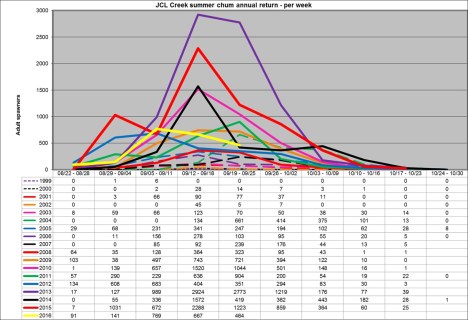
It does not look like we will be setting any records at for summer chum returns at Jimmycomelately Creek this year but this is a strong run.  The daily counts have been fluctuating  between 40 and 100 per day with no real change in stream flow – which remains very low.  The count now stands at 2,342 with three or so weeks to go.  Next week I will be able to tell you just how far upstream some of them went. We’ve had quite a few visitors this season and there is still time for more!

jcl-salmon-reportsalmon-on-jcl-sept-2016jimmy-come-lately-sept-2016