Chilean Sea Bass not likely to be either. Yet, it was certified….

Clare Leschin-Hoar reports in Grist that a significant portion of fish labeled Chilean sea bass and certified by the Marine Stewardship Council was either not Chilean sea bass or caught in waters where the fishery is not sustainable. Chilean sea bass test yields fishy results http://www.grist.org/food/2011-08-31-mislabeled-chilean-sea-bass-reveals-a-sea-of-complexity

Saving Iraq with Environmental Activism–Talk at PTMSC

Monday, September 12 

7:00 p.m.

Natural History Exhibit

presented by Anna Bachmann

Director of Conservation, Nature Iraq 

$7 adults; $5 ages 17 and under

member discount

Formerly the Volunteer Coordinator for the Port Townsend Marine Science Center, Anna first went to Iraq in January of 2003 with a peace organization. She is now the Director of Conservation at the Iraqi Environmental organization, Nature Iraq. She has been working as an environmental advocate with Nature Iraq for over 6 years.  

Nature Iraq’s groundbreaking work restoring  the Mesopotamian Marshlands has been recently featured 

on 60 Minutes and National Geographic.  

Anna will give a presentation on her incredible experiences helping young Iraqis restore and protect their environment.

BC agrees to make fish farm audits public

Transparency is good: Colleen Kimmett blogs in The Tyee on how British Columbia officials have reversed themselves and now will make public the audit findings of salmon farms. Province agrees to make fish farm audits public http://thetyee.ca/Blogs/TheHook/Environment/2011/08/30/Fish_Farm_Audits_Public/

The debate continues on Tarboo Bay salmon

Just finished reading up on the various editorials, posted comments, and raw news stories in the last week at the Kitsap Sun over the Tarboo Bay salmon controversy, if I can call it that.

What we are seeing in action is the notion of ‘fighting over the last fish”. There is a  shift beginning from looking at allowing commercial & tribal fishing of ‘aggregate’ runs versus the more ’emerging’ notion of managing wild stocks to the stream level. I say emerging because that is not how the determination of fishing quota is done now, though has been argued for some years. What with a run of wild salmon that may be down to less than 1000, (if that), , we are seeing a shift to true watershed management of the fisheries, going down to the species level. This is being supported by a diverse group, such as the State, some tribes, and active environmentalists like Peter Bahls.

Peter has spent years working to protect the Tarboo watershed(s) from further degradation, attempting to use science to diligently approach all parties on protecting the remaining fish stocks, along with watersheds, and land use. But for now, he has been unable to convince the Skokomish tribe that his plan, agreed upon by other tribes as well as the State DFW, is the right approach. Part of this might be getting the tribe, living in a very poor region of our State, to make short term sacrifices to protect the longer term outcome. The fisheries probably represent a significant income stream for them. Asking them to possibly do without that, could be part of the sticking point.

To be clear, other tribes, like the Jamestown and Port Gamble tribes, mentioned in the article, have agreed to the plan proposed by Bahls.

While you can read the stories yourselves, I thought I’d touch on the comments that came from a wide variety of individuals.

Apparently there is still a lot of misconceptions about both the landmark Boldt decision and what constitutes, “tribes”. While I am not a scholar on this, here’s what I understand.

Boldt’s decision only clarified that the treaty that the U.S. government, (not the State), signed with the tribes, in total, granted them the ability to continue harvesting natural resources (I’m ignoring the details on this for now). Many people still think of ‘the indians’ or ‘the tribes’ as a unified class, but the real truth to the matter is that they were all, and are all, sovereign nations as a matter of law. There was no united states of indians, (at least up in the Northwest, as there was in New York State, etc.), only a vast amount of peoples who were independent hunters and gatherers, living in a tribal manner. It was as arbitrary to deal with them as a whole, as it was to deal with the tribes in Middle East as some kind of unified nation. We, in our 1800’s naiveté (some may say racism), chose to lump them all together, and some of that was for their own protection, against settlers and others who were taking everything they had.

So, by law, the State works with all the tribes to determine how to go about fishing. The state cannot ‘force’ anything at this point on the tribes, we negotiate with them in good faith as they do with our representatives. Overall, the ‘tribes’ seem, to this viewer, to be pretty good at working with the state on this issue. The crab fishery is pretty stable, considered a success. There are exceptions, and we are witnessing one right now over the Tarboo fishery. But, to be clear, this is asking for a change to the methods, and that might take time. The question is, ‘how much time is there’? The stocks are severely depleted, and the Skokomish are in the process of stripping the last stocks from the fishery, if Bahls and the State are correct. Can it be saved?

The tribes ‘usual and accustomed’ fishing/crabbing/etc grounds are real. Tribes do have areas that they are allowed to do this ‘usual and accustomed’ fishing, and as I understand it, cannot be taking commercial or subsistence stocks from outside these areas. If I am wrong on this, I’d like to be corrected. So please feel free to point me to the regs that would clarify it.

Also, I know for a fact that the Tribes do use a good deal of this fish to divvy up between the members, feed the elderly, smoke their own fish for winter use, and other ‘subsistent’ uses, as we Anglos would call them. To the tribes, this is just an extension of how they have always lived, going back hundreds,even thousands of years. So we have a cultural gap, in viewing this as just some kind of greed driven issue.

Given the numbers being fought over at Tarboo, the remaining stocks could probably qualify for the taking just for those subsistence uses. To be clear, it is not up to us non-indians to determine what it means to do subsistence takes. It does fall to all of us, tribal and non-tribal peoples to save the native stocks. If the fish are gone, then the treaties are moot (as it relates to fish). The view of the tribal members I’ve talked to is of someone looking at the problem from the inside out, and we tend to be viewing it from the outside in. They see it as the way they’ve always lived. To many of them, *we* created the problem, and they want to work with us to fix it. But not at the expense of having no catch.

Finally, after being out on native boats with tribes other than the Skokomish, I have been impressed by how many tribal fishermen and geoduck harvesters, are extremely cautious to be legal and follow the agreed upon rules. I would guess that the anger from the non native fishing people, over specific issues they’ve seen, is more the outliers than the norm. And I bet that the same is true from the tribal perspective. The Tribes have been willing to come to the table and work on saving the salmon. I’ve been at those tables. But too often, we only meet at those tables and do not go to the tribes to talk to them one on one. Peter’s letter to the Skokomish seems like a reaching out in that direction. There are real, seemingly intractable issues, like what is the right approach to shoreline management and use. But all too often there is just not enough getting together.

It does no good, to sit back and throw stones, as many of the people did who posted comments on The Sun. If you want to save the fish, then get out into the fray, and work, as Peter Bahls, and many others, along with the Tribes, are doing to save the last of our local wild fish. It’s going to take all of us along the canal to come up with solutions, and it won’t happen overnight. The option of losing the last of the runs, is still very much ahead of us. One of the lights at the end of this fish tunnel is the end of the stocks, one is the restoration of them. We are about to throw what might be the last available switch before that train arrives to choose which one we want to take. We all need to pitch in.

OK. So where is the enforcement? Orcas under siege

orcas and boatsFirst off, 100’ away is great, 200’ feet is the rule!

We hear so much about how NOAA and the State want to protect the Orcas. So where is our enforcement when it’s needed? Photo from Kim Merriman of Budd Inlet via a mutual friend. Orcas in the center of the boats. Does that  look like 200’ let alone 300’? This is the core of the argument. You can pass all the laws and regs you want, but no one shows up when it’s needed. It really seems more of  a joke, that only ends up destroying the industry of whale watching who are actually following the rules. It’s why some of us get a bit upset when the Feds come in and demand ‘protection’ without supplying any money for it.

According to the State:

Marine enforcement officers from the Washington Department of Fish and Wildlife have enforced the law since its inception.  Between July 2008 and February 2010, they issued 10 citations and dozens of warnings to recreational boaters.  Violation of the law is a civil infraction that carries penalties of up to $1,025.

From the State Guidelines: (http://wdfw.wa.gov/conservation/orca/)

In an effort to improve boater behavior around the southern residents, the Washington Legislature passed a law (RCW 77.15.740) in 2008 placing legal restrictions on the activities of vessels near the whales. It is now unlawful to:

  • Approach within 300 feet of a southern resident whale;
  • Cause a vessel or other object to approach within 300 feet of a southern resident whale.  Vessels are defined as including aircraft, canoes, fishing vessels, kayaks, personal watercraft, rafts, recreational vessels, tour boats, whale watching boats, vessels engaged in whale watching activities, or other small craft including power boats and sailboats;
  • Intercept a southern resident whale.  Interception is defined as when a person places a vessel or allows a vessel to remain in the path of a whale and the whale approaches within 300 feet of that vessel;
  • Fail to disengage the transmission of a vessel that is within 300 feet of a southern resident whale, for which the vessel operator is strictly liable; or
  • Feed a southern resident whale

In 2011, NOAA Fisheries Service adopted new regulations under the Marine Mammal Protection Act and Endangered Species Act to protect all killer whales in inland waters of Washington. Be Whale Wise and Follow the Law. It’s easy as 1, 2, 3…

  1. The ONE place not to be is in the path of whales. Don’t position your vessel in the path of oncoming whales within 400 yards of a whale.
  2. Stay at least TWO hundred yards away from any killer whale (200 yards = the distance of two football fields or about 200 meters).
  3. Remember these THREE ways to Be Whale Wise: follow the guidelines for viewing all wildlife, check for local protected areas  and restrictions, and always be safe.
  4. Federal regs are actually more than most state regs.

http://www.bewhalewise.org/new-regulations/

To report violators

IN THE US 1-800-853-1964 NOAA Fisheries, Office for Law Enforcement

Concerns raised over Tarboo Creek salmon – Kitsap Sun

A superb article by Chris Dunagan in the Kitsap Sun about the difficult choices facing salmon recovery efforts. This, my friends, is where the rubber meets the road. As Dick Goin was once quoted as saying, “Let’s restore the salmon first and we can fight over who gets to catch them later.”

QUILCENE — With $20 million invested in the restoration of Tarboo Creek, it is time to allow more salmon to survive the fishing nets, swim up the stream and lay their eggs to produce even more coho and chum salmon.

That’s the bottom line for Peter Bahls of Northwest Watershed Institute, along with others who have worked hard for 10 years to make Tarboo Creek more hospitable for salmon. But Bahls worries that all the efforts to restore the Hood Canal stream in Jefferson County will be for naught if current harvesting practices continue.

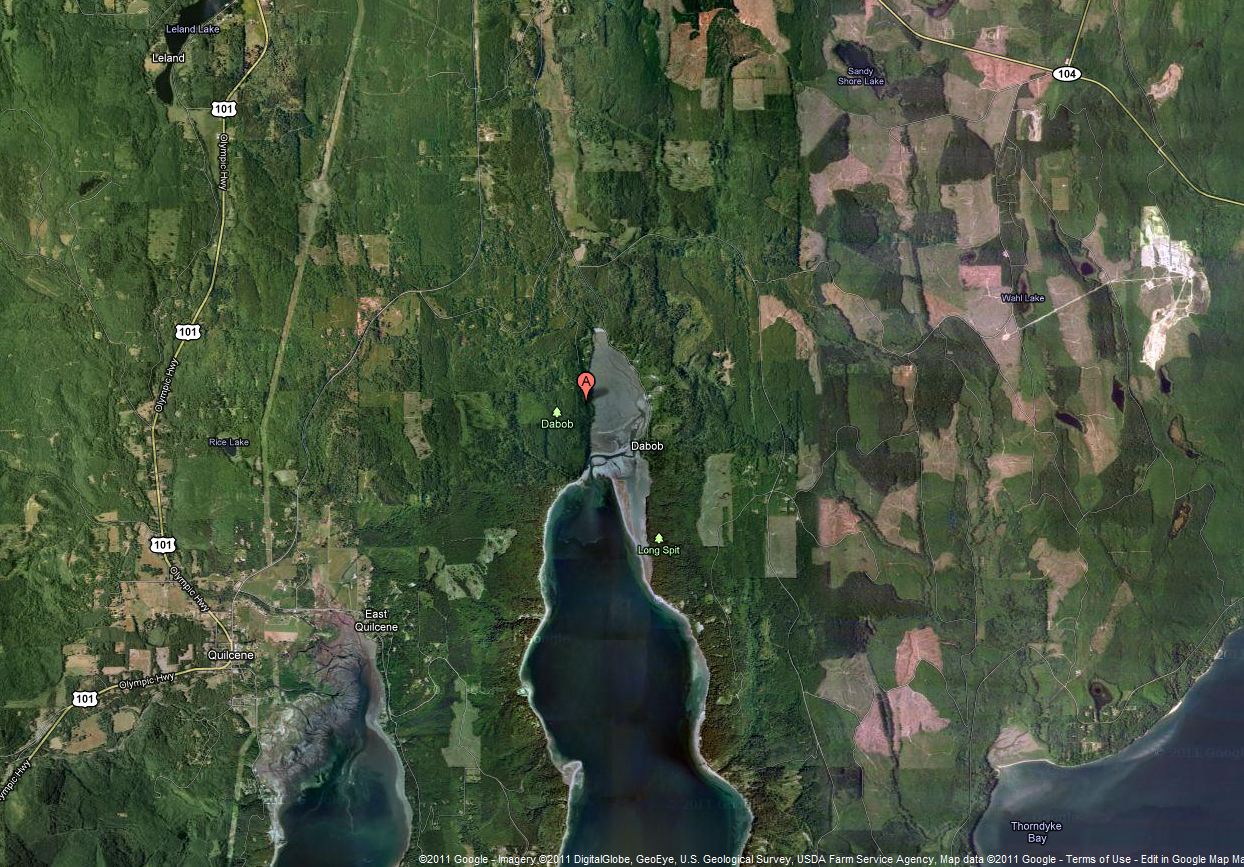
Because the Skokomish Tribe fishes in Tarboo Bay — the inner portion of Dabob Bay — Bahls appealed to the Skokomish Tribal Council in a letter:

Tarboo Bay - Image by Google Maps

As patience runs short, Puget Sound cleanup accelerates

A story that relates to our efforts here. This isn’t about a major metropolitan area, this is about a relatively lightly deveoloped area.

By Rob Hotakainen
McClatchy Newspapers

BOW, Skagit County — Nearly every time heavy rain falls in North Puget Sound, high levels of fecal bacteria flow into Samish Bay, disrupting work at Taylor Shellfish Farms, the largest shellfish producer in the United States

The bay has been choked by many sources, including animal and human waste, broken septic tanks and farmland runoff. It’s been so bad the past two years that the state Health Department has closed the bay to shellfish harvesting for more than 100 days.

“We lost a market opportunity and there’s an erosion of consumer confidence,” said company spokesman Bill Dewey, who also owns a clam farm in the bay. “And you still have to keep the lights on. The bills don’t stop coming.

http://seattletimes.nwsource.com/html/localnews/2016035078_pugetsound28.html

Researchers Study Micropollutants in Wastewater–Kitsap Sun

Christopher Dunagan of the Kitsap Sun reports on researchers’ efforts to use specialized bacteria to destroy ‘micropollutants’ — chemicals in medicines, pesticides and personal-care products — in sewage wastewater. When successful, it might put all your fears to rest when the wastewater is reclaimed and reused.

Researchers study micropollutants in wastewater http://www.kitsapsun.com/news/2011/aug/24/researchers-study-micropollutants-in-wastewater/

Jefferson and Clallam counties approve pact for shoreline plans.–PDN

Jefferson County has completed update of its shoreline management plan; Clallam County’s update process is underway and has to be completed by 2014. All updated plans must meet requirements that there be ‘no net loss’ of ecological functions along shores. Clallam County hopes to learn from Jefferson County what works, what doesn’t, as it develops its plan. Jefferson, Clallam counties approve pact for shoreline plans http://www.peninsuladailynews.com/article/20110825/news/308259995/jefferson-clallam-counties-approve-pact-for-shoreline-plans

Harnessing Tides in the Northwest–KCTS

PORT TOWNSEND, Wash. — The sun is setting as the Jack Robertson, a 65-foot research vessel, leaves the harbor. Two spidery-looking orange pieces of machinery, each one weighing about 1,000 pounds, crouch on the back deck. These sea spiders, as they’re called, are for measuring tidal currents and more.

They’re part of an extensive research project, lead by researchers at the University of Washington, to try to better understand the environmental impacts of putting turbines on the sea floor.

Read the whole story and see the video at:

http://earthfix.kcts9.org/energy/article/harnessing-tides-in-the-northwest/

Dog feces found to be in air over Detroit, and probably elsewhere

You may have seen the recent ads from the Puget Sound Partnership, and my latest video on behalf of WSU Beachwatchers on “Scoop the Poop.”

http://www.vimeo.com/26983098

More fuel for the fire of teaching people to pick up their dog waste. In addition to getting into our water, like the Sound & Strait, it also becomes airborne.

From the Detroit Free Press is a report on how researchers have found that in winter bacteria from dog poop hovers over the city. Study finds bacteria from dog feces in Detroit’s sky http://www.heraldnet.com/article/20110821/NEWS02/708219922/-1/News

6 Million Pink Salmon return to Puget Sound

Fox Q13 reports..note that “this is 3 million less than returned in 2009..And so it goes..

SEATTLE—

There wasn’t much elbow room today at Seattle’s Lincoln Park — as Puget Sound anglers were out trying to catch returning pink salmon.

After many cast from shore, the elusive pinks eventually rewarded their patience.

Close to 100 fishermen lined the shoreline at Lincoln Park this morning as the pinks began to return in big numbers.

Some six million pink salmon are expected to return to the Puget Sound region in the next two months.

http://www.q13fox.com/news/kcpq-pink-salmon-return-to-puget-sound-20110814,0,2496242.story

Washington Conservation Corps hiring 245 young adults for projects around the state

A good use of our tax dollars. Thanks to the legislators who supported us, including ours in Jefferson and Clallam County. Let’s support our teens and young adults in finding work to do, outside and working to restore our habitats.
________________________________

Washington Conservation Corps hiring 245 young adults for projects around the state

OLYMPIA – The state Department of Ecology’s Washington Conservation Corps (WCC) is seeking 245 young adults, including military service veterans, between 18 and 25 to for on-the-ground projects in 16 counties across the state.

For the 2011-2012 service year, Ecology will hire 150 WCC AmeriCorps members using a $2 million AmeriCorps grant from the Washington State Commission for National and Community Service. AmeriCorps Education Awards received through the Corps Network, a national service partner, will support the remaining positions.

WCC’s AmeriCorps members sign on for a year of service that starts in October 2011 and ends September 2012. Ecology WCC members work on environmental and community service projects and disaster response.

Members earn $8.67 an hour and receive a $5,550 AmeriCorps education award upon completing their service year. The award may be used for student loans or future tuition expenses.

The WCC was created in 1983 and has provided jobs and work training for about 1,600 young adults. In 1994, WCC started received federal AmeriCorps funding, allowing crews to carry out on-the-ground projects across the state. Local communities rely on WCC to complete environmental projects by forming cost-share agreements with Ecology.

Since 1994, WCC crews have:

Planted more than 7.5 million native trees and shrubs.
Improved or restored 15,800 acres of new habitat for fish and wildlife.
Constructed or repaired nearly 3,000 miles of trails and boardwalks – enough to cover the distance between Seattle and Boston.
Built almost 2 million feet of fencing for agricultural landowners to help keep animals out of creeks and rivers.
Opened about 240 miles of habitat in salmon-bearing streams.
Provided 133,500 hours of emergency response service to communities in need.
Recruited and managed more than 65,000 community volunteers working on environmental projects.
Taught environmental classes for some 191,000 students.

When WCC members are not working directly with local organizations, they are called upon for disaster response. In 2011, WCC crews assisted with emergency response efforts in Washington, including flood response in Ellensburg and shelter operations after the White Swan fire near Yakima. As part of the interstate compact associated with the federal funding, crews also worked to help communities in Alabama and Missouri that suffered extensive tornado damage earlier this spring.

“In a tight economy, the WCC is making a critical difference for our young adults, our communities and environment,” said Nick Mott who oversees WCC activities across the state. “By providing practical job experience and critical professional training, more than half of our members continue on to full-time employment or go on to further their education.”

Last year, Ecology used federal American Recovery and Reinvestment Act funding to add 10 new WCC crews, employing 50 young adults. The remaining recovery act funding expires in 2012.

In 2011, the Washington Legislature created the WCC “Puget Sound Corps” as a partnership of Ecology and the state Department of Natural Resources. The new legislation means new opportunities for WCC crews, including veterans. The Puget Sound Corps will support the Puget Sound Partnership’s Action Agenda to restore, protect and preserve the Sound by 2020, Mott said. The official rollout of the WCC Puget Sound Corps will occur this fall.

State Supreme Court affirms Ecology approval authority for shoreline master programs

As assumed, the SMP process is legal. The lawyer that convinced these guys to do take this case forward must have been laughing to the bank. A cursory read of the laws that the SMP is based on clearly shows what the court *unanimously* affirmed. Their argument about tax law shows how little they understood of the process or perhaps that they were willing to pay a lawyer to grasp at straws.
___________________________________________________

State Supreme Court affirms Ecology approval authority for shoreline master programs

OLYMPIA – The Washington Supreme Court has unanimously affirmed that the state, not local governments, has final approval authority for shoreline management plans and regulations.

The case was brought before the high court by Citizens for Rational Shoreline Planning, Ronald Jepson and the Building Industry Association of Whatcom County against the Department of Ecology (Ecology) and Whatcom County.

The lawsuit was an attempt to broadly invalidate key protections in Whatcom County’s state-approved shoreline planning and development regulations, also called a shoreline master program. Ecology approved the county’s shoreline program in 2008.

The plaintiffs asserted that because Whatcom County had developed its proposed shoreline master program at the local level, final approval of the county’s updated shoreline program was a local decision.

They claimed some of the requirements in Whatcom County’s shoreline program would violate state tax law generally prohibiting local governments from imposing certain taxes or fees in exchange for development rights.

The 1972 voter-approved Shoreline Management Act was passed to help minimize environmental damage to shoreline areas, reserve appropriate areas for water-oriented uses, and protect the public’s right to public lands and waters.

“The court’s decision clarifies that the collaborative process Ecology and local governments use to manage our shoreline areas is fair, transparent and flexible,” said Ecology Deputy Director Polly Zehm. “We all have a stake in protecting our treasured shoreline resources for ourselves as well as our children and future generations. Our shorelines make Washington a great place to live.”

Under the law, local governments and Ecology work cooperatively on shoreline master programs.

The Shoreline Management Act gives local governments flexibility to tailor their shoreline programs to help respond to local conditions and needs – while fulfilling the statewide vision for shoreline development, protection and uses.

However, the court’s decision recognizes that under state law Ecology is charged with final review and approval authority to ensure each shoreline master program meets state law.

Ecology must also ensure that state requirements negotiated in 2003 among 58 different parties including business interests, ports, environmental groups, shoreline user groups and local governments are being met.

Once Ecology approves a local shoreline master program, the department will help defend the decision against legal challenges.

The plaintiffs’ case had previously been dismissed by the Skagit County Superior Court which was affirmed by the Court of Appeals. The Supreme Court decision affirmed the appellate court.

Sequim Bay shellfish harvest shut down. Recall in process.

Ugly new toxin showing up in Sequim Bay. First time found in U.S. waters. Bad business.

OLYMPIA, WASH. High levels of a foreign biotoxin has been discovered in some Washington state shellfish.

The Washington State Department of Health said Thursday that this is the first time that unacceptable levels of the toxin has been found in U.S. food. It’s typically found in European counties and was recently found in British Columbia waters.

Read more: http://www.bellinghamherald.com/2011/08/11/2138544/high-levels-of-biotoxin-found.html#ixzz1UrJJLGdq

Governor Gregoire asks state to prepare for more cuts

The revenues are still not up to what’s needed. We did not come out of the recession, we have been in it for at least three years.  After the last exercise of cutting $4 billion to balance the state’s budget, the Guv asks agencies to be prepared for cuts of up to 10 percent more.

Gregoire tells state to get ready for more cuts http://seattletimes.nwsource.com/html/localnews/2015856380_budgetcuts09m.html

Billie Frank, Jr. on loss of salmon habitat

Bill Frank, Jr. of the Nisqually Tribe and Northwest Indian Fisheries Commission also addresses where we stand 12 years after Puget Sound chinook were listed as endangered, “Northwest salmon, tribal cultures and treaty rights at risk from disappearing habitat,” http://seattletimes.nwsource.com/html/opinion/2015822689_guest05frank.html

Elwha River Salmon, Steelhead better off without hatcheries–Crosscut

Part of restoring the Elwha should do away with the hatchery program on the river, according to Will Atlas, Rich Simms, Kurt Beardslee, and Pete Soverel editorializing in Crosscut, Elwha River salmon, steelhead better off without hatcherieshttp://crosscut.com/2011/08/02/environment/21168/Elwha-River-salmon%2C-steelhead-better-off-without-hatcheries/

Congressional Reform Act of 2011 – An idea whose time has come?

Slightly Off Topic – but relevent. Making the rounds of the Internet today. I think that since Congress is asking us all to sacrifice, it’s time they did too. I support this notion, not sure how far afield it might go. But do something crazy and forward to your congressman/woman, asking  for their support. As to the sacrifices, it appears that we may be facing some terrible cuts in domestic spending, which I assume will mean environmental, education, and health care cuts. More to follow on that, and I’ll keep tabs on this.

To be clear, this is not about “term limits” this is about pay for performance.  How many of us volunteer our time and spend years on committees crafting laws and regulations? Critical Area Ordinances, Shoreline Master Programs, Marine Resource Committees, hospital boards, city council committees. Do we demand pay for this time? Is it really any different?  Given that the vast majority of Congress are multimillionaires, it seems absurd, given their performance of especially the last 10 years, to pay them $90 an hour (approx. hourly based on $174k a year they get paid) for this job. Congress works, on average, 3.5 days a week, so the hourly is actually higher than that.

Ben Franklin argued, unsuccessfully, that Congress should be a voluntary position. I think that we can give them their offices, staff and special perqs like free military flights, and do some kind of means testing for whether or not they should be getting any pay. To be clear, I am not against people becoming multimillionaires in our society. It is about what happens when these same people decide to run our country, and the performance they get when they do either a poor or superb job.

1. No Tenure / No Pension.

A Congressman collects a salary while in office and receives no pay when they are out of office. This is not about term limits.

2. Congress (past, present & future) participates in Social Security.

All funds in the Congressional retirement fund move to the Social Security system immediately. All future funds flow into the Social Security system, and Congress participates with the American people. It may not be used for any other purpose. This has, by and large been completed, but there may be existing members who are not yet on this system, and should be moved into it.

3. Congress can purchase their own retirement plan, just as all Americans do.

  • Congress does purchase their own 401k plans, but this should not be funded by the Government, at all.

4. Congress will no longer vote themselves a pay raise. Congressional pay will rise by the lower of CPI or 3%.

  • Congress should not be allowed to use a voice vote to approve the CPI or 3% raise, which allows them to hide behind the vote.

5. Congress loses their current health care system and participates in the same health care system as the American people.

  • Remove all Congressional health care perqs based on free care at military hospitals.

6. Congress must equally abide by all laws they impose on the American people.

  • This has almost been achieved but it is worth restating. There was a time, not long ago, when Congress was above some of the laws.

7. No elected official may serve as a private sector lobbyist for a period of ten (10) years following service in an elected position.

Serving in Congress is an honor, not a career. The Founding Fathers envisioned citizen legislators, so ours should serve their term(s), then go home and back to work. This is not about term limits, but limits on their benefits, just as they are asking us to take limits on our benefits.

State issues RFP for $5.4 Million for watershed based ecosystem restoration

Ecology and Commerce today issued a Request for Proposals (RFP) for projects that will protect or restore freshwater ecosystems in the watersheds of Puget Sound. The RFP and related documents are available at: www.ecy.wa.gov/puget_sound/grants_fed.html.

They will provide a maximum of $5.4 million to fund projects under two tracks:

· Protecting and Restoring Watersheds and

· Managing Land Use.

Both tracks are based in using a watershed approach. The first track is intended to focus on directly managing ecosystem processes, whereas the second track focuses more on managing development patterns within a watershed context.

Eligible Applicants

For the first track, eligible applicants include state, local and tribal governments, special purpose districts, public institutions and non-profit organizations. The second track is limited to local and tribal governments and special purpose districts. The geographic extent of this RFP includes only those watersheds that drain to Puget Sound.

Two-step Proposal Process

They anticipate there will be a strong interest in these funds and want to encourage all interested applicants to submit their proposals. Their first step will be initially requesting pre-proposals to determine the range of potential proposals, and to simplify the application and evaluation processes. They will evaluate the pre-proposals to determine which will be invited to submit final proposal applications. Pre-proposals are due September 19, 2011. Applicants should use the pre-proposal form available at the website shown above.

Encourage Collaborative Proposals

They  want to encourage regional collaboration and groups working in partnership on proposals. They are especially interested in soliciting applications from groups implementing local agendas with the Puget Sound Partnership as well as other regional consortia in the greater Puget Sound basin.

Sign-up on PSP Website to Receive Other NEP Grant Information

Sign up to receive e-mails about this and other funding opportunities under the National Estuary Program grants at www.psp.wa.gov/EPA_funding_FY10.php.