By donating to the News you help us bring more news to you! We will use the donations to pay additional reporters, and spend more time on stories! Want to donate more than $10? Under the $10 is a dropdown box, choose multiples of 10. (i.e. Qty 3 at $10)
*DataGovArchive
archive of data.gov on Source Cooperative. The 16TB collection includes over 311,000 datasets harvested during 2024 and 2025, a complete archive of federal public datasets linked by data.gov. It will be updated daily as new datasets are added to data.gov.
-Alexandra Morton's Web Site (NEW)
The new web site for the work of Canada’s leading researcher in to farmed Atlantic Salmon and it’s effects.
-The Cove
One of the most important environmental documentaries ever created. If you value dolphins, then you must see this film.
North Olympic Peninsula Skills Center Natural Resources
To provide a program that provides hands-on, relevant natural resources research experience while meeting the needs of and building capacity within individual students and the North Olympic Peninsula region.
openchannels.org
OpenChannels is designed to become a comprehensive source for news, guidance, and community discussion on sustainable practices in ocean planning and management.
River of Kings – Video
Part 1 of 2 part series by Carl Safina on the Nisqually River Restoration.
Salish Magazine
Salish Magazine is a free online magazine that takes inquisitive readers outdoors with visually rich storytelling about features people can see firsthand in our public forests and beaches.
Victoria Sewage Project
The official city site on the project. The latest scoop on the Canadian poop!
WA State Family Forest Fish Passage Program
The Family Forest Fish Passage Program provides funding to small forest landowners to repair or remove fish passage barriers. Download the film.
Green Acre Radio on KBCS
Green Acre Radio on KBCS — Sustainability, local food production, restoration & environmental talk radio.
NW Indian Fisheries Commission
The Northwest Indian Fisheries Commission (NWIFC) is a support service organization for 20 treaty Indian tribes in western Washington.
Brinnon Group
Local group opposing Black Point resort
Clam Gardens
Network of researchers exploring First Nation gardening of clams in history, and it’s relationship to today.
Coastal Watershed Institute
“To promote long term, ecological, community based stewardship of marine and terrestrial ecosystems thru scientific research and local partnerships.”
League of Women Voters – Clallam County
a nonpartisan political organization, encourages the informed and active participation of citizens in government, and influences public policy through education and advocacy.
League of Women Voters – Jefferson County
The League of Women Voters, a nonpartisan political organization, encourages the informed and active participation of citizens in government, and influences public policy through education and advocacy.
Local Food Access Network
North Peninsula local food org with an emphasis on developing and supporting increased and sustainable capacity for production, distribution, and consumption locally.
North Olympic Salmon Coalition
The mission of the North Olympic Salmon Coalition is to restore, enhance, and protect habitat of North Olympic Peninsula wild salmon stocks and to promote community volunteerism, understanding, cooperation and stewardship of these resources.
Northwest Watershed Institute
NWI’s mission is to provide scientific and technical support to protect and restore fish and wildlife habitats and watershed ecosystems of the Pacific Northwest.
Olympic Environmental Council
The Olympic Environmental Council works on issues related to the environment and health that affect our North Olympic Peninsula communities.
Olympic Park Associates
If you share with us a passion for Olympic National Park, a concern for the Park’s future, and a vision that Olympic National Park should always be a wild and natural place, we invite you to join Olympic Park Associates.
Washington Environmental Council
WEC has been working for a couple of decades on environmental activism. A great group of people actually getting things done.
Whale Trail
Signs along the way to take you to great whale viewing locations
Wild Fish Conservancy
Wild Fish Conservancy seeks to improve conditions for all of the Northwest’s wild fish
An interesting interview with one of the scientists who early on figured out the differences between a “forest” and a “tree farm”.
From eating dirt as a child to discovering the mycorrhizal network below the forest floor, Simard has spent her entire career trying to find answers about how forests work; now, armed with those answers, she’s calling for change. Matt Simmons report. (The Narwhal)
We hear from our Puget Sound Partnership that things are doing “better” from their indicators. However, this new study sheds another perspective on the issue. I’m wondering after the recent heat wave, whether shellfish are going to remain a “positive” indicator.
A joint Canada-U.S. report on the health of the Salish Sea has found either an overwhelming decline or stable trend in nine out of 10 environmental indicators tracked by researchers. The only positive? Shellfish. Stefan Labbe reports. (Coast Reporter)
We’d like to remind you to register by 1:59 p.m. Pacific Time tomorrow, Thursday, May 6, for the third of this year’s virtual Puget Sound Days on the Hill sessions, which will be held on Friday, May 7, from 1:00–2:00 p.m. Pacific Time, hosted by the Puget Sound Partnership and the Northwest Indian Fisheries Commission.
At this session, we’ll discuss Puget Sound restoration and protection, salmon recovery efforts, climate change adaptation and mitigation, and infrastructure, among other topics, with Representative Dan Newhouse. We will also host a panel discussion, “What’s Happening in D.C.?,” with Morgan Wilson, director of Governor Inslee’s office in Washington, D.C., and Rich Innes of the Meridian Institute. Wilson and Innes will discuss the appropriations process and give an overview of potential upcoming legislation, such as the infrastructure package.
Representative Newhouse will speak for about 25 minutes, including a Q&A component, beginning at 1:30 p.m.
Advance registration is required.
We will send regular announcements with confirmed speakers for the week as well as a registration link for each event. You can also check https://www.psdoth.org for the latest information.
Week 3:
Friday, May 7, 1:00 – 2:00 p.m. Pacific Time
With Representative Dan Newhouse and panelists Morgan Wilson (Governor Inslee) and Rich Innes
New research out regarding Southern Resident killer whales and their needs for chinook. Very good research here, based on scat samples over long periods of time.
Abstract
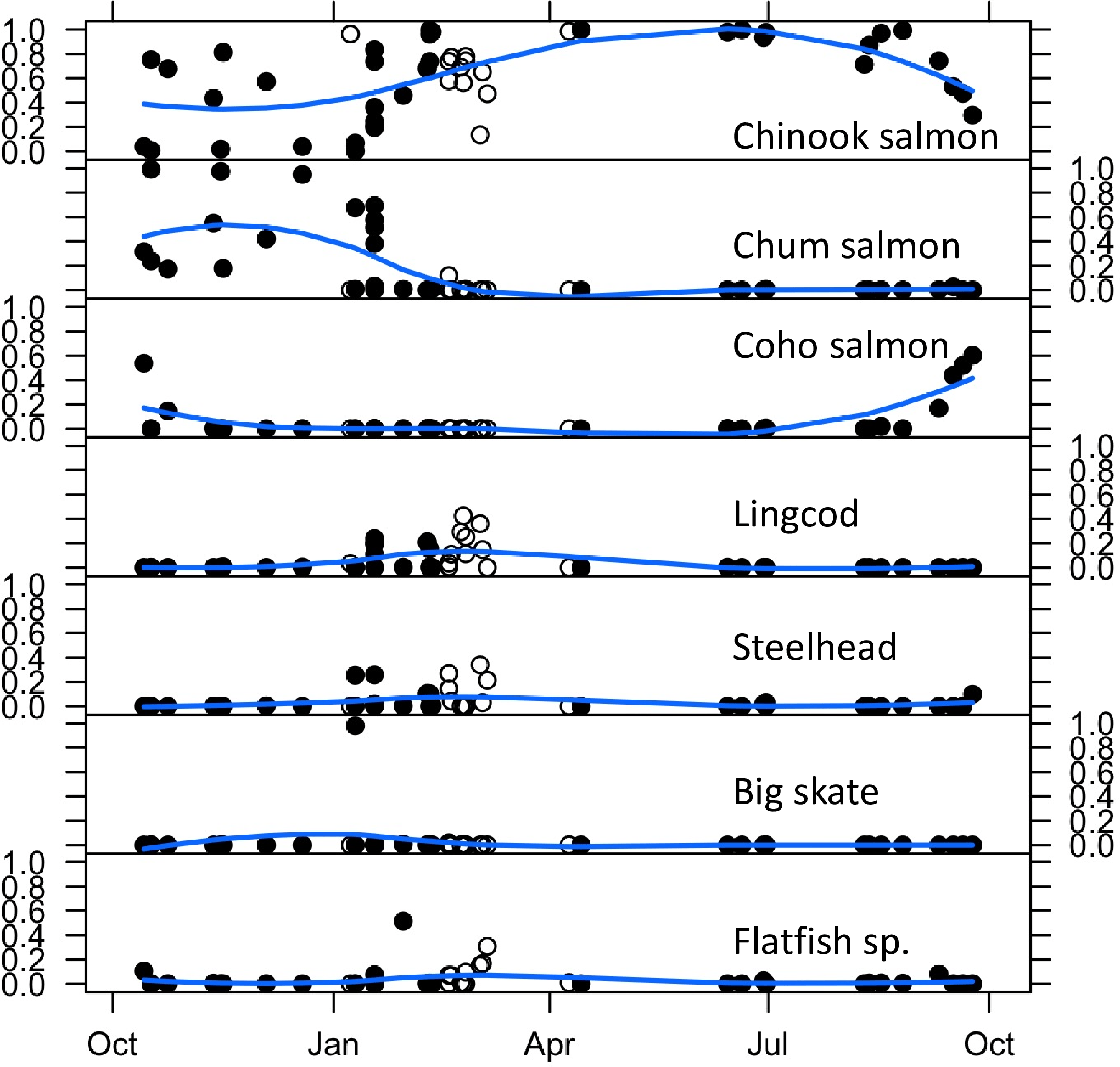
Understanding diet is critical for conservation of endangered predators. Southern Resident killer whales (SRKW) (Orcinus orca) are an endangered population occurring primarily along the outer coast and inland waters of Washington and British Columbia. Insufficient prey has been identified as a factor limiting their recovery, so a clear understanding of their seasonal diet is a high conservation priority. Previous studies have shown that their summer diet in inland waters consists primarily of Chinook salmon (Oncorhynchus tshawytscha), despite that species’ rarity compared to some other salmonids. During other times of the year, when occurrence patterns include other portions of their range, their diet remains largely unknown. To address this data gap, we collected feces and prey remains from October to May 2004–2017 in both the Salish Sea and outer coast waters. Using visual and genetic species identification for prey remains and genetic approaches for fecal samples, we characterized the diet of the SRKWs in fall, winter, and spring. Chinook salmon were identified as an important prey item year-round, averaging ~50% of their diet in the fall, increasing to 70–80% in the mid-winter/early spring, and increasing to nearly 100% in the spring. Other salmon species and non-salmonid fishes, also made substantial dietary contributions. The relatively high species diversity in winter suggested a possible lack of Chinook salmon, probably due to seasonally lower densities, based on SRKW’s proclivity to selectively consume this species in other seasons. A wide diversity of Chinook salmon stocks were consumed, many of which are also at risk. Although outer coast Chinook samples included 14 stocks, four rivers systems accounted for over 90% of samples, predominantly the Columbia River. Increasing the abundance of Chinook salmon stocks that inhabit the whales’ winter range may be an effective conservation strategy for this population.
Good news here. SeaDoc is a critical scientific resource to our region and the world. Looks like they have hired a good one to fill this important role. Congratulations to Leigh Ann.
The SeaDoc Society has hired Leigh Ann Gilmer to fill its regional director position. She began on Feb. 1 and has hit the ground running.
Prior to joining SeaDoc, Gilmer served as executive director of Cascadia Art Museum in Edmonds, Washington, and development director and chief operating officer at Conservation Northwest. In addition, she’s held key roles at the Museum of Pop Culture and Seattle University, where she completed her master’s degree while working full time in fund development.
We continue to find out more about the wild life that lives just off our beaches. No need for looking for extra terrestrial life. It’s right here.
Every spring, a small group of about a dozen gray whales pauses along an epic migration from calving lagoons in Baja California to their feeding grounds in the Artic. They travel more than 170 miles off their coastal migration route, to stop off in northern Puget Sound. There, they linger from about March through May. Now scientists think they know why the Sounders, as this beloved group of regulars is known, likes to visit — and hang around. New research confirms these whales have figured out a brilliant feeding strategy. Lynda Mapes reports.
Filed under: environmental education, Environmental Science | Comments Off on Gray whales learn daring feeding strategy in Puget Sound: Digging for ghost shrimp at high tide – Seattle Times
New from the Partnership, which is tasked with recovery of Puget Sound. Recovery is not going well. So they are tuning their goal setting. Probably a good thing. But reading the following from the article I worry about the words, “reduce the ongoing costs of recovery”. This comes across as another change of direction that is more worried about costs than results. But I hope I’m wrong.
The Partnership has been a mixed bag over the years. It has mainly been an organization helping large scale projects find the funding and political support they need, narrowing the group attending to what seems to be project managers and government officials. They have always lacked a serious budget to educate the population about the issues that need to change to fix the Sound. It has been underfunded to achieve the goals that it was created to solve. Many of its’ most useful pieces oddly are the monitoring it does to help identify baselines which illustrate it’s lack of progress. Certainly an agency like this is needed, but many of us wonder just how useful this particular version is to the people spending vast amounts of volunteer time attending it’s meetings. So many people have shown up with good intentions only to fade away because of what’s perceived as a lack of progress and inability to really help them achieve their goals. Could there be a better way to achieve the goals of Puget Sound Recovery? As someone who has attended many of their meetings and closely monitored their efforts since they day they were formed, I’m not being critical so much as asking the question, “when will we see real progress at saving the species at risk, and making the Sound more “swimmable, fishable and healthy?” When will we see real efforts at educating the public about this, rather than just assume that everyone is on board for making the hard choices to fix the Sound? The sad reality seems to have been that the deeper we dig into the science, the more monumental are the problems. A good case in point is the finding that road runoff may be a major contributor to the decline of salmon in the Sound. That is not an easy thing to fix quickly. . The declining populations of salmon won’t wait on a bunch of meetings to survive or not. When the Partnership set goals in 2007 to 2010, (and reset them and reset them) they were simple. Do we really need to take time to re-calibrate when the answers have been pretty clear from the beginning? Educate the public for buy in. Identify the projects needed, fund them, measure the results. Recalibrate. The goal should not be to reduce the cost of ongoing recovery. That may be impossible. We have spent hundreds of millions of dollars trying to reverse the decline. If we saw runs of salmon returning in ever increasing numbers, we would be cheering the Partnership on. But we aren’t seeing the fish after 13 years of concentrated efforts. In fact, a recent report I reported on just in the last month discussed that we are losing the battle. What is the Partnership going to do to solve that issue?
“If planners can agree on these general directions, the next step will be to develop individual strategies to improve the ecosystem in ways that improve the efficiency and reduce the ongoing costs of recovery. The final step is to identify individual actions in line with the strategies.“
Puget Sound Action Agenda, often referred to as Puget Sound Partnership’s blueprint for ecological recovery, continues to evolve. The next Action Agenda — scheduled to go into effect a year from now — will incorporate an expanded long-range vision for Puget Sound, complete with broad-based strategies, not just near-term actions. “Desired Outcomes,” the first major component of the next Action Agenda, will be unveiled…(Thursday) before the Ecosystem Coordination Board, the wide-ranging, 27-member committee that advises the Leadership Council in its recovery oversight and strategic planning. A live video of the discussion can been viewed online, as described in the meeting agenda. “Desired Outcomes are statements that describe what we intend to accomplish — the positive change we want to see in Puget Sound,” states a fact sheet describing the next Action Agenda update. The idea is that near-term actions proposed over four years should fit into a larger vision leading to “transformational change and bold progress toward Puget Sound recovery.” Chris Dunagan reports. (Puget Sound Institute)
An interesting experiment in public discourse starts tonight to bring together a truly random group of Washingtonians to discuss Climate Change and what can be done to bridge the gap between beliefs to find a solution that might be acceptable to all. It’s being supported by some of our legislature. Can this work? As one of the people involved told me, “It’s an experiment being done with a rigorous framework.” Could it fail? Yes. Is it worth doing ? You bet. You can watch the assembly tonight (1/12/21) at 6PM at this link. https://www.youtube.com/watch?v=7q1_0VI71Aw\
The WA Climate Assembly will focus on answering the following question:
How can Washington State equitably design and implement climate mitigation strategies while strengthening communities disproportionately impacted by climate change across the State?
People’s Voice on Climate is the initiator and sponsor of the Washington Climate Assembly, the nation’s first climate assembly. Supported by five key State House Committee chairs, this event will gather “our state in miniature” to deliberate and ultimately answer this question: How can Washington State equitably design and implement climate mitigation strategies while strengthening communities disproportionately impacted by climate change across the State?
The Assembly itself is conducted by an independent team hired by a diverse panel of Washingtonians. People’s Voice On Climate will publicize this event and promote the Assembly’s recommendations in the Legislature and elsewhere.\\
A People’s (or Citizens’) Assembly is a democratic process that seeks to answer a question or solve a problem facing a community in a way that fairly represents the interests of people from all walks of life.
An Assemblycan center around any topic; a Climate Assembly is one that centers around the problem of climate pollution.
Assemblies have been used worldwide to help shape the work of governments. At the WA Climate Assembly, members will learn about the issue of climate pollution, take time to discuss the issue and potential solutions with one another, and then make recommendations about what should happen legislatively.
The Assembly is an exciting event in which 80 Washington residents will come together remotely in Winter 2021 to learn about, discuss, deliberate, and recommend climate change solutions for consideration by the State Legislature. Participants will be chosen through a lottery so as to accurately represent the state in terms of demographics such as age, race/ethnicity, geographic distribution, and views on climate change.
Friends of the San Juans have been keeping an eye on the waters of the islands and recently got to witness a herring event! These balls attract a huge number of predators and are a basis of much of the food for whales, birds and other fish. They have given me the ability to publish a few of their shots. With thanks to Jess Newley from Friends of the San Juans for the use of the photos! Might be a good idea to include them in your end of year giving if you can! Also thanks to Anne Schaffer of the Coastal Watershed Institute.
(an earlier version of this post incorrectly identified this as a spawning event.)
“Humpback and flocks of gulls and marine diving birds (the most murrelets we’ve seen in over a decade) are just a few surface ‘tells’ of the seasonal migration underway.“
And more of the organization that brought this to you. Connect4Climate.org
The Challenge. Our network. Your Community.
Communicate change and accelerate real-world solutions through partnerships, competitions, events, and knowledge sharing.
Take on climate change. Ending extreme poverty is impossible without tackling climate change. Now is the time to face the defining challenge of our generation.
Collaborate for impact. Forge creative partnerships to advance solutions and bring new audiences into the climate change movement. Share experiences and knowledge.
Communicate for action. Join an ever-growing community. Hear how others are taking on climate change and inspire by sharing your own stories. Contribute online and in person to grow the climate movement. Contribute by adding your voice to our community, and add your climate change content to our Connect4Climate Facebook Knowledge Group and our Facebook Student Group.
Get involved. Play your part in the global climate change movement by sharing your experiences, resources, and knowledge. Have your say. Talk to us about developing innovative campaigns that will inspire, enthuse and reach new audiences.
Go social. Contribute to our blogs and post on our Facebook page. Tweet your thoughts and ideas. Taken some good pictures or video? Upload on Instagram, Vimeo or YouTube, then tag us to let us know.
The Governor tells the President a few facts about wildfires and their prevention.
September 14, 2020
The Honorable Donald J. Trump President of the United States The White House 1600 Pennsylvania Avenue NW Washington, D.C. 20500
Mr. President,
I hope you had an enlightening trip to the West Coast, where your refusal to address climate change — and your active steps to enable even more carbon pollution — will accelerate devastating wildfires like those you’re seeing today. I implore you to recognize the science behind this destruction and stop your path of distortion and deception.
Rapid climate change driven by human activity has created a fusion of natural risk and man-made catalysts to accelerate these unnatural disasters. Study after study confirm the close connection between climate change and intensifying wildfires. Your reckless statements that climate change is a hoax and your gutting of environmental policies benefit no one but fossil fuel companies.
These willful denials are harming our nation and our people. Today, you said about the climate: “It’ll start getting cooler. You just watch.” That is false. This abandonment of leadership has once again left the states on their own to fight this existential threat to our people.
The knowledge and tools are at your disposal to be a leader if you choose. Every day, climate experts are showing us ways to reduce carbon pollution while helping our health and economy.
Wildfires are not new in the Western states, yet the 21st century is quickly laying claim to the worst levels of devastation we have ever seen. It took five days for 2020 to become our state’s second-worst fire season on record with more than 600,000 acres burned, eclipsed only by the 1.1 million acres burned in 2015. Worse events in California and Oregon have sent historic levels of smoke to the Puget Sound region, forcing millions of Washingtonians indoors until it passes.
Mr. President, our temperatures are consistently rising while moisture is increasingly evaporating. Forest management is merely one piece of the puzzle — something our own firefighters would be quick to remind you. Since 2009, our state has spent more than $130 million for forest health and fire preparedness. These events still overwhelm our residents and resources, because these fires are unlike anything people have seen before.
You have worked to distract from our country’s most critical driver of long-term risk in favor of a more politically convenient target — state forest management. This shows an utter lack of understanding about the robust forest management plans our states already have in place, as well as the need for our federal partners to work more collaboratively with us on forest health issues.
Your comments also betray ignorance of the very sources and locations of these wildfires. They don’t just happen in the forests; the fire that burned 80 percent of the buildings in Malden, Washington, was a grass and brush fire. These fires could not be prevented by thinning timber because there is no timber to thin.
As Dana Skelly, a fuels program manager for the U.S. Forest Service in Portland, told the Washington Post last week: “The systems that people rely on to help them get through these events are completely maxed out.”
To Stefan Doerr, a geographer at Swansea University in Wales and a chief editor of the International Journal of Wildland Fire, it’s basic physics: “If we have higher temp[eratures], we have a greater probability of fire starting, fire spreading, and fire intensifying.”
The federal government produced a rigorous, comprehensive report, the National Climate Assessment, that concluded “the annual area burned in the western United States could increase 2–6 times from the present” if current trends continue, due to human-caused climate change.
Research by the Climate Impacts Group at the University of Washington shows our region is dealing with higher temperatures and less frost, which is both affecting our water reclamation efforts and heightening conditions for fires throughout our diverse ecosystems, not just forests. The group projects temperatures will rise rapidly throughout this century, making conditions ripe for longer fire seasons and more challenging circumstances for trying to mitigate them.
Climate change is doing more damage to our communities faster than anyone thought. Hotter temperatures are drawing more moisture out of soils, grasses, bushes and trees — which evolved over thousands of years to withstand less severe fires — turning them into the perfect fuel for ignition.
I would urge you to abandon your half-baked theories and engage in good faith about the obvious relationship between climate change and wildfires.
The rules of fighting wildfires are changing because our climate is changing. There is no fire suppression plan on this planet that does anyone any good if it doesn’t even acknowledge the role of climate change. Deliberate and decisive action must be taken on a global scale, with the United States in the lead.
It is time to abandon the disastrous course that now envelops us in smoke and ash. A new approach could slow or turn around the damage done by climate change, all while building a more robust and more sustainable future for all 50 states.
The states are willing and eager to work in partnership with the federal government to protect all Americans from the ravages of climate change. Washingtonians in places such as Malden, Bonney Lake, Bridgeport and Graham — which have all begun long roads to recovery from the fires of recent days — deserve as much.
We are fortunate to have Denis in Seattle. His message now?
“Covid-19 robbed us of Earth Day this year. So let’s make Election Day Earth Day.” He urged his readers to get involved in politics and set aside national division. “This November 3,” he wrote, “vote for the Earth.”
Denis Hayes, Earth Day, climate change, renewable energy and the challenges ahead. John Schwartz reports. (NY Times)
After our snow canceled the Environmental Lobby Day events last month, it’s been rescheduled this week. (ironic, isn’t it?) This is an excellent way to meet your legislators on their ground and let them know what is important environmentally. Mad about the net pens? Oyster farms in our National Wildlife Refuge? Believe me,the folks from Seattle aren’t fighting that.
So get out from behind Facebook and Next Door and get a group together to car pool to Olympia and participate! You get to schmooze with the best of them while you watch high paid and well dressed lobbyists argue that environmental rules are too expensive! What could be funnier than that!
And while you are there, just to show that I’m not a total bummer of a date, where does one eat? My favorite place for lunch or dinner is Chelsea Farms Oyster Bar They have superb clam chowder and lots of other great eats. You can pretend you are one of them being plucked by a walrus and carpenter. But no, I’m serious, this is one of the finest restaurants in the state IMHO. Just go. You are on a field trip.
Also try Wagner’s European Bakery And Cafe for great lunches. More budget oriented. Or pack your own bag of goodies! Actually if you sign up you get a healthy lunch.
What bills are being supported? Take a look at my right hand top tab, where I’ve conveniently cut and pasted the Coalition Priorities. Or go to the URL listed a few paragraphs up above.
So sign up, read up on the bills being promoted, and learn how to effectively lobby your elected officials! It’s fun and is far better than watching an impeachment any day!
Date: Thursday, January 30, 2020 Time: 8:30 am – 5:00 pm Location: Temple Beth Hatfiloh, 201 8th Ave. SE, Olympia, WA 98501
Join the Environmental Priorities Coalition and hundreds of activists to push for key environmental legislation in Olympia on January 30th!
During lobby day, you will team up with other activists to speak up for the environment and gain the skills to be a persuasive constituent. You’ll have the opportunity to attend issue briefings, learn how to lobby, hear from environmental champions, attend breakout sessions, and meet face-to-face with your elected officials to advance the Environmental Priorities Coalition’s 2020 priorities.
For the 2020 legislative session, we have adopted four priorities essential for healthy communities and a thriving environment: Clean Fuels Now, Healthy Habitat Healthy Orcas, Climate Pollution Limits, and Reduce Plastic Pollution.
The Northwest Straits Commission, which since 1998 has run the nationally-recognized conservation initiative, the Northwest Straits Marine Conservation Initiative has opened it’s 2019 conference. The conference brings together scientists and community volunteers in seven counties in northwest Washington. Due to space limitations it was a limited audience but they will be publishing Powerpoints & Audio taping of many of these sessions.
During this conference, the participants get to share their expertise and projects, restoring and educating county citizens and politicians in their local locales.
The conference attendees will participate in field trips, roundtable worksessions,
The Northwest Straits Initiative’s unique and innovative approach combines sound science and ecosystem perspective together with citizen energy and entrepreneurship to improve efforts to save Puget Sound.
This was the agenda.
Friday, November 15
9:30 AM – 10:30 AM
Field trip: Howarth Park (optional) Hosted by the Snohomish MRC, led by Bob Hillman
10:00 AM – 11:00 AM
Northwest Straits 101 (optional)
Dr. Lucas Hart, Director, Northwest Straits Commission
Don Hunger, Executive Director, Northwest Straits Foundation
12:30 PM – 1:00 PM
Welcome and opening remarks
Alan Clark, Chair, Northwest Straits Commission
Anne Murphy, President, Northwest Straits Foundation
Sarah Brown, Chair, Snohomish MRC
Executive Dave Somers, Snohomish County
1:00 PM – 2:30 PM
Tying it all together: the impact of our collective actions
Dr. Tessa Francis, Puget Sound Institute
Dr. Ron Thom, Northwest Straits Commission
Dr. Tom Mumford, Marine Agronomics
Moderator: Dana Oster, Northwest Straits Commission staff
2:30 PM – 3:00 PM
Room check-in and break
3:00 PM – 4:00 PM
Musings on habitat loss and restoration in Puget Sound
Dr. Tish Conway-Cranos, WA Dept. of Fish and Wildlife
Moderator: Lisa Kaufman, Northwest Straits Foundation staff
4:00 PM – 4:15 PM
Lessons learned from painting Fishes of the Salish Sea
Ray Troll, Artist
4:15 PM – 4:30 PM
Remarks from Senator Liz Lovelett Introduced by Tom Cowan, Northwest Straits Commission
4:30 PM
5:00 PM – 6:30 PM
Reception and networking
Podcast: OCTOPOD – Open Communications for The Ocean
Raye Evrard and Allie Brown
Book signing: Cruisin’ the Fossil Coastline
Dr. Kirk Johnson and Ray Troll
6:30 PM – 8:30 PM
Dinner and Keynote Speaker
Welcome – Chairman Shawn Yanity, Stillaguamish Tribe of Indians
Environmental Leadership Award
Deep Time and the Salish Sea Dr. Kirk Johnson, Sant Director, Smithsonian National Museum of Natural History
Saturday, November 16
Location: Courtyard by Marriott Ballroom
8:45 AM – 9:00 AM
Tying it all together – summary results
Dr. Tessa Francis, Puget Sound Institute
9:00 AM – 10:30 AM
Building community connections
Cheryl Lowe, Jefferson MRC staff
Rebecca Benjamin, North Olympic Salmon Coalition
Dr. Julia Parrish, UW Coastal Observation & Seabird Survey Team
You may be aware of the coming conversion of cell phones to a new technology called, “5G”. This next generation of our current (4G, 3G) has created a wide range of controversy, with those who are against wide scale deployment being painted as ‘tin hat’ lunatics in some quarters, or simply dismissed. I for one, always come down on the side of science, real science, peer reviewed by other scientists in the field and science that is able to be replicated in the lab. I have been standing back and waiting to form an opinion on the topic, while assuming that if 4G has been relatively benign (and that is also debatable given the sea of cancer that we are currently swimming in), that 5G should be not all that much worse.
However, recently, voices have been raised that are impossible to ignore. In Scientific American’s blog on Oct 17, 2019, a key researcher with significant credibility, Joel Moskowitz, put forward a very credible arguement about why we citizens should be concerned about this technology.
His article, entitled, “We have no reason to believe that 5G is safe”, and subtitled, “The technology is coming , but contrary to what some people say, there could be health risks,” is an appeal to take seriously the over 500 studies that found health risks of radio frequency radiation (RFR).
Citing this large body of research, more than 240 scientists who have published peer-reviewed research on the biologic and health effects of nonionizing electromagnetic fields (EMF) signedthe International EMF Scientist Appeal, which calls for stronger exposure limits.
According to Mr. Moskowitz, the FDA, with no formal risk assessment done, has approved the technology. He concludes by stating:
Instead, we should support the recommendations of the 250 scientists and medical doctors who signed the5G Appealthat calls for an immediate moratorium on the deployment of 5G and demand that our government fund the research needed to adopt biologically based exposure limits that protect our health and safety.
To be clear, Mr. Clegg’s opinion on this is his, and not that of Microsoft. Also, Mr. Moskowitz’ article is an opinion piece in the Scientific American blog, not the main magazine. It is not the editors of the magazine endorsing the point of view. They are individuals commenting on the growing body of evidence that there could be a problem if we deploy this in wide spread use, covering virtually all people in developed countries, from birth to death.
It is stated, and many including myself believe, that modern society has seen a growing number of brain tumors since the advent of the cellular phone. However, it’s not easy to pin it to one specific cause. I have heard medical researchers state that with an aging population, that may be a given. But I have also heard many extremely intelligent people argue that there are real concerns. They often are dismissed.
However, those looking at rounding up data on the subject should also be heard. As stated in a Forbes article by science writer Jeffery Kabat, recently, “Many epidemiological studies, show little evidence of an association.” His research using PubMed and Google, clearly shows that there is a variety of ways to understand the data on brain cancers, which in themselves are a rare form of cancer, and that there is not a consensus by brain tumor specialists that there has been an increase in brain cancers over the last decades. Some cancers have been recategorized into other categories, skewing the numbers of that category and appearing as if there has been huge increases.
5G is not a foregone conclusion. But the time to ask our legislators for a halt to deployment and additional significant research is here, now. The push by business to demand this deployment and belittle the concerns is very hard to fight. While I am not yet totally convinced there is a real threat, I am concerned enough to ask for a moratorium while a wide range of independent scientists look into this further. Having lost my best friend to brain cancer (and he was a voracious cell phone user for two decades), I cannot just sit back and accept industry and government assurances (especially given the behavior of the current government in regards to research results) that there will be no harm.
This helps clarify things. The status quo is unacceptable.
Our climate just can’t tolerate widespread frequent flying,” said Dan Rutherford, who directs the council’s aviation program. “At some level we need to figure out, collectively, which flights are necessary, and which are luxuries.”
While this blog publishes a lot of articles that can be quite depressing when placed in context, I feel a need to make sure that we here on the Peninsula get the big picture. You the reader can edit them out yourself. However, there is discussion I’ve heard about being positive, especially for younger audiences, tailoring the message. That is a good idea. Greta Thurnberg is championing waking up the teens. But as she said, she suffered from depression when coming to grips with it. No one in her family or school apparently understood how to communicate the message to her.
This article in Grist, below, and also the recent documentary film about Fred Rogers (not the Tom Hanks movie) are worth considering.
My goal, when talking to anyone about climate change, is to establish rapport that
It is here and happening now, not something coming in the future. Younger audiences can be told how we are the beginning of weather changes that they will continue to see as they grow up. And that they can do things, to help make the changes go better.
Focus on what people can do. Children like being included. Pick up trash on the beach, don’t throw bags in the water, etc. Small things build their ability to understand larger things later.
Ask adults what they think they can do that could make a difference. Fly less? Drive less? Become more politically active?
Fred Rogers was a master of communicating hard news to children. In fact, as the movie states, “He was radical”. His taking on issues of assassination, death, violence and divorce, were well thought out and researched in advance. I recommend this movie to anyone that teaches young children. If you never really gave Mr. Rogers any thought, this will be an eye opener.
Grist also just published the following article.
Life as an outdoor educator might seem like it’s all fun and games — romping around outside, playing games, looking at bugs — until it comes to talking to 9-year-olds about climate change.
“They want to talk about it, but it can be hard sometimes,” Ian Schooley said with a laugh. He spent four years teaching visiting fourth and fifth graders at the Pacific Science Center’s Mercer Slough Environmental Education Center about the wetland ecosystems just outside of Seattle. Wetlands are a unique habitat that filters water, sucks up carbon dioxide, and protects our coasts — but the triple threat of sea-level rise, pollution, and development is putting them at risk.
An interesting article by the New York Times documenting how many people have been displaced by climate change related weather in the first half of this year alone. The only question left to ask is, who’s next?
Al Latham always has a good take on the weather. He’s our local weatherman down in Center Valley.
Greetings Earthlings – here’s the July rainfall report from www.cocorahs.org station WA-JF-1, located 5.1 miles south of beautiful downtown Chimacum.
Rainfall/precipitation/whatever for July was 1.42″ with 0.09″ the average here. Though the rain came in small amounts it was comforting to get some moisture this time of year.
Not good for those trying to make hay – some unexpected rain with hay down created some losses for the hay makers. Unusual for July.
The water year (Oct1 – Sept30) so far has accumulated 25.9″ with the average being 32.5″ so we’re still well below the average and with little chance of making up the difference before end of Sept.
You may wonder what is meant by “average” rainfall. It takes 30 years of records to come up with an average. “The reason behind choosing the 30 years is to represent the climatic condition of that place. Here, to note, climate is the average condition of weather over a considerable length of time, that doesn’t have much variation. In climatic studies we generally take this length of time as 30 years (or sometime 35 years).” Here at Station WA-JF-1 we have records dating back to 1981 so we have enough data to determine an average for this location.
NOAA Climate Prediction Center’s guesstimate for what we have in store for us weather wise for Aug – Oct is warmer than “normal” with an equal chance of wetter, drier or average rainfall. Not sure what how they define “normal” when it comes to weather…..
The focal point for environmental news & perspective on the news. Our goal is to help educate and connect the public on the Peninsula. We are not a non-profit so donations are not tax deductible. Maybe someday with your help!
This site is based on news and my opinion on that news. I come with over 50 years of experience in various environmental and tribal involvement. You may not agree with my POV. At my age, I am willing to listen to your POV and put it in comments. But I might not agree with you and that's the way it works.
HOTLINES FOR REPORTING SPILLS
WA State Emergency Management Division: 1-800-258-5990
National Response Center: 1-800-424-8802
Pacific States & British Columbia: 1-800-OILS-911 (1-800-645-7911)
Local Events
Add your local event here. Contact us to include your next event.
—————————————————
TSUNAMI DEBRIS HOTLINE:
1-855-WACOAST (1-855-922-6278)
—————————————————
Event Date:
NATURE NOW
A Program About the Natural World.
KPTZ.ORG 91.9
WEDNESDAYS AT 12:05
REPEATS: SATURDAYS 12:30 AND WEDNESDAYS
PODCASTS AT KPTZ.ORG