Is the Hood Canal Floating Bridge Causing The Problems in Hood Canal?

In 2010 I worked on a video for the Puget Sound Partnership called, “Voices of the Strait”. In that video I interviewed old timers from all over the Peninsula, and asked them about their experiences and changes in the environment. Off camera, I happened to meet one old fisherman, a man who had fished here for his whole life, and was in his 80s. We got to talking over coffee about the Hood Canal problems, and he had an interesting thing to tell me.

“It’s my opinion,” he said, “that ever since the Hood Canal Floating Bridge went in, we have seen a collapse of fish stocks and water quality down there. None of this ever seemed to be a problem before that. I bet the bridge is the cause of it all.”

I remember that conversation clearly, but didn’t ask him to be on camera, because it was, as we say, more of a hypothesis than a proof. You could insert many other hypothesis’ and be just as likely to be right, given a lack of data.

Now, it appears the old timer may have been correct in his observations. At a meeting of restoration recovery organizations held in Port Townsend, Scott Brewer, the head of the Hood Canal Coordinating Council, stood up and validated what the old timer had said. Brewer said that preliminary research  has shown, especially with steelhead, that the bridge might be stopping the fish from moving out to sea. Radio tagged fry have been seen swimming up to the bridge and are unable to figure out how to get around it. They appear to pool against the bridge, which is 30 feet deep, and get picked off by seals or sea lions.  The fry tend to stay on the surface layer of the water, so are stymied by the blockage. Additionally, the bridge may be affecting tidal water exchange.

This poses an interesting problem. Obviously, if accurate, short term fixes might look something like fish ladders or perhaps some kind of underwater fence that could direct the fish towards one end or the other. But longer term, if the bridge is the problem, the question of replacing the bridge will have to be raised. The health of an entire ecosystem might be at stake.

While all this is preliminary and speculative, we’ll keep an eye on this issue and report back as we get more data. But it’s worth remembering that most of the major and minor fundamental scientific advancements, up to the 20th century, were usually amateur local scientists, relying on observation, and hypothesis based on that knowledge of local systems from living there. It’s well worth keeping an open mind to even the oddest possible root causes. The notion that we can throw down a bridge and  have it not affect the body of water it lies on is  something that most bridge planners probably never anticipated. And the findings also point out that the revolution in miniaturization of computer and GPS tracking, will have profound effects on our ability to better understand natural processes.

10 million scallops are dead; Qualicum company lays off staff – Parksville Qualicum Beach News

This in from just over the border. What I understand about scallops is that they are the hardest shellfish to grow, and recent attempts to re-establish them in US Puget Sound waters have been unsuccessful (to commercially viable sizes). Maybe this is why.

High acid levels in the waters around Parksville Qualicum Beach have killed 10 million scallops and forced a local shellfish producer to scale operations back considerably.

Island Scallops CEO Rob Saunders said the company has lost three years worth of scallops and $10 million.

“I’m not sure we are going to stay alive and I’m not sure the oyster industry is going to stay alive,” Saunders told The NEWS. “It’s that dramatic.”

Small sewage leak closes Port Townsend’s North Beach – PDN

A “no contact” advisory is in effect for the waters off North Beach Park in Port Townsend, where city officials reported an intermittent leak of treated sewage Monday. Jefferson County Public Health issued the health advisory for all of North Beach, with warning signs at the county park. The public is advised to avoid surfing, swimming, boating, fishing and the harvesting of shellfish and seaweed at North Beach. Shellfishing always is closed in the area because of the proximity of the sewage plant outfall. (Peninsula Daily News)

http://peninsuladailynews.com/article/20140225/NEWS/302259980/small-sewage-leak-closes-port-townsends-north-beach

UPDATE: This has been repaired and is no longer a threat, though the beach there is always closed to shellfish harvest because the outfall is out there. 3/7/2014.

Judge overrules minister’s decision to open herring fishery – Vancouver Sun

B.C.’s First Nations declare victory over Department of Fisheries in fight to conserve fish.

B.C. First Nations won a major victory Friday when a Federal Court judge granted an injunction blocking the opening this year of a herring fishery on the west coast of Vancouver Island.

The decision came after an internal memo revealed Fisheries Minister Gail Shea overruled recommendations of scientists in her own department.

Read the whole story at the Vancouver Sun

http://www.vancouversun.com/technology/Judge+overrules+minister+decision+open+herring+fishery/9541803/story.html

Jefferson County shoreline program gains state approval

February 12th. So it’s finally done. No thanks to The Department of Ecology for stonewalling our County  on banning net pens in our county for years, on behalf of the net pen industry. It has been an incredibly divisive effort, that has called into question  Ecology’s mission and their allegiances. Their intransigence in being unwilling to look at the issues and concerns of citizens and their representatives who have legitimate questions about the net pen industry seemed to be entirely self serving of that industry, instead of supporting those who are spending hundreds of millions of tax dollars trying to recover wild fish. While just to the north of us in British Columbia, the scientific evidence continues to mount that net pens are very likely to be contributing to the decline in those stocks.

Much thanks to County Commissioner Phil Johnson who fought for the ban tooth and nail for many years, along with David Sullivan and John Austin, to Michelle McConnell for sheparding this through, the two volunteer groups that spent years going over the existing Program and updating it, and for the Planning Commission all of whom took time to deliberate whether what was done was acceptable. It was a Herculian task. Also thanks to the Jefferson County Democrats, who have fought hard at the State level to promote banning net pens in our waters.

Ecology webpage about our SMP Update (with related documents)

The new SMP (full document, non-codified version; 40 MB)
http://www.ecy.wa.gov/programs/sea/shorelines/smp/mycomments/jefferson.html

Press release announcement

OLYMPIA — The Washington Department of Ecology (Ecology) has approved Jefferson County’s updated shoreline master program.
The county’s shoreline program will result in significant improvements in the water quality, protection, use, development and restoration of about 250 miles of marine shorelines including Hood Canal and the Strait of Juan de Fuca; roughly 600 miles of river shorelines, including portions of the Quinault, Hoh, Elwha and Dungeness rivers; as well as along the shores of numerous lakes and streams.

Jefferson County is one of nearly 90 local governments that have completed shoreline program updates. The new master program combines local plans for future shoreline development and preservation with new shoreline development ordinances and related permitting requirements.

Before they can take effect, each locally-tailored city and county shoreline master program must be approved by Ecology to affirm compliance with the state’s 1972 voter-approved Shoreline Management Act (SMA) and the most current shoreline master program regulations.

About 150 cities and counties statewide are in the process of, or soon will be, updating or crafting their master programs.

“We are pleased with how the new shoreline program addresses net pens and establishes local controls that include a conditional use permitting process,” said Sally Toteff, Ecology Southwest and Olympic Region director.

The conditional use permit process allows the county to evaluate proposals based on site-specific concerns, and to require mitigation or use other measures to offset impacts. Any permit application would also trigger an environmental review under the State Environmental Policy Act.

Shoreline master programs are the cornerstone of the SMA. The law requires cities and counties with regulated shorelines to develop and periodically update their locally tailored programs to help minimize environmental damage to shoreline areas, reserve appropriate areas for water-oriented uses, and protect the public’s right to public lands and waters.

“It’s very impressive how Jefferson County brought diverse local interests to the table to work collaboratively through tough issues,” Toteff said.

Jefferson County conducted extensive public outreach and facilitated technical and policy advisory committees. The committees included shoreline property owners and experts from various disciplines and agencies.

The county’s shoreline master program:

  • Provides shoreline regulations that are integrated with the Jefferson County growth management planning and zoning, floodplain management and critical areas ordinances as part of a unified development code.
  • Limits new stair towers in landslide hazard and feeder bluff areas.
  • Limits the length of new residential docks and piers.
  • Encourages soft-bank erosion control methods and limits construction of new shoreline armoring such as bulkheads.
  • Includes a restoration plan showing where and how voluntary improvements in water and upland areas can enhance the local shoreline environment.
  • Helps support the broader initiative to protect and restore Puget Sound.
  • Once approved by Ecology, the local shoreline plan becomes part of the state shoreline master program. If needed, the department will help defend Jefferson County’s shoreline program against legal challenges.
  • All of Washington’s cities and counties with regulated shorelines are updating their programs to meet a December 2014 deadline. They are following regulations adopted in 2003 that resulted from a negotiated settlement among 58 different parties including business interests, ports, environmental groups, shoreline user groups, cities and counties, Ecology and the courts.

# # #

Media Contacts:

Linda Kent, 360-791-9830, linda.kent@ecy.wa.gov; @ecySW

Navy Looks To Renew Permits For Bombing And Sonar Exercises In The Northwest – Earthfix

The Navy is pursuing permits to continue conducting sonar and explosives exercises in a large area of the Pacific Ocean — and that’s putting marine mammal advocates on high alert. Public hearings kick off next week as the Navy gathers public comments on its draft environmental impact statement for the Northwest training and testing range. The range stretches from northern California to the Canadian border. Ashley Ahearn reports.

http://earthfix.kcts9.org/flora-and-fauna/article/navy-looks-to-renew-permits-for-bombing-and-sonar-/

Battery small enough to be injected, energetic enough to track salmon – Science Daily

Scientists have created a microbattery that packs twice the energy compared to current microbatteries used to monitor the movements of salmon. The battery is just slightly larger than a long grain of rice, however is not the world’s smallest battery. Engineers have created batteries far tinier than the width of a human hair, but those smaller batteries don’t hold enough energy to power acoustic fish tags. The new battery is small enough to be injected into an organism and holds much more energy than similar-sized batteries.

http://www.sciencedaily.com/releases/2014/02/140218143330.htm

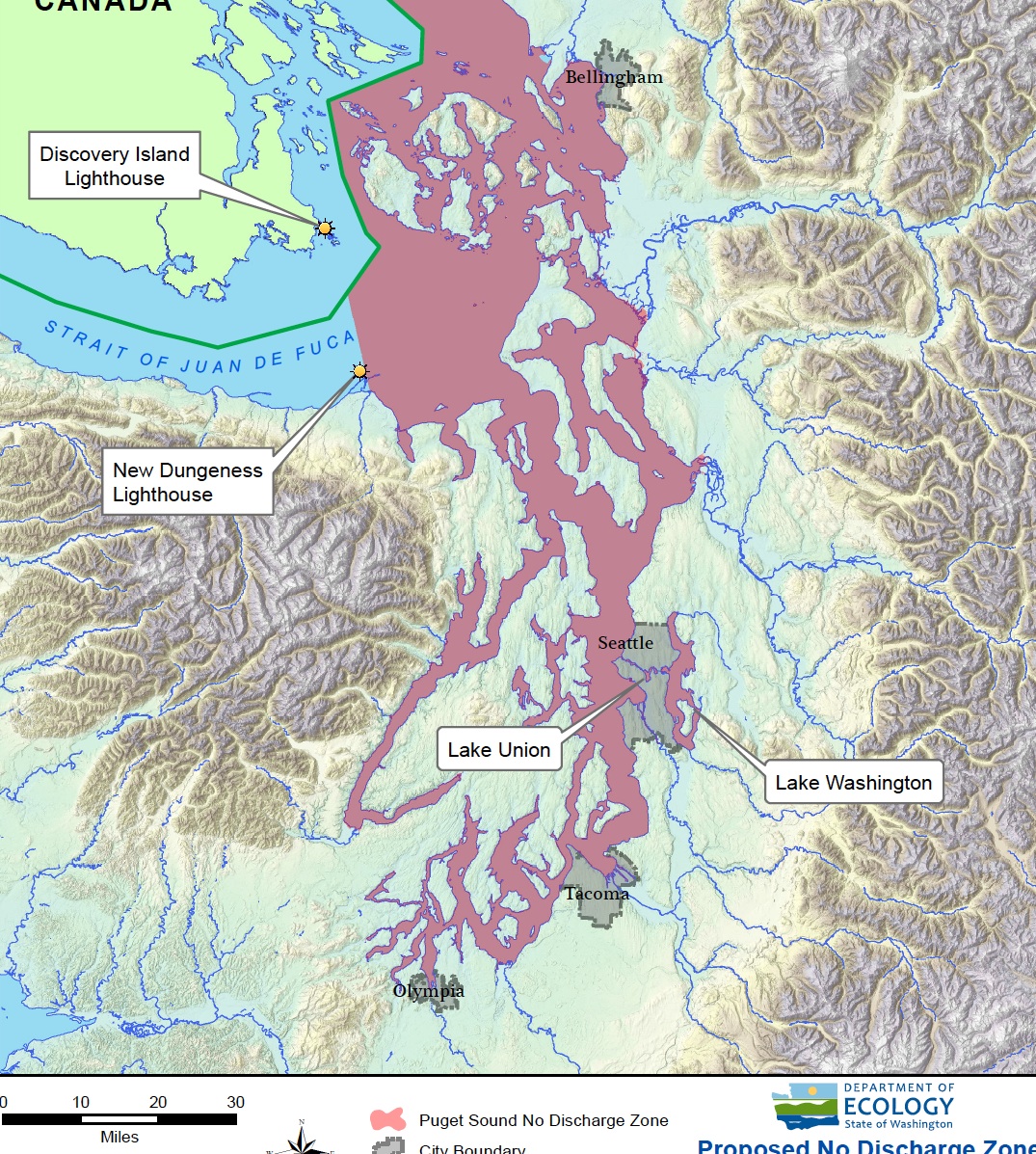
Boaters Beware: State Wants to Ban Sewage Dumping in Puget Sound – Earthfix

UPDATED: This proposal would not ban grey water discharge.

It is currently illegal to dump untreated sewage overboard in Puget Sound. When I last chartered, it was made clear to me that I had to pump out, not macerate. Now the State Department of Ecology wants to ban *all* treated sewage coming off recreational and commercial vessels in the Sound.

Proposed No Dump Zone for boaters.

No dump zone

————————————–

It might surprise you to learn that you can dump the contents of your toilet into Puget Sound and not get in trouble. That’s essentially what some boaters do when they discharge their sewage into the water instead of pumping it out at a dock or marina.

The state Department of Ecology has proposed a federally-enforced ban on dumping in Puget Sound to stop the practice.

Read or listen to the rest of the story at:

http://kplu.org/post/boaters-beware-state-wants-ban-sewage-dumping-puget-sound

Department of Ecology backgrounder Powerpoint (from 2012? )

http://www.ecy.wa.gov/programs/wq/wastewater/cruise_mou/NDZpresentation2_16_12.pdf

Three Sheets Northwest analysis

http://threesheetsnw.com/blog/2013/03/ban-on-sewage-discharge-in-puget-sound-under-study/

Story by Chris Dunagan in the Kitsap Sun

http://www.kitsapsun.com/news/2014/feb/19/tugboat-operators-oppose-no-discharge-zone-in/#axzz2tt4BAY1s

$3.8 million project to provide face-lift for Dungeness’ 3 Crabs estuarine area – PDN

Work to begin on the final phase of the 3Crabs area restoration work, over on the east side of the Dungeness River estuary. This has been a long time coming, and is a good piece of work to help salmon move back into the estuary area in greater numbers. Runs have been increasing in recent years, with the work already done.

DUNGENESS –– Rerouting Sequim-Dungeness Way, removing a century of shoreline armoring and expanding wetland lagoons will soon be done under a plan to restore the beach and estuary at 3 Crabs.

Read the whole story at the PDN:

http://www.peninsuladailynews.com/article/20140218/NEWS/302189992/-38-million-project-to-provide-face-lift-for-dungeness-3-crabs

Is Fukushima Radiation Causing Pacific Starfish Die-offs?- Earthfix

Good info on a question that has been raised a lot lately.

The short answer is almost definitely no. Scientists do not see a connection between the massive die-offs of starfish along the Pacific shores of North America and Japan’s Fukushima nuclear disaster.

Read the rest of the story here:

http://www.earthfix.info/flora-and-fauna/article/is-fukushima-radiation-causing-of-pacific-starfish/?utm_source=EarthFix+Weekly&utm_campaign=aa77699d69-EarthFix_Weekly_Feb_19_2014002_19_2014&utm_medium=email&utm_term=0_693d42e2f5-aa77699d69-46872029

Lawsuits Could Lead To Changes At Fish Hatcheries – KPLU.org

Looks like it’s time to re-evaluate the value of hatcheries.

People on the West Coast have counted on fish hatcheries for more than a century to help rebuild populations of salmon and steelhead and bring them to a level where government would no longer need to regulate fisheries. But hatcheries have thus far failed to resurrect wild fish runs and artificially bred fish have come to dominate rivers. Critics say their influx harms wild salmon and masks the fact that wild populations are barely hanging on. Now, hatcheries are facing court challenges in Oregon, California and Washington state — though state and federal officials say they are already working to address the problems they cause.

http://kplu.org/post/lawsuits-could-lead-changes-fish-hatcheries

Oil-train safety emerges as hot environmental issue in Olympia – Seattle Times

Having just returned from a trip on Amtrak to Montana, I can tell you this is a big deal there too. Why? My 9 PM return train arrived at 1:30 AM, and the evening before it arrived at 7:30 AM the next day. All because of oil and coal train traffic, which is prioritized over Amtrak by Burlington Northern. An watching the seemingly endless oil tankers roll by knowing that a derailment could cause a catastrophic explosion like in Quebec, didn’t help. Why does this matter to us? Because we have rail lines running right along Puget Sound, there are six more refinery plans on the books for the near future, and the oil industry is lobbying hard to allow them to ship the excess to China, right through the Strait. This would mean hundreds of more tankers a year.

The fight over coal trains, billed as the Pacific Northwest’s biggest environment debate in decades, is so 2013. The new hot topic is oil transportation. Fueled by statistics showing that more oil spilled in the United States last year than in the 37 previous years combined — along with recent oil-train explosions — state lawmakers from both parties and chambers are pushing for quick action…. But Republicans and Democrats support differing proposals for how to do so, setting up a potential collision in the divided Legislature. Brian M. Rosenthal reports. See also: House passes bill aimed at oil train safety http://www.goskagit.com/news/state/house-passes-bill-aimed-at-oil-train-safety/article_b98631e6-0fa5-500c-a878-7ad0567160c1.html See also: Oil train safety: Political wreck ahead? http://crosscut.com/2014/02/19/under-the-dome/118808/oil-train-safety-energy-transportation-legislature/

http://seattletimes.com/html/localnews/2022939321_oilbillsxml.html

Waters off B.C. coast awash in plastic particles. Vancouver Sun

If it’s there, it’s here. Could this issue have links to other problems we are seeing in the marine environment? Very likely. This could be a great project for some researchers here as well. The PT Marine Science Center did surveys of the beaches a few years ago and also found extensive plastic pollution almost everywhere they looked.

Water samples from off the B.C. coast have found up to about 9,200 particles of plastic per cubic metre, the director of a new ocean pollution program at the Vancouver Aquarium said Tuesday. Based on 34 water samples taken between inshore waters and 1,200 kilometres due west of Victoria, the concentrations of microplastics — pieces typically the size of a coffee ground — were found to increase in proximity to the mainland coast. Microplastics can be ingested by plankton, invertebrates and other marine life forming the base of the food chain; ingestion of plastics may make organisms think they are full, causing them to starve. “There is extensive contamination of sea water by microplastics,” confirmed Peter Ross, a former research scientist with the federal Institute of Ocean Sciences in Sidney on Vancouver Island. “It raises the questions: where are they coming from and do they pose a threat to the food web? This will remain a priority for the aquarium.” Larry Pynn reports.

http://www.vancouversun.com/technology/Waters+coast+awash+plastic+particles+says+head+Vancouver/9520815/story.html

Drift Card Project Shows the impact of an Oil Spill – Globe and Mail

Experiment using plywood cards shows the effects of a major oil spill on the Strait, San Juans and beyond.

An interesting experiment generates unexpected results. And shows how vulnerable we all are to the massive increase in oil tankers that the Canadian Government is hell-bent on creating in the Straits just outside our windows. This issue is trans-border. The San Juans will be one of the first hit by a major spill. The beaches along the Strait are next.

A small piece of plywood that washed up in Haida Gwaii shows the potentially massive reach of an oil spill in the Salish Sea, say environmental groups studying the risks associated with Kinder Morgan’s proposed expansion of its Trans Mountain pipeline.

http://www.theglobeandmail.com/news/british-columbia/drift-card-project-shows-potential-impact-of-oil-spill/article16845002/

Hood Canal Bangor Oil Spill Update – Various Sources

Still, no one apparently has asked or answered whether the Navy was supposed to have been booming the area of the transfer prior to it being done. That is the critical question that could have averted the spill.

From the Kitsap Sun

No major effects seen from oil spill in Hood Canal
Kitsap Sun
BANGOR — An oil sheen on Hood Canal continued to dissipate Thursday, as Navy crews kept mopping up oil spilled at the Navy’s submarine base at Bangor. Volunteers combing the shoreline found no signs of oiled birds or other wildlife, nor has oil been observed on any beach outside Naval Base Kitsap, said Lisa Copeland, spokeswoman for the Washington Department of Ecology. The Ecology volunteers are trained to help implement geographic response plans, designed to mobilize personnel and equipment at environmentally sensitive areas. Anyone who notices any environmental effects from oil in Hood Canal is asked to call the state’s oiled-bird hotline, (800) 22-BIRDS, Copeland said.

To continue reading >> 

From the Department of Ecology

Thursday, February 13, 2014 3:30 PM

Monday afternoon, Feb. 10, Naval Base Kitsap Bangor, a part of the U.S. Naval installation in west Puget Sound experienced a spill from a waste-transfer system located on a pier into Hood Canal.

As part of the transfer system, a tank exists on the pier and accepts oily waste (water, hydraulic fluid, transmission fluid, lubricants, etc.) from ships. Monday, the tank system malfunctioned and overflowed. The Navy immediately began responding. They deployed 4000 feet of oil containment boom around the affected area and notified the Department of Ecology (Ecology) and the National Response Center/ U.S. Coast Guard. Early estimations of the spill were 150 gallons.

Early Tuesday, after further investigation and an aerial overflight by the U.S. Coast Guard a large sheen was observed on the water outside of the containment area. The Navy – along with its partners at the Coast Guard, Ecology and the Department of Fish and Wildlife (DFW) — established a Unified Command Center at Bangor. The spill was reassessed to be up to 2,000 gallons of oily waste.

Wednesday the cleanup continued and the Unified Command held a press conference at Salisbury Point Park, located near the Hood Canal Bridge. Seattle (KOMO) and local media attended.

Thursday morning another overflight was conducted to view the status of the sheen in the canal. Aerial observations showed the sheen in the canal dissipating. Ecology will continue to monitor until there is no threat of harm to wildlife or the environment. Cleanup efforts are focused on the Delta Pier where the product is recoverable.

Cleanup efforts are ongoing and include containing and skimming as much product from the water as possible; implementing local geographic response plans (which include booming naturally sensitive areas at Lofall, Devil’s Hole and Thorndyke Bay); and assessing shorelines.

No harmful effects to beaches, wildlife or marine life have been identified or reported.

The cleanup/recovery process is expected to continue over the next few days. Once complete, Ecology will begin to analyze data and provide information regarding how much product was recovered and its level of toxicity. Tuesday the Department of Health (DOH) issued a ‘precautionary recommendation’ to avoid harvesting or eating shellfish from Bangor north to the Hood Canal Bridge. Once DOH receives sample results from Ecology, they can reassess their recommendation.

Members of the public or community are urged to call 1-800-22-BIRDS if they notice oiled wildlife or beaches.

http://www.ecy.wa.gov/programs/spills/incidents/ShipOverboardDischargeSpill/index.html

Eelgrass Mapping Results – BC Island Tides News

I sign up for the BC “Island Tides” newsletter, from the Gulf Islands. It often has very interesting articles. This month, they cover eelgrass mapping, something we are also involved with here. Ellgrass beds are fundamental habitat to juvenile fish and other species. We have been involved in Jefferson County in protecting the ell grass beds from having boaters anchor in them.

Environmental scientists took to the waters last fall for the second year of a three year initiative to map eelgrass in the Islands Trust area. The study will provide baseline information that marine scientists and conservation organizations can use to monitor marine habitats of the Salish Sea. The project’s partners—the Islands Trust Fund, SeaChange Conservation Society, and Seagrass Conservation Working Group—released the results of that mapping this week.

http://islandtides.com/assets/IslandTides.pdf

Goodbye to Larry Doyle

My next door neighbor, and friend Larry Doyle, quietly passed away this month. He was a man that was very involved in supporting the protection of our streams for the protection of his beloved steelhead salmon, that he fished for over many years. I liked Larry a lot. I will miss running into him on my daily walks. I wish his wife Darlene good health and all the best to his extended family. Here’s a bit of his obit from the Seattle Times. The link to the rest is below. 

_________________________________________

Lawrence Bissell DOYLE, Jr.

Lawrence Bissell Doyle, Jr, “Larry”, of Port Townsend, WA, died peacefully in his sleep February 3, 2014, from Idiopathic Pulmonary Fibrosis. Larry was diagnosed more than ten years ago and given only another five years to live. He amazed his doctors and family by beating the odds of his prognosis with a fierce determination & love of life. 

Larry was born February 24, 1936 in Mount Vernon, New York, to Lawrence Bissell Doyle, Senior and Helen Hansen Doyle. Larry spent his childhood fishing and exploring the waters of New England with his father. He obtained his Mechanical Engineering degree from Tufts University in Massachusetts in 1958. He left New England to start his career with Boeing in Seattle, where he met his wife of 48 years Darlene Adora Driver.

A memorial service is planned for family and friends in Seattle, WA. In Lieu of flowers, the family requests that tax-deductible donations be sent to Wild Steelhead Coalition, www.wildsteelheadcoalition.org, or to Project Healing Waters, www.projecthealingwaters.org. 

Please sign Larry’s online Guestbook at www.Legacy.com.

Full obit at 


South Sound Activist Sue Patnude Joins Sound Action Board of Directors

Sound Action is shaping up to becoming a force to be reckoned with in protecting the Sound. The problem this is trying to solve is that while many people may feel that shoreline protection is overly regulated, the reality is that there is no enforcement of the regulations in many jurisdictions, and the people who should be enforcing laws are being paid by the people wanting the approvals. This not only leads to lax or no enforcement of laws and rubber stamping of anything that is put in front of them, but frustration from citizens that are made to jump through regulatory hoops to find out that the laws have no teeth. I heard, not very long ago,  one county planner say to a public gathering that, “well there’s no real money to do enforcement so I wouldn’t worry about it.”  Do you want real protection of the Sound? Then you are going to have to rely on organizations like Sound Action to demand it. 

———————————-

2/17/14 NEWS RELEASE: 

Sue Patnude of Olympia and Elma, Washington, has joined the board of directors of Sound Action, an environmental watchdog group dedicated to protecting the health of Puget Sound’s nearshore habitats and species.

Patnude is principal consultant in environmental policy management at Patnude and Associates and has extensive experience working for the Washington Department of Fish and Wildlife, the Washington Department of Ecology, and for the City of Ocean Shores and Grays Harbor Regional Planning.

Patnude currently serves as executive director of the Deschutes Estuary Restoration Team (DERT), which seeks to restore the Deschutes River to a healthy estuary.

“Puget Sound needs accountability and regulation enforcement,” said Patnude, “and I look forward to working with people supporting Sound Action and who are unafraid to speak out. We need to openly discuss and find solutions on the hard stuff if we are going to be successful in cleaning up our waters and having healthy habitat.”

Sound Action was launched in 2013 to watchdog government application of nearshore regulations protecting habitat and species. It has reviewed state hydraulic permits for Puget Sound marine in-water construction and appealed those permits failing to meet protection standards. 

In 2014, Sound Action focuses on state legislation affecting Puget Sound, watchdogs the state revision of the hydraulics code, and continues to insist that every hydraulic project approval incorporates environmental protections required by law.

Beaches appear clean after Bangor naval base spill of oil, water mixture; shellfish harvest still suspended – PDN

I go on vacation for a few days and the Navy screws up Hood Canal…..I  wonder why they didn’t put boom in place around an active fuel transfer, which I believe is the law. Or is it? Also, interesting to note from the earlier story, listed at the bottom, that the Navy dismissed first reports from Washington State Ecology people, that the spill was much larger than they wanted to admit. This is distressing in that the Navy is likely to be very much a lead entity in larger spills that they might cause.

Officials with the Navy, the state Department of Ecology, the Coast Guard and Jefferson County Public Health continued Thursday to monitor the possible effects on wildlife of a 2,000-gallon spill earlier this week of an oil and water mixture at Bangor naval base.  “We haven’t yet seen any oil attached to birds or beaches,” said Lisa Copeland, Ecology spills manager. “But we are watching the situation very carefully and are most concerned with the spill’s effect on wildlife and the environment.” After the spill, the state Department of Health issued a shellfish advisory for Hood Canal from Brown Point on the Toandos Peninsula to the Hood Canal Bridge. Charlie Bermant reports.

http://peninsuladailynews.com/article/20140214/news/302149977/beaches-appear-clean-after-bangor-naval-base-spill-of-oil-water

Support local journalism. Subscribe to the PDN.

Earlier report of the oil spill:

http://ijpr.org/post/navy-says-failed-pump-led-oily-wastewater-spill-puget-sound

The Navy is blaming a failed pump for its spill of nearly 2,000 gallons of oily wastewater into Puget Sound.

Tom Danaher, spokesman for Naval Base Kitsap-Bangor, said the Navy was using a pumping system on one of its piers to remove oily bilge water from a ship late Monday.


Washington State looks at eliminating oil industry tax breaks. Bellingham Herald

Given that these companies are profiting as never before with the increasing shipments of Bakken crude by rail to Washington State, this tax break is long overdue for closure. If you want to contact your legislators and let them know you support it, it will help counterbalance the irrational claims of the oil industry lobbyists to keep it. The savings that will come back into the state treasury will be earmarked for the public schools, sorely in need of more funding.

SEATTLE — Washington lawmakers considered a plan Thursday that would eliminate a decades-old tax break now used by oil refineries to save millions of dollars each year.

A state House committee heard testimony on a bill that would narrow a tax exemption for extracted fuels and direct the new revenues to the state education system. The state projects the change would raise an extra $30 million a year for the state and another $10 million a year for local governments.

Support local journalism, subscribe to the Bellingham Herald.
Read more here: http://www.bellinghamherald.com/2014/02/06/3460811/wash-looks-at-eliminating-oil.html#storylink=cpy