Port Gamble S’Klallam Tribe examines the nearshore throughout mid-Hood Canal and Admiralty Inlet

Data is good: The Port Gamble S’Klallam tribe is surveying the nearshore environment “to prioritize nearshore habitat restoration projects, to determine what species are living where throughout Puget Sound waters, and to learn more about habitat conditions in the nearshore environment.”

http://www.pnwlocalnews.com/kitsap/nkh/news/129130573.html

Shellfish Harvest Allowed on Strait beaches..

Avoid eating shellfish in months without an ‘r’. Now it’s September and state Department of Health says that samples show no sign of paralytic shellfish poisoning, aka red tide, so recreational harvest can begin on Strait of Juan de Fuca beaches.Shellfish closure lifted from Dungeness Spit to Neah Bay  http://www.peninsuladailynews.com/article/20110902/news/309029998/shellfish-closure-lifted-from-dungeness-spit-to-neah-bay

More on the Bangor Base expansion, and environmental handouts

I personally am very critical of the need for another sub base on Hood Canal. This make work project for the Navy is using our tax dollars for military subsidies, rather than helping families, education, jobs in industries other than the military industrial complex, and other problems we face in this worse depression since the 30s. Military spending does not create wealth, as the output is not useful beyond war. We are not getting any kind of say on whether this is needed, or wanted. And the issue of how much more the Hood Canal Bridge is likely to be needing to be closed with double the sub traffic will affect our ability to get to key hospitals in Bremerton and Seattle.

. That being said, it ‘feels’ like the Navy is buying the acceptance of the environmental community with this money. Why can’t we get this money without the strings of the military attached if its’ so important? Is this saying that the military is going to do $15M worth of damage to the Hood Canal?  There are so many more questions than answers…

Christopher Dunagan in the Kitsap Sun reports on what may be another approach to mitigating the negative environmental effects of large scale developments. The state and feds are reviewing a possible agreement by the Navy, which wants to build an explosives handling wharf at Bangor, to pay the Hood Canal Coordinating Council “a dollar amount based on the assessed environmental damage. The council would, in turn, oversee restoration projects that coincide with the larger goals of restoring Hood Canal.” Mitigation program could work for counties http://www.kitsapsun.com/news/2011/sep/01/mitigation-program-could-work-for-counties/

Ensuring Fish Restoration After The Elwha Dams Come Down–Seattle Times

Can we be guided by good science and careful monitoring to ensure the success of salmon restoration after the two Elwha Dams are removed? We should be, write guest columnists Jacques White, Michael Schmidt and Lars Mobrand in the Seattle Times.Ensuring fish restoration after the Elwha dams come out

http://seattletimes.nwsource.com/html/opinion/2016084377_guest02white.html

Marine Anemia Cover Up in B.C.

This just in from Alexandra Morton, the leading scientist opposing net pen aquaculture. If you have any question about the safety of net pen aquaculture, or the lengths that entrenched bureaucracy will go to support the unsupportable, then not only read the info below, but follow the link to Morton’s web site and read the lurid details. It’s quite sad, actually. Fiddling again while Rome burns.

Just to be clear on Ms. Morton’s credentials before you go further: She graduated Magna Cum Laude from American University with a bachelor’s in science. Her further studies have led her to be recognized as one of the leading researchers on the planet documenting behaviors of Orca.

“Testimony at the Cohen Inquiry Aquaculture Hearings hit a new low yesterday. The lengths scientists are going to cover up the marine anemia outbreak that occurred on salmon farms in the Fraser sockeye migratory corridor is extraordinary. If DFO succeeds in disassembling Dr. Miller’s lab, the truth about this disease, its impact on sockeye and the concern voiced in the 1990s regarding its potential for health concerns will never be revealed. If these vets want to tell us all the research done on marine anemia, also called Plasmacytoid Leukemia was wrong, they are going to have to retract the papers they wrote in journals such as Cancer Research, Diseases of Aquatic Organisms, The Canadian Veterinary Journal, the Journal of General Virology and Dr. Stephen’s PhD Thesis. “

Alexandra Morton

http://alexandramorton.typepad.com/

New email news feed on The Salish Sea starts

Kudos to Mike Sato, co-founder of People For Puget Sound and ex-head of their communications. Mike has started his  own independent feed of Salish Sea news, appropriately titled, “Salish Sea News”.  This is a daily compilation of news stories from around the Puget Sound, Strait, Strait of Georgia and Hood Canal.

We have used Mike’s feeds as a basis for this blog, weeding out the non-native stories so you can enjoy only the relevant news to our Peninsula.

We wish Mike success in his new endeavors and hope that People For Puget Sound can find someone else with the ability of Mike to drive their communications efforts.

Mike’s blog on this is at

http://salishseanews.blogspot.com/

Chilean Sea Bass not likely to be either. Yet, it was certified….

Clare Leschin-Hoar reports in Grist that a significant portion of fish labeled Chilean sea bass and certified by the Marine Stewardship Council was either not Chilean sea bass or caught in waters where the fishery is not sustainable. Chilean sea bass test yields fishy results http://www.grist.org/food/2011-08-31-mislabeled-chilean-sea-bass-reveals-a-sea-of-complexity

Saving Iraq with Environmental Activism–Talk at PTMSC

Monday, September 12 

7:00 p.m.

Natural History Exhibit

presented by Anna Bachmann

Director of Conservation, Nature Iraq 

$7 adults; $5 ages 17 and under

member discount

Formerly the Volunteer Coordinator for the Port Townsend Marine Science Center, Anna first went to Iraq in January of 2003 with a peace organization. She is now the Director of Conservation at the Iraqi Environmental organization, Nature Iraq. She has been working as an environmental advocate with Nature Iraq for over 6 years.  

Nature Iraq’s groundbreaking work restoring  the Mesopotamian Marshlands has been recently featured 

on 60 Minutes and National Geographic.  

Anna will give a presentation on her incredible experiences helping young Iraqis restore and protect their environment.

The debate continues on Tarboo Bay salmon

Just finished reading up on the various editorials, posted comments, and raw news stories in the last week at the Kitsap Sun over the Tarboo Bay salmon controversy, if I can call it that.

What we are seeing in action is the notion of ‘fighting over the last fish”. There is a  shift beginning from looking at allowing commercial & tribal fishing of ‘aggregate’ runs versus the more ’emerging’ notion of managing wild stocks to the stream level. I say emerging because that is not how the determination of fishing quota is done now, though has been argued for some years. What with a run of wild salmon that may be down to less than 1000, (if that), , we are seeing a shift to true watershed management of the fisheries, going down to the species level. This is being supported by a diverse group, such as the State, some tribes, and active environmentalists like Peter Bahls.

Peter has spent years working to protect the Tarboo watershed(s) from further degradation, attempting to use science to diligently approach all parties on protecting the remaining fish stocks, along with watersheds, and land use. But for now, he has been unable to convince the Skokomish tribe that his plan, agreed upon by other tribes as well as the State DFW, is the right approach. Part of this might be getting the tribe, living in a very poor region of our State, to make short term sacrifices to protect the longer term outcome. The fisheries probably represent a significant income stream for them. Asking them to possibly do without that, could be part of the sticking point.

To be clear, other tribes, like the Jamestown and Port Gamble tribes, mentioned in the article, have agreed to the plan proposed by Bahls.

While you can read the stories yourselves, I thought I’d touch on the comments that came from a wide variety of individuals.

Apparently there is still a lot of misconceptions about both the landmark Boldt decision and what constitutes, “tribes”. While I am not a scholar on this, here’s what I understand.

Boldt’s decision only clarified that the treaty that the U.S. government, (not the State), signed with the tribes, in total, granted them the ability to continue harvesting natural resources (I’m ignoring the details on this for now). Many people still think of ‘the indians’ or ‘the tribes’ as a unified class, but the real truth to the matter is that they were all, and are all, sovereign nations as a matter of law. There was no united states of indians, (at least up in the Northwest, as there was in New York State, etc.), only a vast amount of peoples who were independent hunters and gatherers, living in a tribal manner. It was as arbitrary to deal with them as a whole, as it was to deal with the tribes in Middle East as some kind of unified nation. We, in our 1800’s naiveté (some may say racism), chose to lump them all together, and some of that was for their own protection, against settlers and others who were taking everything they had.

So, by law, the State works with all the tribes to determine how to go about fishing. The state cannot ‘force’ anything at this point on the tribes, we negotiate with them in good faith as they do with our representatives. Overall, the ‘tribes’ seem, to this viewer, to be pretty good at working with the state on this issue. The crab fishery is pretty stable, considered a success. There are exceptions, and we are witnessing one right now over the Tarboo fishery. But, to be clear, this is asking for a change to the methods, and that might take time. The question is, ‘how much time is there’? The stocks are severely depleted, and the Skokomish are in the process of stripping the last stocks from the fishery, if Bahls and the State are correct. Can it be saved?

The tribes ‘usual and accustomed’ fishing/crabbing/etc grounds are real. Tribes do have areas that they are allowed to do this ‘usual and accustomed’ fishing, and as I understand it, cannot be taking commercial or subsistence stocks from outside these areas. If I am wrong on this, I’d like to be corrected. So please feel free to point me to the regs that would clarify it.

Also, I know for a fact that the Tribes do use a good deal of this fish to divvy up between the members, feed the elderly, smoke their own fish for winter use, and other ‘subsistent’ uses, as we Anglos would call them. To the tribes, this is just an extension of how they have always lived, going back hundreds,even thousands of years. So we have a cultural gap, in viewing this as just some kind of greed driven issue.

Given the numbers being fought over at Tarboo, the remaining stocks could probably qualify for the taking just for those subsistence uses. To be clear, it is not up to us non-indians to determine what it means to do subsistence takes. It does fall to all of us, tribal and non-tribal peoples to save the native stocks. If the fish are gone, then the treaties are moot (as it relates to fish). The view of the tribal members I’ve talked to is of someone looking at the problem from the inside out, and we tend to be viewing it from the outside in. They see it as the way they’ve always lived. To many of them, *we* created the problem, and they want to work with us to fix it. But not at the expense of having no catch.

Finally, after being out on native boats with tribes other than the Skokomish, I have been impressed by how many tribal fishermen and geoduck harvesters, are extremely cautious to be legal and follow the agreed upon rules. I would guess that the anger from the non native fishing people, over specific issues they’ve seen, is more the outliers than the norm. And I bet that the same is true from the tribal perspective. The Tribes have been willing to come to the table and work on saving the salmon. I’ve been at those tables. But too often, we only meet at those tables and do not go to the tribes to talk to them one on one. Peter’s letter to the Skokomish seems like a reaching out in that direction. There are real, seemingly intractable issues, like what is the right approach to shoreline management and use. But all too often there is just not enough getting together.

It does no good, to sit back and throw stones, as many of the people did who posted comments on The Sun. If you want to save the fish, then get out into the fray, and work, as Peter Bahls, and many others, along with the Tribes, are doing to save the last of our local wild fish. It’s going to take all of us along the canal to come up with solutions, and it won’t happen overnight. The option of losing the last of the runs, is still very much ahead of us. One of the lights at the end of this fish tunnel is the end of the stocks, one is the restoration of them. We are about to throw what might be the last available switch before that train arrives to choose which one we want to take. We all need to pitch in.

OK. So where is the enforcement? Orcas under siege

orcas and boatsFirst off, 100’ away is great, 200’ feet is the rule!

We hear so much about how NOAA and the State want to protect the Orcas. So where is our enforcement when it’s needed? Photo from Kim Merriman of Budd Inlet via a mutual friend. Orcas in the center of the boats. Does that  look like 200’ let alone 300’? This is the core of the argument. You can pass all the laws and regs you want, but no one shows up when it’s needed. It really seems more of  a joke, that only ends up destroying the industry of whale watching who are actually following the rules. It’s why some of us get a bit upset when the Feds come in and demand ‘protection’ without supplying any money for it.

According to the State:

Marine enforcement officers from the Washington Department of Fish and Wildlife have enforced the law since its inception.  Between July 2008 and February 2010, they issued 10 citations and dozens of warnings to recreational boaters.  Violation of the law is a civil infraction that carries penalties of up to $1,025.

From the State Guidelines: (http://wdfw.wa.gov/conservation/orca/)

In an effort to improve boater behavior around the southern residents, the Washington Legislature passed a law (RCW 77.15.740) in 2008 placing legal restrictions on the activities of vessels near the whales. It is now unlawful to:

  • Approach within 300 feet of a southern resident whale;
  • Cause a vessel or other object to approach within 300 feet of a southern resident whale.  Vessels are defined as including aircraft, canoes, fishing vessels, kayaks, personal watercraft, rafts, recreational vessels, tour boats, whale watching boats, vessels engaged in whale watching activities, or other small craft including power boats and sailboats;
  • Intercept a southern resident whale.  Interception is defined as when a person places a vessel or allows a vessel to remain in the path of a whale and the whale approaches within 300 feet of that vessel;
  • Fail to disengage the transmission of a vessel that is within 300 feet of a southern resident whale, for which the vessel operator is strictly liable; or
  • Feed a southern resident whale

In 2011, NOAA Fisheries Service adopted new regulations under the Marine Mammal Protection Act and Endangered Species Act to protect all killer whales in inland waters of Washington. Be Whale Wise and Follow the Law. It’s easy as 1, 2, 3…

  1. The ONE place not to be is in the path of whales. Don’t position your vessel in the path of oncoming whales within 400 yards of a whale.
  2. Stay at least TWO hundred yards away from any killer whale (200 yards = the distance of two football fields or about 200 meters).
  3. Remember these THREE ways to Be Whale Wise: follow the guidelines for viewing all wildlife, check for local protected areas  and restrictions, and always be safe.
  4. Federal regs are actually more than most state regs.

http://www.bewhalewise.org/new-regulations/

To report violators

IN THE US 1-800-853-1964 NOAA Fisheries, Office for Law Enforcement

Concerns raised over Tarboo Creek salmon – Kitsap Sun

A superb article by Chris Dunagan in the Kitsap Sun about the difficult choices facing salmon recovery efforts. This, my friends, is where the rubber meets the road. As Dick Goin was once quoted as saying, “Let’s restore the salmon first and we can fight over who gets to catch them later.”

QUILCENE — With $20 million invested in the restoration of Tarboo Creek, it is time to allow more salmon to survive the fishing nets, swim up the stream and lay their eggs to produce even more coho and chum salmon.

That’s the bottom line for Peter Bahls of Northwest Watershed Institute, along with others who have worked hard for 10 years to make Tarboo Creek more hospitable for salmon. But Bahls worries that all the efforts to restore the Hood Canal stream in Jefferson County will be for naught if current harvesting practices continue.

Because the Skokomish Tribe fishes in Tarboo Bay — the inner portion of Dabob Bay — Bahls appealed to the Skokomish Tribal Council in a letter:

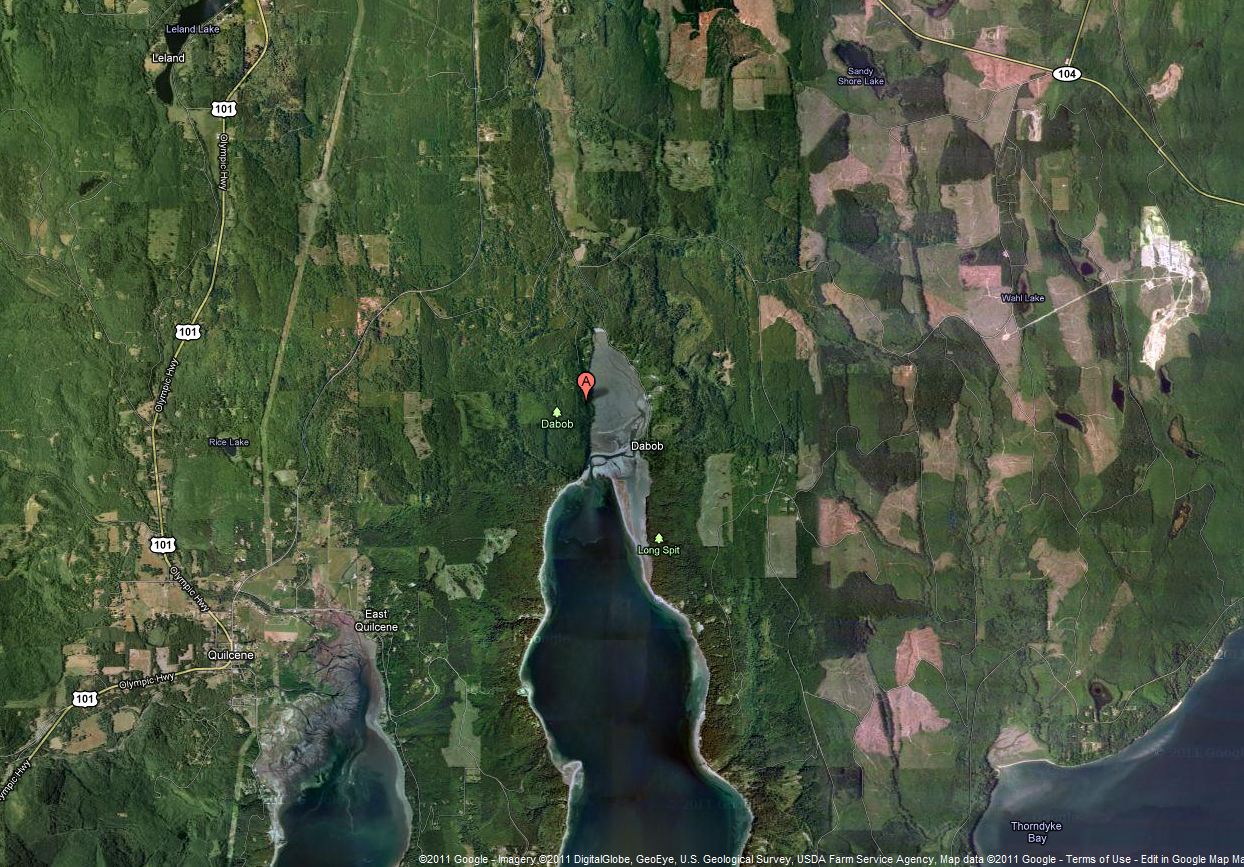
Tarboo Bay - Image by Google Maps

As patience runs short, Puget Sound cleanup accelerates

A story that relates to our efforts here. This isn’t about a major metropolitan area, this is about a relatively lightly deveoloped area.

By Rob Hotakainen
McClatchy Newspapers

BOW, Skagit County — Nearly every time heavy rain falls in North Puget Sound, high levels of fecal bacteria flow into Samish Bay, disrupting work at Taylor Shellfish Farms, the largest shellfish producer in the United States

The bay has been choked by many sources, including animal and human waste, broken septic tanks and farmland runoff. It’s been so bad the past two years that the state Health Department has closed the bay to shellfish harvesting for more than 100 days.

“We lost a market opportunity and there’s an erosion of consumer confidence,” said company spokesman Bill Dewey, who also owns a clam farm in the bay. “And you still have to keep the lights on. The bills don’t stop coming.

http://seattletimes.nwsource.com/html/localnews/2016035078_pugetsound28.html

Researchers Study Micropollutants in Wastewater–Kitsap Sun

Christopher Dunagan of the Kitsap Sun reports on researchers’ efforts to use specialized bacteria to destroy ‘micropollutants’ — chemicals in medicines, pesticides and personal-care products — in sewage wastewater. When successful, it might put all your fears to rest when the wastewater is reclaimed and reused.

Researchers study micropollutants in wastewater http://www.kitsapsun.com/news/2011/aug/24/researchers-study-micropollutants-in-wastewater/

Jefferson and Clallam counties approve pact for shoreline plans.–PDN

Jefferson County has completed update of its shoreline management plan; Clallam County’s update process is underway and has to be completed by 2014. All updated plans must meet requirements that there be ‘no net loss’ of ecological functions along shores. Clallam County hopes to learn from Jefferson County what works, what doesn’t, as it develops its plan. Jefferson, Clallam counties approve pact for shoreline plans http://www.peninsuladailynews.com/article/20110825/news/308259995/jefferson-clallam-counties-approve-pact-for-shoreline-plans

Dog feces found to be in air over Detroit, and probably elsewhere

You may have seen the recent ads from the Puget Sound Partnership, and my latest video on behalf of WSU Beachwatchers on “Scoop the Poop.”

http://www.vimeo.com/26983098

More fuel for the fire of teaching people to pick up their dog waste. In addition to getting into our water, like the Sound & Strait, it also becomes airborne.

From the Detroit Free Press is a report on how researchers have found that in winter bacteria from dog poop hovers over the city. Study finds bacteria from dog feces in Detroit’s sky http://www.heraldnet.com/article/20110821/NEWS02/708219922/-1/News

6 Million Pink Salmon return to Puget Sound

Fox Q13 reports..note that “this is 3 million less than returned in 2009..And so it goes..

SEATTLE—

There wasn’t much elbow room today at Seattle’s Lincoln Park — as Puget Sound anglers were out trying to catch returning pink salmon.

After many cast from shore, the elusive pinks eventually rewarded their patience.

Close to 100 fishermen lined the shoreline at Lincoln Park this morning as the pinks began to return in big numbers.

Some six million pink salmon are expected to return to the Puget Sound region in the next two months.

http://www.q13fox.com/news/kcpq-pink-salmon-return-to-puget-sound-20110814,0,2496242.story

Washington Conservation Corps hiring 245 young adults for projects around the state

A good use of our tax dollars. Thanks to the legislators who supported us, including ours in Jefferson and Clallam County. Let’s support our teens and young adults in finding work to do, outside and working to restore our habitats.
________________________________

Washington Conservation Corps hiring 245 young adults for projects around the state

OLYMPIA – The state Department of Ecology’s Washington Conservation Corps (WCC) is seeking 245 young adults, including military service veterans, between 18 and 25 to for on-the-ground projects in 16 counties across the state.

For the 2011-2012 service year, Ecology will hire 150 WCC AmeriCorps members using a $2 million AmeriCorps grant from the Washington State Commission for National and Community Service. AmeriCorps Education Awards received through the Corps Network, a national service partner, will support the remaining positions.

WCC’s AmeriCorps members sign on for a year of service that starts in October 2011 and ends September 2012. Ecology WCC members work on environmental and community service projects and disaster response.

Members earn $8.67 an hour and receive a $5,550 AmeriCorps education award upon completing their service year. The award may be used for student loans or future tuition expenses.

The WCC was created in 1983 and has provided jobs and work training for about 1,600 young adults. In 1994, WCC started received federal AmeriCorps funding, allowing crews to carry out on-the-ground projects across the state. Local communities rely on WCC to complete environmental projects by forming cost-share agreements with Ecology.

Since 1994, WCC crews have:

Planted more than 7.5 million native trees and shrubs.
Improved or restored 15,800 acres of new habitat for fish and wildlife.
Constructed or repaired nearly 3,000 miles of trails and boardwalks – enough to cover the distance between Seattle and Boston.
Built almost 2 million feet of fencing for agricultural landowners to help keep animals out of creeks and rivers.
Opened about 240 miles of habitat in salmon-bearing streams.
Provided 133,500 hours of emergency response service to communities in need.
Recruited and managed more than 65,000 community volunteers working on environmental projects.
Taught environmental classes for some 191,000 students.

When WCC members are not working directly with local organizations, they are called upon for disaster response. In 2011, WCC crews assisted with emergency response efforts in Washington, including flood response in Ellensburg and shelter operations after the White Swan fire near Yakima. As part of the interstate compact associated with the federal funding, crews also worked to help communities in Alabama and Missouri that suffered extensive tornado damage earlier this spring.

“In a tight economy, the WCC is making a critical difference for our young adults, our communities and environment,” said Nick Mott who oversees WCC activities across the state. “By providing practical job experience and critical professional training, more than half of our members continue on to full-time employment or go on to further their education.”

Last year, Ecology used federal American Recovery and Reinvestment Act funding to add 10 new WCC crews, employing 50 young adults. The remaining recovery act funding expires in 2012.

In 2011, the Washington Legislature created the WCC “Puget Sound Corps” as a partnership of Ecology and the state Department of Natural Resources. The new legislation means new opportunities for WCC crews, including veterans. The Puget Sound Corps will support the Puget Sound Partnership’s Action Agenda to restore, protect and preserve the Sound by 2020, Mott said. The official rollout of the WCC Puget Sound Corps will occur this fall.

Governor Gregoire asks state to prepare for more cuts

The revenues are still not up to what’s needed. We did not come out of the recession, we have been in it for at least three years.  After the last exercise of cutting $4 billion to balance the state’s budget, the Guv asks agencies to be prepared for cuts of up to 10 percent more.

Gregoire tells state to get ready for more cuts http://seattletimes.nwsource.com/html/localnews/2015856380_budgetcuts09m.html

Billie Frank, Jr. on loss of salmon habitat

Bill Frank, Jr. of the Nisqually Tribe and Northwest Indian Fisheries Commission also addresses where we stand 12 years after Puget Sound chinook were listed as endangered, “Northwest salmon, tribal cultures and treaty rights at risk from disappearing habitat,” http://seattletimes.nwsource.com/html/opinion/2015822689_guest05frank.html

Elwha River Salmon, Steelhead better off without hatcheries–Crosscut

Part of restoring the Elwha should do away with the hatchery program on the river, according to Will Atlas, Rich Simms, Kurt Beardslee, and Pete Soverel editorializing in Crosscut, Elwha River salmon, steelhead better off without hatcherieshttp://crosscut.com/2011/08/02/environment/21168/Elwha-River-salmon%2C-steelhead-better-off-without-hatcheries/